Guess where I’m linking today? To a radical feminist web site named Jezebel, to an article written by a radical feminist who writes for the radically leftist Slate.
No, I’m not crazy. Just read it:
Much of the conversation around alcohol and sex has focused on assault—the line at which intoxication becomes incapacitation, for instance—but what we fail to mention is how haunted people can be by the sex they actually, technically consented to.
[…]I wonder what my sex life would even look like if alcohol hadn’t been there. Alcohol gave me comfort in my own body, and it allowed me to turn my erotic curiosity and hunger for experience into an action plan. I was tired of being the stuttering girl sucking in her stomach after the lights went out. I wanted to be the woman who roamed wild and free.
Alcohol also helped me cut the girlish strings on my heart, an action my college years demanded. Three months into my freshman year, I split a six pack with a dashing sophomore, and we wound up partially clothed on his bed, my bare legs wrapped around his waist, my hands around his neck. I pulled back slightly and asked him the question, the naive question of a girl who does not yet understand her fate: “What does this mean?”
He looked past me, into his studio apartment, and then back into my eyes. “It means that I’m a 19-year-old boy, and we’re having fun.”
What is interesting is that she didn’t see this man’s using her for fun after getting her drunk as any disqualification for a serious relationship. On the contrary, she believes that a serious relationship built on self-sacrificial love and commitment that lasts through difficulties can be found in a man who uses her for fun sex:
I’m not saying I didn’t enjoy that night with the dashing sophomore. I’m saying the fun part for me might have been turning our physical intimacy into a sustained attachment.
Amazing. She wasn’t looking for men with good educations, good jobs, lots of savings, who were sober and chaste – they would have made her unhappy with their bossy leading, and strict plans about courting and marriage. She thought that she could get to live-long married love by choosing what was free, easy and fun in the moment.
She is 35 now, and still single. I’m sure if you ask her, she would like to be married “some day”, but who would say that her past decisions were good preparation for the challenges of marriage? Marriage is about self-sacrificial love, and endurance. To prepare for marriage, you practice self-denial and self-control. You learn how to accept expectations, obligations and responsibilities. You grow up.
Anyway, back to the article. She choose the alcohol herself, and she did it for a very specific reason:
I wanted to have fun, too. And alcohol evened the score. I cared less about everything when I was drinking: What you thought of me, what I looked like in this dress, whether that taco was warm or cold when I stuffed it in my mouth. I don’t want to make it sound like I drank in order to have sex. I drank for a million reasons.
[…]Booze downshifted my intense body consciousness, and it revved up my bravado. Sex was scary—but alcohol made me feel safe.
She drank in order to have sex. Got it? She chose to get drunk in order to feel safe about having sex. Many young women think that recreational sex with hot guys is a pathway to marriage. They drink in order to make progress towards the marriage they want – the marriage to the man who is fun. Not the man who is serious. They don’t want the serious man who makes plans for marriage, and expects the woman to sober up, behave responsibly and honor obligations.
Why are millenials acting like children into adulthood?
This reminds me of the Institute for American Values study. Despite their name, it is not a conservative organization
Look at this citation from p. 15:
A number of students noted that being drunk could later serve as your excuse for the hook up.
A Yale University student said, “Some people like hook up because they’re drunk or use being drunk as an excuse to hook up.”
A New York University student observed, “[Alcohol is] just part of an excuse, so that you can say, oh, well, I was drinking.”
A Rutgers University student commented, “If you’re drinking a lot it’s easier to hook up with someone… [and] drugs, it’s kind of like a bonding thing… and then if you hook up with them and you don’t want to speak to them again, you can always blame it on the drinking or the drugs.”
[…]A University of Chicago junior observed, “One of my best friends… sometimes that’s her goal when we go out. Like she wants to get drunk so I guess she doesn’t have to feel guilty about [hooking up].”
I hope that many of the men out there who refuse to hold women accountable for their own desires start to understand that not everything a woman wants is good, and not every plan a woman makes will work. Sometimes, you need to calmly and constructively challenge them about their priorities, plans and actions. It’s for their own good.
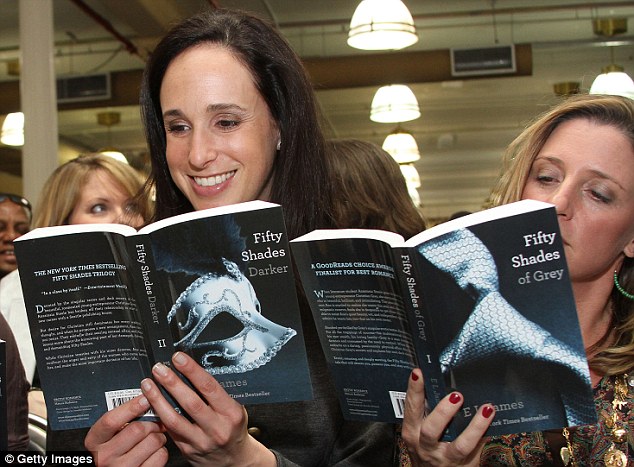
Fifty Shades was popular with women, including “Christian” women – why?
Is it meaningful and rewarding for men to spend their time and money pursuing casual sex? I would expect that men who tried and failed to obtain casual sex to say that it’s a waste of time and money. But what about a man who was so successful at obtaining casual sex that he wrote bestselling books about it? Did he find his achievements meaningful in the end?
Roosh V is a well-known pick-up artist who is a master at seducing women. He’s traveled all over the world and seduced many women from many countries.
In a post from April 2019, he reaches a startling conclusion about his success:
I began pursuing women for mostly sexual reasons in 2001. I must’ve logged tens of thousands of hours into the task. I’ve been also traveling or living abroad near continuously since 2007. I’ve spent a lot of time trying to fornicate, fornicating, traveling to more effectively fornicate, and writing over a million words about fornication. What did I learn from all that? It’s an experience that gets more dull with repetition, like any other experience. However, it also leaves you with a massive hangover where you find yourself at a loss. What was the point of all that? Is there anything I’ve truly gained? What lasting glory have I achieved? If I wasn’t a writer, I would have nothing to “show” for my efforts besides memories that are as likely to make me cringe as give me happiness.
If society were healthy, and if women were more traditional, most of my time would have been spent writing different kinds of books, maybe concerning religion or history. I would have a family, and spend much of my time nurturing the love between them without degenerate interference from the government or cultural elites. […]While there is nothing in life that is solid, my family and community would give me a stronger feeling of continuity. Tomorrow, things that are likely to be here would still be there, compared to the easy-come-easy-go modern lifestyle where putting your penis inside a girl is not even close to a guarantee you’ll see her again, and where any job you have, or apartment you live in, is as transitory as the next bus that rolls down the street.
[…]As I approach 40 years of age, I see most of my hedonistic and travel pursuits as expensive life lessons than a source of meaning. My nature, and I believe the nature of most masculine men I meet, is one of creation, strength, and provision for family, things we’re increasingly not allowed to do, or allowed to do only at impossible cost.
Indeed. Speaking for myself, one of the main reasons that I’ve avoided casual sex (or premarital sex of any kind) is because from earliest days, I could not stomach the idea of a woman that I had sex with walking away. So, my education, career and finance decisions were oriented to winning the heart of one woman who would commit to me for life, so that we could built something nice for the Lord together.
In another post, from March 2014, Roosh explains why casual sex didn’t provide him with validation:
There is definitely not a single woman alive in the Western world who needs a man. While in the past a woman had to put forth effort to obtain a husband who would help her survive, today she is protected by a welfare state that ensures she will never go hungry or spend one night on the street.
[…]From a young age, girls are brainwashed to believe that they don’t need men and that the key to their happiness is self-empowerment by sleeping around and becoming a corporate wage slave. It’s hard to dispute the notion that a woman who believes she doesn’t need a man won’t make as good of a relationship partner as one who does. She will treat you as a distraction to her more important job, girls’ nights out, and social networking validation happy time. Men have become an utterly replaceable and expendable commodity in a girl’s life. Her interest in a man is not unlike her interest in a new television show or Apple product, and your only hope is to have sex with her as many times as possible until her attraction diminishes and she moves on to the next guy in line.
Women don’t seek out comfort or stability in men anymore—they seek entertainment. They seek distraction. They seek hedonistic pleasure. […]Once the entertainment or novelty you provide her declines—and it inevitably will—she moves on to something or someone else. In essence, the only way you can keep a girl is if you adopt the mentality of a soap opera writer, adding a cliffhanger to the end of each episode that keeps a woman interested when being a good man no longer does.
When I look at myself in the mirror, I don’t see a man who has improved himself over the years to be the best that his genes allow—I see a glittery skirt that a girl encounters in the mall. Is the skirt too expensive or is it on sale? Is there only one left of her size or is the rack full of them? Does she already have something similar or is it totally novel? Does her friends think it’s cute or just alright? After trying it on, does it flatter her body or make her look fat? Either she makes the impulsive decision to buy the skirt or not, because odds are she won’t come back for it. There are so many stores with so many skirts that she will soon forget it, forever. We are like glittery pieces of fashion to women—items that she truly doesn’t need. Not only has she already collected so many of them, but she can easily obtain more within walking distance from where she lives. She can even browse online from home while in her pajamas through a nearly unlimited selection.
We are not men in the traditional sense—we are clowns.
Well, I’m a virgin who never spent money or time pursuing casual sex, and precisely because I refuse to be any woman’s clown. It’s very easy for a man to not be a woman’s clown. All he has to do is choose a woman who will let him lead her, instead of a woman who wants him to entertain her. Women use the offer of premarital sex in order to get men to stop trying to lead them. Men who don’t mind acting like clowns in order to get sex will take this bargain. Men who expect women to rise up to the roles of wife and mother will reject the bargain. A Christian man’s goal is to lead a woman away from her self-centeredness, feelings, desires and need for peer-approval, so that she can perform the roles of wife and mother.
How to avoid becoming a clown for casual sex
So, let me give some advice for men about how to get into relationships where they can lead a woman upward, and avoid becoming her clown. It begins and ends with the woman you choose, because some women will let you lead, while others will not.
Research (here, here) shows that women who are virgins are more likely to be content in their marriages, and therefore less likely to financially ruin you with a frivolous divorce. Therefore, women who are virgins are to be preferred. Women who abstain from alcohol, drugs and tattoos should be preferred. Women who have a conservative father who they have respected should be preferred. Women who have STEM degrees should be preferred. Women who are debt-free should be preferred. Women who have challenging STEM careers in the private sector should be preferred. Women who don’t want to outsource the education of their children to daycare, public schools, etc. should be preferred. Women who want three or more children should be preferred. Women who think that a man’s earnings should not be taxed to pay for husband-substitute social programs should be preferred. Women who have demonstrated public opposition to no-fault divorce, premarital sex, abortion and same-sex marriage should be preferred. Women who blame and shame other women for choosing hot bad boys should be preferred. Women who can demonstrate knowledge of intermediate-level science apologetics (e.g. Stephen C. Meyer, Michael Behe, Hugh Ross, etc.) should be preferred. (Philosophical and historical apologetics are useful, but are not forceful enough in a debate). Women who avoid fun and thrills (beaches, FOMO travel, reading fiction, thrill-seeking, etc.) should be preferred. Women who serve others (elderly, disabled, etc.) should be preferred.
Basically, you’re looking for someone who is comfortable with responsibilities, expectations and obligations. You’re looking for someone who respects your demonstrated ability in areas like education, career and finance. (You have led other people to do well in education, career, finances, ministry, etc. right?) You’re looking for someone who lets her logical reasoning override her feelings and intuitions when she makes decisions.
The retreat from male leadership
It used to be the case that you could count on pastors to warn Christian men about wasting their time and money on women who wanted them to be clowns instead of leaders. Even the progressive fideist John Piper wrote against women rebelling against male leadership way back in 1983. Men used to be wary of this desire of women to usurp the leadership role from men. But today, it seems like men are anxious to dance to a woman’s tune – reducing themselves to spineless commodities, like a pair of shoes or a handbag. But men were not designed to be women’s accessories, men were designed to lead. When you tell a woman no to premarital sex, there is the possibility of leading her out of the pig sty of feminism and socialism. But if you say yes to her, you become her clown. If you waste all your 20s and 30s clowning for casual sex, you will have no meaningful legacy. To any man who works for the Lord, this is unacceptable. Christian men, you were bought at a price, and you are expected to produce a return.
Therefore, focus your attention on an early marriage to a good woman, and avoid the hot bad girls who just want to pump and dump you for their own pointless entertainment. If you can’t find a decent wife, then it’s better to remain a virgin and put points on the board some other way.
Man and woman working on a computer upgrade together
Mark Regnerus is a sociologist at the University of Texas, Austin. He publishes a lot of his books with Oxford University Press. So, his research methods are generally seen as reliable. I noticed that he had done a survey of views on religion, sexuality and marriage in 2018, and he published a popular level article about it earlier this week. I think it’s worth taking a look at his findings.
He writes:
Let me offer a word about the survey. I call it the American Political and Social Behavior survey, which interviewed 5,285 Americans in November 2018, just days after the midterm election. The data collection was conducted by Ipsos… a research firm with a very strong record of generating high-quality data for academic projects.
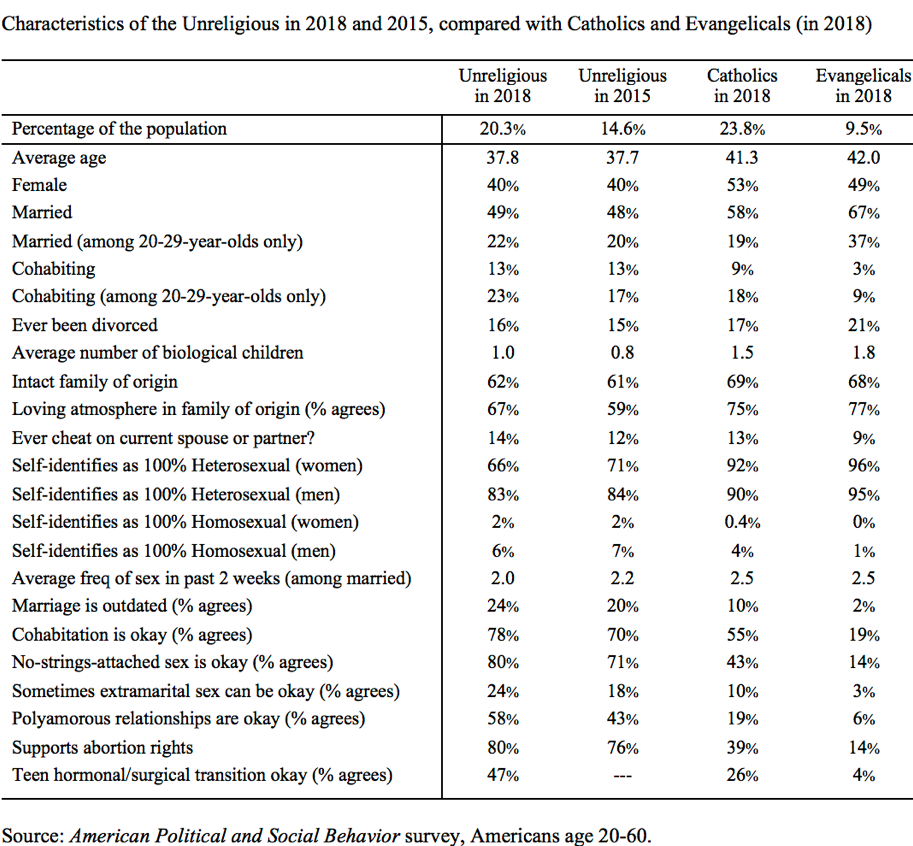
Here are his findings:
Views of unreligious, Catholic and evangelical Americans (click to expand)
This is interesting:
Even when I limit the group to respondents below age thirty—which is just north of the median age at marriage in the United States—it is notable that 22 percent of the unreligious are married and 23 percent are currently cohabiting, not radically different from the 19 and 18 percent of Catholics that are married and cohabiting, respectively. For comparison, 37 and 9 percent of younger evangelicals are married and cohabiting, respectively. The cohabiting habits of the unreligious, however, have shifted—note the uptick in cohabitation—six percentage points in just under four years. That amounts to a 35 percent increase. Since it’s unlikely that the unreligious have recently changed their minds about the morality or pragmatics of living together, my bet is in the other direction: cohabiting leads many to no longer identify as religious at all.
Got that part in bold? Their attitudes are changing because of their sexual behaviors. So, if you want to reverse the decline of Christianity, we’re going to need to come up with some arguments and evidence to counter the sexual revolution. And on this blog, we’ve done that many times, looking at studies showing the future instability of marriages that occur after cohabitation. I’ve never heard a church preach on that, though. And it’s not something that even many Christian apologists focus on. Most Christian apologists, particularly the women, tend to focus on soft arguments,. They stay away from arguments about morality, because it’s divisive and abrasive to their desired audience. However, if the goal is persuading people that Christianity is a viable worldview, then we need to focus more on sexuality.
More Regnerus:
[O]n each of seven attitude measures I examined, the unreligious are notably more permissive than even the spiritual-but-not-religious (not shown). Nearly 80 percent of unreligious Americans agree (or strongly agree) that cohabitation is okay, no-strings-attached sex is okay, and abortion should be a legal right. This is all unsurprising. But even some of the more radically “progressive” attitudes demonstrate strong support among the unreligious: 24 percent agree that it is “sometimes permissible for a married person to have sex with someone other than his/her spouse.” (I thought perhaps women would differ from men here, but they didn’t—or at least not by much.) Although few Americans are actually in polyamorous living arrangements, the unreligious would support them should someone choose such an arrangement; 58 percent of them agreed that “it is okay for three or more consenting adults to live together in a sexual/romantic relationship,” a percentage that is far more supportive than Catholics or evangelicals. Among the latter, only 6 percent thinks polyamory could be okay.
A more interesting theme, however, is the surge in support for such alternatives. On each statement, note the rise in agreement that has occurred in just under four years. Polyamory tops the list—a 35-percent leap in the share of unreligious who now endorse polyamorous arrangements (from 43 to 58 percent). Even support for extramarital affairs grew by one-third (from 18 to 24 percent). The unreligious aren’t alone here. Catholics, too, have witnessed liberalization in attitudes. Evangelical numbers display a more modest uptick, and from lower starting points.
The non-religious people in my office who were raised Christian like to tell me that the existence of the Christian God isn’t important to them, because they can achieve marriage via cohabitation, and behave like good people without the need for any sort of framework to rationally ground it. They think that you can just pull out God, and the marriage will stay the same. They expect the people they start relationships with to act on Christian morality, even if the worldview was rejected as superstitious nonsense. But as you can see from the data, removing God has an enormous effect on the person’s ability to be stable and faithful. The truth is that when you take out the vertical relationships with God, then the blueprint for the relationship becomes completely different. Relationships used to be seen as an enterprise where each person’s primary commitment was to lead and protect their spouse before delivering them to God with faith intact. Now, relationships are contingent on continuous happiness.
More Regnerus:
Only 66 percent of unreligious women say they are “100% Despite the permissive reputation of the unreligious, their actual marital sexual frequency is lower than that of Catholic and evangelical couples—at two instances in the past two weeks. As has been documented extensively in the past few years, the frequency of sex among American couples—whether cohabiting or married—has been declining at statistically significant rates. This pattern has not spared the godless.
I think this is interesting. I believe that men are facing an epidemic of sex-withholding from their wives, and I have an idea why that is. Today, women most commonly use sex to “jump start” a relationship with men who they perceive as “high value”, but who refuse to commit to them. This behavior is not focused on men who have commitment abilities, e.g. – provider, moral leader, spiritual leader, accurate worldview rooted in logic and evidence. Instead, most women use sex to get men who have the appearance of high value, e.g. – tall, tattoos, piercings, violent tendencies, exciting, fun, etc. Having established that pattern over and over with no-commitment bad boys, they marry someone who they see as beneath them, and then withhold sex. Commitment isn’t worthy of sex. It’s the man’s appearance and entertainment value that makes him worthy of sex. The comparison of this low-quality man to previous partners makes women more likely to initiate divorce for “unhappiness” later on.




 WINTERY KNIGHT