
Tag Archives: Church

Do pastors have a responsibility to know apologetics?

The latest episode of the Reasonable Faith podcast was all about a post done by Pastor Matt Rawlings. The post talked about how churches train children to become atheists.

Pastor Matt offered 6 points in his post:

  • Reason #1 – Churches seem overprotective.
  • Reason #2 – Teens’ and twentysomethings’ experience of Christianity is shallow.
  • Reason #3 – Churches come across as antagonistic to science.
  • Reason #4 – Young Christians’ church experiences related to sexuality are often simplistic, judgmental.
  • Reason #5 – They wrestle with the exclusive nature of Christianity.
  • Reason #6 – The church feels unfriendly to those who doubt.

In his post Pastor Matt said this:

Too many churches do in fact present a shallow faith that skips doctrine and apologetics for “how to…” sermons that are little more than self-help talks with scripture sprinkled over them.  The refusal to learn theology and how to defend the faith as well as to spend the time thinking about how to present them in a clear and winsome manner is at the heart of all four of the valid objections by young people to the evangelical church.  Pastors must simply take this responsibility seriously and put in the time and effort.  There is no other answer.

[…]Det. J. Warner Wallace has argued that we have to T.R.A.I.N. Christian students rather than teach them but I think we need to train all of our fellow Christians (and he would agree).  Training is harder than teaching.  We need to remember that it takes at least seven times for the average person today to hear something before they retain it.  Also, most people do not truly understand something until they put it into practice.  Thus, pastors must be trained in order train congregations to truly be lay theologians and apologists.  The pastors must then challenge the congregation to use their skills reach out to the lost and help each other.  And all of those trained must all help to look after the young to insure they know their faith so well that they do not fall for the poor arguments for atheism.  This means pastors must implement rigorous programs for the people God has entrusted to them.

Pastor Matt lays the blame squarely on pastors for at least some of the problem. And I agree with him. But Dr. Craig asserted in his podcast that pastors should not be responsible to learn apologetics, because they were too busy with all the other duties that pastors have to do. He gave some examples, but they were things like weddings, counseling children about drugs and marriage counseling.

So what I wanted to say about this is that Pastor Matt is right and Dr. Craig is wrong. A pastor should have at least put in the time to learn apologetics so that he is able to inject it into his sermon, where appropriate, and point people to where they can find answers when asked. It seems to me that if you are going to get up there and preach about a bunch of things, then you’d better know at least a little about why those things are true. And it can’t just be “because the Bible says so” or because “that’s just how I was raised”. Respect for the truth claims of Christianity has to come from the top, even if the pastor leverages the skills of people in the church to address different issues in more detail.

Pastor Matt responded to Dr. Craig in this post.

Excerpt:

The biggest disagreement I have with Dr. Craig is that he argues pastors are too busy to be trained in apologetics.  As a pastor and the son of a pastor, I strongly differ!  Unfortunately, what I have witnessed (and heard from several seasoned pastors of very large churches) is that too many pastors are in fact lazy.  I have heard from half a dozen leaders of churches of more than 10,000 that they cannot find young seminary grads who will put in even 40 solid hours a week!  Those statements may ruffle a few feathers and certainly there are hard-working, if not overworked pastors out there but they are apparently few and far between.

Also, pastors often try to do things they shouldn’t do.  As a lawyer who used to defend churches, ministers often get into trouble for counseling those with serious issues that are beyond their training and experience.  A person with addiction issues needs something like Celebrate Recovery, a person with emotional problems needs a licensed professional counselor.  Ministers need to recognize their limits and engage in areas that they can and must address instead of those that are already well covered by other trained professionals.

But to be fair to Dr. Craig, I think he may have misunderstood what I mean by training.  I don’t mean a pastor has to earn a master’s degree or doctorate in apologetics or philosophy.  There are many short but effective training programs out there such as his own Defenders class, the distance certificate from BIOLA, Frank Turek’s short but intense CrossExamined program (that I am attending this week), etc.

I agree with Dr. Craig that we should train layman to create an apologetics team in our churches (see this post) but the pastor has to take the lead.  No pastor can expect his or her church to do what he or she is not willing to do.  If the pastor doesn’t evangelize, the church won’t.  If the pastor is not studying the Bible carefully, the church won’t.  Also, any pastor working in today’s post-Christian culture must know how to meet the challenges of said culture.  It is just part of the gig.  So, every minister should seek some type of solid apologetics training and commit to regular study on the subject as well as subscribe to certain podcasts such as Reasonable Faith.

I wanted to add that I didn’t agree with any of the other points where Dr. Craig disagreed with Pastor Matt. It was really surprising to me, but I think Pastor Matt is right across the board. Leadership starts from the top – how are you supposed to be able to assess different people’s requests to teach apologetics or bring in speakers if you are not comfortable discerning what is good and what isn’t yourself? If the pastor is going to be making those kinds of decisions, then he has to understand apologetics to some degree. Maybe not with formal training, but as much as a typical blogger like me would. Also, don’t you find it weird – the idea that a pastor can get up there and preach on things to people and not be able to show anyone some reasons why these things are true? Christians have to be ready to give an answer, and that answer cannot just be “because the Bible says so”.
Are churchgoing people who accept same-sex marriage really Christians?

Here’s a bit of research from Mark Regnerus to shed some light on what else they believe. (H/T Chris)

Excerpt:

Churchgoing Christians who support same-sex marriage are more likely to think pornography, cohabitation, hook-ups, adultery, polyamory, and abortion are acceptable. And it’s reasonable to expect continued change in more permissive directions.

As mainline Protestant denominations increasingly accept the ordination of gay clergy and publicly affirm same-sex unions, the sociologist in me wishes to understand what this development means for people in those denominations. I’m not talking about subtle linguistic shifts. While the difference between speaking of marriage as a “civil contract between a woman and a man” and as “a unique commitment between two people” is obvious to those who pay attention to church documents, the impact of such changes on congregants’ attitudes and internalized paradigms—their hearts, I suppose—is seldom considered.

What is the sexual and relational morality of Christians who accept the moral legitimacy of same-sex marriages? Some questions naturally arise. Does adultery mean the same thing for both same-sex and opposite-sex unions? Does it make sense to speak of premarital sex in such a context? Historically, the fear of pregnancy was enough to scare many love-struck Christians into taking things slow, but same-sex pregnancies are an accomplishment, not an accident, and most Christians use contraception now anyway.

Integrating homosexual relationships into Christian moral systems is not simple, and has ramifications for how heterosexual relationships are understood, too. What exactly do pro-same-sex-marriage Christians think about sex and relationships in general?

So he’s done some research on this, and here’s a snip:

To do this, I rely on the Relationships in America survey, a data collection project I oversaw that interviewed 15,738 Americans, ages 18-60, in early 2014. It’s a population-based sample, meaning that its results are nationally representative. The survey asked respondents to indicate their level of agreement or disagreement with these seven statements:

  1. Viewing pornographic material is OK.
  2. It is a good idea for couples considering marriage to live together in order to decide whether or not they get along well enough to be married to one another.
  3. It is OK for two people to get together for sex and not necessarily expect anything further.
  4. If a couple has children, they should stay married unless there is physical or emotional abuse.
  5. It is sometimes permissible for a married person to have sex with someone other than his/her spouse.
  6. It is OK for three or more consenting adults to live together in a sexual/romantic relationship.
  7. I support abortion rights.

There is more to sexual and relationship morality than just these seven items, to be sure, but they do offer us a glimpse into how people perceive various practices and relationships. In order to ensure this is not just an exercise in documenting the attitudes of Christians “in name only,” I’ve restricted the analysis to churchgoing Christians—here defined as those who report they attend religious services at least three times a month and who self-identified with some sort of Christian affiliation. And I’ve restricted the analysis to those who report a position either for or against same-sex marriage. (I’ve excluded the one-in-four who reported they are undecided.)

[…]The table above displays the share of each group who either “agree” or “strongly agree” with the seven statements listed above. At a glance, there is a pretty obvious fissure between Christians who do and do not oppose same-sex marriage. More than seven times as many of the latter think pornography is OK. Three times as many back cohabiting as a good idea, six times as many are OK with no-strings-attached sex, five times as many think adultery could be permissible, thirteen times as many have no issue with polyamorous relationships, and six times as many support abortion rights. The closest the two come together is over the wisdom of a married couple staying together at all costs (except in cases of abuse).

Churchgoing Christians who support same-sex marriage look very much like the country as a whole—the population average (visible in the third column). That answers my original question. What would a pro-SSM Christian sexual morality look like? The national average—the norm—that’s what.

Click on through for the rest of it.

As a Christian man, my view is that all sex outside of marriage is wrong. When you hear a church-going person talk about changing the definition of marriage and turning a blind eye to cohabitation. divorce, etc. it’s important to understand that they are just flat out rejecting the no sex outside marriage view. We now have a view of sex in culture that “love makes it right”. And now even “marriage is for anyone who loves someone else”. It’s baloney. That’s not the Christian view, and these church-going people ought to know better.

Woman who had sex with 18 different men shocked that men don’t want to marry her

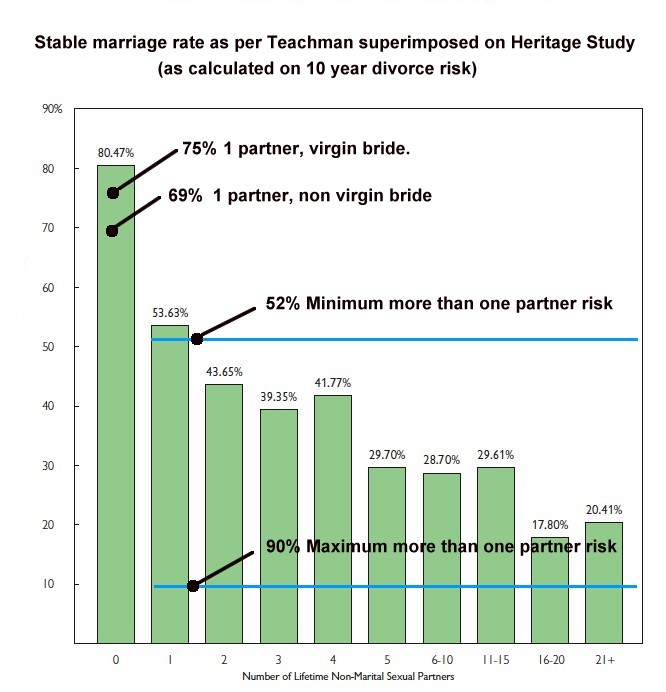
Does being a virgin before marriage affect marital stabilitity?
Does being a virgin before marriage affect marital stability?

Sunshine Mary linked to a post from Reddit by a 32-year old “progressive” woman who is surprised that 15 years of sleeping around with 18 different guys is not attractive to marriage-minded men.

Excerpt:

My parents are first generation immigrants. I have a younger brother and younger sister. In my family I was always the rebellious one; I would often challenge my parents. My family was very strict, when it came to dating and my siblings usually fell in line. However, I would challenge that norm.

My brother and sister were very repressed with their sexualities as a result, while I lost my virginity at 17 to my then boyfriend. While my brother and followed the traditional Indian path. My brother ended up not having any sexual contact with a girl until he got married at 25 (arranged marriage) and now they have a child together. My sister (too never kissed a boy) has recently gotten married too at 24 with an Indian boy she met at our Temple (both parents approved).

I live in LA, a city where both men and woman tend to marry a bit later in life, and yet I still spent the last years of my 20‘s feeling that somehow, I’d messed up. I had followed the wrong trail and thus, my “important-life-moments” timeline was off. Even with my more progressive friends it began slowly at first, when I was 27 … an engagement post on Facebook, an invite to a wedding—it was happening. People I knew were beginning the next stage of life and saying “I do.”

Throughout my whole life I never really dated any Indian guys; I exclusively dated white guys. However now I realize more than ever that the guys I dated never really took me seriously. They never really viewed me as someone they would eventually marry. I was always just some exotic fun. This part was definitely a realization that has hurt me to the core. I didn’t actually do it to spite Indian men or anything like that. I did what a lot of my white female friends did; I thought I was the same as them, but that could be farther from the truth. Most white guys I ran into wanted white wives.

I am now 32, and seems like everyone in my family has lapped me. I too want a family a marriage. However, now my chance of finding someone is gone. At my age getting an arranged marriage or finding another Indian man to marry me is out of the question. Majority of Indian guys usually get married pretty early. Often either to another Indian girl they meet here, or they go back to India for an arranged marriage. My parents have tried signing me up for a matrimony site, but of the guys I’d meet they would be turned off by my history (drink/eat meat/not a virgin).

[…]Most of my relationships have been long term I have only been with 18 guys and I have been sexually active since I was 17 years old.

She has only had steady sexual relationships with 18 guys in 15 years! That’s not a lot. Is it?

Let’s see what Sunshine Mary says first:

However, the more I think about it, the more it seems to me that articles like hers are a good thing simply because they expose the lie.  Feminists have sold young women a bill of goods, that they can live like men, work like men, have sex like men, and then turn back into women when they feel like it.  We laugh at a woman like this sometimes and make fun of her and say, “Didn’t she know that she’d end up like this?”

No, she didn’t know that.  That’s because when you are 17 years old, you don’t know much, especially in this culture of extended adolescence.  And when you have been told from a very young age that, as a girl, it is your destiny to Have It All exactly When You Want It, I’m sure it is very baffling to find yourself in your thirties with no husband and none in sight, with the dawning realization that your job and lonely apartment are not nearly as fulfilling as being a wife and mother would have been.

[…]Personally, I feel no joy in this woman’s pain.  I don’t think a White Knight should ride in to save her because I think she should suffer the natural consequences of her decisions so that other young women may see and learn from her errors, but I take no pleasure in the fact that she will have this lot in life.  However, what most of us don’t seem to understand is that young women make the terrible choices that they are making because they are told from an early age that these are actually good choices.  Some girls are able to resist that message, which saturates every aspect of the media and schools, but most girls aren’t, and they don’t develop the necessary wisdom until it is too late.

Emphasis hers. And now my turn.

Let me tell you what I think awaits a man who marries a woman like that, who spent her 20s hooking up with hot guys who had no interest in marriage and no demonstrated ability to protect, provide and lead on moral/spiritual issues. She will have convinced herself that she is more attractive than she really is because in her mind she deserves a man as attractive as these men. What other criteria is there for a man? It’s all appearances. I therefore do not recommend that any man marry this woman as she is now. What men need in marriage is respect, affection, affirmation and approval. A woman with a background like this will not have the trust and vulnerability that a marriage-minded man wants. The only way to fix this shattered trust is a long period of chastity. She must choose to form relationships with good protector / provider / moral leader / spiritual leader men and to support those men. That is the only way to fix the damage of promiscuity, if it even can be fixed.

A man can sense how trusting and vulnerable a woman is by how much she trusts and encourages him in his plans. If a woman is constantly putting him down, calling him names, and making excuses for why she doesn’t have to care about his needs and feelings, then that’s just her past promiscuity showing itself. Virgins with good relationships with their fathers don’t put men down like that – they choose good men who are doing good things and they build them up. My recommendation for women who realize that they are making bad choices with men and being negative about the men they choose is to look in the mirror and acknowledge that they are the problem. The solution, then, is to find a good man and work hard at being submissive and supportive, but chastely. Stop choosing men with motorcycles. Stop choosing atheists. Stop choosing drunkards. Stop choosing men who are pro-abortion and pro-gay-marriage. Stop choosing men who want bigger government. Just stop it.

That’s the advice I would give this woman. Choose men who can do the work that men do in a marriage. Find out what a man’s plan is. Build the skills he needs for his plan. Marry him.