Tag Archives: Christianity

Is the definition of atheism “a lack of belief in God”?

I have a key that will unlock a puzzling mystery

First, let’s see check with the Stanford University Encyclopedia of Philosophy:

‘Atheism’ means the negation of theism, the denial of the existence of God.

Stanford University is one of the top 5 universities in the United States, so that’s a solid definition. To be an atheist is to be a person who makes the claim that, as a matter of FACT, there is no intelligent agent who created the universe. Atheists think that there is no God, and theists think that there is a God. Both claims are objective claims about the way the world is out there, and so both sides must furnish forth arguments and evidence as to how they are able to know what they are each claiming.

Philosopher William Lane Craig has some thoughts on atheism, atheists and lacking belief in God in this reply to a questioner.

Question:

In my discussions with atheists, they  are using the term that they “lack belief in God”. They claim that this is different from not believing in God or from saying that God does not exist. I’m not sure how to respond to this. It seems to me that its a silly word-play and is logically the same as saying that you do not believe in God.
What would be a good response to this?
Thank you for your time,

Steven

And here is Dr. Craig’s full response:

Your atheist friends are right that there is an important logical difference between believing that there is no God and not believing that there is a God.  Compare my saying, “I believe that there is no gold on Mars” with my saying “I do not believe that there is gold on Mars.”   If I have no opinion on the matter, then I do not believe that there is gold on Mars, and I do not believe that there is no gold on Mars.  There’s a difference between saying, “I do not believe (p)” and “I believe (not-p).”   Logically where you place the negation makes a world of difference.

But where your atheist friends err is in claiming that atheism involves only not believing that there is a God rather than believing that there is no God.

There’s a history behind this.  Certain atheists in the mid-twentieth century were promoting the so-called “presumption of atheism.” At face value, this would appear to be the claim that in the absence of evidence for the existence of God, we should presume that God does not exist.  Atheism is a sort of default position, and the theist bears a special burden of proof with regard to his belief that God exists.

So understood, such an alleged presumption is clearly mistaken.  For the assertion that “There is no God” is just as much a claim to knowledge as is the assertion that “There is a God.”  Therefore, the former assertion requires justification just as the latter does.  It is the agnostic who makes no knowledge claim at all with respect to God’s existence.  He confesses that he doesn’t know whether there is a God or whether there is no God.

But when you look more closely at how protagonists of the presumption of atheism used the term “atheist,” you discover that they were defining the word in a non-standard way, synonymous with “non-theist.”  So understood the term would encompass agnostics and traditional atheists, along with those who think the question meaningless (verificationists).  As Antony Flew confesses,

the word ‘atheist’ has in the present context to be construed in an unusual way.  Nowadays it is normally taken to mean someone who explicitly denies the existence . . . of God . . . But here it has to be understood not positively but negatively, with the originally Greek prefix ‘a-’ being read in this same way in ‘atheist’ as it customarily is in . . . words as ‘amoral’ . . . . In this interpretation an atheist becomes not someone who positively asserts the non-existence of God, but someone who is simply not a theist. (A Companion to Philosophy of Religion, ed. Philip Quinn and Charles Taliaferro [Oxford:  Blackwell, 1997], s.v. “The Presumption of Atheism,” by Antony Flew)

Such a re-definition of the word “atheist” trivializes the claim of the presumption of atheism, for on this definition, atheism ceases to be a view.  It is merely a psychological state which is shared by people who hold various views or no view at all.  On this re-definition, even babies, who hold no opinion at all on the matter, count as atheists!  In fact, our cat Muff counts as an atheist on this definition, since she has (to my knowledge) no belief in God.

One would still require justification in order to know either that God exists or that He does not exist, which is the question we’re really interested in.

So why, you might wonder, would atheists be anxious to so trivialize their position?  Here I agree with you that a deceptive game is being played by many atheists.  If atheism is taken to be a view, namely the view that there is no God, then atheists must shoulder their share of the burden of proof to support this view.  But many atheists admit freely that they cannot sustain such a burden of proof.  So they try to shirk their epistemic responsibility by re-defining atheism so that it is no longer a view but just a psychological condition which as such makes no assertions.  They are really closet agnostics who want to claim the mantle of atheism without shouldering its responsibilities.

This is disingenuous and still leaves us asking, “So is there a God or not?”

So there you have it. We are interested in what both sides know and what reasons and evidence they have to justify their claim to know. We are interested in talking to people who make claims about objective reality, not about themselves, and who then go on to give reasons and evidence to support their claims about objective reality. There are atheists out there that do make an objective claim that God does not exist, and then support that claim with arguments and evidence. Those are good atheists, and we should engage in rational conversations with them. But clearly there are some atheists who are not like that. How should we deal with these “subjective atheists”?

Dealing with subjective atheists

How should theists respond to people who just want to talk about their psychological state? Well, my advice is to avoid them. They are approaching religion irrationally and non-cognitively – like the person who enters a physics class and says “I lack a belief in the gravitational force!”.  When you engage in serious discussions with people about God’s existence, you only care about what people know and what they can show to be true. We don’t care about a person’s psychology.

Dealing with persistent subjective atheists

What happens when you explain all of that to a subjective atheist who continues to insist that you listen to them repeat over and over “I lack a belief in God, I lack a belief in God”? What if you tell them to make the claim that God does not exist, and then support it with arguments and evidence, but instead they keep leaving comments on your blog telling you again and again about their subjective state of mind: “I lack a belief in cupcakes! I lack a belief in icebergs!” What if they keep e-mailing you and threatening to expose you on Twitter for refusing to listen to them, or denounce you via skywriting: “Wintery Knight won’t listen to me! I lack a belief in crickets!”. I think at this point you have to give up and stop talking to such a person.

And that’s why I moderate and filter comments on this blog. There are uneducated people out there with access to the Internet who want attention, but I am not obligated to give it to them. And neither are you. We are not obligated to listen to abusive people who don’t know what they are talking about. I do post comments from objective atheists who make factual claims about the objective world, and who support those claims with arguments and evidence. I am not obligated to post comments from people who refuse to make objective claims or who refuse to support objective claims with arguments and evidence. And I’m not obligated to engage in discussions with them, either.

Related posts

Republicans block Equality Act bill that makes Christian moral values a crime

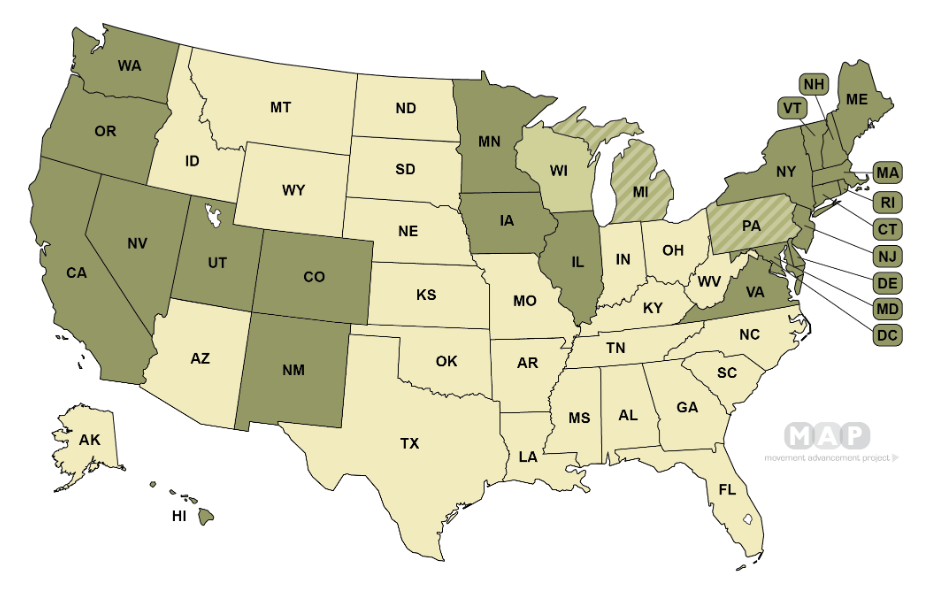
22 states put sexual orientation and gender identity above the Bible

Regular readers will be familiar with the cases where gay activists went after bed and breakfasts, wedding venues, photographers, florists, bakers, etc. who refused to participate in celebrations of same-sex marriage. Christians oppose same-sex marriage, because the leader of the religion defined marriage as being between one man and one woman. However, religious liberty wasn’t a defense in these cases, because these states had passed “SOGI laws”, which made it illegal to discriminate based on sexual orientation and gender identity.

The Equality Act is a federal bill advanced by Democrats that forces all the states without SOGI laws to allow gay activists to weaponize government against Christians, forcing them to participate in non-Christian celebrations of gay activism.

Here’s the story from CBN about what happened to the Equality Act in the Senate:

Senate Democrats were emboldened by Monday’s Supreme Court decision protecting LGBTQ rights in the workplace, so they pushed for a controversial bill that would elevate those rights above religious freedom.

Every Senate Democrat, joined by two independents and Republican Susan Collins of Maine, called for a vote on the so-called Equality Act.

The bill passed the House of Representatives last year. It would extend protections for LGBTQ individuals, superseding the rights of religious groups.

One result would be forcing faith-based adoption agencies to place kids with same-sex couples, even when other adoption agencies are available.

Sen. James Lankford (R-OK) joined with Republicans Joshua Hawley (MO) and Mike Lee (UT) in blocking the vote.

“The Equality Act says that if you’re a faith-based adoption agency that only places children in a home where there’s a mom and dad there, then you either have to change your faith or close,” Lankford said.

“The Equality Act says to that institution, ‘I would rather have fewer adoption agencies in America than have you open’,” Lankford continued. “That’s not protecting the rights of all Americans.”

Critics of the Equality Act say it would also weaken the Religious Freedom Restoration Act, a bipartisan 1994 law that protects religious liberty.

Sen. Hawley argued that the Equality Act can’t be approved because it “guts” the Religious Freedom Restoration Act on the heels of a stunning Supreme Court ruling that rewrote the definition of sex with “nearly nothing to say about religious liberty or religious believers in this country.”

The Federalist described some effects of the Equality Act bill:

On the surface, the “Equality” Act is supposed to protect LGBT folks from discrimination by adding the categories of sexual orientation and gender identity to all federal civil rights laws, including the 1964 Civil Rights Act. It would make claims of discrimination related to these characteristics legally actionable in the way racism is, and applying to virtually every area of life: the workplace, education, banking, jury service, federal funding, housing, medicine and psychiatry, and all public facilities.

It is a power grab in the guise of anti-discrimination. A bait-and-switch. It’s another attempt by a ruling micro-clique to exert mega-control over everyone else’s lives, including those it purports to protect. It allows the Mass State to maximize bureaucracy and social engineering, especially by its huge regulation of speech and expression. It erodes individual rights while claiming to uphold them.

Sane people of goodwill have a host of good reasons to object to the so-called Equality Act. And many of those reasons have been written up, including the de-sexing of toilets and showers, the compelled speech inherent in pronoun protocols and severe punishment for “misgendering,” the promised harassment of business owners, the invasion of girls’ and women’s sports by biological men who force on them an unequal playing field, the utter contempt for individual conscience, and more.

The net result of this act would be a huge inequality of power accrued to the state and drained from the individual.

Other areas that would be affected: tax exempt status for churches, private college admissions, scholarships and curricula, moral standards in Christian organizations, forced transgender treatments at hospitals and health clinics, foster and adoption agencies could not prefer naturally married couples.

The author of that article lists five specific effects of the law:

  1.  It Undermines Everyone’s First Amendment Rights
  2. The Ambiguities in the Bill Threaten the Rule of Law
  3. Nudge Toward a Chinese-style Social Credit System
  4. Redefining Humanity By Outlawing Sex Distinctions
  5. It Enshrines Socially Destructive Identity Politics

Let’s see what the article says about #2:

The first thing that should hit any reader of the so-called Equality Act is the ambiguity of its language, especially with the bill’s outright emphasis throughout on “perceptions.”

[…]Consider how much the “Equality” Act would rely on bureaucratic and court actors to divine the “perception” of the perpetrator or victim of so-called discrimination: it would have to calculate your intent, read your mind, check out your body language, pick you apart for any suggestion of malice. For example, it repeatedly refers to sexual orientation and gender identity as “actual or perceived.” Many times throughout, the text notes that discrimination (or identity?) involves “perception or belief even if inaccurate” (emphasis mine).

This dependence on perception or belief about a person’s self-identity did not exist before. The language of this proposed law is more fluid than gender fluidity on steroids, and it’s wild stuff to push, especially at the federal level. It invites no end of accusations and lawfare that bodes ill for society and promises much human wreckage. The only people “empowered” by such a scam are those on the upper levels of this newly devised food chain who can call the shots.

Here’s more about #3 for those who didn’t know about the China social credit system:

If passed, we shouldn’t be surprised if it eventually produces a social credit system not unlike what is happening in China, whereby your livelihood, education, career, mobility, and access to goods and services is based on a literal “score” of your compliance with government policy. To paraphrase Sir Richard Scruton’s excellent observation of how that works in China, I’d say that the so-called Equality Act would help create robots out of Americans, with the state programming what they can say and do.

As more people self-censor because of the risk of losing their livelihoods and social status, they simply become more prone to robotic compliance and conformity with limits on their speech. This is fast becoming the case in China, where citizens feel the need to build up their “social credit” to be allowed access to jobs, education, housing, and who knows what other goods and services. The so-called Equality Act’s restrictions on First Amendment freedoms would be a big step in that direction.

A social credit system that scores you for conformity would be a logical effect of the intent of the Equality Act: to punish free expression in just about every sphere of life, including the workplace, at school, in the public square, and in all public facilities, and any place that might be connected with federal funding. (By the way, Scruton was punished—stripped of his chairmanship of an architectural commission in Britain—simply for explaining what the social credit system does to people in China. That should be another lesson for us here.)

Now, I know some Christians will say “why does that matter to me, I already agree with sex outside of marriage and I agree that marriage is just when any number of people of any sex cohabitate and have sex”. Right, this is only a problem who think that the Bible is an authority, and that Jesus knows more about morality than LGBT activists and Democrat politicians.

Right now, I live in a state with no SOGI law, and I write about studies, etc. that are critical of the gay agenda from behind an alias. The second that this Equality Act becomes law, I would instantly have to delete this blog, my Facebook page, and my Twitter in case “discrimination” was “perceived” by an LGBT activist based on my previous writings, and they decided to investigate. It would be like writing articles critical of Nazism prior to the ascent of Hitler. It’s fine to do it when Hitler’s not yet in power, but once he’s in power, you shut it down and get out.

Wayne Grudem explains what the Bible says about self-defense

Theology that hits the spot

Reformed Baptist theologian Wayne Grudem speaks on the Bible and the right of self-defense.

About Wayne Grudem:

Grudem holds a BA from Harvard University, a Master of Divinity from Westminster Theological Seminary, and a PhD from the University of Cambridge. In 2001, Grudem became Research Professor of Bible and Theology at Phoenix Seminary. Prior to that, he had taught for 20 years at Trinity Evangelical Divinity School, where he was chairman of the department of Biblical and Systematic Theology.

Grudem served on the committee overseeing the English Standard Version translation of the Bible, and in 1999 he was the president of the Evangelical Theological Society. He is a co-founder and past president of the Council on Biblical Manhood and Womanhood. He is the author of, among other books, Systematic Theology: An Introduction to Biblical Doctrine, which advocates a Calvinistic soteriology, the verbal plenary inspiration and inerrancy of the Bible, the body-soul dichotomy in the nature of man, and the complementarian (rather than egalitarian) view of gender equality.

The MP3 file is here.

The PDF outline is here.

Topics:

  • what about turning the other cheek? doesn’t that undermine self-defense?
  • what does Jesus say about the right to self-defense in the New Testament
  • did Jesus’ disciples carry swords for protection during his ministry?
  • why did Jesus tell his disciples to sell their cloaks and buy swords?
  • what about Jesus stopping Peter from using force during Jesus’ arrest?
  • shouldn’t we rely on police instead of our own personal weapons?
  • what about brandishing a handgun vs actually trying to shoot someone?
  • what are violent crime rates in pro-gun USA and in the anti-gun UK?
  • does outlawing guns cause violent crime to increase or decrease?
  • do academic studies show that gun control decreases crime?
  • do academic studies show that concealed carry laws decreases crime?
  • what do academic studies show about defensive handgun usage?
  • do many children die from guns in the home compared to other causes?
  • doesn’t the US Constitution limit the usage of guns to the army and police?
  • what did the Founding Fathers believe about lawful ownership of firearms?
  • What should be the goal of someone who uses a weapon in self-defense?

This is a good example of applying the Bible to real life. We need more of that!