
Tag Archives: Christianity

David Axelrod: Obama lied about gay marriage in 2008 in order to get elected

This is from Life Site News.

Excerpt:

A former senior adviser to President Obama has confirmed what his most strident critics have said all along: Barack Obama lied to the American people about opposing gay “marriage” to boost his chances of winning the 2008 presidential elections.

David Axelrod, a veteran of Chicago left-wing politics who advised Obama during the campaign, makes the admission in a new book Believer: My Forty Years in Politics, which hits book shelves today.

Obama first indicated his support for redefining marriage while running for state office in Illinois in 1996, filling out a questionnaire that said, “I favor legalizing same-sex marriages, and would fight efforts to prohibit such marriages.”

Candidate Obama wanted to publicly broadcast his views during his campaigns for national office but was afraid the position – then radically unpopular – would end his chances of becoming president. Axelrod writes that campaign manager Jim Messina warned Obama that backing same-sex “marriage” could cost him the electoral votes of North Carolina.

Instead, both he and Hillary Clinton said they held to the traditional definition of marriage, although they supported “civil unions” for homosexuals.

During a 2008 debate, Obama told Saddleback Church megapastor Rick Warren, “I believe that marriage is the union between a man and a woman. Now, for me as a Christian, it is also a sacred union. God’s in the mix.”

But Axelrod reveals in his new book that, after proclaiming his support for marriage at one campaign event, Obama dismissed his rhetoric as nothing more than a bout of “bullsh—ing.”

Axelrod said that the candidate agreed to conceal his views, but “Obama never felt comfortable with his compromise and, no doubt, compromised position. He routinely stumbled over the question when it came up in debates or interviews.”

When others asked about Obama’s 1996 campaign statement, his supporters played it off as a campaign snafu. White House Communications Director Dan Pfeiffer said in 2011, “That questionnaire was actually filled out by someone else.”

As a candidate, he walked a thin line, stating his support for traditional marriage – but opposing any efforts that would legally codify that belief and backing government policies that would grant greater acceptance (and benefits) to homosexuals. In 2008, he dismissed opposition to homosexuality as based on “an obscure passage in Romans.”

Obama did, in fact, carry North Carolina in 2008 on his way to the White House, where he chose to bide his time until he could come out in favor of gay “marriage.”

I can remember like yesterday talking to two black Christians in the parking lot outside my office after work about Obama, just before the 2008 elections. Both of them went to church, and both claimed to be evangelical Christians. One in particular loved the writing of Alistair Begg and read lots of Reformed theology. I asked them who they were voting for, and they said “we are voting for Obama”. I told them both about his votes on the Born-Alive Infant Protection Act in Illinois (he voted in favor of infanticide multiple times), his 1996 position in support of gay marriage, his support for cap and trade carbon taxes, his weak stance on national security, and more. I told them that if we ever hoped to repeal Roe v. Wade, that we could not elect this man President. I told him he would pick two pro-abortion Supreme Court judges, at least (and he already has picked two, and will get more in all likelihood). They told me I was wrong about everything and that Obama was pro-life, pro-marriage and really tough on Islamic terrorism.

I also spoke to a black Christian woman in my office. She loved to read books on Bible Study and theology so that she could teach in the church. She even knew some basic apologists, something that the two black guys did not know. She was a much more avid reader than the two guys, who seemed to be more focused on sports, movies and music. She also voted for Obama. I remember her saying she would vote for him, and I could not believe my ears. She was very strong on being pro-life and pro-marriage.
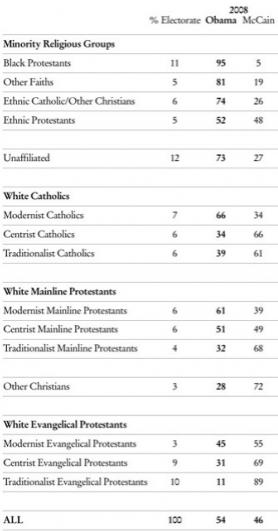
Should Christians have voted for Obama?

I was one of the 5 percent who did not vote for Obama in 2008, despite having dark skin just like my 3 co-workers who voted for him. Those conversations with those three people will stay with me till the day I die. I don’t think I have ever really understand how much people could suppress evidence in order to keep their beliefs before, until I spoke to those people. When I asked them if they were conservative Christians, they told me that they were. I went to a barbecue at one of their houses and saw bookshelves filled with Christian books. And yet they voted for a radical on abortion and a supporter of gay marriage, even when I told them about Obama’s voting record.

Skin color doesn’t matter to me when I am picking a candidate, but to some people it mattered more than facts.

William Lane Craig discusses reason and faith with university students

This is an interview of Dr. William Lane Craig before college students at the University of Central Florida. (95 minutes)

You can get an MP3 of the lecture here. (33 MB)

Questions from the interviewer: (40 minutes)

  • What started you on his journey of studying faith and reason?
  • How would you define the word “faith”?
  • Are faith and reason compatible? How are they related?
  • How can reasonable faith help us to avoid the two extremes of superstition and nihilism?
  • Who makes the best arguments against the Christian faith?
  • Why are angry atheists like Dawkins and Hitchens more well known than better-informed academic atheists?
  • Does the Bible require Christians to give the unbeliever reasons for their faith?
  • How does faith spur Christians to think carefully about the big questions in life?
  • Should the American church prod churchgoers to develop their minds so they can engage the secular culture?
  • When talking about Christianity intellectually, is there a risk of neglecting the experience of being a Christian?
  • Which Christian apologist has shaped your thinking the most?
  • Which Christian philosopher has shaped your thinking the most?
  • Does the confidence that comes from apologetics undermine humility and reverence?
  • If you had to sketch out a 5 minute case for Christianity, what would you present?
  • Can non-Christians use their reason to arrive at truth?
  • Are there cases where atheists must affirm irrational things in order to remain atheists?
  • Can the universe have existed eternal, so that there is no need to explain who created it?
  • Even if you persuade someone that Christianity is true, does that mean they will live it out?

There is also a long period of questions, many of them hostile, from the audience of students (55 minutes).

  • Haven’t you said nasty things about some atheists? Aren’t you a meany?
  • What do you make of the presuppositional approach to apologetics?
  • Can a person stop being a Christian because of the chances that happen to them as they age?
  • Why did God wait so long after humans appeared to reveal himself to people through Jesus?
  • Can a person be saved by faith without have any intellectual assent to truth?
  • How do you find time for regular things like marriage when you have to study and speak so much?
  • How would you respond to Zeitgeist and parallels to Christianity in Greek/Roman mythology?
  • Do Christians have to assume that the Bible is inerrant and inspired in order to evangelize?
  • If the universe has a beginning, then why doesn’t God have a beginning?
  • Can you name some philosophical resources on abstract objects, Platonism and nominalism?
  • How can you know that Christianity more right than other religions?
  • Should we respond to the problem of evil by saying that our moral notions are different from God’s?
  • Define the A and B theories of time. Explain how they relate to the kalam cosmological argument.
  • How can Christians claim that their view is true in the face of so many world religions?
  • What is the role of emotions in Christian belief and thought?
  • Can evolution be reconciled with Christian beliefs and the Bible?
  • When witnessing person-to-person, should you balance apologetics with personal testimony?
  • Is there a good analogy for the trinity that can help people to understand it? [Note: HE HAS ONE!]
  • How can Christians reconcile God’s omniscience, God’s sovereignty and human free will?

This is a nice introductory lecture that is sure to get Christians to become interested in apologetics. As you watch or listen to it, imagine what the world would be like if every Christian could answer the questions of skeptical college students and professors like Dr. Craig. What would non-Christians think about Christianity if every Christian had studied these issues like Dr. Craig? Why aren’t we making an effort to study these things so that we can answer these questions?

It is really fun to see him fielding the questions from the skeptical university students. My favorite question was from the physics student who sounds really foreign, (at 1:19:00), then you realize that he is a Christian. I do think that Dr. Craig went a little far in accommodating evolution, but I put that down to the venue, and not wanting to get into a peripheral issue. I’m also surprised that no one asked him why God allows humans to suffer and commit acts of evil.

If you are looking for a good basic book on apologetics, then I would choose “Is God Just a Human Invention?” by Sean McDowell and Jonathan Morrow.

Who is William Lane Craig?

About William Lane Craig:

William Lane Craig is Research Professor of Philosophy at Talbot School of Theology in La Mirada, California.

Dr. Craig pursued his undergraduate studies at Wheaton College (B.A. 1971) and graduate studies at Trinity Evangelical Divinity School (M.A. 1974; M.A. 1975), the University of Birmingham (England) (Ph.D. 1977), and the University of Munich (Germany) (D.Theol. 1984). From 1980-86 he taught Philosophy of Religion at Trinity… In 1987 they moved to Brussels, Belgium, where Dr. Craig pursued research at the University of Louvain until assuming his position at Talbot in 1994.

He has authored or edited over thirty books, including The Kalam Cosmological ArgumentAssessing the New Testament Evidence for the Historicity of the Resurrection of JesusDivine Foreknowledge and Human FreedomTheism, Atheism and Big Bang Cosmology; and God, Time and Eternity, as well as over a hundred articles in professional journals of philosophy and theology, including The Journal of PhilosophyNew Testament StudiesJournal for the Study of the New TestamentAmerican Philosophical QuarterlyPhilosophical StudiesPhilosophy, and British Journal for Philosophy of Science.

Craig’s CV is here.

Craig’s list of publications is here.

William Lane Craig is, without a doubt, the top living defender of Christianity. He has debated all of the most famous atheists, including Christopher Hitchens, Sam Harris, etc. as well as academic atheists like Quentin Smith, Peter Millican, etc. if you search this blog, you’ll find many debates posted here, sometimes even with snarky summaries.

William Lane Craig’s secret weapon is his amazing wife Jan

I want to draw your attention to a talk on “Vision in Life” given by Dr. William Lane Craig. Dr. Craig is the ablest defender of the Christian faith operating today. He has done formal academic debates with all of the best known atheists on major university campuses in front of thousands of university students.

It turns out that he owes a lot of his success to his amazing wife Jan.

The MP3 file is here. (32 minutes)

This talk was Dr. Craig’s chapel address to Biola University students.

About 11 minutes into the talk, Bill describes what happened after he finished his Bachelor’s degree at Wheaton:

And so I joined the staff of Campus Crusade for Christ for 2 years, and was assigned to Northern Illinois University. And that was where I met my wife Jan. She was a graduate of the University of North Dakota where she had come to faith in Christ. And she had a similar vision for her life of evangelism and discipleship.

And as we worked at NIU together, she with gals and I with the guys, leading students to Christ and discipling them to walk with the Lord, we fell in love. And we decided that we would be more effective if we joined forces and became a team.

So their reason for getting together was because they thought that they would be more effective in evangelism and discipleship if they worked as a team.

It is at this point in the talk where Bill begins to explain just how Jan molded him into the lean, mean debating machine that travels the world striking terror into the hearts of atheists.

Bill’s first story about Jan occurs early after their marriage while he is working on his first Masters degree at Trinity:

And it was also at that time that I began to see what an invaluable asset the Lord had given me in Jan. I remember I came home from classes one day, and found her at the kitchen table with all the catalogs and schedules and papers spread out in front of her and she said, “look! I’ve figured out how you can get two Masters degrees at the same time that it would normally take to get one! All you have to do is take overloads every semester, go to all full-time summer school and do all these other things, and you can do two MAs in the time it takes to do one!”

And I thought, whoa! Are you sure you really want to make the commitment it takes to do this kind of thing? And she said, “Yeah! Go for it!” And it was then I began to see that God had given me a very special woman who was my supporter – my cheerleader – and who really believed in me. And as long as she believed in me, that gave me the confidence to dream bigger dreams, and to take on challenges that I had never thought of before.

In an article on his web site, he talks about how Jan encouraged him to do his first Ph.D:

As graduation from Trinity neared, Jan and I were sitting one evening at the supper table in our little campus apartment, talking about what to do after graduation. Neither of us had any clear leading or inclination of what we should do next.

So Jan said to me, “Well, if money were no object, what would you really like to do next?”

I replied, “If money were no object, what I’d really like to do is go to England and do a doctorate under John Hick.”

“Who’s he?” she asked.

“Oh, he’s this famous British philosopher who’s written extensively on arguments for the existence of God,” I explained. “If I could study with him, I could develop a cosmological argument for God’s existence.”

But it hardly seemed a realistic idea.

The next evening at supper Jan handed me a slip of paper with John Hick’s address on it. “I went to the library today and found out that he’s at the University of Birmingham in England,” she said. “Why don’t you write him a letter and ask him if you can do a doctoral thesis under him on the cosmological argument?”

What a woman! So I did, and to our amazement and delight Professor Hick wrote back saying he’d be very pleased to supervise my doctoral work on that subject. So it was an open door!

And in the same article, he explains how Jan encouraged him to get his second Ph.D:

As Jan and I neared the completion of my doctoral studies in Birmingham, our future path was again unclear to us. I had sent out a number of applications for teaching positions in philosophy at American universities but had received no bites. We didn’t know what to do.

I remember it like yesterday. We were sitting at the supper table in our little house outside Birmingham, and Jan suddenly said to me, “Well, if money were no object, what would you really like to do next?”

I laughed because I remembered how the Lord had used her question to guide us in the past. I had no trouble answering the question. “If money were no object, what I’d really like to do is go to Germany and study under Wolfhart Pannenberg.”

“Who’s he?”

“Oh, he’s this famous German theologian who’s defended the resurrection of Christ historically,” I explained. “If I could study with him, I could develop a historical apologetic for the resurrection of Jesus.”

Our conversation drifted to other subjects, but Jan later told me that my remark had just lit a fire under her. The next day while I was at the university, she slipped away to the library and began to research grants-in-aid for study at German universities. Most of the leads proved to be defunct or otherwise inapplicable to our situation. But there were two grants she found that were possibilities. You can imagine how surprised I was when she sprung them on me!

Both of these Ph.D experiences are also described in the talk. And the talk concludes as follows:

I am so thankful to be married to a woman who is tremendously resourceful, tremendously talented and energetic, who could have pursued an independent career in any number of areas, but instead, she has chose to wed her aspirations to mine, and to make it her goal to make me the most effective person I can be, for Christ. And she has been like my right arm in ministry over these many years. And it is a tremendous privilege to be a team with a person like that.

And you young men, I would encourage you, if you marry, to find a gal who shares your vision, not some independent vision, but who is interested in aligning herself with you, and pursuing together a common vision and goal that will draw you [together], so that you will avoid the growing separateness that so often creeps into marriages.

And now you know the rest of Bill’s story. The person you marry will have an enormous influence on the impact you will have for Christ and his Kingdom. It is up to you to decide whether that influence is going to be positive or negative, by deciding if you will marry, and if you do marry, by deciding whom you will marry.

I have a popular post that has a lot of questions to ask a woman to make sure that she has the knowledge required to be a wife and mother, but I think in the context of this talk, I should highlight a few other questions that are more about her personality instead of her knowledge.

  • Does she think that the purpose of the relationship is to serve God or to serve herself?
  • Does she enjoy taking on the helper role, or does she ignore the man’s need for help?
  • Is she able provide alternatives when decisions have to be made?
  • Is she comfortable letting a man lead by letting him making decisions?
  • Is she good at being calm, persuasive and reasonable during disagreements?
  • Is she able to control her emotions, and separate facts from feelings?
  • Does she respect what her man has been able to achieve in the normal male roles? (Provider, etc.)
  • Is she the man’s “cheerleader”? Does she praise and encourage him privately and publicly?
  • Does she see her man as an engine for serving God? Does she have a plan to help him perform better?
  • Does she show her man that she is interested in teaching and mentoring others to grow?
  • Does she take an interest in growing her man spiritually? (Men are often more practical than spiritual)

You may also be interested in this talk given by William Lane Craig, entitled “Healthy Relationships” (National Faculty Leadership Conf. 2008) (audio here) In that talk, he offers advice to Christians who want to have a marriage that is consistent with their Christian faith.