
Tag Archives: Christian Apologetics

Why is the universe so big, and why is so much of it hostile to life?

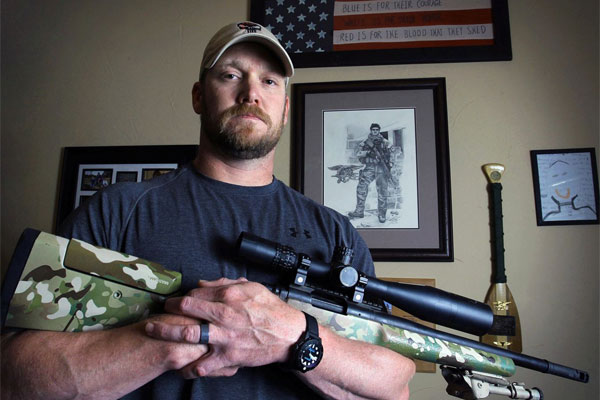
Chris Kyle, Navy SEAL
Chris Kyle, Navy SEAL, can hit a very small target from a mile away – very improbable

Review: In case you need a refresher on the cosmological and fine-tuning arguments, as presented by a professor of particle physics at Stanford University, then click this link and watch the lecture.

If you already know about the standard arguments for theism from cosmology, then take a look at this post on Uncommon Descent.

Summary:

In my previous post, I highlighted three common atheistic objections to to the cosmological fine-tuning argument. In that post, I made no attempt to answer these objections. My aim was simply to show that the objections were weak and inconclusive.

Let’s go back to the original three objections:

1. If the universe was designed to support life, then why does it have to be so BIG, and why is it nearly everywhere hostile to life? Why are there so many stars, and why are so few orbited by life-bearing planets? (Let’s call this the size problem.)

2. If the universe was designed to support life, then why does it have to be so OLD, and why was it devoid of life throughout most of its history? For instance, why did life on Earth only appear after 70% of the cosmos’s 13.7-billion-year history had already elapsed? And Why did human beings (genus Homo) only appear after 99.98% of the cosmos’s 13.7-billion-year history had already elapsed? (Let’s call this the age problem.)

3. If the universe was designed to support life, then why does Nature have to be so CRUEL? Why did so many animals have to die – and why did so many species of animals have to go extinct (99% is the commonly quoted figure), in order to generate the world as we see it today? What a waste! And what about predation, parasitism, and animals that engage in practices such as serial murder and infant cannibalism? (Let’s call this the death and suffering problem.)

In today’s post, I’m going to try to provide some positive answers to the first two questions: the size problem and the age problem.

Here’s an excerpt for the size argument:

(a) The main reason why the universe is as big as it currently is that in the first place, the universe had to contain sufficient matter to form galaxies and stars, without which life would not have appeared; and in the second place, the density of matter in the cosmos is incredibly fine-tuned, due to the fine-tuning of gravity. To appreciate this point, let’s go back to the earliest time in the history of the cosmos that we can meaningfully talk about: the Planck time, when the universe was 10^-43 seconds old. If the density of matter at the Planck time had differed from the critical density by as little as one part in 10^60, the universe would have either exploded so rapidly that galaxies wouldn’t have formed, or collapsed so quickly that life would never have appeared. In practical terms: if our universe, which contains 10^80 protons and neutrons, had even one more grain of sand in it – or one grain less – we wouldn’t be here.

If you mess with the size of the universe, you screw up the mass density fine-tuning. We need that to have a universe that expands at the right speed in order to form galaxies, stars and planets. You need planets to have a place to form life – a place with liquid water at the surface.

And an excerpt for the age argument:

(a) One reason why we need an old universe is that billions of years were required for Population I stars (such as our sun) to evolve. These stars are more likely to harbor planets such as our Earth, because they contain lots of “metals” (astronomer-speak for elements heavier than helium), produced by the supernovae of the previous generation of Population II stars. According to currently accepted models of Big Bang nucleosynthesis, this whole process was absolutely vital, because the Big Bang doesn’t make enough “metals”, including those necessary for life: carbon, nitrogen, oxygen, phosphorus and so on.

Basically, you need heavy elements to make stars that burn slow and steady, as well as to make PEOPLE! And heavy elements have to be built up slowly through several iterations of the stellar lifecycle, including the right kinds of stellar death: supernovae.

Read the rest! These arguments come up all the time in debates with village atheists like Christopher Hitchens and Richard Dawkins. It’s a smokescreen they put up, but you’ve got to be able to answer it using the scientific evidence we have today. They always want to dismiss God with their personal preferences about what God should or should not do. But the real issue is the design of the cosmological constants that allow life to anywhere. That’s the part that’s designed. And that’s not a matter of personal preference, it’s a matter of mathematics and experimental science.

One last parting shot. If God made the universe have life everywhere, the first thing atheists would say is “See? Life evolves fine by itself without any God!” The only way to recognize a marksman is when he hits a narrow target (not hostile to life) from a wide range of possibilities that have no value (hostile to life). We don’t credit Chris Kyle for hitting the wall above an Islamic terrorist from a mile away, we credit Chris Kyle for hitting an Islamic terrorist a mile away. The design is not how much of the universe is hospitable to life versus how much is hostile to life. The design is in the cosmological constants – where we are in the narrow band that is hospitable to life and not in the huge regions that are hostile to life.

You can read the best explanation of the design argument in this lecture featuring Robin Collins. That link goes to my post which has a summary of the lecture. He has a new lecture that I also blogged about where he extends the fine-tuning argument down to the level of particle physics. I have a summary of that one as well.

If unborn babies don’t have consciousness or don’t feel pain, may we kill them?

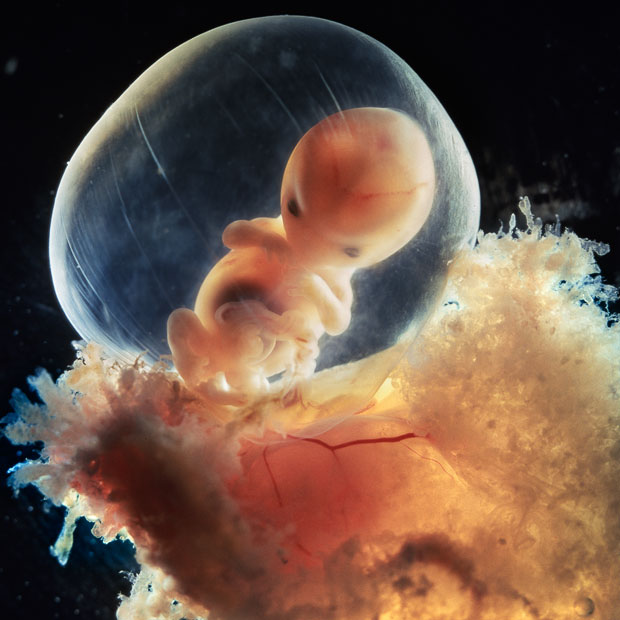
Unborn baby scheming about pro-life apologetics

Was having a conversation by e-mail yesterday with a pro-abortion atheist, and he gave two reasons why he supported abortion in the first and second trimester. First, he said that unborn babies can’t feel pain, so it’s OK to kill them. Second, he said that unborn babies don’t have consciousness, so it’s OK to kill them. I thought it might be useful to link to something that answers both of these objections.

Frank Beckwith is the author of “Defending Life: A Moral and Legal Case Against Abortion Choice“. He wrote that book for Cambridge University Press, a top academic press. But before Cambridge University Press, Beckwith wrote four easy-to-understand essays for the Christian Research Journal. Part IV is the one that has the response to the two questions raised by my atheist friend.

Part I. The Appeal to Pity

Part II. Arguments from Pity, Tolerance, and Ad Hominem

Part III. Is The Unborn Human Less Than Human?

Part IV. When Does a Human Become a Person?

Excerpt:

Some ethicists argue that the unborn becomes fully human sometime after brain development has begun, when it becomes sentient: capable of experiencing sensations such as pain. The reason for choosing sentience as the criterion is that a being that cannot experience anything (i.e., a presentient unborn entity) cannot be harmed. Of course, if this position is correct, then the unborn becomes fully human probably during the second trimester and at least by the third trimester. Therefore, one does not violate anyone’s rights when one aborts a nonsentient unborn entity. [13]

There are several problems with this argument. First, it confuses harm with hurt and the experience of harm with the reality of harm. [14] One can be harmed without experiencing the hurt that sometimes follows from that harm, and which we often mistake for the harm itself. For example, a temporarily comatose person who is suffocated to death “experiences no harm,” but he is nevertheless harmed. Hence, one does not have to experience harm, which is sometimes manifested in hurt, in order to be truly harmed.

Second, if sentience is the criterion of full humanness, then the reversibly comatose, the momentarily unconscious, and the sleeping would all have to be declared nonpersons. Like the presentient unborn, these individuals are all at the moment nonsentient though they have the natural inherent capacity to be sentient. Yet to countenance their executions would be morally reprehensible. Therefore, one cannot countenance the execution of some unborn entities simply because they are not currently sentient.

Someone may reply that while these objections make important points, there is a problem of false analogy in the second objection: the reversibly comatose, the momentarily unconscious, and the sleeping once functioned as sentient beings, though they are now in a temporary state of nonsentience. The presentient unborn, on the other hand, were never sentient. Hence, one is fully human if one was sentient “in the past” and will probably become sentient again in the future, but this cannot be said of the presentient unborn.

There are at least three problems with this response. First, to claim that a person can be sentient, become nonsentient, and then return to sentience is to assume there is some underlying personal unity to this individual that enables us to say that the person who has returned to sentience is the same person who was sentient prior to becoming nonsentient. But this would mean that sentience is not a necessary condition for personhood. (Neither is it a sufficient condition, for that matter, since nonhuman animals are sentient.) Consequently, it does not make sense to say that a person comes into existence when sentience arises, but it does make sense to say that a fully human entity is a person who has the natural inherent capacity to give rise to sentience. A presentient unborn human entity does have this capacity. Therefore, an ordinary unborn human entity is a person, and hence, fully human.

Second, Ray points out that this attempt to exclude many of the unborn from the class of the fully human is “ad hoc and counterintuitive.” He asks us to “consider the treatment of comatose patients. We would not discriminate against one merely for rarely or never having been sentient in the past while another otherwise comparable patient had been sentient….In such cases, potential counts for everything.” [15]

Third, why should sentience “in the past” be the decisive factor in deciding whether an entity is fully human when the presentient human being “is one with a natural, inherent capacity for performing personal acts?” [16] Since we have already seen that one does not have to experience harm in order to be harmed, it seems more consistent with our moral sensibilities to assert that what makes it wrong to kill the reversibly comatose, the sleeping, the momentarily unconscious, and the presentient unborn is that they all possess the natural inherent capacity to perform personal acts. And what makes it morally right to kill plants and to pull the plug on the respirator-dependent brain dead, who were sentient “in the past,” is that their deaths cannot deprive them of their natural inherent capacity to function as persons, since they do not possess such a capacity.

These four essays are a very good introduction to common responses to pro-abortion arguments. I recommend that people get familiar with this, as once you look into it, you will see that the abortion issue can be debated with as much confidence as William Lane Craig defends Christian theism. You will have the same access to scientific evidence and rational arguments on this topic, and so you will have the upper hand. And that’s fun.

The best introductory book on the abortion / right to life issue is “The Case for Life” by pro-life debater Scott Klusendorf. The best comprehensive book is a tie between “The Ethics of Abortion” by Christopher Kaczor, and Frank Beckwith’s “Defending Life: A Moral and Legal Case Against Abortion Choice“.

Book review of R.C. Sproul’s “If there’s a God, why are there atheists?”

I have a key that will unlock a puzzling mystery

Brian Auten has a book review posted up at Apologetics 315.

The book is “If There’s A God, Why Are There Atheists?”, by theologian R.C. Sproul. R.C. Sproul is one of my favorite theologians. The book in question has a very, very special place in my heart, because I think that it is one of the major reasons why I was able to resist pernicious ideas like religious pluralism and postmodernism for so long. Once you put on the glasses of Romans 1 and see for the first time what man is really doing with respect to God, you can never see things the same again. I’ll say more about this at the end, but let’s see what Brian wrote first.

The review

So often, you hear atheists complaining about religion is nothing but wish-fulfillment or some sort of crutch for people who are frightened by a variety of things. They think that God is invented to solve several problems. 1) how does the world work?, 2) is there meaning to suffering and evil?, 3) why should I be moral?, and 4) what will happen to me and my loved ones when I die?. On the atheistic view, God is just a crutch that people cling to out of weakness and ignorance. But is this really the case?

Sproul starts the book by investigating three atheists who sought to explain religious belief as a result of psychological factors.

Brian writes:

Before tackling the psychology of atheism, Sproul spends a chapter on the psychology of theism, from the perspective of Freud’s question “If there is no God, why is there religion?”11 What follows is an overview of various psychological explanations of theistic belief: Feuerbach’s “religion is a dream of the human mind.”12 Marx’s belief that religion is “due to the devious imagination of particular segment of mankind.”13 And Nietzche’s idea that “religion endures because weak men need it.”14 The author properly reiterates: “We must be careful to note that the above arguments can never be used as proof for the nonexistence of God. They can be useful for atheists who hear theists state that the only possible explanation for religion is the existence of God.”15 That being said, Sproul also reveals what these arguments presume:

Their arguments already presupposed the nonexistence of God. They were not dealing with the question, Is there a God? They were dealing with the question, Since there is no God, why is there religion?16

Sproul points out the weaknesses of each of these approaches and says “there are just as many arguments showing that unbelief has its roots in the psychological needs of man.”

Wow, could that really be true? What are the real reasons why people reject God? Does the Bible have anything to say about what those reasons are?

Brian cites Sproul’s contention:

The New Testament maintains that unbelief is generated not so much by intellectual causes as by moral and psychological ones. The problem is not that there is insufficient evidence to convince rational beings that there is a God, but that rational beings have a natural hostility to the being of God.

[…]Man’s desire is not that the omnipotent, personal Judeo-Christian God exist, but that He not exist.

In Romans 1:18-23, the apostle Paul explains what is really going on:

18The wrath of God is being revealed from heaven against all the godlessness and wickedness of men who suppress the truth by their wickedness,

19since what may be known about God is plain to them, because God has made it plain to them.

20For since the creation of the world God’s invisible qualities—his eternal power and divine nature—have been clearly seen, being understood from what has been made, so that men are without excuse.

21For although they knew God, they neither glorified him as God nor gave thanks to him, but their thinking became futile and their foolish hearts were darkened.

22Although they claimed to be wise, they became fools

23and exchanged the glory of the immortal God for images made to look like mortal man and birds and animals and reptiles.

On this blog, I regularly present many, many arguments for theism in general, and Christian theism in particular:

Sproul explains why atheists cannot allow themselves to live according to the evidence that is presented to them:

The cumulative effect of this knowledge that is clearly seen is to leave men ‘without excuse.’ Herein lies the basis of the universal guilt of man. No one can claim ignorance of the knowledge of God. No one can cite insufficient evidence for not believing in God. Though people are not persuaded by the evidence, this does not indicate an insufficiency in the evidence, but rather an insufficiency in man.

[…]The basic stages of man’s reaction to God can be formulated by means of the categories of trauma, repression, and substitution.

[…]If God exists, man cannot be a law unto himself. If God exists, man’s will-to-power is destined to run head-on into the will of God.

And this is the force that is animating atheists today. They don’t want to be accountable to God in a relationship, no matter what the evidence is. They have to deny it, so that they can be free to get the benefits of a universe designed for them, without having to give any recognition or acknowledgement back. If they have to lie to themselves to deny the evidence, they will do it. Anything to insulate themselves from the Creator and Designer who reveals himself in Jesus Christ.

The rest of the book review, and the book, deals with explaining in detail how atheists respond to an all-good, all-powerful, all-knowing Creator/Designer. I encourage you to click through and read the whole book review. You can read the review, and the book, and then investigate for yourself whether atheists really are like that.

My survey of atheists

By the way, did you all see my survey of atheists that I did a while back? It’s relevant because one of the questions I asked to my volunteers was “How you begin to follow Christ if it suddenly became clear to you that Christianity was objectively true?”. I got some very strange responses that dovetail nicely with Sproul’s book.

Here are a few of the responses:

  • I would not follow. My own goals are all that I have, and all that I would continue to have in that unlikely situation. I would not yield my autonomy to anyone no matter what their authority to command me.
  • I would not follow, because God doesn’t want humans to act any particular way, and he doesn’t care what we do.
  • I would not follow. Head is spinning. Would go to physician to find out if hallucinating.
  • I hope I would be courageous enough to dedicate my life to rebellion against God.
  • I would not have to change anything unless forced to and all that would change is my actions not my values.  I would certainly balk at someone trying to force me to change my behavior as would you if you were at the mercy of a moral objectivist who felt that all moral goodness is codified in the Koran.
  • He would have to convince me that what he wants for me is what I want for me.

This is all part of my series discussing whether morality is rationally grounded by atheism.

Well Spent Journey did a similar survey of atheists, inspired by mine, and got this result on the relevant question:

12. How would you begin to follow Jesus if it became clear to you that Christianity was true?

– Would follow (5)
– Wouldn’t follow (6)
Might follow the teachings of Jesus, but that isn’t Christianity (2)
– It would depend on how this truth was revealed (3)
– Christianity can’t be true (3)
– No answer given (4)

…What would be the hardest adjustment you would have to make to live a faithful, public Christian life?

– Adjusting wouldn’t be that difficult; would eagerly welcome knowing that Christianity was true (2)
– Praying, since it seems weird, creepy, and strange
– Trying to figure out how the Bible became so corrupted

– Trying to convince myself that the God of the Bible is deserving of worship (2)
– Don’t think it would be possible to adjust

– No clear response, or not applicable (16)

Yes, they really think like that! Just ask an atheist questions and you’ll see how “objective” they really are. Atheism is entirely psychological. It’s adopted in order to feel sufficient and to operate with autonomy, with the goal of self-centered pleasure-seeking above all. Evidence has nothing to do with it.

UPDATE: Greg Koukl  responded to concerns by Ed Feser, and Ed Feser posted his response here. I agree with Koukl.