
Tag Archives: Care

Understanding Obama’s health care reform bill… with video clips!

Sen. Tom Coburn
Sen. Tom Coburn

Tom Coburn

These video clips feature one of the conservatives I like, Senator Tom Coburn! (H/T Club for Growth)

Tom Coburn is a medical doctor, and ran a medical business. He gives you the inside view of why American health care needs changing, and why big government socialism is not the answer. This is not just a lesson in health care. Listen closely – this is a lesson in economics, and it shows the vision of free-market capitalism, liberty and personal responsibility that drives the policies of the right-wing.

Part 1:

Part 2:

And here is Ronald Reagan talking about the loss of liberty that follows when a country adopts socialized medicine. (H/T Club for Growth)

This is the easiest way to learn about health care policy.

Note: If you prefer to learn about socialized vs consumer-driven health care with podcasts, click here.

More details from a think tank

Here is a comprehensive treatment of the problems of health care today, and the right way to reform it. This article by the founder of the Heritage Foundation, Edwin Feulner, Ph.D., is so long that it is exactly the kind of thing that lefties like commenter Jerry won’t have the patience to read! This is the best thing to read in this post if you can only read one thing.

Here is are some of the myths he corrects:

If you like your health care package you can keep it

“…a public plan will lead many employers to drop private health coverage for their workers and dump them into the public plan… According to independent analyses, as many as 119 million Americans could end up in a public plan….”

The end goal is not a single payer system

“…The “single payer” here is Uncle Sam, using taxpayers’ money, and not just paying the bills but calling the shots and deciding what care every American will get—or not get….”

The end goal is not a single payer system

“…Congress’s own watchdog–have issued preliminary estimates that the cost could be high as $2 trillion over 10 years, with most of that borrowed money…”

The quality of your health care will get better

“…Medicare has huge gaps in coverage. Medicaid’s quality is notoriously bad. They both offer substandard care compared to most private insurance plans…”

And of course his letter also gives conservative solutions to the problem of rising health care costs. The Heritage Foundation is my favorite think tank. Conservative across the board – not just on fiscal issues.

James Demint

And conservatives like James Demint are getting this message out to the public, too.
Sen. James Demint
Sen. James Demint

Here is Senator Demint’s article in Forbes magazine. He answers the question: “What is the cause of our current health care problems? Is it the free market? Or is it government intervention into the free market?”

Excerpt:

…Washington politicians make it hard for individuals to own their own health insurance policies. Government gives tax benefits to businesses to provide group health plans to employees, but offers no such tax benefit to individuals who try to buy their own plan for themselves or their family. Government prevents consumers from shopping for better plans across state lines, which limits competition and drives up prices. Government health care programs like Medicare and Medicaid pay doctors and hospitals less than the full value of their services, and the difference gets priced into the higher premiums paid by people who do have insurance.

In other words, politicians deliberately restrict consumer choice, drive up prices, underpay doctors and hinder both access and portability. Then they turn around, blame the free market for the health care crisis and say the only way to save the system is a government takeover of health insurance in the form of a so-called “public option.”

And he’s goes on to explain conservative solutions to the problem of rising health care costs. A great article from one of my favorite conservatives.

The real costs of Obama’s plan

Keith Hennessey has an analysis of the costs of Obama’s new government-controlled, rationed health care plan. You may have heard that the CBO has issued an estimate about the costs of Obama’s plan: 1 Trilliion over 10 years. Keith says that the number is actually closer to 1.3 trillion.
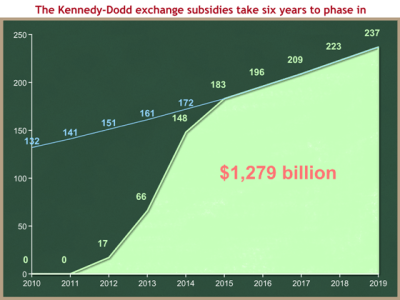
Health care subsidies over 6 years

Keith took at closer look at the CBO’s 1 Trillion estimate, which includes only ONE area where money will need to be spent (subsidies for the poor). He found that many items in the Democrats’ health care bill were not included in the CBO estimate!

Excerpt:

  1. The budgetary effects of neither the individual mandate nor the employer mandate are included in this score.  I think CBO will find these provisions would raise revenues for the government and reduce the deficit.  While the leaked draft of Kennedy-Dodd was specific about the employer mandate, the official version has just the placeholder language, “Policy under discussion.”  Both mandates leave wide discretion for the Secretaries of Treasury and HHS to create a level and structure of taxation “to accomplish the goal of enhancing participation in qualifying coverage.”  It is extremely difficult for CBO and their tax counterparts, the Joint Committee on Taxation (JCT) staff, to estimate something like this.
  2. The estimate does not include the budgetary cost of expanding Medicaid to childless adults with income below 150% of the poverty line.  I expect that this will add hundreds of billions of dollars to the cost over the next decade.
  3. It does not include the requirement that health plans define “children” as dependents up to age 27.  I expect this will raise costs.
  4. It does not include the effects of the Medical Advisory Council’s ability to define benefits, or the requirements that plans rebate premiums to the insured.  I think this too will raise costs.
  5. It does not include the budget effect of having a “public plan option.”
  6. There are a bunch of other programs in the bill, including a new disability program and lots of new public health programs.

Keith will be posting more articles on his blog as he calculates the real costs of Obama’s plan.

The bottom line

Obama’s health care plan is simply “Obama knows best”. You will pay money to Obama, based on your income, (not on your health risks). And then Obama will decide whether government will give you any health care. He’ll probably make these decisions the same way he makes other decisions: based on whether you are one of his unionized supporters, whether you donated to Democrats, or whether you investigate his corrupt dealings.

Obama thinks that you are more satisfied with the service at your local DMV than you are with Amazon.com. And he plans to make sure that you are dealing with government bureaucrats, not with private businesses, when you need health care. Who gives you better service? The government, that isn’t trying to compete with anyone to meet your needs? Or private businesses, which do need to compete to earn your business?

Further study

You can watch some videos containing horror stories from countries that have adopted single-payer health care, too.

My previous post on socialized medicine linked to even more horror stories from other countries with socialized medicine.

CRISIS! Evaluating the leaked Democrat health care bill

Keith Hennessey is the go-to guy for analyzing economic policies. He takes a look at the leaked draft of the health care bill that I blogged about before. He lists 15 things you need to know about the draft bill.

Below I’ve listed a few of the scariest parts.

Mandatory coverage

The Kennedy-Dodd bill would create an individual mandate requiring you to buy a “qualified” health insurance plan, as defined by the government.  If you don’t have “qualified” health insurance for a given month, you will pay a new Federal tax.  Incredibly, the amount and structure of this new tax is left to the discretion of the Secretaries of Treasury and Health and Human Services (HHS), whose only guidance is “to establish the minimum practicable amount that can accomplish the goal of enhancing participation in qualifying coverage (as so defined).”  The new Medical Advisory Council (see #3D) could exempt classes of people from this new tax.  To avoid this tax, you would have to report your health insurance information for each month of the prior year to the Secretary of HHS, along with “any such other information as the Secretary may prescribe.”

Employer mandate

The bill would also create an employer mandate.  Employers would have to offer insurance to their employees.  Employers would have to pay at least a certain percentage (TBD) of the premium, and at least a certain dollar amount (TBD).  Any employer that did not would pay a new tax.  Again, the amount and structure of the tax is left to the discretion of the Secretaries of Treasury and HHS.

Mandatory services that I don’t use

A qualified plan would have to cover “essential health benefits,” as defined by a new Medical Advisory Council (MAC), appointed by the Secretary of Health and Human Services… The MAC would have to include items and services in at least the following categories:  ambulatory patient services, emergency services, hospitalization, maternity and new born care, medical and surgical, mental health, prescription drugs, rehab and lab services, preventive/wellness services, pediatric services, and anything else the MAC thought appropriate.

That’s just redistribution of wealth for elective services, right there. I wonder whether support for contraceptives and abortion would also be required.

Premiums not related to lifestyle risks

Health insurance plans could not charge higher premiums for risky behaviors:  “Such rate shall not vary by health status-related factors, … or any other factor not described in paragraph (1).”  Smokers, drinkers, drug users, and those in terrible physical shape would all have their premiums subsidized by the healthy.

Guaranteed issue and renewal

All health insurance would be required to have guaranteed issue and renewal, modified community rating, no exclusions for pre-existing conditions, no lifetime or annual limits on benefits, and family policies would have to cover “children” up to age 26.

…Guaranteed issue and renewal combined with modified community rating would dramatically increase premiums for the overwhelming majority of those Americans who now have private health insurance.  New Jersey is the best example of health insurance mandates gone wild.  In the name of protecting their citizens, premiums are extremely high to cover the cross-subsidization of those who are uninsurable.

Massive wealth redistribution, especially to Democrats

People from 150% of poverty up to 500% (!!) would get their health insurance subsidized (on a sliding scale).  If this were in effect in 2009, a family of four with income of $110,000 would get a small subsidy.  The bill does not indicate the source of funds to finance these subsidies.

…People in high cost areas (e.g., New York City, Boston, South Florida, Chicago, Los Angeles) would get much bigger subsidies than those in low cost areas (e.g., much of the rest of the country, especially in rural areas).  The subsidies are calculated as a percentage of the “reference premium,” which is determined based on the cost of plans sold in that particular geographic area.

Hennessey then goes on to explain all of the implications of his 15 points. READ IT ALL.

BONUS

Verum Serum has 2 posts up where they examine:

Comparing patient outcomes for cancer treatment in the USA vs Europe

Related chart:

Cancer mortality rates

AND:

Obama’s plan to pass the health care bill unilaterally, under a bi-partisan smokescreen

They have a plan to bypass the likely Republican filibuster. It’s a done deal.

Selling single-payer health care with lies

Holy Snark!

You will watch this 3 minute video about the Democrats’ plan for single-payer health care right now! (H/T Heritage Foundation)

This video is courtesy Verum Serum, the same guys who brought us that Jan Schakowsky video where she admits that Obama’s plan will destroy private medical insurance. They seem to be a Christian blog, so I blogrolled them, along with Bush White House economist Keith Hennessey, who I linked to twice.

Quick quote from Heritage Foundation’s post:

As Yale professor Jacob Hacker says in the video: “Someone once said to me this is a Trojan Horse for single payer and I said well its not a Trojan Horse, right? Its just right there.”

And then later:  “One of the virtues of it though is that you can at least make the claim that there is a competitve system between the public and private sectors.”

Don’t forget some other videos I posted on health care, (that post has a link to Laura’s amazing post on health care that was on Hot Air, which had more helpful videos!).

Michelle Malkin has some ideas about what the grassroots can do! We can fight this.

A comprehensive, point-by-point refutation of government-run health care is here, at the Heritage Foundation.

They cover:

  • the hidden costs of government-run health care, that are paid by the private sector
  • the low efficiency and low quality of existing government plans like Medicare and Medicaid
  • how government-run health care would lead to controls on your private life to reduce health costs
  • the real solution to the health care mess: competition, de-regulation and consumer choice

Some good news on health care

OK, Heritage Foundation had this story on a bill introduced by Republican senators Tom Coburn and Richard Burr. It’s called the “Patient’s Choice Act”.

Excerpt: (I bolded the stuff I liked)

As Galen Institute President Grace-Marie Turner and Joseph Antos with American Enterprise Institute note in The Wall Street Journal, the legislation “provides a path to universal coverage by redirecting current subsidies for health insurance to individuals. It also provides a new safety net that guarantees access to insurance for those with pre-existing conditions.”

By restructuring the tax treatment for health insurance, the plan would give every taxpayer direct assistance to buy private health insurance, and end the inequities that plague the current system. The bill would shift the $300 billion annual tax exclusion for employer-based health benefits toward refundable tax credits for families and individuals. Families would get $5,700 a year and individual consumers would get $2,300 a year to purchase private plans and invest in health savings accounts (HSAs).

Low-income families would receive a supplemental debit card worth up to $5,000 that would help them pay for health coverage and out-of-pocket medical bills. They’d also be incentivized to make the most of their health care dollars since the remaining balance on their card would roll over to the next year. The expected expansion of private health plans would reduce the dependence of many uninsured Americans on the hospital emergency rooms for routine care, saving American taxpayers billions of dollars.

“The combination of the refundable tax credit and debit card gives lower-income Americans a way out of the Medicaid ghetto so they can have the dignity of private insurance,” Turner and Antos add.

This is what Republicans would do if we could elect enough of them.