Melissa send me this post from The leftist Huffington Post.
Excerpt:
Just because the Supreme Court affirmed that the Affordable Care Act is the law of the land, doesn’t mean that Republican governors are rushing to follow it.
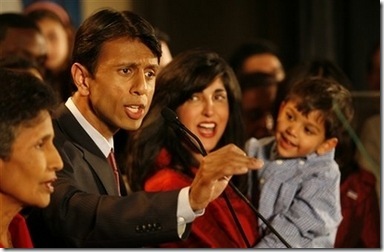
“We’re not going to start implementing Obamacare. We’re committed to working to elect Governor Romney to repeal Obamacare,” said Louisiana Gov. Bobby Jindal (R) Friday morning on a call with reporters hosted by the Republican National Committee.
The Affordable Care Act requires states to set up health care benefits exchanges to help Americans buy insurance. If a state fails to act, the federal government will operate that state’s exchange program.
States have until Jan. 1, 2013, to demonstrate to the Department of Health and Human Services that it has a plan in place for the exchanges, which are required to be up and running by Jan. 1, 2014.
“On the exchanges, we’ve continued not to implement the exchanges in Louisiana. We’re going to work very hard to get Governor Romney elected so this law will be repealed long before the effective dates,” Jindal added.
[…]On Thursday, another leading Republican governor — Wisconsin’s Scott Walker — similarly said, “Wisconsin will not take any action to implement Obamacare. I am hopeful that political changes in Washington, D.C., later this year ultimately end the implementation of this law at the federal level.”
[…]”Here in Louisiana, we’ve not applied for the grants, we’ve not accepted many of these dollars,” Jindal said. “We’re not implementing the exchanges. We don’t think it makes any sense to implement Obamacare in Lousiana. The next opportunity we have to get rid of this law is to get Governor Romney elected, and I absolutely believe that he will be elected in November, and one of his first actions will be to repeal and replace this law.”
It’s good to see some Republican governors in tune with the mood of the public.
Governor Bobby Jindal signed two new laws. The legislation – SB 766 by Senator John Alario and HB 1086 by Representative Alan Seabaugh – are part of the Governor’s 2012 legislative package.
SB 766 by Senator John Alario prohibits abortions of an unborn child who is 20 weeks or older, and provides for license revocation and disciplinary action for any person who intentionally or knowingly performs or induces an abortion on a woman when she has a baby who is 20 weeks or older.
HB 1086 by Representative Alan Seabaugh prohibits euthanasia for the non-terminally ill and the severely disabled. Prior to Governor Jindal signing this new law those same protections were only offered for the terminally ill.
Governor Jindal said, “It is incumbent upon us to protect the weakest and most vulnerable among us, and these new laws will protect innocent human life.”
Earlier this year, Governor Jindal signed SB 330 by Senator Rick Ward to create a specific crime for performing an abortion in Louisiana if the abortionist is not licensed to practice medicine in Louisiana. The legislation also created the crime of aggravated criminal abortion by dismemberment when the unborn child is dismembered in the course of a criminal abortion.
Governor Jindal also signed SB 708 by Senator Sharon Weston Broome to require that the fetal heartbeat be made audible and ultrasound images be displayed for optional review prior to an abortion.
1a. Gov. Bobby Jindal, LA — No single person better combines the ability to excite the Republican “base” with the breadth of resumé experience, the reformist record, and the proven ability ofcrisis management than does Jindal. At age 25 he rescued Louisiana’s state health-care system from Medicaid-induced collapse; he helped forge a national Medicare solution (along Paul Ryan’s later lines) that won over Democratic moderates like John Breaux and Bob Kerrey but fell short when Bill Clinton pulled the plug during the Lewinsky mess; he ran Louisiana’s second-largest system of colleges; he served as the number two guy at the federal Department of Health and Human Services; he served three years in Congress and emerged from Hurricane Katrina as the only Louisiana politician with his stature enhanced by his highly effective responses; and he has been the most successful conservative reformer (and the only re-elected one) ever to serve as Louisiana’s governor. As governor he pushed through some needed ethics reformed, pared state government, kept taxes low, handled the BP oil spill superbly, and pushed through (partly in his first term, partly in his second) a series of education reforms (expanding choice and improving accountability) that, combined, probably outstrip even those of Florida’s Jeb Bush and Wisconsin’s Tommy Thompson as the boldest and best school improvements in modern American history.
Some will gripe that Jindal adds no geographical advantage to the ticket — and they are right. But that consideration pales in comparison with what he will add in one particular area. It is almost certain that, regardless of how the Supreme Court rules on Obamacare, the question of “what would Republicans do to replace it” will dominate campaign coverage throughout the summer and perhaps all the way until Election Day. Romney himself, as the author of Romneycare and a once-avid advocate of an individual insurance mandate, is poorly equipped to handle this question. No high-ranking elected official in the country, however, can match Jindal for his expert knowledge on health-care policy, nor can anybody else match Jindal’s ability to explain positive, conservative alternatives to the Left’s state-controlled systems. In short, he takes a major Romney weakness and turns it into a strength, on an issue that really could sway the whole election.
Jindal also will be hard to attack. He has been somewhat inoculated by none other than James Carville, who said (for the dust-jacket of Jindal’s excellent book) that “I don’t agree with the guy on everything, but Governor Jindal has provided competent, honest, and personable leadership throughout some of Louisiana’s toughest times.”
Alas, nobody is perfect, and while national conservatives love Jindal, numerous Louisiana conservatives (some of them quite perspicacious, not to mention friends of mine) will bend anybody’s ear about certain alleged shortcomings and apostasies. Individually, their complaints may have merit. Collectively, they still don’t add up to an effective indictment of somebody who has had more success with conservative governance than anybody in Louisiana history.
Conservatives also will complain that Jindal is sometimes too inaccessible, and that his own geniality masks a serious political ruthlessness in his administration. In truth, there is a certain air of LBJ-like political muscle — definitely minus the corruption, thank goodness — that comes from the administration. On the other hand, in the hardball realm of national politics in which the Left and its media allies have no compunction about smearing conservatives relentlessly, conservatives could probably use a measure of ruthless effectiveness.
If Bobby Jindal and his team are deceptively tough, it also means they are tough to beat. Conservatives and Republicans of all stripes should celebrate such a quality — and Mitt Romney darn well ought to make use of it.
He is tied for first place with former senator John Kyl of Arizona.
I would prefer Wisconsin congressman Paul Ryan, Pat Toomey or Bobby Jindal. Go with ice cold competence. These are all people with stong fiscal conservative credentials but who are also thoughtful, reflective social conservatives.
Governors of both parties have promoted education reform, but so far no one has delivered more than Louisiana’s Bobby Jindal. This week he’ll sign two bills that offer a national model for competition and parental choice.
Louisiana’s new laws will essentially give all parents an average of $8,500 to use for their child’s education as they see fit. They can keep their child in their local public school, but they can also try to get Johnny into a more demanding charter school, or a virtual school, or into special language or career-training courses, among other options.
Nearly 400,000 low-income children—a bit more than half of all students—will also be eligible for vouchers to attend private schools. State officials estimate that about 2,000 students will use vouchers this September given private-school capacity limits, but that tens of thousands will do so over time.
Louisiana is also making life easier for charter schools, with new authorizing boards, a fast-track for high-performing networks, and access to facilities equal to that of traditional public schools. The new laws seek to strengthen superintendents and principals over local school boards, which are bastions of bureaucratic and union intransigence.
Nearly as dramatic are reforms in teacher tenure. To earn tenure, teachers will now have to rate in the top 10% (measured in part by student performance) for five of six consecutive years, and any teacher who falls into the bottom 10% loses tenure. No teacher in the bottom 10% can get a raise, while layoffs will no longer hit the junior-most teachers first while ignoring performance.
Mr. Jindal made school reform a second-term priority after winning a landslide re-election last November. By then he had appointed or helped elect reformers to the state superintendent’s office and board of education.
Louisiana voters also had a preview of reform’s potential. Since Hurricane Katrina in 2005, New Orleans schools have become almost exclusively charters—with dramatic academic improvements—and the city has run a small and oversubscribed voucher program since 2008. As for tenure, the reforms attach consequences to a teacher-evaluation system enacted in 2010.
The result: the reforms attracted bipartisan legislative majorities of roughly 60%. Over four votes (two different bills, each having to pass the House and Senate), one-quarter to one-half of Democrats voted for reform, including many black representatives, especially those from New Orleans.
Teachers unions were predictably opposed and even heavier-handed than usual. Michael Walker Jones of the Louisiana Association of Educators dismissed choice on grounds that “If I’m a parent in poverty I have no clue because I’m trying to struggle and live day to day.” Unions pushed principals to cancel school—sometimes giving parents less than 24 hours notice—so teachers could protest at the state Capitol. It was a tired act.
Mr. Jindal joins Indiana’s Mitch Daniels in passing the most far-reaching school reforms, and now they’ll have to follow through to produce better student outcomes. Unions will seize on any troubles as a sign of failure, but success might catalyze similar reforms across the country that could finally improve the life prospects for all American children.
Now is a good time to compare and contrast those reforms with the record of the Obama administration:
“House and Senate Appropriators this week ignored the wishes of D.C.’s mayor, D.C.’s public schools chancellor, a majority of D.C.’s city council, and more than 70 percent of D.C. residents and have mandated the slow death of the D.C. Opportunity Scholarship Program. This successful school voucher program–for D.C.’s poorest families–has allowed more than 3,300 children to attend the best schools they have ever known.
The decision to end the program, a decision buried in a thousand-page spending bill and announced right before the holidays, destroys the hopes and dreams of thousands of D.C. families. Parents and children have rallied countless times over the past year in support of reauthorization and in favor of strengthening the OSP.
Yet, despite the clearly positive results and the proven success of this program, Sen. Dick Durbin, Rep. Jose Serrano, Del. Eleanor Holmes Norton, and Secretary Arne Duncan worked together to kill the OSP. Funding the program only for existing children shrinks the program each year, compromises the federal evaluation of the program, denies entry to the siblings of existing participants, and punishes those children waiting in line by sentencing them to failing and often unsafe schools.
What is incredibly disappointing to low-income families in Washington, D.C. has been the silence of President Barack Obama. The President, who benefited from K-12 scholarships himself, worked on behalf of low-income families in Chicago, and exercises school choice as a parent, has stood silently on the sidelines while his Secretary of Education belittled the importance of helping such a small number of children in the nation’s capital.”
Another Wall Street Journal article explains why voucher programs work for children. They don’t work for teacher unions, and that’s why Democrats oppose them.
Excerpt:
In a study published last year, Patrick Wolf of the University of Arkansas found that voucher recipients had graduation rates of 91%. That’s significantly higher than the D.C. public school average (56%) and the graduation rate for students who applied for a D.C. voucher but didn’t win the lottery (70%). In testimony before a Senate subcommittee in February, Mr. Wolf said that “we can be more than 99% confident that access to school choice through the Opportunity Scholarship Program, and not mere statistical noise, was the reason why OSP students graduated at these higher rates.”
The administration downplays these findings. But the students who attend D.C. public schools are overwhelmingly black and poor, and the achievement gap has a particularly devastating impact on their communities. High school dropouts are eight times more likely than someone with a diploma to wind up behind bars. Some 60% of black male high school dropouts in their 30s have prison records. And nearly one in four young black male dropouts is in jail or juvenile detention.
Mr. Obama says he wants to help all students—not just the lucky few who receive vouchers. But that’s an argument for offering more vouchers to those in need, not for reducing school choice. Policies ought to be weighed against available alternatives, not some unattainable ideal. The alternative to a voucher for families in D.C. ghettos and elsewhere is too often a substandard public school.
The positive effects of the D.C. voucher program are not unique. A recent study of Milwaukee’s older and larger voucher program found that 94% of students who stayed in the program throughout high school graduated, versus just 75% of students in Milwaukee’s traditional public schools. And contrary to the claim that vouchers hurt public schools, the report found that students at Milwaukee public schools “are performing at somewhat higher levels as a result of competitive pressure from the school voucher program.” Thus can vouchers benefit even the children that don’t receive them.
Research gathered by Greg Forster of the Foundation for Educational Choice also calls into question the White House assertion that vouchers are ineffective. In a paper released in March, he says that “every empirical study ever conducted in Milwaukee, Florida, Ohio, Texas, Maine and Vermont finds that voucher programs in those places improved public schools.” Mr. Forster surveyed 10 empirical studies that use “random assignment, the gold standard of social science,” to assure that the groups being compared are as similar as possible. “Nine [of the 10] studies find that vouchers improve student outcomes, six that all students benefit and three that some benefit and some are not affected,” he writes. “One study finds no visible impact. None of these studies finds a negative impact.”
Such results might influence the thinking of an objective observer primarily interested in doing right by the nation’s poor children. But they are unlikely to sway a politician focused on getting re-elected with the help of teachers unions.
There is a difference between Demcorats and Republicans, and the difference is that Republicans think that children do better when their parents can choose a school that works for their child. Republicans are the evidence-based party – they do what’s right. But Democrats do whatever it takes to please their special interest groups.

 WINTERY KNIGHT