
Tag Archives: Birth

New study compares donor-conceived vs biologically-conceived children

The study is here. (H/T Dr. J from RuthBlog)

Dr. J writes:

The Institute for American Values has just published a new study, My Daddy’s Name is Donor, of how donor conceived persons are doing in comparison with those who were born and raised by their biological parents and in comparison with those who were adopted.

And she notes this comment from a gay man who thinks that the fact that he and his partner PLANNED their donor-conceived child, that they are therefore justified morally in doing so.

The gay man writes:

I’m a gay man who has had a child, with my partner of 8 years, through surrogacy and egg donation. The egg donor and surrogate will be known to our son.

One way that I explain to people our experience with the artificial reproduction process is that it is the opposite of being ‘knocked-up’. We were very involved in the planning and conception and the growth and birth of our child. Our child’s conception and birth was considered, thought about, planned for, dreamed about, fantasized about. He was most definitely wanted. He is loved and treasured.

We did not have sex to have our child. We did not have wedded, heterosexual, within marriage, we-want-to-have-a-child-sex. We did not have wedded, passionate, spur-of-the-moment at the wrong time of the month (or the wrong time of our life) sex. We did not have wedded, spur-of-the-moment, right time of the month sex. We did not have any of these types heterosexual sex as unmarried heterosexuals.

But so many children are born to heterosexual couples via each of these eight scenarios. So many. Many more, around the world are born in wider range of unloving scenarios.

And then one of the authors (Elizabeth Marquardt) of the new study responds by citing evidence.

I just want to note that one way of looking at the My Daddy’s Name is Donor study is as a study of three groups: The first completely one hundred percent wanted and intended — that is, the donor offspring. The other two groups made up of a lot of unintended pregnancies — that is, the adopted and those raised by their biological parents.

Which group is faring the worst? The 100 percent wanted, planned, intended group. The donor offspring, overall, even with controls, are twice as likely to have struggled with substance abuse and delinquency, and 1.5 times as likely to have struggled with depression, compared to those raised by their biological parents (and these differences are significant). The adopted generally fall in between except with regard to depression in which case they were higher than both the donor conceived and the raised-by-biological.

No one is saying, T, that “all” of those raised by biological parents are doing great. But when you look at these populations, measured by our study, you find that, contrary to today’s conventional wisdom, being wanted isn’t enough. What the child is born into — who the child is raised by — matters.

Some more stats from Maggie Gallagher.

Excerpt:

Forty-five percent of these young adults conceived by donor insemination agree, “The circumstances of my conception bother me.” Almost half report that they think about their donor conception a few times a week or more. Forty-five percent agree, “It bothers me that money was exchanged in order to conceive me.”

Nearly half of donor offspring (compared to about a fifth of adopted adults) agree, “When I see friends with their biological fathers and mothers, it makes me feel sad.” Similarly, 53 percent (compared to 29 percent of adoptees) agree, “It hurts when I hear other people talk about their genealogical background.”

This is not fair to children – it treats them like a commodity instead of as a gift from God to be treasured and nurtured.
Melanie Phillips has a radical plan to stop the breakdown of marriages

From the UK Daily Mail.

Here’s the problem:

Devastating new research by sociologist Geoff Dench shows that not only is one in four mothers single, but more than half of such mothers have never lived with a man at all and are choosing to live alone on state benefits.

[…]Back in the mists of time … relationships between men and women were based on a bargain between the sexes which, although never stated openly, everyone accepted as a given.

Women realised they needed the father of their children to stick around to help bring them up.

In turn, men committed themselves to the mothers of their children on the basis that they could trust they were indeed the father because the woman was sexually faithful.

Today, this bargain has been all but destroyed. A number of factors have conspired to make women and girls think they can go it alone without men.

The first has been that so many women work and are therefore economically independent. Next was the sexual revolution which saw women becoming as sexually free as men.

In short order, any stigma over having babies out of wedlock was abolished. Then there was the collapse of manufacturing industry, which deprived many boys of the job prospects which once made them an attractive, marriageable proposition.

Finally, the coup de grace was administered by welfare benefits to single mothers which enabled them to live without the support of their babies’ fathers.

The result of all this was that many women and girls decided they no longer needed their children’s fathers to be part of the family unit.

This has given rise to an increasing number of women-only households where fathers have been written out of the family script for three or four generations or more.

The consequences of such family disintegration – as is now indisputable – are in general catastrophic for both individuals and for society.

This problem will not be cracked, however, unless women come to believe once again that their interests lie in attracting one man to father their children and then stick with them. Which is where my proposal of a Man Benefit comes in.

Click here to find out what the “Man Benefit” is. This is a fine article, and every man and woman who wants to understand how big government government causes the destruction of the family should read it. Then forward it to all of your friends. I think that we have a problem today where we just don’t think intelligently about what it takes to have a good marriage. Does government help children to grow up in stable homes, or does government make it more likely for children to grow up in a broken home? What does the evidence say?

This column by Stephen Baskerville is a nice follow-up to Melanie’s article.

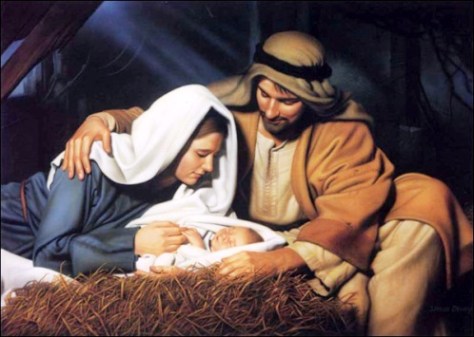
What is the meaning of Christmas? Why celebrate Christmas?

I thought that I would try to write a post to explain Christmas as I understand it to everyone who is foggy on what it is all about. I hope I am not making any theological errors here, after all, I am just a software engineer.

Basically, we know from a variety of scientific arguments that the universe was created and fine-tuned for life by an intelligent agent that existed causally prior to the beginning of the universe, because this agent brought the universe into being. Our purpose as humans is to enter into a two-way loving relationship with this Creator/Designer of the universe. This is the only way that we can ultimately be happy and fulfilled.

The mess we were in

Now, when you look at human experience, none of us is interested in finding out about the character of this Creator/Designer, because we are afraid that if we find out too much about him then we will have our freedom to do as we please constrained by the demands of a relationship with an all-powerful, all-good being. Just knowing that such a person exists and has a character distinct from our own is enough to cause us to flee from him so that we can stay autonomous from the obligations of the moral law that he expects us to follow.

Christians believe that this universal desire to avoid an all-powerful, all-good God who will judge us is a result of bad behaviors inherited by us from the very first rebellion against God by our ancestors. Ever since that rebellion, the capability for relating to God has been lost, because we no longer have the ability to stop our rebellion against God. Christians call the first rebellion of our ancestors “The Fall of Man”.

What does this rebellion look like for us today? Well, we want to do whatever we want, in order to be happy, and to ignore God’s demands. We want to have happy feelings, including security, community and being morally good, all without a relationship with God. We want to acquire and rearrange matter for our selfish ends without acknowledging and honoring the Creator/Designer of that matter. And, of course, we would like other people to affirm, voluntarily or involuntarily, that our rebellion against God is really the height of moral goodness.

Additionally, some people imagine that God, if he exists at all, must desire our happiness. And of course when their needs are not met by this invented God, then they become even more bitter at God, and eventually decide that God could not really exist since their selfish needs are not being met by him. It never seems to occur to us humans that some pain and suffering may be permitted by God in order to turn our attention away from pleasure and security in this life, and back towards a relationship with him.

This is the mess we find ourselves in. This propensity for turning away from God and trying to pursue selfish happiness and security apart from a relationship with God is what the Bible calls “sin”. Every single one of us deserves severe punishment for refusing to pursue a genuine two-way love relationship with the God who is there. That is the mess we are in before Jesus appears to address this problem.

The birth of Jesus

I cannot say much about how Jesus solves the problem of rebellion against God, because that is really the story of Easter, and today we are dealing with the story of Christmas. But I can say that the solution to the problem requires that God step into history to communicate with his creatures and to perform actions in order to be reconciled with them. That is the message of Christmas: God is stepping into history to do something to end our rebellion. Easter is the story of what he does.

This is talked about in the Bible in John 1, for example.

John 1:1-5:

1In the beginning was the Word, and the Word was with God, and the Word was God.

2He was with God in the beginning.

3Through him all things were made; without him nothing was made that has been made.

4In him was life, and that life was the light of men.

5The light shines in the darkness, but the darkness has not understood it.

You can substitute the word “Word” there for Logos, which really means logic or reason or wisdom. This is a person with a divine nature, identified with the eternal being of God, who exists causally prior to the creation of the universe, who is going to take on an additional human nature, including a human body. (Christians believe that there is one divine “what” being and three divine “who” persons). Software engineers, you can think of Jesus having two natures as multiple inheritance in C++.

And it continues in John 1:10-14:

10He was in the world, and though the world was made through him, the world did not recognize him.

11He came to that which was his own, but his own did not receive him.

12Yet to all who received him, to those who believed in his name, he gave the right to become children of God—

13children born not of natural descent, nor of human decision or a husband’s will, but born of God.

14The Word became flesh and made his dwelling among us. We have seen his glory, the glory of the One and Only, who came from the Father, full of grace and truth.

Here the word grace doesn’t mean like a graceful ballet dancer. It means an instance of mercy received from a superior. A person (a “who”) identified with the divine being (a “what”) has decided to make us a top-down offer of mercy.

The same message of God stepping into history is found in the Christmas carols that people sing at Christmas.

Christmas carols

Here’s the best one, “O, Holy Night“, and it says:

O holy night! The stars are brightly shining.
It is the night of the dear Savior’s birth.
Long lay the world in sin and error pining,
Till He appeared and the soul felt its worth.

When we were in rebellion, we had lost our most valuable capacity – the capacity of being in a direct relationship with God. And if Jesus can accomplish his mission, then we are going to regain that capacity for a direct relationship with God.

Now look at “Hark! The Herald Angels Sing“, which one of my favorites:

Hark! The herald angels sing,
“Glory to the newborn King!
Peace on earth and mercy mild,
God and sinners reconciled.”

Basically, as I often say, there are only two kinds of people in the world. There are people who are willing to respond to the offer of a relationship with God, with all the little sacrifices and compromises that a relationship entails, and then there are people who are not willing to respond. For the people who are willing to respond, the appearance of Jesus is the best thing that could possibly happen, because now we are finally going to have a chance to deal directly with God, face-to-face, to find out what he is like, and change ourselves to be more like him, with his help.

And that is why people celebrate Christmas. It’s the anniversary of the birth of Jesus. It is the story of God stepping into history to be reconciled with his rebellious creatures. It’s the story of the divine Logos divesting himself of his glory and subjecting himself to the life of a creature in order to rescue us from our sinful, self-destructive rebellion. This love for undeserving creatures is above and beyond the call of duty. We didn’t love him, but instead he loved us first, and he loved us enough to come down here and suffer with us so that we could be reconciled with God.

MERRY CHRISTMAS!