Tag Archives: Bible

Christians should support natural marriage because it protects children from adult selfishness

I have been following Katy Faust’s work on Twitter. She runs the organization “Them Before Us”. She fights laws and policies which allow adults to put their desires above the needs of children. And especially a child’s need for a relationship with his or her mother and father. In a recent article for The Federalist, she takes on a Joshua Harris, who is attacking traditional Christian moral values.

She writes:

In a recent interview, newly ex-mega-church pastor Joshua Harris and author of the 1990s best-seller “I Kissed Dating Goodbye” remarked that the support President Trump has received from the evangelical community has been “incredibly damaging to the gospel and to the church.” I’d wager Harris is projecting something fierce.

In August, Harris announced that he and his wife Shannon were divorcing, that he no longer considers himself a Christian, and that he regrets “standing against marriage equality.” Just in case the point was lost on any of us, he followed up his announcement by posting a picture of himself eating a rainbow donut at the Vancouver Pride parade.

It’s no coincidence that Harris reversed himself on biblical teachings on sex and marriage while abandoning the core tenets of the faith.

The denial of sexual and marital norms by believers is often adjacent to a rejection of the core tenets of the faith. That’s because to arrive at these “inclusive” and “affirming” positions on marriage, Christians must exalt intoxicants such as emotion over uncompromising scripture, tradition, and natural law. Once you shift the authority from sola scriptura to sola feels, it’s only a matter of time before every other orthodox teaching finds itself on the woke chopping block.

I love this SO MUCH.

If I had to pick one conclusion that I have found to be true in 30 years of debating Christian truth claims, it would be that the normal process for becoming an atheist has nothing to do with reason or evidence. People abandon their faith in their teens, long before they have ever done any research into whether Christianity is true. And why? Because they know that their desire to be free of the moral demands of Christianity is true. And they know that their desire to be liked by their non-Christian friends is true.

Katy explains that she loves loves to discuss and debate with non-Christians and LGBT people about the issue she cares about: natural marriage and children’s rights. But she gets annoyed with Christian leaders who misunderstand the gospel.

She writes:

Whether approaching the issue from a natural law perspective where male and female complementarity features prominently, or considering the most widely ratified treaty in human history outlines a child’s right to be known and loved by their mother and father, or through the lens of scripture where God joins together man and woman in life-long union because he is seeking “godly offspring” (Malachi 2), Christian leaders have no excuse for getting marriage wrong.

Zip. Zero. Nada. Their more-tolerant-than-Jesus definition of marriage (Mark 10:6-9) is, to use Harris’ own words, incredibly damaging not only to the church, but to the most vulnerable as well.

The reality is that Christians cannot get gay marriage wrong unless they first get the gospel wrong. Progressive Christians are under the wrong impression that ours is a gospel of affirmation: the idea that God affirms everything we think and say and do and want. This misconceived notion of the gospel believes that for God to genuinely love us, he has to love everything about us.

In this self-esteem-driven, everyone-gets-a-prize culture, a God who sometimes disapproves of our thoughts and behavior (*cough* Psalm 19:14) appears to be quite a bigot. In the “Born This Way” version of the Gaga gospel, Matthew 5:29 would read, “If your right eye causes you to stumble, by all means, redefine the word ‘stumble’ because, well, I wouldn’t want you to lose an eye now, would I?”

An honest reading of scripture reveals that ours is not a gospel of affirmation. Leave aside the 613 laws of the Old Testament in which God is rigidly un-affirming as he imposes devastating consequences on his people when they misuse their words, money, bodies, land, and worship. The New Testament and the gospels are also brimming with commands to put off behaviors that displease God and put on an entirely new nature.

Katy likes to tweet a lot of stories where children who have been impacted by divorce or same-sex marriage or donor-conception or surrogacy speak about how they feel about not having a relationship with their father or mother (or both). But she also knows how to argue against adult selfishness using data.

My advice to Christians is this. If you want to have confidence when defending the Christian teaching on marriage, or defending the rights of children to a Mom and a Dad, then you need to be equipped with research, statistical evidence and stories of those who have been impacted. Being a Christian means advocating for the teachings of Jesus. Jesus cared about children, and he wanted adults to act in a way towards children that would help those children to come to know him and follow him. We should not be affirming adult selfishness when it harms the children who are made to know God.

I think one of the reasons why people like Joshua Harris are abandoning the faith is because abandoning the morality came first. And before the abandoning of morality, there was a refusal to get informed about the harm that sin does. Instead of putting in the time to look at the evidence, they just altered their worldviews in order to feel good and be liked. Well, feeling good and being liked has never been important to the Christian life. But valuing truth, defending Christian convictions with evidence, and protecting the weak from the strong is found everywhere in the New Testament.
Does the “legacy of slavery” explain black women’s 72% out-of-wedlock birth rate?

James White asks: does the Bible apply to black women?

I don’t like Calvinist theologian James White very much, but at least he’s willing to defend the moral teachings of the Bible against the woke identity politics that is taking over Christian churches. A few months ago he tweeted something very controversial (see above), and got into a lot of hot water with fake Christians. In this post, I’ll explain why he is right.

So, as you can see above, James is concerned that black women are having so many abortions, and he thinks that the solution to this is to encourage black women to take the Bible’s advice on sexual morality. Shocking, I know.

If you read the replies to his tweet on Twitter, you’ll see millions and millions of comments calling him a racist, and telling him that slavery is to blame for EVERYTHING that black women do wrong. Basically, the James haters say that black women can do anything they want, and should never be told that it’s wrong according to the Bible, because their bad choices are all the fault of slavery. So the Bible doesn’t even apply to them, or something.

Here is an example from a radical feminist progressive named Karen Swallow Prior:

Karen Swallow Prior says that black people have no moral agency
Karen Swallow Prior says that unlike whites, blacks have no moral agency

According to the fake Christians, it’s not that black women make poor choices with sex, it’s that the ghosts of white slavers who raped their great-great-great grandmothers reach through time with magic and force them to have sex with hunky bad boys who won’t commit to them before sex. It’s not rap music calling black women hoes! It’s the ghosts of slavery past. And even if this ghost theory isn’t true, we shouldn’t tell black women not to sin, because… it would hurt their feelings. After all, the Bible isn’t a book that’s designed to set boundaries to prevent self-destructive behaviors. It encourages us to listen to our hearts, be reckless, and sin as much as we can.

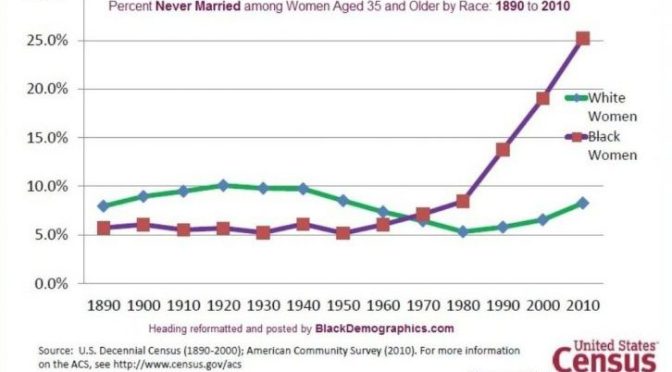
So when did black community problems with sex and abortion start? Did it start with slavery times? Actually, blacks were doing GREAT at marriage and sexual matters just 50 years ago.

This reply to James White explained:

Blacks married at rates comparable to whites before welfare

That’s true. Black children weren’t fatherless, so they weren’t having early sex outside of marriage, and so they weren’t getting abortions.

As the header graphic shows, black women were just as likely to be married as white women in the 1960s,  FAR AFTER the days of slavery.

The reason that the graph is going upward is because daughters raised in fatherless homes tend to engage in sexual activity at younger ages, because they are seeking approval from a man which their (single) mother cannot give them. It’s a tragic downwards spiral, and it affects all races. The only way to stop it is to tell women to choose marriage-minded men (not hot bad boys) and marry before having sex, like the Bible says. But woke fake Christians think the Bible is too mean, and better to allow sin by saying that sin is inevitable because slavery ghosts or something.

What’s neat is that black men who take Christianity seriously are totally on board with the facts:

Black man here. Can confirm that the Bible applies to black women.

On this blog, I don’t talk about my ethnicity myself, for confidentiality reasons, but I have said that my skin is darker than Barack Obama. I’m not white or Asian. And the reason that I don’t fall into this trap of causing babies to be born out of wedlock is because I think that when the Bible says that sex outside of marriage is a sin, that this is true. I don’t make excuses or shift blame. It’s incumbent on me to obey, since I claim to be a follower of Jesus.I’m not interested in identity politics. I’m not interested in racial divisions. I’m not interested in blame-shifting. The rules are the rules. And my following of the rules caused me to not cause abortions, according to Christian specifications. Period.

When it comes to sex outside of marriage, the answer of every Bible believing Christian is simple: I’m against it. That is the correct answer, and anything more or less than this answer is demonic. If you are a Christian, sex outside of marriage is always morally wrong. And if you try to justify it, or blame someone else, in order to excuse it, then you’re not a Christian at all. If you try to make excuses for why someone did it, you’re not a Christian. Whether you have had it and been forgiven, or never had it, the answer is always the same: it’s morally wrong. Don’t do it. Never do it.

What I am seeing from people who are critical of James White’s tweet is that they are basically trying to attack those who make moral judgments based on what the Bible says. They want to make room for sinners to sin. The root of abortion sin is sexual sin. Real  Christians discourage sexual sin, and therefore protect unborn children. Fake Christians want to be liked by appearing compassionate, so they make excuses for sexual sin. If you take the Bible seriously on morality, you won’t be liked. Those who try to excuse sin do so because their need to be liked is more important than their need to promote what the Bible teaches.

Some fake Christians will say “oh, but I do think the Bible is right about sex and marriage, but we have to care about slavery reparations and global warming and refugees and illegal immigrants and trasnsgender rights, too”. Baloney. An authentic Christian is concerned about the things that the Bible teaches are “major” things. Drunkenness is a major thing. Sexual immorality is a major thing. Divorce is a major thing. Homosexuality is a major thing. If you meet a Christian who treats those issues as minor issues, and instead majors in what the secular left tells them are major issues, then you’re talking to a fake Christian.

Christianity isn’t a brain-dead faith. You get your priorities from the Bible, and you argue those priorities using facts. The facts about marriage rates are clear and they show that the problems in the black community aren’t caused by slavery. They’re caused by single mother welfare programs. Those welfare programs taught women of all races that they didn’t have to listen to their fathers when choosing men. Those welfare programs taught women that feelings were a better guide in relationships than the Bible. Those welfare programs taught women that their eyes were a better judge of character than performance of traditional marriage roles. Those welfare programs taught women that recreational sex was a way to get a man to commit and stop being a bad boy. We need to go back to the root cause of the problem. The root cause of the problem was making excuses for disobedience to the Bible, and transferring money from married homes to out-of-control women. Of all races.

What are the historical arguments for the post-mortem appearances of Jesus?

Eric Chabot of Ratio Christi Ohio State University has a great post up about the post-mortem appearances of Jesus.

The post contains:

  • a list of the post-mortem resurrection appearances
  • quotations by skeptical historians about those appearances
  • alternative naturalistic explanations of the appearances
  • responses to those naturalistic explanations

Although there is a lot of research that went into the post, it’s not very long to read. The majority of scholars accept the appearances, because they appear in so many different sources and because some of those sources are very early, especially Paul’s statement of the early Christian creed in 1 Corinthians 15:3-7, which is from about 1-3 years after Jesus was executed by the Romans. Eric’s post lists out some of the skeptical scholars who the appearances, and you can see how they allude to the historical criteria that they are using. (If you want to sort of double-check the details, I blogged about how historians investigate ancient sources before)

Let’s take a look at some of the names you might recognize:

E.P. Sanders:

That Jesus’ followers (and later Paul) had resurrection experiences is, in my judgment, a fact. What the reality was that gave rise to the experiences I do not know. “I do not regard deliberate fraud as a worthwhile explanation. Many of the people in these lists were to spend the rest of their lives proclaiming that they had seen the risen Lord, and several of them would die for their cause. Moreover, a calculated deception should have produced great unanimity. Instead, there seem to have been competitors: ‘I saw him first!’ ‘No! I did.’ Paul’s tradition that 500 people saw Jesus at the same time has led some people to suggest that Jesus’ followers suffered mass hysteria. But mass hysteria does not explain the other traditions.” “Finally we know that after his death his followers experienced what they described as the ‘resurrection’: the appearance of a living but transformed person who had actually died. They believed this, they lived it, and they died for it.”[1]

Bart Ehrman:

It is a historical fact that some of Jesus’ followers came to believe that he had been raised from the dead soon after his execution. We know some of these believers by name; one of them, the apostle Paul, claims quite plainly to have seen Jesus alive after his death. Thus, for the historian, Christianity begins after the death of Jesus, not with the resurrection itself, but with the belief in the resurrection.[2]

Ehrman also says:

We can say with complete certainty that some of his disciples at some later time insisted that . . . he soon appeared to them, convincing them that he had been raised from the dead.[3]

 Ehrman also goes onto say:  

Historians, of course, have no difficulty whatsoever speaking about the belief in Jesus’ resurrection, since this is a matter of public record.[4]

Why, then, did some of the disciples claim to see Jesus alive after his crucifixion? I don’t doubt at all that some disciples claimed this. We don’t have any of their written testimony, but Paul, writing about twenty-five years later, indicates that this is what they claimed, and I don’t think he is making it up. And he knew are least a couple of them, whom he met just three years after the event (Galatians 1:18-19).[5]

Marcus Borg

The historical ground of Easter is very simple: the followers of Jesus, both then and now, continued to experience Jesus as a living reality after his death. In the early Christian community, these experiences included visions or apparitions of Jesus. [8]

The references to Paul are because of the early creed he records in 1 Corinthians 15:3-7, and his conversations with the other eyewitnesses in Galatians. Eric has another post where he goes over that early creed, and it is something that every Christian should know about. It’s really kind of surprising that you never hear a sermon on that early creed in church, where they generally sort of assume that you believe everything in the Bible on faith. But skeptical historians don’t believe in the post-mortem appearances by faith – they believe it (in part) because of 1 Corinthians 15:3-7.

If you want to see a Christian scholar make the case for the resurrection appearances in a debate, then here is a post I wrote with the video, audio and summary of the William Lane Craig vs James Crossley debate on the resurrection.