Tag Archives: Belief

New study on tidal heating strengthens stellar habitability argument

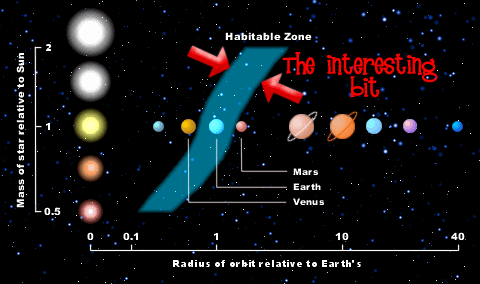
Circumstellar Habitable Zone

Note: If you need a refresher on the habitability argument, click here.

Here’s an article entitled “Tidal heating shrinks the ‘goldilocks zone’: Overlooked factor suggests fewer habitable planets than thought”. It appeared in Nature, the most prestigious peer-reviewed science journal.

The gist of it is that tidal forces can alter orbits so that planets don’t spend all of their orbit in the habitable zone. If planets go outside the habitable zone, it damages their supply of liquid water, and any life chemistry going on in there is disrupted.

Excerpt:

A previously little-considered heating effect could shrink estimates of the habitable zone of the Milky Way’s most numerous class of stars — ‘M’ or red dwarfs — by up to one half, says Rory Barnes, an astrobiologist at the University of Washington in Seattle. That factor — gravitational heating via tides — suggests a menagerie of previously undreamt-of planets, on which tidal heating is a major source of internal heat. Barnes presented the work yesterday at a meeting of the American Astronomical Society’s Division on Dynamical Astronomy in Timberline Lodge, Oregon.

The habitable zone is the orbital region close enough to a star for a planet to have liquid water, but not so close that all of the water evaporates. For our Sun, the zone extends roughly from the inner edge of the orbit of Mars to the outer edge of that of Venus. For smaller, cooler stars, such as M-class dwarfs, the zone can be considerably closer to the star than Mercury is to the Sun. And because close-in planets are easier to spot than more distant ones, such stars have been a major target for planet hunters seeking Earth-like worlds.

There’s just one problem with finding habitable planets around such stars, says Barnes. Because tidal forces vary dramatically with the distance between a planet and its star, closer orbits also result in massively larger tidal forces.

Since planets do not have perfectly circular orbits, these tidal forces cause the planet to flex and unflex each time it moves closer to or further from its star; kneading its interior to produce massive quantities of frictional heat. Substantial heat can be produced, he added, with even slight deviations from a perfectly circular orbit. And, Barnes notes, other factors — such as the rate of the planet’s rotation and its axial tilt — can also influence heat production.

A similar tidal process makes Jupiter’s moon Io the most volcanic body in the Solar System. “I’m just scaling that Io–Jupiter system up by a factor of 1,000 in mass,” Barnes said at the meeting. “It’s the same process, on steroids.”

So, stars that are smaller and cooler will have a habitable zone that is closer to the star, exposing them to more tidal forces. More tidal forces makes their orbits less likely to stay circular – within the habitable zone around the star. These variations cause an increase in heat production on the planet. Too much heat means that the planet is unable to support liquid water on the surface, making it inhospitable for life. Therefore, solar systems with less massive stars can be ruled out as possible sites for life, because of these tidal forces.

Does atheism mean “a lack of belief in God”?

First, let’s see check with the Stanford University Encyclopedia of Philosophy.

Excerpt:

‘Atheism’ means the negation of theism, the denial of the existence of God.

Stanford University is one of the top 5 universities in the United States, so that’s a solid definition. To be an atheist is to be a person who makes the claim that, as a matter of FACT, there is no intelligent agent who created the universe. Atheists think that there is no God, and theists think that there is a God. Both claims are objective claims about the way the world is out there, and so both sides must furnish forth arguments and evidence as to how they are able to know what they are each claiming.

Philosopher William Lane Craig has some thoughts on atheism, atheists and lacking belief in God in this reply to a questioner.

Question:

In my discussions with atheists, they  are using the term that they “lack belief in God”. They claim that this is different from not believing in God or from saying that God does not exist. I’m not sure how to respond to this. It seems to me that its a silly word-play and is logically the same as saying that you do not believe in God.
What would be a good response to this?
Thank you for your time,

Steven

And here is Dr. Craig’s full response:

Your atheist friends are right that there is an important logical difference between believing that there is no God and not believing that there is a God.  Compare my saying, “I believe that there is no gold on Mars” with my saying “I do not believe that there is gold on Mars.”   If I have no opinion on the matter, then I do not believe that there is gold on Mars, and I do not believe that there is no gold on Mars.  There’s a difference between saying, “I do not believe (p)” and “I believe (not-p).”   Logically where you place the negation makes a world of difference.

But where your atheist friends err is in claiming that atheism involves only not believing that there is a God rather than believing that there is no God.

There’s a history behind this.  Certain atheists in the mid-twentieth century were promoting the so-called “presumption of atheism.” At face value, this would appear to be the claim that in the absence of evidence for the existence of God, we should presume that God does not exist.  Atheism is a sort of default position, and the theist bears a special burden of proof with regard to his belief that God exists.

So understood, such an alleged presumption is clearly mistaken.  For the assertion that “There is no God” is just as much a claim to knowledge as is the assertion that “There is a God.”  Therefore, the former assertion requires justification just as the latter does.  It is the agnostic who makes no knowledge claim at all with respect to God’s existence.  He confesses that he doesn’t know whether there is a God or whether there is no God.

But when you look more closely at how protagonists of the presumption of atheism used the term “atheist,” you discover that they were defining the word in a non-standard way, synonymous with “non-theist.”  So understood the term would encompass agnostics and traditional atheists, along with those who think the question meaningless (verificationists).  As Antony Flew confesses,

the word ‘atheist’ has in the present context to be construed in an unusual way.  Nowadays it is normally taken to mean someone who explicitly denies the existence . . . of God . . . But here it has to be understood not positively but negatively, with the originally Greek prefix ‘a-’ being read in this same way in ‘atheist’ as it customarily is in . . . words as ‘amoral’ . . . . In this interpretation an atheist becomes not someone who positively asserts the non-existence of God, but someone who is simply not a theist. (A Companion to Philosophy of Religion, ed. Philip Quinn and Charles Taliaferro [Oxford:  Blackwell, 1997], s.v. “The Presumption of Atheism,” by Antony Flew)

Such a re-definition of the word “atheist” trivializes the claim of the presumption of atheism, for on this definition, atheism ceases to be a view.  It is merely a psychological state which is shared by people who hold various views or no view at all.  On this re-definition, even babies, who hold no opinion at all on the matter, count as atheists!  In fact, our cat Muff counts as an atheist on this definition, since she has (to my knowledge) no belief in God.

One would still require justification in order to know either that God exists or that He does not exist, which is the question we’re really interested in.

So why, you might wonder, would atheists be anxious to so trivialize their position?  Here I agree with you that a deceptive game is being played by many atheists.  If atheism is taken to be a view, namely the view that there is no God, then atheists must shoulder their share of the burden of proof to support this view.  But many atheists admit freely that they cannot sustain such a burden of proof.  So they try to shirk their epistemic responsibility by re-defining atheism so that it is no longer a view but just a psychological condition which as such makes no assertions.  They are really closet agnostics who want to claim the mantle of atheism without shouldering its responsibilities.

This is disingenuous and still leaves us asking, “So is there a God or not?”

So there you have it. We are interested in what both sides know and what reasons and evidence they have to justify their claim to know. We are interested in talking to people who make claims about objective reality, not about themselves, and who then go on to give reasons and evidence to support their claims about objective reality. There are atheists out there that do make an objective claim that God does not exist, and then support that claim with arguments and evidence. Those are good atheists, and we should engage in rational conversations with them. But clearly there are some atheists who are not like that. How should we deal with these “subjective atheists”?

Dealing with subjective atheists

How should theists respond to people who just want to talk about their psychological state? Well, my advice is to avoid them. They are approaching religion irrationally and non-cognitively – like the person who enters a physics class and says “I lack a belief in the gravitational force!”.  When you engage in serious discussions with people about God’s existence, you only care about what people know and what they can show to be true. We don’t care about a person’s psychology.

Dealing with persistent subjective atheists

What happens when you explain all of that to a subjective atheist who continues to insist that you listen to them repeat over and over “I lack a belief in God, I lack a belief in God”? What if you tell them to make the claim that God does not exist, and then support it with arguments and evidence, but instead they keep leaving comments on your blog telling you again and again about their subjective state of mind: “I lack a belief in cupcakes! I lack a belief in icebergs!” What if they keep e-mailing you and threatening to expose you on Twitter for refusing to listen to them, or denounce you via skywriting: “Wintery Knight won’t listen to me! I lack a belief in crickets!”. I think at this point you have to give up and stop talking to such a person.

And that’s why I moderate and filter comments on this blog. There are uneducated people out there with access to the Internet who want attention, but I am not obligated to give it to them. And neither are you. We are not obligated to listen to abusive people who don’t know what they are talking about. I do post comments from objective atheists who make factual claims about the objective world, and who support those claims with arguments and evidence. I am not obligated to post comments from people who refuse to make objective claims or who refuse to support objective claims with arguments and evidence. And I’m not obligated to engage in discussions with them, either.

Sean McDowell takes a closer look at the Mormon Scriptures

Brian Auten of Apologetics 315 tweeted this article from Conversant Life.

Excerpt:

The view of faith in the Mormon Scriptures differs from the Bible. Alma 32:17 says, “Yea, there are many who do say: If thou wilt show unto us a sign from heaven, then we shall know of a surety; then we shall believe. Now I ask, is this faith? Behold, I say unto you, Nay; for if a man knoweth a thing he hath no cause to believe, for he knoweth it.” In other words, faith involves believing something we do not know. If we knew it, there would be no need for faith. But the Bible proposes a different relationship between faith and reason. Rather than being opposites, the Bible presents a view of faith that is based upon what we do know. As philosopher J.P. Moreland put it, “Faith is trusting what we have reason to believe is true.”

For instance, in Exodus 7-14 Moses performs various miracles so the people will know there is a God and then in turn trust him (see 7:14 and 8:10). The pattern is:

1.  God performs a miracle

2.  The people have knowledge about God

3.  They are called to believe

Exodus 14:31 says, “When Israel saw the great power that the Lord used against the Egyptians, the people feared the Lord and believed in Him and in His servant Moses.” The miracle that they could see and know came first, not the belief.

Knowledge is not the opposite of belief, as the Mormon scriptures suggest. Faith does not involve believing something without evidence. Rather, it is a trust in God in light of what weknow to be true. Jesus healed the paralytic so the people would know that he has the authority of God (Mark 2:10).

I suspect the reason the Book of Mormon has this view of faith and knowledge is that the Mormons’ claims cannot be investigated. The cities mentioned in the Book of Mormon have not been located (i.e. Zarahemla), the gold plates cannot be examined, the hill Cumorah cannot be excavated because LDS scholars can’t even agree whether it’s in North or Central America, and the millions of bodies destroyed in the Americas are nowhere to be found. When there is no convincing external evidence corroborating a belief, it must be based upon experience, feeling, and blind faith. This may be the view of faith in the Book of Mormon, but it is decidedly not the biblical view (see John 20:30-31).

This reminded me of a comment written by a Mormon named “Stacie” over at Answering Mormons:

I feel very sad that you are so lost. I also find it sad that you do so much more ‘research’ on why the LDS beliefs are ‘wrong’ rather than simply living your life as you believe you should. I know that the Church of Jesus Christ of Latter-Day Saints is true. I have received confirmation that it is true, that every aspect of the LDS church is true. Joseph Smith was a true prophet and all prophets that have succeeded him have been and are true prophets of God. I know that the Book of Mormon is true. I know that the Bible is true as far as it is translated correctly. I know that Heavenly Father hears and answers our prayers, whether you are LDS or not. I know that Jesus Christ died for our sins and that through His Atonement and resurrection we have the ability to return to our Heavenly Father. I won’t use any more of my time to read anything on this blog, but I know that if you truly read the Book of Mormon, pray about it, do all that you can to learn about the LDS church and believe that Heavenly Father will answer your prayers then you, too, will know the truth of the Gospel. If we based our faith on logic it wouldn’t be faith would it? Faith is believing in something that you cannot see or feel. I wish you all the best and pray that you may find the peace and happiness that comes with the truth and light of the Gospel of Jesus Christ.

This view by Stacie is consistent with my own experiences dealing with Mormons over the past two decades. Many of them can be quite “nice” and talented in every area except religion. When it comes to the religion, feelings and blind faith dominate over reason and evidence, for Mormons. They believe what they believe because they want to, and that’s all there is to it. I once had a Mormon in high school tell me that Mormons didn’t care at all about what scientists could show about the origin of the universe. Whenever what scientists could show contradicted their Scriptures, they always chose their Scriptures. There was a huge divorce between their religion and the real world.

I explained in a previous post that Mormonism is not only contradicted by science, but also by history. In addition, others have shown that Mormonism is incoherent philosophically. I recommend checking those posts out if you want three clear-cut reasons why Mormonism cannot be true.

One final thought. As Mormonism becomes more widespread, might we not expect that their unBiblical, irrational, unsupported view of faith will infect the larger culture, so that the the divorce between theology and truth becomes complete in the minds of the secular world? Let’s hope that Mormonism’s view of faith does not become mainstream.

For a good explanation of the Christian view of faith, read this post.