Tag Archives: Atheist

Jeff Hester debates William Lane Craig on the topic “Is Belief in God Rational in a Scientific Age?”

This is an accurate protrayal of what went down in this debate

I was very excited to see a recent debate by Christian philosopher William Lane Craig against atheist astronomer Jeff Hester. When I summarize a debate, I do a fair, objective summary if the atheist is intelligent and informed, as with Peter Millican, Walter Sinnott-Armstrong or Austin Dacey. But the following summary is rated VS for Very Snarky, and you’ll soon see why.

The debate itself starts at 29 minutes:

The audio is very poor.

Dr. Craig’s opening speech

Dr. Craig went first, and he presented 4 arguments, as well as the ontological argument which I won’t summarize or discuss. He later added another argument for theism from the existence of the universe that does not require an origin of the universe.

A1. Counter-examples

Theists who are elite scientists cannot be “irrational”, for example: Allan Sandage, Gustav Tammann, George Ellis, Don Page, Christopher Isham

A2. Kalam cosmological argument

  1. Whatever begins to exist requires a cause.
  2. The universe began to exist.
  3. Therefore, the universe requires a cause.

A3. Fine-tuning of the universe to permit complex intelligent life

  1. The fine-tuning of the universe is due either to physical necessity, chance or design.
  2. It is not due to physical necessity or chance.
  3. Therefore it is due to design.

A4. Moral argument

  1. If God does not exist, objective moral values and duties do not exist.
  2. Objective moral values and duties do exist.
  3. Therefore, God exists.

Dr. Hester’s opening speech

Dr. Hester went second and presented two arguments which both committed the genetic fallacy, a logical fallacy that makes the arguments have no force.

Hester starts his opening speech by asserting that Albert Einstein was irrational, because he denied quantum mechanics.

Hester explains that he became an atheist at 15. This would have been before the evidence for the origin of the universe became widespread, before we had very many examples of fine-tuning, before the discovery that the origin of life problem is a problem of the origin of complex, specifed information, etc. What kind of reasons can a 15-year-old child have for becoming an atheist? It’s hard to say, but I would suspect that they were psychological. Children often desire autonomy from moral authorities. They want to be free to pursue pleasure. They don’t want to be thought of as superstitious and morally straight by their non-religious peers.

Later on in the debate, Hester volunteers that he hated his father because his father professed to be a Christian, but he was focused on his career and making money. In the absence of any arguments for atheism, it’s reasonable to speculate that Hester became an atheist for psychological reasons. And as we’ll see, just like the typical 15-year-old child, he has no rational basis for atheism. What’s astonishing is how he continues to hold to the atheism of his teens when it has been falsified over and over by scientific discoveries in the years since.

Dr. Craig’s deductive arguments do  have premises that reach a conclusion through the laws of logic. On the contrary, he just asserts that God exists as his conclusion, and then says that this assertion is the best explanation of a gap in our scientific knowledge. Some of the gaps in our scientific knowledge he uses in his arguments are: 1) he doesn’t understand why the Sun moves through the sky, so God exists, 2) he doesn’t understand why the wind blows, so God exists.

What counts as “rational” are things that have not been disproved. The progress of science has shown that the universe did not need a casuse in order to begin to exist, and also there is no cosmic fine-tuning.

A1. The success of evolution in the software industry proves that there is no God

All hardware and software is developed using genetic algorithms that exactly match Darwinian processes. All the major computer companies like Google, Microsoft, Amazon, Apple, etc. are just generating products using mutation and selection to evolve products over long periods of time. If you look over a typical software engineering degree, it’s all about Darwinian evolution, and nothing about design patterns, object-oriented design, etc.

This widespread use of evolution in the software industry undermines all of the arguments for God’s existence. Evolution caused the origin of the universe. Evolution explains why the universe is fine-tuned for life. Evolution, which requires replication already be in place in order to work, explains the origin of the first self-replicating organism.

A2. Theist’s view of the world is just a result of peer pressure from their tribes

All of Dr. Craig’s logical arguments supported by scientific evidence don’t matter, because he got them from a primitive tribe of Christians that existed 2000 years ago. Everyone gets their view of origins, morality, meaning in life, death, etc. from their tribes. Except me, I’m getting my beliefs from reason and evidence because I’m a smart atheist. I don’t have an atheist tribe in the university that would sanction me if I disagreed with nonsense like homosexuality is 100% genetic, transgenderism, man-made catastrophic global warming, fully naturalistic evolution, aliens seeded the Earth with life, infanticide is moral, socialism works, overpopulation will cause mass starvation, nuclear winter, etc. Also, my argument isn’t the genetic fallacy at all, because smart atheists don’t commit elementary logical fallacies that even a first-year philosophy student would know.

A3. Our brains evolved so our rational faculties are unreliable, so God does not exist

The logical reasoning that Dr. Craig uses to argue for theism are all nonsense, because human minds just have an illusion of consciousness, an illusion of rationality, and an illusion of free will. Everything Dr. Craig says is just deluded nonsense caused by chemicals in his brain. He has cognitive biases the undermine all his logical arguments and scientific evidence. He just invented an imaginary friend with super powers. Except me, I’m a smart atheist, so I actually have real consciousness, real reasoning powers, and no cognitive biases. Also, my argument isn’t the genetic fallacy at all, because my arguments would not get an F in a first-year philosophy course.

Discussion

I’m not going to summarize everything in the discussion, or the question and answer time. I’m just going to list out some of the more interesting points.

Dr. Craig asks him how it is that he has managed to escape these biases from tribalism, projection, etc. He talks about how brave and noble atheist rebels are. The moderator asks him the same question. He repeats how brave and noble atheist rebels are.

Dr. Hester is asked whether he affirms a causeless beginning of the universe or an eternal universe. He replies he states that the universe came into being without a cause, because causality doesn’t apply to the beignning of the universe. He also asserts with explanation that Borde, Guth and Vilenkin have undermined the kalam cosmological argument, mentioning a web site.

Dr. Craig replied to this phantom argument after the debate on Facebook:

Speaking of which, although I haven’t had time to consult the website mentioned by Dr. Hester concerning Guth and Vilenkin on the kalam cosmological argument, I know the work of these two gentlemen well enough to predict what one will find there. Since neither one is yet a theist (so much, by the way, for the dreaded confirmation bias!), they have to reject at least one of the premises of the kalam cosmological argument.

Guth wants to deny premiss (2) The universe began to exist–for which Vilenkin has rebuked him. Guth would avoid the implications of their theorem by holding our hope for the Carroll-Chen model, which denies the single condition of the BGV theorem. This gambit is, however, unsuccessful, since the Carroll-Chen model does so only by positing a reversal of the arrow of time at some point in the finite past. This is not only highly non-physical, but fails to avert the universe’s beginning, since that time-reversed, mirror universe is no sense in our past. The model really postulates two different universes with a common beginning.

So Vilenkin is forced to deny premiss (1) Whatever begins to exists has a cause. He says that if the positive energy associated with matter exactly counterbalances the negative energy associated with gravity, then the net sum of the energy is zero, and so the conservation of energy is not violated if the universe pops into being from nothing! But this is like saying that if your assets exactly balance your debts, then your net worth is zero, and so there does not need to be a cause of your financial situation! As Christopher Isham points out, there still needs to be “ontic seeding” in order to create the positive and negative energy in the first place, even if on balance their sum is zero.

Dr. Hester is asked how he explains the evidence for fine-tuning. He literally says that “Life is fine-tuned for the Universe”, i.e. – that evolution will create living beings regardless of the laws of physics, constants, etc. For example, he thinks that in a universe with a weaker stong force, which would have only hyrogen atoms, evolution would still evolve life. And in a universe that recollapses in a hot fireball, and never forms stars or planets, evolution would produce life. Physicist Luke Barnes, who was commenting on the YouTube chat for the video, said this:

“Life is fine-tuned for the Universe” – complete ignorance of the field. Read a book.

Hester tries to cite Jeremy England to try to argue for life appearing regardless of what the laws of physics are. Barnes comments:

Jeremy England’s work supports no such claim.

Hester appealed to the multiverse, which faces numerous theoretical and observational difficulties. For example, the multiverse models have to have some mechanism to spawn different universes, but these mechanisms themselves require fine-tuning, as Robin Collins argues. And the multiverse is falsified observationally by the Boltzmann brains problem. It was so ironic that Hester claimed to be so committed to testing theories. The mutliverse theory cannot be tested experimentally, and must be accepted on faith.

Dr. Hester is asked how he grounds morality on atheism. He says there are no objective moral values and duties. He instead lists off a bunch of Christian beliefs which he thinks are objectively wrong. Even his statements about these moral issues are misinformed. For example, he asserts that homosexuality is causally determined by biology, but this is contradicted by identical twin studies that have a rate of 20-40% where both twins are gay.

Dr. Hester is asked about free will, which is required in order to make moral choices. He denies the existence of free will, which undermines his earlier statements about morality. Morality is only possible if humans can make free choices to act in accordance with a moral standard. So, he claims that Christians are immoral, then he claims that they have no freedom to act other than they do.

Dr. Hester also volunteered that his father believed in the prosperity gospel, and tithed in order to be rewarded with money by God. Dr. Craig immediately says “no wonder you’re in rebellion against Christianity”. Indeed.

Dr. Hester is asked about his view that human beings are unable to unable to perceive the world objectively. How is he able to perceive the world objectively, when all of the rest of us are unable to? His response is that he is just smarter than everyone else because his ideas have never been falsified by testing.

Scoring the debate

Dr. Craig’s 5 arguments went unrefuted. Hester’s argument about genetic algorithms was ludicrous to anyone who understands software engineering. His arguments about tribalism and unreliable mental faculties were self-refuting, and committed the genetic fallcy. At several points, Hester denied mainstream science in favor of untested and untestable speculations. It was the worst defeat of atheism I have ever witnessed. He was uninformed and arrogant. He didn’t know what he was talking about, and he tried to resort to speculative, mystical bullshit to cover up his failure to meet Dr. Craig’s challenge.

Is asking “Am I going to Hell?” a good rebuttal to scientific arguments for theism?

A conflict of worldviews

I want to use this woman’s story to show how sensible atheists reach a belief in God.

Excerpt:

I don’t know when I first became a skeptic. It must have been around age 4, when my mother found me arguing with another child at a birthday party: “But how do you know what the Bible says is true?” By age 11, my atheism was so widely known in my middle school that a Christian boy threatened to come to my house and “shoot all the atheists.” My Christian friends in high school avoided talking to me about religion because they anticipated that I would tear down their poorly constructed arguments. And I did.

As I set off in 2008 to begin my freshman year studying government at Harvard (whose motto is Veritas, “Truth”), I could never have expected the change that awaited me.

It was a brisk November when I met John Joseph Porter. Our conversations initially revolved around conservative politics, but soon gravitated toward religion. He wrote an essay for the Ichthus, Harvard’s Christian journal, defending God’s existence. I critiqued it. On campus, we’d argue into the wee hours; when apart, we’d take our arguments to e-mail. Never before had I met a Christian who could respond to my most basic philosophical questions: How does one understand the Bible’s contradictions? Could an omnipotent God make a stone he could not lift? What about the Euthyphro dilemma: Is something good because God declared it so, or does God merely identify the good? To someone like me, with no Christian background, resorting to an answer like “It takes faith” could only be intellectual cowardice. Joseph didn’t do that.

And he did something else: He prodded me on how inconsistent I was as an atheist who nonetheless believed in right and wrong as objective, universal categories. Defenseless, I decided to take a seminar on meta-ethics. After all, atheists had been developing ethical systems for 200-some years. In what I now see as providential, my atheist professor assigned a paper by C. S. Lewis that resolved the Euthyphro dilemma, declaring, “God is not merely good, but goodness; goodness is not merely divine, but God.”

Joseph also pushed me on the origins of the universe. I had always believed in the Big Bang. But I was blissfully unaware that the man who first proposed it, Georges Lemaître, was a Catholic priest. And I’d happily ignored the rabbit trail of a problem of what caused the Big Bang, and what caused that cause, and so on.

By Valentine’s Day, I began to believe in God. There was no intellectual shame in being a deist, after all, as I joined the respectable ranks of Thomas Jefferson and other Founding Fathers.

I wouldn’t stay a deist for long. A Catholic friend gave me J. Budziszewski’s book Ask Me Anything, which included the Christian teaching that “love is a commitment of the will to the true good of the other person.” This theme—of love as sacrifice for true good—struck me. The Cross no longer seemed a grotesque symbol of divine sadism, but a remarkable act of love. And Christianity began to look less strangely mythical and more cosmically beautiful.

So, I want to point out the progression of her beliefs from atheist to deist to Christian. First, she listened to the scientific arguments for God’s existence, which took her to deism, which is a variety of theism where God just creates the universe and then doesn’t interfere with it after. Those arguments, the Big Bang and the cosmic fine-tuning, were enough for her to falsify atheism and prove some sort of theism. After that, she remained open to the evidence for Christian theism, and finally got there after looking at other evidence.

But this makes me think of how some of the atheists that I talk to do the exact opposite of what she did. I start off by explaining to them scientific evidence for a Creator and Designer. I explain the mainstream discoveries that confirm an origin of the universe (e.g. – light element abundance predictions and observations), and I cite specific examples of fine-tuning, (e.g. – the gravitational constant). I explain protein sequencing and folding, and calculate the probabilities of getting a protein by chance. I explain the sudden origin of the phyla in the Cambrian explosion, and show why naturalistic explanations fail. I talk about the fine-tuning needed to get galaxies, solar systems and planets to support life. But many of these atheists don’t become deists like the honest atheist in the story. Why not?

Well, the reason why not is because they interrupt the stream of scientific evidence coming out of my mouth and they start to ask me questions that have nothing to do with what we can know through science. See, evangelism is like building a house. You have to start with the foundation, the walls, the plumbing, the electricity, etc., but you can’t know all the specific details about furniture and decorations at the beginning. But militant atheists don’t care that you are able to establish the foundations of Christian theism – they want to jump right to the very fine-grained details, and use that to justify not not building anything at all. Just as you are proving all the main planks of a theistic worldview with science, they start asking “am I going to Hell?” and telling you “God is immoral for killing Canaanite children”, etc. They want to stop the construction of the house by demanding that you build everything at once. But, it is much easier to accept miracles like the virgin birth if you have a God who created the universe first. The foundation comes first, it makes the later stuff easier to do.

So rather than adjust their worldview to the strong scientific evidence, and then leave the puzzling about Hell and Old Testament history for later, they want to refute the good scientific arguments with “Am I going to Hell?”. How does complaining about Hell and unanswered prayer a response to scientific evidence? It’s not! But I think that this does explain why atheists remain atheists in the face of all the scientific evidence against naturalism. They insulate their worldview from the progress of science by focusing on their emotional disappointment that they are not God and that God isn’t doing what they want him to do. That’s the real issue. Authority and autonomy. In my experience, they are usually not accountable to science, although there are, thank God, exceptions to that rule.

My conversation about morality with an atheist millennial man

This is one of the memes from the Wintery Knight facebook page
Congratulations! Your view of what’s moral aligns exactly with your actions!

I spent some time talking to an atheist millennial recently. He considers himself a moral person, and he is very helpful to others. I asked him to define morality, and he said that morality was feeling good, and helping other people to feel good. I was trying to think of a way to punch a hole in his feelings-based utilitarianism. How could I show him that happy feelings are not a good basis for morality?

Now, you’re probably thinking that abortion is the most obvious example of something that is morally wrong – it’s just killing a baby because adults don’t want to take responsibility for their foolish pursuit of pleasure. But atheists typically don’t think of unborn children as people. They usually believe in naturalistic evolution, and they are committed to a view of reality where the universe is an accident, human beings are accidents, there are no objective human rights, and biological evolution progresses because the strong survive while the weak die. So you aren’t going to be able to generate a moral standard that includes compassion for weak unborn children on that scenario. If the rule is “let’s do what makes us happy”, and the unborn child can’t voice her opinion, then the selfish grown-ups win.

Instead, I decided to focus on fatherlessness. I asked him whether he thought that fatherlessness harmed children. Surprisingly, he said that it didn’t, and that he had a relative who was doing a great job raising fatherless kids. I asked him if he had ever looked at the research on what father absence does to children. He hadn’t. Then I asked him if a system of sexual rules based on “me feeling good, and other people around me feeling good”, was likely to protect children. He went silent.

Well, that was the end of that conversation. And I think it was a nice window into how millennials – who are absolutely clueless about what research says about sex, dating, marriage and parenting – think about relationships. They’re making decisions based on their feelings, then acting surprised when their “common sense” decisions based on happiness “in the moment” blow up in their faces, and destroy the lives of their children, including their unborn children.

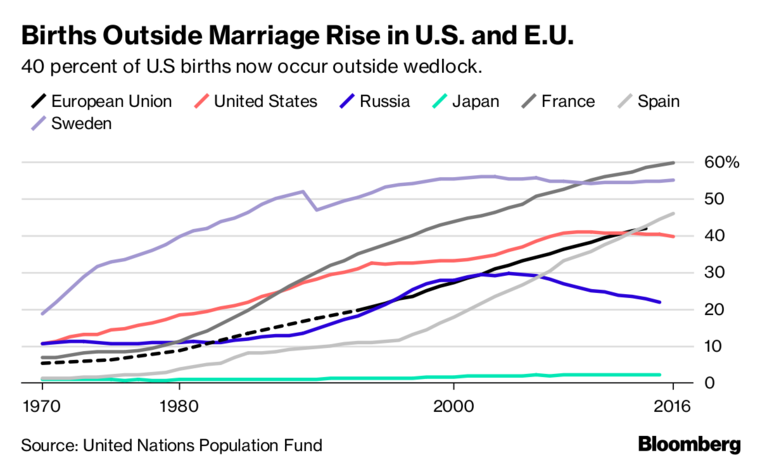
Unfortunately, young people are having children outside of a marriage commitment more and more.

Out-of-wedlocks births rising as cohabitation replaces marriage

Far-left Bloomberg News reports:

Forty percent of all births in the U.S. now occur outside of wedlock, up from 10 percent in 1970, according to an annual report released on Wednesday by the United Nations Population Fund (UNFPA), the largest international provider of sexual and reproductive health services. That number is even higher in the European Union.

The EU has a higher rate of fatherless births because they have high taxes and big government to allow women to have children without having to commit to a husband:

The EU likely sees more births out of wedlock because many member countries have welfare systems that support gender-balanced child care, said Michael Hermann, UNFPA’s senior adviser on economics and demography, in an interview. Public health care systems, paid paternal leave, early education programs and tax incentives give unwed parents support beyond what a partner can provide.

More welfare and more government services make it easier for women to pursue relationships with men who aren’t interested in marriage. Hot bad boys who give them all the tingles. Big government makes those boring, predictable marriage-ready men dispensable. Big government also makes it much harder for a man who does marry to afford a stay-at-home mother for his kids, because he has to pay higher taxes for big government.

More:

The data show such births in the U.S. and EU are predominantly to unmarried couples living together rather than to single mothers, the report says.

[…]Jones also noted that the rise in births outside of marriage is closely correlated to delays in childbearing. “Women are claiming their ground professionally,” she said. “Delaying motherhood is a rational decision when you consider the impact it can have on your career, and that’s contributing to this trend.”

[….]The traditional progression of Western life “has been reversed,” said John Santelli, a professor in population, family health and pediatrics at Columbia’s Mailman School of Public Health. “Cohabiting partners are having children before getting married. That’s a long-term trend across developing nations.”

Regardless of marital status, more couples are choosing not to have kids at all. The U.S. fertility rate hit a historic 30-year low last year, according to the Centers for Disease Control and Prevention. Hermann said the rise in births outside of wedlock has actually mitigated the decline in fertility, which “would be much steeper if women weren’t having children outside marriage.”

What’s interesting about this anti-marriage article is that they have nothing to say about the research showing that cohabitation – and also marriages that occur after a period of cohabitation – are inferior to no-cohabitation marriages. People who are serious about self-control, and who are serious about committing through thick and thin, tend to have longer lasting marriages. But we don’t prioritize chastity, fidelity and self-sacrificial commitment anymore, because that relationships that require self-denial make us unhappy.

The article concludes: “We can’t go back to the ’50s”. Right. Because if feelings-based “morality” is assumed, then any choice between adult happiness and children’s happiness will favor the adults. Today’s young people carefully AVOID any evidence that contradicts their new “happiness-morality”. They act surprised when their unstable relationships dissolve, leaving children separated from their fathers. Marriage requires that both partners have a system of morality that puts the commitment above happy feelings. People have to be accustomed to doing things that feel bad, just because they are good and moral things to do according to an objective standard of morality. The new atheist morality of happy feelings doesn’t develop the character needed for commitment.

If you ask an atheist millennial, they think they are doing a great job of being “moral”. They don’t see the messes they are making for children as something that they are causing themselves, with their own foolish feelings-based decision-making. They think they know everything about relationships through their feelings. They think that they are exempt from the patterns of cause and effect in the peer-reviewed research.