Tag Archives: Atheism

William Dembski replies to theistic evolutionist Darrel Falk

William Dembski is much nicer than I am, and so he takes theistic evolutionist Darrel Falk to task very gently.

Excerpt:

In the paper to which Falk responds, I lay out four non-negotiables of Christianity as well as four non-negotiables of Darwinism. Falk and I are united on the four non-negotiables of Christianity, but differ a bit on those of Darwinism. The four non-negotiables of Darwinism that I list are common descent, natural selection, human continuity, and methodological naturalism. Because Falk and I both reject Darwinism, there’s quite a bit of overlap in how we view these four non-negotiables. Nonetheless, I think it will help readers of my essay and Falk’s response to clarify some of our differences here, subtle though they may be.

With regard to common descent, I agree with Falk that God could have brought about life by means of a large-scale form of evolution that links all organisms to a common ancestor. That said, I don’t accept common descent. I think the scientific evidence is against it (for my reasons, see my book The Design of Life, coedited with Jonathan Wells). Also, even though common descent may be acceptable in broad theological terms, I think it is problematic exegetically with regard to Scripture. Simply put, I think you’re going to have a hard time getting large-scale evolution out of Scripture or rendering the two compatible.

With regard to natural selection, Falk appears to accept that this is the principal mechanism by which organisms are brought into existence successively by an evolutionary process. At the same time, Falk does not want to see natural selection as devoid of purpose but rather as a mechanism through which God is able to accomplish his purposes. But in that case, in what sense is selection “natural”? Is Falk’s view of natural selection, when viewed as a scientific hypothesis, any different from Richard Dawkins’s? And if their views, taken scientifically, are the same, what is the evidence for the creative power of this mechanism?

Falk extols “God’s marvelously ordinary processes of creation: ordinary because they follow his natural laws so faithfully, marvelous because they have resulted in a world of complex and beautiful life.” In my view, the word “ordinary” is entirely out of place here. As I’ve argued with Robert Marks in a paper titled “Life’s Conservation Law,” even if life is the result of an evolutionary process driven by natural selection, it would have to be a form of selection finely tuned by an environment that is itself finely tuned (see our contribution to The Nature of Nature, edited by Bruce Gordon and me — the paper in question is available online here).

Falk takes exception to my thinking it “odd” that God would create by natural selection, and thus by a process that gives no evidence of intelligence. And he rejects my charge that such a method of creation “occludes” God’s activity. Falk, echoing Psalm 19, proclaims that all aspects of creation bespeak God’s handiwork and glory. Now let me concede that “oddness,” in the sense of what appears odd to us very limited human beings with our very limited vantages on the world, is not a good criterion for determining what God would and wouldn’t do. Still, it hardly seems that God is mandated to create via a process that provides no evidence of his creative activity — and nowhere does Falk admit that God provides actual evidence of himself in creation (at best he allows that nature provides “signposts” — but what exactly are these signs? who is reading them? why should we take them as pointing to God?). Moreover, for Falk to echo the psalmist is hardly an argument for the world proclaiming God’s handiwork and glory, because many atheistic evolutionists will deny Falk’s confident affirmations of divine perspicuity.

I’ve seen this directly. I recall posting on my blog a gorgeous picture of wildflowers, hinting at the wonders of God’s creation, and seeing comments by atheistic evolutionists who dismissed it as merely “sex” run amuck. Thus, when Falk echoes Psalm 19, what more is he doing than giving expression to his own faith? Indeed, what more is he saying to atheists than merely “I see God’s hand in all of this and you don’t — you’re blind and I see.” Perhaps faith has given him sight that atheists lack. But in that case, how can it be claimed that God is not occluding his activity in nature? God, as omnipotent, can certainly make his existence and presence known to even the most ardent atheist – we can all imagine flamboyant enough miracles that would convince anyone.

Still, the more interesting question here is whether there is a rational basis for Falk’s faith that is grounded in the order of nature. ID, in finding scientific evidence of intelligence in nature, says there is. Falk, along with BioLogos generally, denies this. But in that case, how can he avoid the charge that the faith by which he sees God’s handiwork is merely an overlay on top of a nature that, taken by itself, is neutral or even hostile to Christian faith? Note that I’m not alone in thinking it odd that God would create by natural selection. Many atheistic evolution see evolution as a brutal and wasteful process that no self-respecting deity would have employed in bringing about life. Jerry Coyne, Richard Dawkins, and the late Stephen Jay Gould were united on this point.

There are three things that annoy me greatly and cause me to lose my temper. One of those things is theistic evolution, which to me is essentially atheism with unnecessary subjective verbiage added on top. My advice for discussing evolution with a theistic evolutionist is to never, ever allow them to talk about anything about religion. Just focus on the science and what the science can show. Anything else they say about their personal feelings and beliefs that isn’t scientific is just an attempt to deceive the listener. Never ever allow a theistic evolutionist to talk about possibilities – what God could or could not do. That is irrelevant to the discussion because it is outside of what science can show.

The central question when discussing evolution is this: can we use the ordinary methods of science, just as Dembski’s method for recognizing design based on specified complexity, in order to detect intelligent causes? Atheists and theistic evolutionists are united on the answer: NO. Darrel Falk and Richard Dawkins agree that there is no way for science to show that an intelligence is needed to explain some effect in nature, because natural mechanisms can do the job with the probabilistic resources available. Design theorists think that you can infer that intelligence is the best explanation – for some effects that pass the mathematical tests.

So you have atheists and theistic evolutionists on one side, and intelligent design people on the other side.
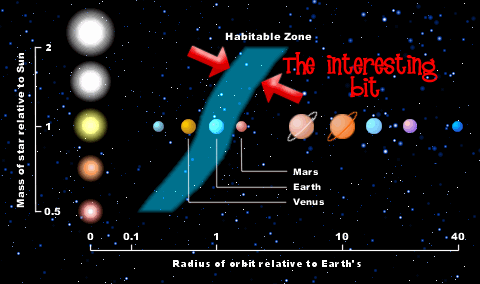
New study on tidal heating strengthens stellar habitability argument

Circumstellar Habitable Zone

Note: If you need a refresher on the habitability argument, click here.

Here’s an article entitled “Tidal heating shrinks the ‘goldilocks zone’: Overlooked factor suggests fewer habitable planets than thought”. It appeared in Nature, the most prestigious peer-reviewed science journal.

The gist of it is that tidal forces can alter orbits so that planets don’t spend all of their orbit in the habitable zone. If planets go outside the habitable zone, it damages their supply of liquid water, and any life chemistry going on in there is disrupted.

Excerpt:

A previously little-considered heating effect could shrink estimates of the habitable zone of the Milky Way’s most numerous class of stars — ‘M’ or red dwarfs — by up to one half, says Rory Barnes, an astrobiologist at the University of Washington in Seattle. That factor — gravitational heating via tides — suggests a menagerie of previously undreamt-of planets, on which tidal heating is a major source of internal heat. Barnes presented the work yesterday at a meeting of the American Astronomical Society’s Division on Dynamical Astronomy in Timberline Lodge, Oregon.

The habitable zone is the orbital region close enough to a star for a planet to have liquid water, but not so close that all of the water evaporates. For our Sun, the zone extends roughly from the inner edge of the orbit of Mars to the outer edge of that of Venus. For smaller, cooler stars, such as M-class dwarfs, the zone can be considerably closer to the star than Mercury is to the Sun. And because close-in planets are easier to spot than more distant ones, such stars have been a major target for planet hunters seeking Earth-like worlds.

There’s just one problem with finding habitable planets around such stars, says Barnes. Because tidal forces vary dramatically with the distance between a planet and its star, closer orbits also result in massively larger tidal forces.

Since planets do not have perfectly circular orbits, these tidal forces cause the planet to flex and unflex each time it moves closer to or further from its star; kneading its interior to produce massive quantities of frictional heat. Substantial heat can be produced, he added, with even slight deviations from a perfectly circular orbit. And, Barnes notes, other factors — such as the rate of the planet’s rotation and its axial tilt — can also influence heat production.

A similar tidal process makes Jupiter’s moon Io the most volcanic body in the Solar System. “I’m just scaling that Io–Jupiter system up by a factor of 1,000 in mass,” Barnes said at the meeting. “It’s the same process, on steroids.”

So, stars that are smaller and cooler will have a habitable zone that is closer to the star, exposing them to more tidal forces. More tidal forces makes their orbits less likely to stay circular – within the habitable zone around the star. These variations cause an increase in heat production on the planet. Too much heat means that the planet is unable to support liquid water on the surface, making it inhospitable for life. Therefore, solar systems with less massive stars can be ruled out as possible sites for life, because of these tidal forces.

How to respond to an atheist who complains about slavery in the Bible

I often hear atheists going on and on about how the Bible has this evil and that evil. Their favorite one seems to be slavery. Here are three things I say to atheists when they push this objection.

The Bible and slavery

First, you should explain to them what the Bible actually says about slavery. And then tell them about the person responsible for stopping slavery in the UK: a devout evangelical named William Wilberforce.

Here’s an article that works.

Excerpt:

We should compare Hebrew debt-servanthood (many translations render this “slavery”) more fairly to apprentice-like positions to pay off debts — much like the indentured servitude during America’s founding when people worked for approximately 7 years to pay off the debt for their passage to the New World. Then they became free.

In most cases, servanthood was more like a live-inemployee, temporarily embedded within the employer’s household. Even today, teams trade sports players to another team that has an owner, and these players belong to a franchise. This language hardly suggests slavery, but rather a formal contractual agreement to be fulfilled — like in the Old Testament.3

Second, inform them that moral values are not rationally grounded on atheism. In an accidental universe, there is no way we ought to be. There is no design for humans that we have to comply with. There are no objective human rights, like the right to liberty (that would block slavery) or the right to life (that would block  abortion). Although you may find that most atheists act nicely, the ones who really understand what atheism means and live it out consistently are not so nice.

Atheism and moral judgments

Second, inform them that moral values are not rationally grounded on atheism. In an accidental universe, there is no way we ought to be. There is no design for humans that we have to comply with. There are no objective human rights, like the right to liberty (that would block slavery) or the right to life (that would block  abortion). Although you may find that most atheists act nicely, the ones who really understand what atheism means and live it out consistently are not so nice.

Dawkins has previously written this:

The total amount of suffering per year in the natural world is beyond all decent contemplation. During the minute that it takes me to compose this sentence, thousands of animals are being eaten alive, many others are running for their lives, whimpering with fear, others are slowly being devoured from within by rasping parasites, thousands of all kinds are dying of starvation, thirst, and disease. It must be so. If there ever is a time of plenty, this very fact will automatically lead to an increase in the population until the natural state of starvation and misery is restored. In a universe of electrons and selfish genes, blind physical forces and genetic replication, some people are going to get hurt, other people are going to get lucky, and you won’t find any rhyme or reason in it, nor any justice. The universe that we observe has precisely the properties we should expect if there is, at bottom, no design, no purpose, no evil, no good, nothing but pitiless indifference.

(“God’s Utility Function,” Scientific American, November, 1995, p. 85)

When people like Dawkins talk about morality, you have to understand that they are pretending. To them, morality is just about personal preferences and cultural conventions. They just think that questions of right and wrong are arbitrary. Things that are wrong in one time and place are right in another. Every view is as right as any other, depending on the time and place. That’s atheist morality.

What’s worse than slavery? Abortion!

Third, you should ask the atheist what he has done to oppose abortion. Abortion is worse than slavery, so if they are sincere in thinking that slavery is wrong, then they ought to think that abortion is wrong even more. So ask them what they’ve done to oppose the practice of abortion. That will tell you how sincere they are about slavery.

Here’s Richard Dawkins explaining what he’s done to stop abortion:

That’s right. The head atheist supports killing born children.