Tag Archives: Apologetics

William Lane Craig discusses faith and reason with university students

This is an interview of Dr. William Lane Craig before college students at the University of Central Florida. (95 minutes)

You can get an MP3 of the lecture here. (33 MB)

Questions from the interviewer: (40 minutes)

  • What started you on his journey of studying faith and reason?
  • How would you define the word “faith”?
  • Are faith and reason compatible? How are they related?
  • How can reasonable faith help us to avoid the two extremes of superstition and nihilism?
  • Who makes the best arguments against the Christian faith?
  • Why are angry atheists like Dawkins and Hitchens more well known than better-informed academic atheists?
  • Does the Bible require Christians to give the unbeliever reasons for their faith?
  • How does faith spur Christians to think carefully about the big questions in life?
  • Should the American church prod churchgoers to develop their minds so they can engage the secular culture?
  • When talking about Christianity intellectually, is there a risk of neglecting the experience of being a Christian?
  • Which Christian apologist has shaped your thinking the most?
  • Which Christian philosopher has shaped your thinking the most?
  • Does the confidence that comes from apologetics undermine humility and reverence?
  • If you had to sketch out a 5 minute case for Christianity, what would you present?
  • Can non-Christians use their reason to arrive at truth?
  • Are there cases where atheists must affirm irrational things in order to remain atheists?
  • Can the universe have existed eternal, so that there is no need to explain who created it?
  • Even if you persuade someone that Christianity is true, does that mean they will live it out?

There is also a long period of questions, many of them hostile, from the audience of students (55 minutes).

  • Haven’t you said nasty things about some atheists? Aren’t you a meany?
  • What do you make of the presuppositional approach to apologetics?
  • Can a person stop being a Christian because of the chances that happen to them as they age?
  • Why did God wait so long after humans appeared to reveal himself to people through Jesus?
  • Can a person be saved by faith without have any intellectual assent to truth?
  • How do you find time for regular things like marriage when you have to study and speak so much?
  • How would you respond to Zeitgeist and parallels to Christianity in Greek/Roman mythology?
  • Do Christians have to assume that the Bible is inerrant and inspired in order to evangelize?
  • If the universe has a beginning, then why doesn’t God have a beginning?
  • Can you name some philosophical resources on abstract objects, Platonism and nominalism?
  • How can you know that Christianity more right than other religions?
  • Should we respond to the problem of evil by saying that our moral notions are different from God’s?
  • Define the A and B theories of time. Explain how they relate to the kalam cosmological argument.
  • How can Christians claim that their view is true in the face of so many world religions?
  • What is the role of emotions in Christian belief and thought?
  • Can evolution be reconciled with Christian beliefs and the Bible?
  • When witnessing person-to-person, should you balance apologetics with personal testimony?
  • Is there a good analogy for the trinity that can help people to understand it? [Note: HE HAS ONE!]
  • How can Christians reconcile God’s omniscience, God’s sovereignty and human free will?

This is a nice introductory lecture that is sure to get Christians to become interested in apologetics. As you watch or listen to it, imagine what the world would be like if every Christian could answer the questions of skeptical college students and professors like Dr. Craig. What would non-Christians think about Christianity if every Christian had studied these issues like Dr. Craig? Why aren’t we making an effort to study these things so that we can answer these questions?

It is really fun to see him fielding the questions from the skeptical university students. My favorite question was from the physics student who sounds really foreign, (at 1:19:00), then you realize that he is a Christian. I do think that Dr. Craig went a little far in accommodating evolution, but I put that down to the venue, and not wanting to get into a peripheral issue.

Bible study: why would a loving God make a terrible place like Hell?

Theology that hits the spot

It’s time for us to take a look in the Bible and make some sense of it, again. Today’s question is really “what does God expect us to be doing with our lives?” but I wanted the title of this post to be more eye-catching for non-Christians.

Why do people go to Hell?

Let’s start with finding out what we are supposed to be doing, and then we’ll know why there is a place like Hell for people who don’t do that to be separated from God.

Everyone has a moral obligation to choose how to use their time wisely during their life time. People everywhere, in all times and places, have had the choice of whether to spend more time thinking about the “big questions” or more time having fun and being selfish. Thinking about the big questions logically leads a person to making discoveries about God’s existence and character. Once the people who think about the “big questions” discover the answers to those big questions, they are morally obligated to use their free will to love God using all their capabilities.

Bible verse break:

Deuteronomy 4:27-30:

27 The Lord will scatter you among the peoples, and only a few of you will survive among the nations to which the Lord will drive you.

28 There you will worship man-made gods of wood and stone, which cannot see or hear or eat or smell.

29 But if from there you seek the Lord your God, you will find him if you seek him with all your heart and with all your soul.

30 When you are in distress and all these things have happened to you, then in later days you will return to the Lord your God and obey him.

At a bare minimum, loving God also means obeying the moral law. But I think there is a lot more to loving God than just obeying rules. Each person is also obligated to engage in and support enterprises that help others to know God as he really is. If a person fails to use their free will to love God, then that person is sinning. Notice that on my view, being nice to your neighbor is relatively unimportant compared to being nice to God. Jesus’ first commandment is to love God, and that vertical dimension is much more important than horizontal dimension of loving your neighbor.

Bible verse break, again – this time Paul is explaining what he does to love God:

Philippians 1:3-19:

3 I thank my God every time I remember you.

4 In all my prayers for all of you, I always pray with joy

5 because of your partnership in the gospel from the first day until now,

6 being confident of this, that he who began a good work in you will carry it on to completion until the day of Christ Jesus.

7 It is right for me to feel this way about all of you, since I have you in my heart and, whether I am in chains or defending and confirming the gospel, all of you share in God’s grace with me.

8 God can testify how I long for all of you with the affection of Christ Jesus.

9 And this is my prayer: that your love may abound more and more in knowledge and depth of insight,

10 so that you may be able to discern what is best and may be pure and blameless for the day of Christ,

11 filled with the fruit of righteousness that comes through Jesus Christ—to the glory and praise of God.

12 Now I want you to know, brothers and sisters, that what has happened to me has actually served to advance the gospel.

13 As a result, it has become clear throughout the whole palace guard and to everyone else that I am in chains for Christ.

14 And because of my chains, most of the brothers and sisters have become confident in the Lord and dare all the more to proclaim the gospel without fear.

15 It is true that some preach Christ out of envy and rivalry, but others out of goodwill.

16 The latter do so out of love, knowing that I am put here for the defense of the gospel.

17 The former preach Christ out of selfish ambition,not sincerely, supposing that they can stir up trouble for me while I am in chains.

18 But what does it matter? The important thing is that in every way, whether from false motives or true, Christ is preached. And because of this I rejoice.

Yes, and I will continue to rejoice,

19 for I know that through your prayers and God’s provision of the Spirit of Jesus Christ what has happened to me will turn out for my deliverance.

So we are supposed to be telling people the gospel, which is the good news about who God is, and what he has done for us to bring us into a right relationship with him, despite our lack of curiosity about him, and our focus on ourselves instead of him. The pre-condition to loving God and sharing the gospel is knowing what his character is really like. Most people are born into a certain religion or learn it from their parents or their culture and they either adopt it without thinking or they reject it without thinking. They are not interested in investigating who God is using reason and evidence, including scientific and historical evidence.

On the Christian view, the best thing you can possibly do with your time is to investigate whether God is real, and what he is like. It’s wrong to say that investigating doesn’t matter or that all religions are the same. In fact, when you actually look into these things like you do any other area of knowledge, with logic and evidence, you do arrive at knowledge of who God is. And that’s because God has left clues of who he is in the natural world and in history – he expects us to be looking for him. He is as real as any other person you know, and his character is as defined as any other person you know.

Bible verse break:

Acts 17:26-27:

26 From one man he made all the nations, that they should inhabit the whole earth; and he marked out their appointed times in history and the boundaries of their lands.

27 God did this so that they would seek him and perhaps reach out for him and find him, though he is not far from any one of us.

I think that the result of any honest investigation is going to be that the Christian religion is going to be found to be more true in its major claims than any other religion. I.e. – people who conduct an honest investigation are going to find that the Christian claims about the universe coming into being out of nothing, and of Jesus rising from the dead, etc. will be validated by the progress of science and historical inquiry.

But since people have a natural tendency to focus on making themselves happy, not many investigations occur. They know that if Christianity is true, they would have to engage in radical self-denial and self-sacrificial love. They know they would have to sober, be chaste, be different, and not be liked because of their exclusive view. And people don’t want to do that, so an honest investigation never even gets started.

Instead, what you find non-Christians doing is hoping in speculations to justify their flight from the demands of the God who is there. We want to be free to make ourselves happy, and that means that we have to keep the real God who is there and who is not silent at arms length. That’s what non-Christians do – they use their time on Earth to push God away so they can focus on themselves and their own happiness. In fact, even Christians do it, which is why we rely on Jesus as a sacrifice for our sin. We could come near to God and work on the things that he would like us to work on without some way to get past our own rebellion. For those who grasp the sacrifice of Jesus as an atonement for our rebellion, cooperation with God becomes possible.

One of the problems that Christians have today is that we do not really understand what sin is. We think that sin is about hurting other people or making other people feel bad. But actually, the sinfulness of a person has little to do with that, and much more to do with how we respond to God. We have a moral obligation to know God and to include God in all of our decision making. Hell is the place that God has made for people who turn away from him. A person chooses Hell when she refuses to investigate whether God is there and who God is, so that she does not have to adjust her choices to respect God.

Robin Collins lectures on fine-tuning for discoverability from particle physics

This lecture is 29 minutes long, the Q&A is 15 minutes. I highly recommend this lecture to all audiences of all levels of ability, for the simple reasons that apart from the content, this lecture is a how-to clinic in the tone, body language, slides and so on for you to use when trying to be persuasive when making your case. Science is king in this lecture. The scientific method is defined and applied in a winsome way. Making science understandable should be the bread and butter approach to Christian apologetics, and this lecture rivals the Mike Strauss lecture at Stanford University and the Mike Strauss lecture at the University of Texas – Dallas as the ideal lectures for showing that. It’s not just the scientific material that makes this lecture by Collins work, it’s the narrative and the style that make the lecture work.

About Robin Collins:

Robin Collins (PhD, University of Notre Dame, 1993), is professor of philosophy at Messiah College, Grantham, PA specializing in the area of science and religion.  He has written over twenty-five articles and book chapters on a wide range of topics, such as the fine-tuning of the cosmos as evidence for the existence of God, evolution and original sin, the Doctrine of Atonement, Asian religions and Christianity, and Bohm’s theory of quantum mechanics.  Some of his most recent articles/book chapters are “Philosophy of Science and Religion” in The Oxford Handbook of Science and Religion, “Divine Action and Evolution” in The Oxford Handbook of Philosophical Theology (2009)  “The Multiverse Hypothesis: A Theistic Perspective,” in Universe or Multiverse? (Cambridge University Press), and “God and the Laws of Nature,” in Theism or Naturalism: New Philosophical Perspectives (Oxford University Press, forthcoming).  He recently received a grant from the John Templeton Foundation to finish a book that presents the case for design based on physics and cosmology,  tentatively entitled The Well-Tempered Universe: God, Cosmic Fine-tuning, and the Laws of Nature.

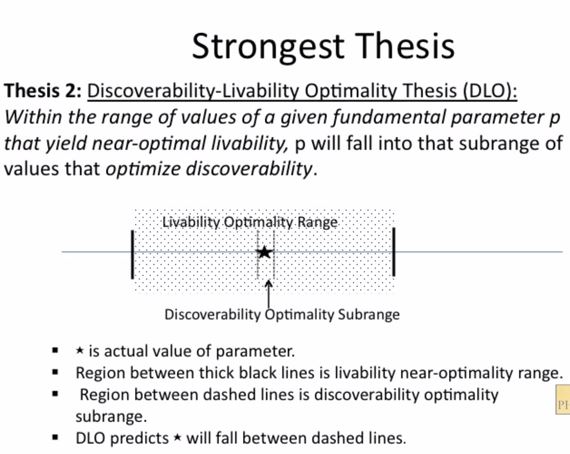
His thesis in one slide:

Fine-tuning for discoverability
Fine-tuning for discoverability – the DLO thesis

Summary:

  • Thesis: the universe is more intelligible than we would expect it by chance
  • The regular fine-tuning argument says that complex embodied observers are very rare
  • But the number of highly-discoverable universes that have complex embodied observers is rarer still
  • Why do we exist in a highly-discoverable universe?
  • Can we quantify and test discoverability?
  • Yes: by varying fundamental parameters and seeing how it affects discoverability
  • Conclusion of his calculations: The Discoverability-Liveability Optimality range is an even smaller range within the Liveablity Optimality range of the standard fine-tuning argument
  • Fine-tuning #1: the fine structure constant, governs the strength of the electro-magnetic force
  • If larger, wood-burning fire becomes impossible because fires won’t stay lit, and therefore forging metals becomes unlikely
  • If smaller, wood-burning fires won’t go out, e.g. – from lightning strikes, so that wood would be less accessible
  • Other constraints: smaller value decreases effectiveness of light microscopes, drastically lowers efficiency of transformers and motors
  • Fine-tuning #2: the cosmic microwave background radiation (CMBR), radiation left over from the Big Bang
  • humans need to discover the CMBR in order to confirm the Big Bang creation out of nothing, and it depends on baryon/pothon ratio
  • his calculations show that the actual value of CMBR is exactly at the peak for detectability by humans
  • if baryon/photon ratio larger, CMBR is less discoverable
  • if baryon/photon ratio smaller, CMBR is less discoverable
  • Fine-tuning #3: parameters related to subatomic particles are fine-tuned for their discovery and usefulness, e.g. – the bottom quark, the charm quark, the tau lepton and the Higgs Boson
  • the lifetime of the particles affects their usefulness to scientists who want to investigate the Standard Model of physics
  • decay rates of these subatomic particles are related to several of the finely-tuned parameters
  • for example, the mass of the bottom quark is finely-tuned for its discoverability by scientists
  • the tau lepton and the charm quark are similarly fine-tuned for disoverability
  • the mass of the Higgs boson is finely-tuned for discoverability and for making further discoveries
  • Conclusion: the DLO thesis is strongly confirmed – this is an even greater degree of fine-tuning that the already astonishing probabilities of the fine-tuning for complex, embodied intelligent beings
  • The formalized version of the philosophical argument based on this evidence is impervious with some of the traditional objections to the standard fine-tuning argument
  • #1 multiverse/selection effect: it is not subject to multiverse / observer selection objections
  • #2 normalizeability: it is not subject to the McGrew-Vestrup objection because the range of possible values is finite not infinite
  • #3 falsifiability: it makes falsifiable predictions, and in fact Collins’ earlier calculations of the CMBR discoverability contained an error that falsified the thesis – until he found the error and corrected for it
  • #4 usefulness: it gives clues about the Creator’s purpose for us, namely that the universe was created for us to be able to do science and find evidence of the Creator’s existence – there is no expectation for us to exercise blind faith, trust in God is meant to be a plausible deduction from the progress of experimental science

Sample slide:

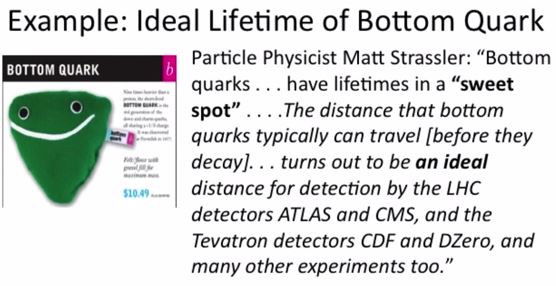
Fine-tuning of the bottom quark for discoverability
Bottom quark lifetime is finely-tuned for discoverability

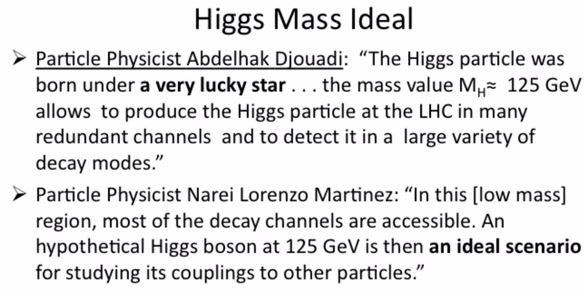
And another:

Higgs boson mass is finely-tuned for discoverability

Earlier, I blogged about a Robin Collins lecture on the fine-tuning that allows complex, embodied life to exist. Another must-see lecture. If you are looking for something to study in university, and you have funding, then physics, mathematics and philosophy are the best places to be for a Christian scholar.