Tag Archives: Apologetics

What helps young men resist peer disapproval?

Tough enough to not care about peer pressure
Tough enough to not care whether you approve of what he’s doing

A post by Nick Peters about young people and apologetics, at the Christian Apologetics Alliance blog.

Excerpt:

Now picture a teenage youth who is a Christian. Is he on the outs with his peers in any way? Well if he’s a good and observant Christian, he’ll be a virgin (since most teenagers in high school aren’t married). Will that lead to any shame to his peers? Yep. Especially since they consider “getting laid” to be a rite of passage and a sign that you are a real man or woman.

So what happens with a boy who’s seventeen and can drive and who is with the guys who are talking about their sexual exploits and the guy has nothing to contribute? If he is asked why he’s not “getting some” he replies that he is a Christian. Is that going to win him any friends? Nope. His “friends” there will most likely mock him for believing in antiquated ideas that science has disproven and tell him he needs to get with the times. Result? The young man is shamed.

Now imagine instead if he’s told the latter part about how his ideas are antiquated and instead, he’s able to make a rational case for the resurrection of Jesus from the dead. Do you think he’ll be able to be shamed the same way? Sure, his friends can still mock him, but he can take the mockery as a sign that they cannot answer his arguments. The young boy has honor then, rather than shame. He might not be sleeping around, but he can hold his head high knowing he can stand up against his peers.

[…]No one wants to be embarrassed, and that includes youth, but if our young people think they can do something that none of their peers can do, it will help them to have that honor that they seek, and there is nothing wrong with seeking honor. Remember the parable where Christ told us to take a lowly position at a banquet so our host would say, “Move up to a better place” and we would be honored? He was saying that that is the proper way to receive honor. Don’t just go out and try to grab it. Let it be given to you.

There are many things that a young person can be ashamed of, but if they’re intellectually unprepared, being a Christian is something that they may be shamed for. In the face of temptation, they need a reason to be obedient rather than just, “The church says so” or “Mom and Dad say so.” Neither of those will be seen as honorable positions. They need to know for themselves why it is that they hold the stance that they do. If they are waiting until marriage, they need to know why. If they believe a man rose from the dead, they need to know why.

That youth are eating this stuff up should tell us something. Youth don’t want to be shamed in the eyes of their contemporaries. They won’t mind holding a different position as long as they can defend that position. If they cannot, then the tide of social pressure could be enough to get them to abandon that and if their emotions and wills start acting against Christianity, it is only a matter of time until the intellect follows.

That excerpt is basically a summary of my life – that’s how I started out as a teen – with apologetics. I’ve been a Christian the whole time in between then and now. I think many parents and churches are wondering how it is that you get a young man to stand up to the culture and peer pressure. The answer is apologetics, and I think integrating Christianity with every other area of knowledge helps as well. Winning arguments over and over is an excellent way to build a suit of armor against temptation and peer pressure.

And in speaking to young people who were raised as Christians then fell away, the common denominator is that they were uncomfortable claiming to be Christians in a secular environment. We have to have a plan to help our young people deal with pluralism and peer pressure. Apologetics is the best answer I can think of.

If you find a discrepancy in the Bible, does that mean Jesus didn’t exist?

Let's think clearly about Christianity
Let’s think clearly about Christianity

Even if we don’t know whether there was one angel or two angels at Jesus’ tomb, we can still know things about whether God exists and whether Jesus rose from the dead.

First, we can know that the universe was created and designed because of reliable, experimental evidence that the universe came into being and is finely-tuned for life. And second, we can know that Jesus was buried, that his tomb was found empty, that a variety of people had experiences of him appearing to them after his death, and that the Christian movement had an early belief that he was resurrected from the dead. We know those core things like we know anything – because we have good evidence. Other things that are more peripheral may not be as supported by evidence. We can remain agnostic about those peripheral things, but that agnosticism about peripheral things doesn’t undermine the things that we know.

William Lane Craig answered a question related to this problem for a person who accepted the minimal facts case for the resurrection but then though that someone this case couldn’t work unless he accepted inerrancy as well.

Here’s the question:

After re-evaluating my Christian faith and pruning it for two years, I can’t shake what seem like two disparate conclusions. One is that the evidence for Jesus resurrection is impecable. But the other is that there seem to be some very awkward realities about the composition of scripture (like errors or authors claiming to write by another name). Yet, the authors of the New Testament, including Jesus, seem to use Scripture in a way that assumes it is word for word from God.

While inductive logic is used to arrive at a strong historical case for the resurrection of Jesus, inductive logic can also be used to arrive at a strong case for many of the peculiaraties about Scripture previously mentioned.

It seems that the approach which many apologists take at this point is that, having established the authority of Jesus by the resurrection, if the argument being raised against scripture contradicts an opinion expressed by Jesus in the Gospels, then the argument for a contradiction must have no possible harmonizations for it to really stick. But I don’t see how this is fair to say, since (1) it seems unfair to use inductive logic to evidence Jesus’ resurrection but then not use it for criticisms against the Bible and (2) an inductive argument can be strong despite what Jesus as recorded in the Gospels says, especially since we cannot assume the precision with which many of the saying were recorded. And (3), anybody can cook up a harmonization of some verse that is possible but not plausible, which I am sure you have seen first hand many times.

Yet, holding these two positions in tension tends to be corrosive to my faith and ultimately leads to a certain bitterness against God for allowing the biblical writers to play fast-and-loose with his words and for not providing a clarity that brings more certainty about what is from him and what isn’t. Any help you can give to relieve this tension would be greatly appreciated.

Now Dr. Craig has a long response on his Reasonable Faith web site, but I just want to quote you this:

But secondly, suppose you’ve done all that and are still convinced that Scripture is not inerrant.  Does that mean that the deity and resurrection of Christ go down the drain?  No, not all.  […]As you recognize, we have a very strong case for the resurrection of Jesus.  That case in no way depends on the Bible’s being inerrant.  This became very clear to me during my doctoral studies in Munich with Wolfhart Pannenberg.  Pannenberg had rocked German theology by maintaining that a sound historical case can be made for the resurrection of Jesus.  Yet he also believed that the Gospel resurrection appearances stories are so legendary that they have scarcely a historical kernel in them!  He did not even trust the Markan account of the discovery of the empty tomb.  Rather his argument was founded on the early pre-Pauline tradition about the appearances in I Corinthians 15.3-5 and on the consideration that a movement based on the resurrection of dead man would have been impossible in Jerusalem in the face of a tomb containing his corpse.

Evangelicals sometimes give lip service to the claim that the Gospels are historically reliable, even when examined by the canons of ordinary historical research; but I wonder if they really believe this.  It really is true that a solid, persuasive case for Jesus’ resurrection can be made without any assumption of the Gospels’ inerrancy.

By contrast, the case for Jesus’ belief that the Old Testament Scriptures are inerrant is much weaker.  I think there’s no doubt that (5) is the premiss that would have to go if biblical inerrancy were to be abandoned.  We should have to re-think our doctrine of inspiration in that case, but we needn’t give up belief in God or in Jesus, as Bart Ehrman did.  Ehrman had, it seems to me, a flawed theological system of beliefs as a Christian.  It seems that at the center of his web of theological beliefs was biblical inerrancy, and everything else, like the beliefs in the deity of Christ and in his resurrection, depended on that. Once the center was gone, the whole web soon collapsed.  But when you think about it, such a structure is deeply flawed.  At the center of our web of beliefs ought to be some core belief like the belief that God exists, with the deity and resurrection of Christ somewhere near the center.  The doctrine of inspiration of Scripture will be somewhere further out and inerrancy even farther toward the periphery as a corollary of inspiration.  If inerrancy goes, the web will feel the reverberations of that loss, as we adjust our doctrine of inspiration accordingly, but the web will not collapse because belief in God and Christ and his resurrection and so on don’t depend upon the doctrine of biblical inerrancy.

We have mainstream scientific evidence for God’s existence, and a mainstream historical evidence for a minimal facts case for the resurrection. None of that evidence depends on inerrancy being true.

So can we please just accept what can be known from experimental science and standard historical methods, and work our lives around that, and not nitpick about peripheral issues so much? I am inerrantist, and so is Dr. Craig. But you don’t have to be in order to accept that the mainstream evidence that shows that universe was created and fine-tuned, and that Jesus was raised bodily from the dead. Don’t let “one angel vs two angels “stop you from accepting things we can know. You can just stay agnostic about the things you think we don’t know.

How should Christians respond to the Supreme Court’s decision to redefine marriage?

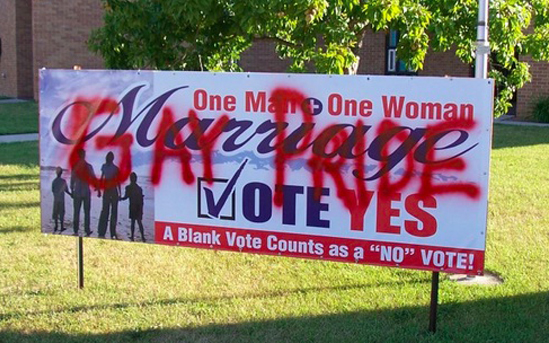
Gay activist vandalizes pro-marriage sign

In case you haven’t heard, the Supreme Court voted to redefine marriage to remove the focus on creating and raising children in stable relationships. Now marriage is just for any two or more people who have feelings for each other, and when the feelings go, so does the marriage. The commitment is gone, the child-centered focus is gone. It’s just about the needs of selfish adults.

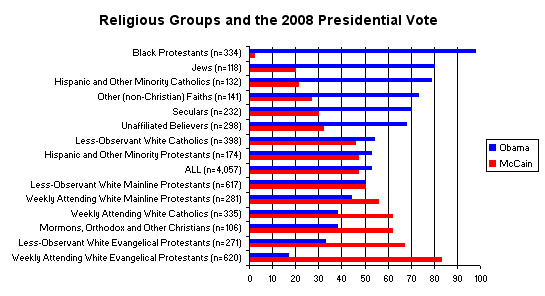
Which Religions Voted for Obama in 2008?

And more:

2008 voting broken by religious groups
2008 voting broken down by religious groups

So, remember that when you are processing today’s decision on gay marriage – not every person who calls herself a Christian actually is what she claims to be. For many of them, religion is just a custom, like the clothes they wear, or the food they eat. They don’t really believe a word of the Bible, and just want to dance and sing in church for the sake of their own happiness. There is nothing cognitive going on in some churches. No understanding, no authenticity.

You can read Justice Scalia’s dissent to the decision here.

How should Christians respond?

This post by Lenny Esposito at Come Reason made me laugh. He writes about how Christians should respond to same-sex marriage, since the Supreme Court is about to rule on it, and is guaranteed to rule against natural marriage.

Lenny has arguments against same-sex marriage that are made on the basis of logic and evidence. But not everyone is happy with his approach.

He writes:

I did receive a few responses from people who wrote something to the effect of “All we need is the Gospel. Share the Word with them.” I’ve run into such thinking before, with those who question the necessity of rigorous training in logic and apologetics. They think such things are “of men.” They admonish me and other believers to simply let loose the “the sword of the Spirit, which is the word of God” (Eph. 6:17) to fight our battles.

I think such talk is sincere but misguided. First of all, we live in a post-Christian culture. The Bible is not taken to be the final answer on issues such as same-sex marriage. That’s why if I quote the Bible to a person who supports homosexual unions, it really doesn’t sway them at all. In fact, many times it solidifies their stance since they see themselves as more modern and progressive than some 2,000 year-old book.

Anyone who has been paying attention to the changes of belief about this issue can quickly see my point. We’ve been offering Biblical admonition against homosexuality and same-sex marriage for over 30 years. Which way did the culture shift? Which way did the Church shift? According to a newly released Pew study, over 60% of Catholic and mainline Protestants support same-sex marriage.1 Even among Evangelicals, the support for same-sex marriage has DOUBLED in the last ten years.2 All this even though the scriptural admonitions against homosexuality are clear and have been discussed repeatedly, especially in churches.

In the words of Dr. Phil, “How’s that workin’ for ya?” I can answer that: it isn’t.

I’m actually not sure that any churches have talked about the Bible says about any issue in the real world. Mine certainly never does, and the pastors are all quite proud of preaching the gospel every week and never talking about current events, law or policy. It’s just Bible, Bible, Bible all the time, and never a word about how it is supported by evidence, or how it applies to real world issues. No wonder churched Christians get the idea that Christianity is just about their emotional state, and not about reality.

More from Lenny:

While I do believe that the Christians who think quoting scripture is the proper way to face these questions are sincere, they are trying to make scripture into something that it is not. They think scriptures are some kind of secret weapon that cannot be resisted. They see it as a sort of mystical summons of the Holy Spirit who will magically change those with whom they’re engaging; a few phrases that one only needs to voice in order to change people’s hearts and minds.

But “the Word” is not a magical incantation and it’s wrong to think of it that way. Such is an unbiblical view of scripture itself. Yes, the Holy Spirit is the one who transforms lives. It is he would is responsible for our understanding our sinfulness and our need for Christ. But that doesn’t mean the Spirit will reshape every unregenerate idea, even among believers. That’s why Paul didn’t quote scripture to the Athenians in Acts 17 when he witnessed to them. Instead, he used popular poets and thinkers they were familiar with to make his point. When Paul was held prisoner in Jerusalem, he didn’t quote scripture to his captors, but appealed to Roman law (Acts 22:25) in order to escape flogging.

I thought it was worth quoting what Lenny said. I think he is more familiar with the normal church  background where people rely on feelings and nudges and intuitions, and are hyper-spiritual about everything.

So what do you think? Is he right about this?

He didn’t provide a case against same-sex marriage in his post, so I’ll just link to my case against same-sex marriage, and summarize the main points below:

  1. Celebrating same-sex unions is bad for children
  2. Celebrating same-sex unions is bad for public health
  3. Celebrating same-sex unions is bad for business and religious liberty

And of course there have been more recent studies since I wrote that which are relevant, like this one that I blogged about previously. There’s much more to the case for natural marriage than my 3 points, but it’s a start.