
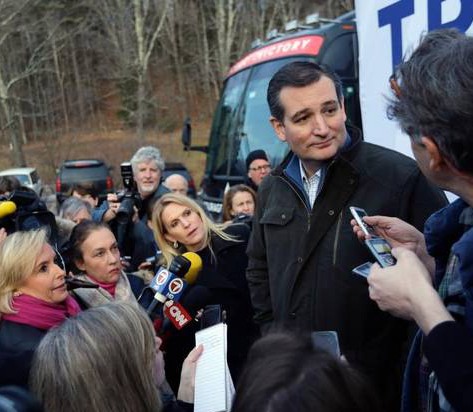
Everything you need to understand about the 2016 election is in one video.
First, the back story from the New York Times: (H/T Mysterious H.)
Senator Ted Cruz of Texas had a date with a waiting car.
It was the second of five stops on Monday, the eve of Indiana’s critical primary, and the event at a restaurant here had been billed as little more than a meet-and-greet.
When he got back outside, a half-dozen protesters who supported Donald J. Trump were waiting across North Washington Street, some holding signs.
“Vote Trump!” one shouted.
“Say something really funny!” a Cruz supporter replied.
“Ted Cruz is going to win!” a Trump fan in dark sunglasses shot back.
Then Mr. Cruz did something unusual: He crossed the street.
Then the video:
Here is the rest of the New York Times article, which has additional material about the confrontation:
With a phalanx of aides and reporters trailing him, Mr. Cruz approached his critics with a question.
“What do you like about Donald Trump?” he asked.
“Everything,” said the man in the sunglasses, who later refused to give his name.
When the protester mentioned the Second Amendment, Mr. Cruz said he had defended gun rights in front of the Supreme Court. The man appeared unimpressed.
When he mentioned immigration, Mr. Cruz was ready with a bit of opposition research.
“May I ask you something?” the Texas senator said. “Out of all the candidates, name one who had a million-dollar judgment against them for hiring illegal immigrants. Name one. Donald Trump.”
“Self-funding,” the man replied.
“O.K.,” Mr. Cruz said, “so you like rich people who buy politicians?”
The man asked Mr. Cruz where his “Goldman Sachs jacket” was, alluding to the employer of Mr. Cruz’s wife, Heidi, who took a leave from her job for the campaign.
Mr. Cruz responded that he had attracted more than a million campaign contributions, with an average of $60. He was interrupted sporadically by shouts of “Lyin’ Ted” from the protester’s peers.
“Sir, with all respect,” Mr. Cruz said, “Donald Trump is deceiving you. He is playing you for a chump.”
Mr. Cruz conjectured that Mr. Trump would not have walked over to meet the protesters.
“If I were Donald Trump, I wouldn’t have come over and talked to you,” he said. “You know what I would have done? I would have told the folks over there, ‘Go over and punch those guys in the face.’ That’s what Donald does to protesters.”
The catcalls of “Lyin’ Ted!” returned.
“O.K., stop,” Mr. Cruz said. “What word did I say was a lie?”
“About Donald telling people to punch people,” the man said.
“O.K., let me ask you, sir,” Mr. Cruz responded. “Just go home and Google ‘Donald-punched-in-the-face-protester.’ This is on national television.”
The man ignored him to make a conjecture of his own: “You’ll find out tomorrow. Indiana don’t want you.”
Mr. Cruz turned toward the cameras, as if making a closing argument in court.
“A question that everyone here should ask,” he began.
“Are you Canadian?” the man interjected.
“Do you want your kids,” Mr. Cruz continued, “repeating the words of Donald Trump?”
Mr. Cruz said he respected the man and believed in the people of Indiana to show good judgment. He started walking to his car.
A television reporter asked why he had bothered to engage.
“Because I believe in the democratic process,” he said.
[…]Moments later, when the cameras cleared out, the man strolled east, crossing railroad tracks with his peers in tow. He reached for a cigarette.
Mr. Cruz’s nerve had surprised him, he allowed, but failed to impress him.
“Anything that Donald Trump talks about,” he said, “that’s what I’m about.”
What you see in the video is a microcosm of this entire election.
Ted Cruz is a Princeton and Harvard educated Tea Party conservative who has a record of conservative achievements that runs all the way back to his days in high school, when he traveled around giving lectures on the Constitution and fiscal conservatism to different groups in his community. Ted Cruz has a 100% conservative record from Heritage Action and he has been endorsed by the National Right to Life because of his record of pro-life actions. He defended the second amendment and religious liberty at the Supreme Court and won. And there are many, many more conservative achievements. Ted Cruz is a man who is confident in his views, and he believes that he can win over the average American voter if he is able to dialog with them, and compare arguments and evidence. He respects the American voter.
The Trump supporters know absolutely nothing about Senator Cruz’s career, and his record of going against the Republican establishment. And everything they know about Donald Trump’s record was what they saw when they watched him clowning around on reality TV shows and beauty pageants. In short, they know literally nothing about his past positions and past actions. They like him because he talked about his penis size in a national debate. They think that is “telling it like it is” and “not being politically correct”. They don’t know that he has always been a Democrat, and that he has always donated to Democrat causes. To them, entertaining words have more value than the patterns of past actions.
Trump supporters have done literally no homework at all in trying to look into the past actions and achievements of the candidates. The only thing they know how to do when confronted with Trump’s liberal record, and Cruz’s conservative record, is to try to drown out the truth with slogans that they obtained from the liberal media, or from their idol Trump himself. The reason why they support an airhead leftist con man like Donald Trump is because they are just not willing to invest the time to know what the candidates have done. They want to figure out who to vote for by watching television, not by researching or reading.
Trump supporters like Trump because they want to blame others for their own failure to grow up and achieve the American dream. America is a country where penniless first-generation immigrants who could not even speak English were able to come here and raise children who would later run for President, e.g. – Marco Rubio and Ted Cruz. Unfortunately, America is a country where too many who are born here think that they are entitled to such success without having to do any work to earn it. But I suspect that this failure has more to do with an attitude that disrespects knowledge and dismisses hard work.
By the way, this isn’t a one-off video… this happens all the time. One previous example occurred in Iowa, where Cruz took time to talk with an angry Iowa farmer about why he opposed ethanol subsidies:
Donald Trump not only supports ethanol subsidies, he pandered to Iowans and offered to raise them – passing the costs of this vote buying on to other taxpayers.
If Ted Cruz loses this election, it will be because too many natural-born Americans abandoned learning about their own history and heritage. To learn those things, they would have to turn off the TV and do their own research. One thing is for certain – if you meet a Trump supporter, you can absolutely assume about that person that he knows literally knows nothing about the Constitution, economics, American history, foreign policy, or anything else that matters.
Related posts
- Is Donald Trump a Christian? Is Donald Trump a moral person?
- How well is Obamacare working, and will Ted Cruz or Donald Trump fix health care?
- Which candidate is the best at defending religious liberty: Trump or Cruz?
- Against misogyny: why every conservative should #DumpTrump #NeverTrump
- Donald Trump’s plan to introduce tariffs is just a tax on consumer goods
- Suppose God had coffee with Donald Trump… how would that go?
- Is Donald Trump right to order U.S. troops to commit war crimes?
- How well did Donald Trump do in the hotel and casino business?
- Trump donated to group that promotes homosexuality to 5-year-olds
- Do supporters of Donald Trump really support what Trump believes?
- Is Donald Trump a successful businessman? Let’s look at his record
- Report: how Donald Trump used illegal immigrants to build Trump Tower
- Is Trump right to praise Putin’s leadership abilities?
- Is Trump right to say that Bush lied about the Iraq war, and there were no WMDs?
- Donald Trump promises gay publication “forward motion” on gay rights issues
- Who has done more on the pro-life and pro-marriage issues – Trump or Cruz?
- Trump, eminent domain, a widow’s house, and a limousine parking lot
- Trump wants to increase taxpayer subsidies of ethanol, Cruz wants to end them
- Trump supported the bank bailout and auto bailout, Cruz opposes all bailouts
- Should evangelical Christians prefer Donald Trump on moral grounds?
- What are the “New York Values” that Trump’s evangelical Christian supporters admire?
- Donald Trump would expand Obamacare into single-payer health care system
 WINTERY KNIGHT