Tag Archives: Abortion

Did “thousands of women” die in “back alley abortions” before Roe v. Wade?

I get into debates about abortion, and sometimes my opponent will complain that if Roe v. Wade were overturned, then thousands of women would die in illegal abortions. Well, if that ever happens to you, this post will help you to know how to respond to it.

First of all, if Roe v. Wade were overturned, then each of the 50 states would pass legislation deciding when abortions would be legal.

Here’s a map taken from the Washington Examiner:

Abortion rights after Roe v. Wade is overturned

Red states are more pro-life than blue states in this map. For example, New York is ranked #6, and Tennessee is ranked #45.

So, if a woman did have irresponsible sex with a hot bad boy, then she easily could terminate her child in one of the blue states.

Second, the number thrown around by abortion advocates is not accurate. It’s simply not true that “thousands of women” were dying from poorly-performed abortions when abortion was still illegal. Actually, abortions were performed by trained medical personnel, but it just wasn’t reported to the police.

Here’s a recent article from the radically leftist Washington Post:

Erica Sackin, a Planned Parenthood spokeswoman, directed us to a 2014 policy statement issued by the American College of Obstetricians and Gynecologists (ACOG): “It is estimated that before 1973, 1.2 million U.S. women resorted to illegal abortion each year and that unsafe abortions caused as many as 5,000 annual deaths.”

There is no citation in the statement for the estimate of “as many as 5,000 annual deaths,” even though many of the other sentences are carefully documented. None of the citations around this sentence supports the figure, and there is no explanation about how it was calculated.

[…]Meanwhile, Sackin also sent a variety of reports, many of which were referenced in a footnote in a document published by NARAL Pro-Choice America. One of the citations especially caught our eye: Frederick Taussig, “Abortion Spontaneous and Induced: Medical and Social Aspects,” (1936).

Why was a study from 1936 being cited? Because in 1936, we didn’t have antibiotics! People were dying all the time from any kind of surgery – not just abortion.

More:

The advent of antibiotics such as penicillin and improved medical procedures suddenly made abortion less risky. Another prominent researcher, Christopher Tietze, argued in a 1948 paper that the number of deaths from abortion was rapidly declining because of three reasons: contraceptive methods had improved so fewer women were getting pregnant, abortion providers were getting better at avoiding infections, and many lives had been saved because of the introduction of sulfa drugs and penicillin.

[…]The data collected by Tietze showed 2,677 deaths from abortion in 1933, compared with 888 in 1945, with much of the decline in septic cases associated with illegal abortions. (The numbers also include deaths from “therapeutic abortions,” permitted by law, and “spontaneous abortions.”)

By 1959, a leading researcher wrote: “Abortion is no longer a dangerous procedure. This applies not just to therapeutic abortions as performed in hospitals but also to so-called illegal abortions as done by physicians. In 1957, there were only 260 deaths in the whole country attributed to abortions of any kind. In New York City in 1921, there were 144 abortion deaths, in 1951 there were only 15.”

The writer was Mary Steichen Calderone, at the time medical director of Planned Parenthood. She attributed the decline in the mortality rate to antibiotics and the fact that 90 percent of illegal abortions were done by trained physicians.

OK, so abortion advocates cite the study from 1936, which already relies on questionable estimates, because they know that the later numbers are far, far lower – thanks to the widespread use of antibiotics. They’re lying, essentially, because lying helps them to persuade people who think with their feelings, and don’t look too closely at facts.

Third, there are over 2,000 pregnancy care ministries and clinics operating throughout the continental United States. Women who want help with pregnancy or adoption can get help from one of these clinics.

Fourth, even if women hurt themselves during abortions, that wouldn’t be a reason to legalize abortion. Bank robbers hurt themselves during bank robberies, and drug dealers hurt themselves during drug deals. We do not legalize criminal activities just because criminals get hurt during the commission of those activities. So the real question is, what is the unborn? If the unborn is a living human being, then abortion on demand takes the life of an innocent human being without justification, and should therefore be illegal.

Most Americans think cohabitation leads to a stable marriage, but what does the data say?

Men who cohabitate are not certain that the relationship is permanent

If there’s one thing that ought to lead people to Christianity, it’s the proven ability of the Christian moral rules to guide believers away from the sins that destroy them. A lot of modern “Christians” have reduced Christianity to being about their feelings and their community, while allowing the culture to determine their goals and moral boundaries. But that won’t protect them from danger.

Cohabitation describes the situation of a couple moving into the same home and being sexually active, but without any legally-recognized commitment. It’s extremely popular among young people today, and even Christians.

Consider this article from The Federalist about cohabitation:

A new Pew Research Center study shows Americans both cohabitate (“live with an unmarried partner”) and find cohabitation acceptable more than before.

[…]More young adults have cohabited than have married. Pew’s analysis in the summer of 2019 of the National Survey of Family Growth found that, for the first time ever, the percentage of American adults aged 18-44 who have ever cohabited with a partner (59 percent) exceeded the percentage of those who have ever married (50 percent).

I thought this was very interesting, especially for the Christian parents and pastors who imagine that their lovely pious daughters all have a Christian worldview just because they sing in the church choir:

Just 14 percent hold a view consistent with a biblical sexual ethic, that cohabitation with an unmarried romantic partner outside of marriage is “never acceptable.”

Just to be clear, in my life I’ve met about 6 non-Christian men who cohabitated with women, and every single one of them cohabitated with a Christian-raised woman. That should tell you what young women are being told about relationships in their homes and churches about sex and marriage. “Do whatever you want”.

So what purpose does cohabitation serve?

A majority of Americans (69 percent) say that “it is acceptable for an unmarried couple to live together even if they don’t plan to get married.” They may assume that they can decrease their chances of a bad marriage and increase their chances of a good one by giving the relationship a cohabitation “test run.”

[…]A plurality of Americans believe cohabitating before marriage yields more successful unions. Nearly half of Americans (48 percent) believe that couples who live together before marriage “have a better chance of having a successful marriage.” This view is even more prevalent among young adults aged 18-29 (63 percent).

Another 38 percent of all Americans say cohabitation “doesn’t make much difference” on marital success. Only 13 percent of Americans believe cohabiting couples have “a worse chance” of having a successful marriage.

[…]Most Americans believe cohabitating couples raise children just as well as married couples. Pew also surveyed people’s opinions about cohabiting couples raising children, and 59 percent of Americans declared that cohabiting couples “can raise children just as well as married couples.” Again, the younger respondents were most likely to have a favorable view of cohabitation: among adults aged 18 to 49, 67 percent agreed cohabiting couples do just as well, while 32 percent said: “Married couples do a better job raising children.”

Yes, cohabitation seen as a test run, and it’s supposed to make stable marriage more likely and not be harmful to children at all.

But why think that a test run should be part of getting married? After all, when I buy a parrot from the pet store, I don’t expect to later return that parrot. Why not? Because I am not buying the parrot to enhance MY life. I am buying the parrot to make a commitment to care for the parrot. Whether the parrot fulfills any of my needs is irrelevant to me. I want the bird in my house so that I can decide what it eats, what it drinks, and invest myself into making it happy, according to its birdish nature. This is because I think that parrots have value in and of themselves, and they deserve a certain quality of life. When I buy the parrot, I am guaranteeing a permanent commitment to the bird to provide for its needs, physical and emotional. And that commitment carries forward to the time (now) when the bird is elderly, and can’t even fly up to his cage or down to the floor. He calls for me, and I go over and pick him up and move him. That’s commitment.

Cohabitation, on the other hand, is the practice of saying to another human being: “I am going to try you out as an entertaining commodity in my home, but if you don’t fulfill my needs then I’m going to send you right back.” That’s not a commitment. That’s self indulgence. It’s defining a relationship as entertainment that is designed to meet my needs and make me happy. And that’s because the concept of commitment in relationships is not presented to young people at any time in their lives. Not from parents. Not in churches. Not in the secular left culture as a whole. Everything is a consumer good designed for the purpose of entertainment – including people. It was only the Christian worldview that had a view of people as creatures made by God for eternal life, so that marriage was about guarding the other person’s faith, and building them up to achieve all the things that God wanted them to achieve for his purposes.

But does cohabitation really work to create stable relationships? After all, anyone can find a partner when they’re young and pretty. The real question is whether that partner will stick around when you’re old and ugly and can’t be as “fun” as you used to be.

Here’s a recent (2018) study on cohabitation and stability:

A new study published in the Journal of Marriage and Family finds that the “premarital cohabitation effect” lives on, despite what you’ve likely heard. The premarital cohabitation effect is the finding that those who live together prior to marriage are more likely, not less, to struggle in marriage.

[…]Michael Rosenfeld and Katharina Roesler’s new findings suggest that there remains an increased risk for divorce for those living together prior to marriage, and that prior studies suggesting the effect has gone away had a bias toward short versus longer-term effects. They find that living together before marriage is associated with lower odds of divorce in the first year of marriage, but increases the odds of divorce in all other years tested, and this finding holds across decades of data.

Strategy advice to those who debate this issue: just be aware that Team Secular Leftist is using papers that have short-range samples, which don’t show the instability problem, because they deliberately cherry-pick recently married couples.

And what about children raised in cohabitating relationships?

While Americans are optimistic about the ability of cohabiting couples to raise children, a study published by the American College of Pediatricians in 2014 reported that children whose parents cohabit face a higher risk of: “premature birth, school failure, lower education, more poverty during childhood and lower incomes as adults, more incarceration and behavior problems, single parenthood, medical neglect and chronic health problems both medical and psychiatric, more substance, alcohol and tobacco abuse, and child abuse,” and that “a child conceived by a cohabiting woman is at 10 times higher risk of abortion compared to one conceived in marriage.”

I’m just going to be blunt here. The majority of young people are progressives, and they vote for candidates who believe in abortion through all nine months of pregnancy, and even after birth. Why? Because they don’t want to have their right to seek happiness impacted by the needs of other people. Progressives believe that children, if they exist at all, should enhance the lives of their adult owners. No one should be surprised that people who think that killing inconvenient children is moral are willing to inflict other bad outcomes on them by raising them in an unstable cohabitation environment.

New survey of 20 studies about breast cancer – abortion link

I’ve blogged about a half-dozen studies from different countries on the link between abortion and breast cancer. It’s always interesting to keep up with the research, so we know what to tell young people about the likely consequences of their choices with sex and abortion. The survey was reported by Life News.

Excerpt:

In 2018, the Breast Cancer Prevention Institute funded and published “Induced Abortion as an Independent Risk Factor for Breast Cancer: A Systematic Review and Meta-analysis of Studies on South Asian Women” in Issues in Law and Medicine. (A meta-analysis looks at separate but similar studies in order to use the pooled data for statistical significance. It is regarded by scientists as very strong evidence.)

Of the 20 studies analyzed, 16 were done on Indian women. The meta-analysis found a 151% increased risk of breast cancer after an induced abortion.

In 2014, “Breast Cancer and Induced Abortion,” an analysis also published in Issues in Law and Medicine, revealed that the incidence of breast cancers increased 10-14 years after an abortion. This analysis was consistent with the known biology of breast cancer. There was no statistically significant increase in breast cancer risk before 10 years and after 14 years of an abortion.

Induced abortion in India, referred to as “Medical Termination of Pregnancy,” was legalized in 1971. Sons are most highly prized and sex selection abortions, although illegal, are not uncommon.

A study published in the Lancet 2006 and based on conservative assumptions, reported that the practice of sex-selection accounts for about a half million missing female births yearly. Over the past two decades this translates into the abortion of some 10 million female fetuses.

Abortion is especially a problem for Indian women, because – as in China – India is very pro-abortion. Both India and China have a very pro-abortion culture, and sex-selection abortion is seen as normal.

Here are a couple of studies that focused on China and Chinese women who choose abortion.

Study 1: (September 2010)

Based on the expression of estrogen receptor (ER), progesterone receptor (PR) and HER2/neu (HER2), breast cancer is classified into several subtypes: luminal A (ER+ and/or PR+, HER2-), luminal B (ER+ and/or PR+, HER2+), HER2-overexpressing (ER-, PR-, and HER2+) and triple-negative (ER-, PR-, and HER2-). The aim of this case-control study is to determine reproductive factors associated with breast cancer subtypes in Chinese women. A total of 1,417 patients diagnosed with breast cancer in the First Affiliated Hospital, China Medical University, Shenyang, China between 2001 and 2009 and 1,587 matched controls without a prior breast cancer were enrolled.

[…]Postmenopause and spontaneous abortion were inversely associated with the risk of luminal tumors. By contrast, multiparity, family history of breast cancer and induced abortion increased the risk of breast cancer.

Study 2: (March 2010)

OBJECTIVE: To explore the risk factors of breast cancer for better control and prevention of the malignancy.

METHODS: The clinical data of 232 patients with pathologically established breast cancer were investigated in this 1:1 case-control study to identify the risk factors of breast cancer.

RESULTS: The history of benign breast diseases, family history of carcinoma andmultiple abortions were the statistically significant risk factors of breast cancer, while breast feeding was the protective factor.

CONCLUSION: A history of benign breast diseases, family history of carcinoma and multiple abortions are all risk factors of breast cancer.

Those are both about abortion and breast cancer in China.

And more recently, I blogged about a very recent study from China which concluded thus:

IA is significantly associated with an increased risk of breast cancer among Chinese females, and the risk of breast cancer increases as the number of IA increases. If IA were to be confirmed as a risk factor for breast cancer, high rates of IA in China may contribute to increasing breast cancer rates.

The effect seems to be most observable for women who have induced abortions before ever completing a pregnancy.

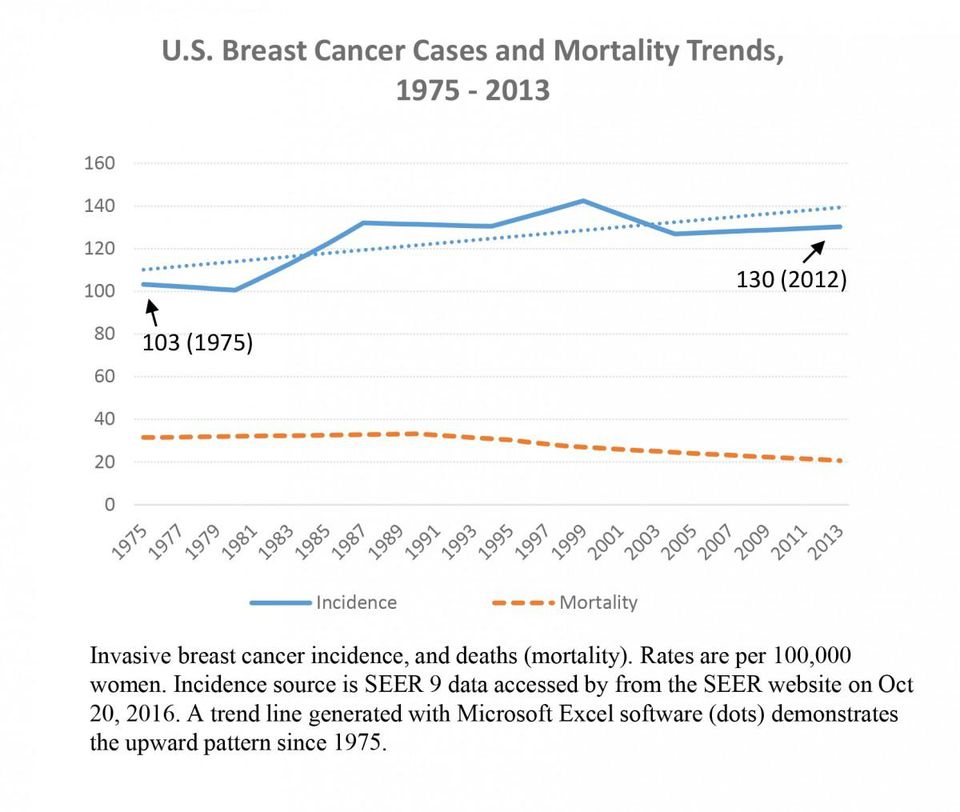
Even though the United States has massively focused on breast cancer screening and treatment, (in contrast to other cancers, such as prostate cancer), the rate of breast cancer has not declined:

Despite much attention and funding, breast cancer rates rising
Breast cancer rates have been rising since abortion was legalized

(Source)

We have so much attention on breast cancer in the West. Many charities raising money for it. Policy changes to promote early testing. Taxpayer money being spent to stop it. And yet the rate has not gone down. It started going up right around the time abortion became legal.