Alexandria Ocasio-Cortez explains how she will pay for $40 trillion in new spending

Young people seem to think that implementing socialism in the United States won’t cost them a thing. The truth is, the rich don’t have enough money to cover all the spending that socialists want to do. It’s going to be young people who are stuck with the bill, and they’ll have to scale their lives down to third world levels to pay for what they voted for.

Here’s a socialist (former bartender) to explain how she would pay for $40 trillion in new spending, over 10 years:

The Daily Wire reports:

TAPPER: “Right. I get that. But the price tag for everything that you laid out in your campaign is $40 trillion over the next 10 years. I understand that Medicare for all would cost more to some wealthier people and to the government and to taxpayers, while also reducing individual health care expenditures. But I am talking about the overall package. You say it’s not pie in the sky but $40 trillion is quite a bit of money. And the taxes that you talked about raising to pay for this, to pay for your agenda, only count for two [trillion dollars]. We’re going by left-leaning analysts.”

OCASIO-CORTEZ: “Right. When you look again at how our health care works, currently we pay — much of these costs go into the private sector. So, what we see, for example, is, you know, a year ago I was working downtown in a restaurant. I went around and I asked how many of you folks have health insurance? Not a single person did. They’re paying — they would have had to pay $200 a month for a payment for insurance that had an $8,000 deductible. What these represent are lower cost overall for these programs. Additionally, what this is, it’s a broader agenda. We do know and acknowledge that there are political realities. They don’t always happen with just a wave of a wand but we can work to make these things happen. In fact, when you look at the economic activity that it spurs — for example, if you look at my generation, millennials, the amount of economic activity that we do not engage in. The fact that we delay purchasing homes, that we don’t participate in the economy as purchasing cars as fully as fully as possible is a cost. It is an externality, if you will, of unprecedented amount of student loan debt.”

TAPPER: “I am assuming I won’t get an answer for the other $38 trillion. We’ll have you back and go over that.”

Some people are going to vote for her just because she’s young, female, and sounds so passionate. But let’s take a look at some numbers so we can understand how feasible her plans are.

First, the rich don’t earn enough money to be able to pay for trillions of dollars in spending.

In 2012, John Stossel wrote this in Forbes:

If the IRS grabbed 100 percent of income over $1 million, the take would be just $616 billion.

In 2011, the Tax Foundation explained that even if you taxed ALL THE DISPOSABLE INCOME from all the people who make $200,000 or more, you would only raise $1.53 trillion dollars:

There’s simply not enough wealth in the community of the rich to erase this country’s problems by waving some magic tax wand.

[…]After everyone making more than $200,000/year has paid taxes, the IRS would need to take every single penny of disposable income they have left. Such an act would raise approximately $1.53 trillion. It may be economically ruinous, but at least this proposal would actually solve the problem.

Socialists want to spend $40 trillion more over 10 years, or about $4 trillion per year. Taking most of what the wealthy earn would make up less than half of that spending.

Anyway, we’re not in a position to be doing any spending, because the costs of our existing socialist programs will be increasing going forward.
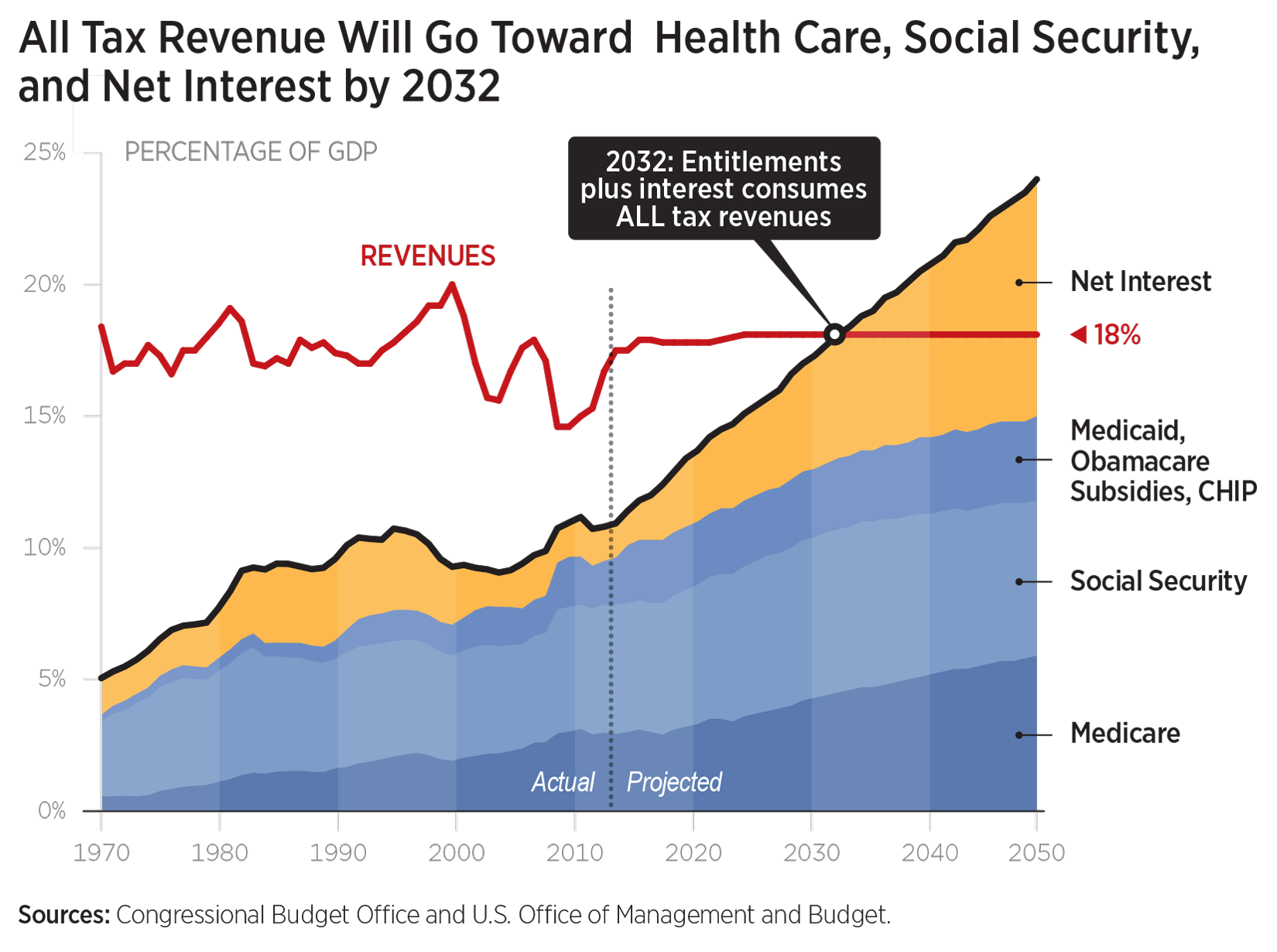
Pretty soon, our mandatory expenses will consume all of our tax revenues

USA Today explains:

After averaging 35 percent of national income from the mid-1950s through 2008, the national debt has surged to 78 percent today and is projected to reach 100 percent within a decade, and 200 percent by 2050. Even these scary estimates rest on rosy assumptions — no new military or economic crises and creditors willing to accept record-low interest rates from a government heading towards a debt crisis.

Just to be clear, he’s talking about the debt-to-gdp ratio. When ours gets too high, interest on the debt will rise, be ause lenders aren’t sure they’ll be getting their money back. This will put us into a debt death spiral.

More:

The cause of this coming debt deluge is no mystery: Social Security and Medicare are projected to run a staggering $82 trillion cash deficit over the next 30 years. We are adding 74 million retiring baby boomers to a system that provides Medicare recipients with benefits three times as large as their lifetime contributions and pays Social Security benefits typically exceeding lifetime contributions (even accounting for inflation and interest on the contributions).

We can’t afford the spending we’re already committed to right now:

Politicians promise changes to avoid cuts in Social Security and Medicare, but their alternatives are plainly insufficient. Democrats favor tax hikes on the rich, but even doubling the highest two tax brackets to 70 and 74 percent would close just one-fifth of these programs’ shortfalls — and even that assumes people keep working at 90 percent tax rates when including state and payroll taxes. Slashing defense spending to European levels would close just one-seventh of the gap. Single-payer healthcare proposals are projected by even liberal economists to increase the debt. Republicans favor cuts in antipoverty and social spending, but even the unimaginable elimination of all anti-poverty spending would close barely half of the shortfall.

So, who’s going to pay for all this? It will be the people who have to work and pay income taxes for the next 30 years. The very same young Americans who are voting for socialists today. They’re the ones who are going to have to survive on a fraction of what their parents earned.

But there’s more. The truth is that raising taxes on the wealthy will cause enormous damage to job creators. If you look at socialist countries, the unemployment rate among young people is astronomical compared to the USA today. Why? Because these other countries have taxed and regulated businesses so much that they simply don’t have money to hire people, and if they do hire people, they pay them less than what they can earn for the same work in America.

Reuters explains:

Last December, the most recent full figures available, 25 million of the EU’s workforce of 240 million were unemployed and actively looking for jobs, producing an unemployment rate of 11 percent.

An additional 11 million were unemployed but had stopped looking or were not immediately available to start work, and were therefore not classified as unemployed. Adding them to the total would bump the jobless rate up to 15 percent.

Then there were more than 9 million part-time workers who wanted to work more hours but had no opportunity to do so – they were counted as employed but felt underemployed.

And finally there were those who were overqualified for their jobs and might well have been making more money elsewhere if they had found the right match for their skills.

European socialism is a kind of hybrid of socialism and capitalism, so it’s not too bad.  In places like Cuba, and Venezuela, you get the real thing. I doubt that most young people really understand what is going on right now on the streets of Cuba and Venezuela. If they did, maybe they wouldn’t be voting for socialism here.

Is the presupposition of naturalism in science good for the pursuit of truth?

I have a key that will unlock a puzzling mystery

This topic came up recently in a discussion, and I wanted to be sure that all my readers were aware of how to think about the work that the presupposition of naturalism does in supporting naturalistic views of science. When I was little, way back in the 1990s, Phillip E. Johnson’s work on the definitions of science, evolution and creation were very important stuff. He was everywhere, doing lectures on university campuses and debates on the radio with Eugenie Scott. I was able to get a bunch of this audio from Access Research Network on AUDIO CASSETTES, but now that’s all obsolete.

Thankfully, I was able to find an old column written by Johnson in the Wall Street Journal, and preserved by Access Research Network.

Excerpt:

A Chinese paleontologist lectures around the world saying that recent fossil finds in his country are inconsistent with the Darwinian theory of evolution. His reason: The major animal groups appear abruptly in the rocks over a relatively short time, rather than evolving gradually from a common ancestor as Darwin’s theory predicts. When this conclusion upsets American scientists, he wryly comments: “In China we can criticize Darwin but not the government. In America you can criticize the government but not Darwin.”

That point was illustrated last week by the media firestorm that followed the Kansas Board of Education’s vote to omit macro-evolution from the list of science topics which all students are expected to master. Frantic scientists and educators warned that Kansas students would no longer be able to succeed in college or graduate school, and that the future of science itself was in danger. The New York Times called for a vigorous counteroffensive, and the lawyers prepared their lawsuits. Obviously, the cognitive elites are worried about something a lot more important to themselves than the career prospects of Kansas high school graduates.

The root of the problem is that “science” has two distinct definitions in our culture. On the one hand, science refers to a method of investigation involving things like careful measurements, repeatable experiments, and especially a skeptical, open-minded attitude that insists that all claims be carefully tested. Science also has become identified with a philosophy known as materialism or scientific naturalism. This philosophy insists that nature is all there is, or at least the only thing about which we can have any knowledge. It follows that nature had to do its own creating, and that the means of creation must not have included any role for God. Students are not supposed to approach this philosophy with open-minded skepticism, but to believe it on faith.

[…]All the most prominent Darwinists proclaim naturalistic philosophy when they think it safe to do so. Carl Sagan had nothing but contempt for those who deny that humans and all other species “arose by blind physical and chemical forces over eons from slime.” Richard Dawkins exults that Darwin “made it possible to be an intellectually fulfilled atheist,” and Richard Lewontin has written that scientists must stick to philosophical materialism regardless of the evidence, because “we cannot allow a Divine Foot in the door.”

So, if you’re having a discussion with a person who believes in naturalism – that everything in nature can be explained by material forces alone – then they will give you a stock response to all of your evidence for something outside of nature.

  • Origin of the universe? That’s not science
  • Cosmic fine-tuning? That’s not science
  • Origin of life? That’s not science
  • Cambrian explosion? That’s not science
  • Habitability-discoverability? That’s not science

It’s not that the people who did the science around these discoveries invoked God, and that’s why it’s not science. On the contrary, the mainstream scientists who made these discoveries scrupulously left God out of their microscopes and telescopes. These discoveries – which have only gotten worse for the naturalists as more details emerge – do not have easy naturalistic explanations. If you ask the naturalist for an explanation, they will resort to various sorts of speculations:

  • future science will undermine all our current knowledge
  • we are in an unobservable multiverse that exists eternally
  • aliens seeded the Earth with life, and THEY evolved
  • there are lots of fossils we haven’t discovered yet
  • there are lots of stars and planets we haven’t discovered yet

What’s the answer to this arguing from ignorance?

I think ridicule is best. You need to start by telling the full story about how these discoveries were made. Name the scientists, state the dates. Tell the whole story of how the science was done. Do this for each discovery. Then, at the end, ask them which of these scientific discoveries they deny. Ask them for naturalistic explanations of the ones they accept. Pretend to be confused, then concerned about their sanity. Finally, you should be as condescending as possible, and just explain that we can’t believe in fairies and unicorns. Explain things to them as if they were a child: we have to base our worldview on what science has revealed. We can’t hold out for Santa Claus to come down the chimney with new science that undermines all we have discovered. We have to go with the science we have today, and the science we have today says Creator and Designer. That is the best explanation of the what we know right now. And the trend is that these discoveries are becoming even MORE difficult for naturalism to account for. I guarantee you that the average rank-and-file atheist knows more about Star Wars and Star Trek lore than they do about actual scientific discoveries that threaten their beloved religion of naturalism.

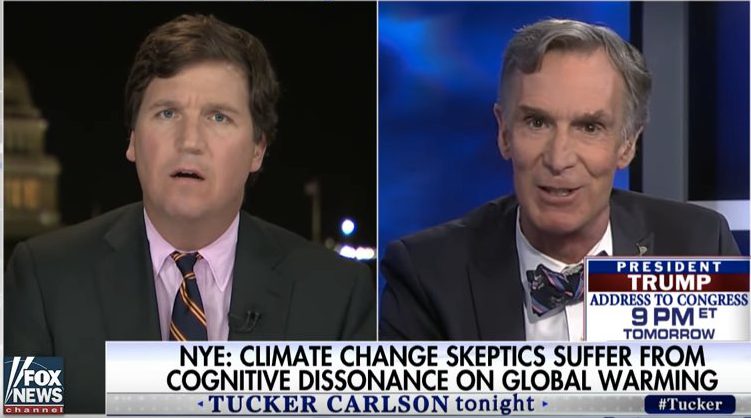
Try to make your face look like Tucker Carlson:

When dealing with a naturalist fundamentalist, make the Tucker Carlson face
The Tucker Carlson face conveys a mix of confusion, disappointment and horror

For God’s sake, even Richard Dawkins admitted in his debate with John Lennox that a good case can be made for a deistic God from the science we have now. If Dawkins can admit this, then you need to be extremely harsh to the village atheists.

If the word “naturalism” is all new to you, you should probably read the whole article and this longer article as well. The longer article really explains the different definitions of the words that are used in these debates. Johnson’s an excellent writer, and you will learn a lot.

Study: sex-reassignment surgery does not improve mental health of transgender people

Investigation in progress

I found this peer-reviewed PLOS study while reading an article from CNS News.

The study takes a look at sex-reassigned people in pro-LGBT Sweden, between 1973 and 2003. Specifically, they aim to measure “mortality, morbidity, and criminal rate after surgical sex reassignment of transsexual persons” over a 30 year period.

The setting is important because Sweden has a much higher tolerance for gay rights than other Western countries, e.g. – America. There’s virtually no dissent from the gay rights agenda in Sweden – certainly no organized dissent.

Here are the results and the conclusion:

Results

The overall mortality for sex-reassigned persons was higher during follow-up (aHR 2.8; 95% CI 1.8–4.3) than for controls of the same birth sex, particularly death from suicide (aHR 19.1; 95% CI 5.8–62.9). Sex-reassigned persons also had an increased risk for suicide attempts (aHR 4.9; 95% CI 2.9–8.5) and psychiatric inpatient care (aHR 2.8; 95% CI 2.0–3.9). Comparisons with controls matched on reassigned sex yielded similar results. Female-to-males, but not male-to-females, had a higher risk for criminal convictions than their respective birth sex controls.

Conclusions

Persons with transsexualism, after sex reassignment, have considerably higher risks for mortality, suicidal behaviour, and psychiatric morbidity than the general population. Our findings suggest that sex reassignment, although alleviating gender dysphoria, may not suffice as treatment for transsexualism, and should inspire improved psychiatric and somatic care after sex reassignment for this patient group.

So, there were higher risks of death, higher risk of suicidal behavior, and higher mental illness.

The CNS News article interviewed a Johns Hopkins University scientist who is familiar with the history of sex-reassignment surgery.

Excerpt:

Dr. Paul R. McHugh, the Distinguished Service Professor of Psychiatry at Johns Hopkins University and former psychiatrist–in-chief for Johns Hopkins Hospital, who has studied transgendered people for 40 years, said it is a scientific fact that “transgendered men do not become women, nor do transgendered women become men.”

[…]Dr. McHugh, who was psychiatrist-in-chief at Johns Hopkins Hospital for 26 years, the medical institute that had initially pioneered sex-change surgery – and later ceased the practice – stressed that the cultural meme, or idea that “one’s sex is fluid and a matter of choice” is extremely damaging, especially to young people.

[…][T]here is plenty of evidence showing that “transgendering” is a “psychological rather than a biological matter,” said Dr. McHugh.

“In fact, gender dysphoria—the official psychiatric term for feeling oneself to be of the opposite sex—belongs in the family of similarly disordered assumptions about the body, such as anorexia nervosa and body dysmorphic disorder,” said McHugh.

“Its treatment should not be directed at the body as with surgery and hormones any more than one treats obesity-fearing anorexic patients with liposuction,” he said.

In fact, at Johns Hopkins, where they pioneered sex-change-surgery, “we demonstrated that the practice brought no important benefits,” said Dr. McHugh. “As a result, we stopped offering that form of treatment in the 1970s.”

Regarding the study, McHugh says this:

The most thorough follow-up of sex-reassigned people—extending over 30 years and conducted in Sweden, where the culture is strongly supportive of the transgendered—documents their lifelong mental unrest.”

“Ten to 15 years after surgical reassignment, the suicide rate of those who had undergone sex-reassignment surgery rose to 20 times that of comparable peers,” said McHugh.

Normally, when it comes to questions like these, I think it’s best to be guided by the evidence. What good would it do to tell someone to do something that makes them like you today (“you’re so tolerant and compassionate”) if they commit suicide tomorrow? Although people today think that being truthful and setting boundaries is “intolerant”, it can actually save someone’s life. When you stop someone from going further in a direction that will expose them to harm, you’re actually doing the right thing – even if they hate you right now for disagreeing with them. (That hatred of dissent is a sign that they are wrong, by the way)