Study: the early Earth’s atmosphere contained oxygen

Christianity and the progress of science

Here’s a paper published in the prestigious peer-reviewed science journal Nature, entitled “The oxidation state of Hadean magmas and implications for early Earth’s atmosphere”. This paper is significant because it undermines naturalistic scenarios for the origin of life.

Evolution News explains what the paper is about.

Excerpt:

A recent Nature publication reports a new technique for measuring the oxygen levels in Earth’s atmosphere some 4.4 billion years ago. The authors found that by studying cerium oxidation states in zircon, a compound formed from volcanic magma, they could ascertain the oxidation levels in the early earth. Their findings suggest that the early Earth’s oxygen levels were very close to current levels.

[…]Miller and Urey conducted experiments to show that under certain atmospheric conditions and with the right kind of electrical charge, several amino acids could form from inorganic compounds such as methane, ammonia, and water. Several experiments have been done using various inorganic starting materials, all yielding a few amino acids; however, one key aspect of all of these experiments was the lack of oxygen.

If the atmosphere has oxygen (or other oxidants) in it, then it is an oxidizing atmosphere. If the atmosphere lacks oxygen, then it is either inert or a reducing atmosphere. Think of a metal that has been left outside, maybe a piece of iron. That metal will eventually rust. Rusting is the result of the metal being oxidized. With organic reactions, such as the ones that produce amino acids, it is very important that no oxygen be present, or it will quench the reaction. Scientists, therefore, concluded that the early Earth must have been a reducing environment when life first formed (or the building blocks of life first formed) because that was the best environment for producing amino acids. The atmosphere eventually accumulated oxygen, but life did not form in an oxidative environment.

The problem with this hypothesis is that it is based on the assumption that organic life must have formed from inorganic materials. That is why the early Earth must have been a reducing atmosphere. Research has been accumulating for more than thirty years, however, suggesting that the early Earth likely did have oxygen present.

[…]Their findings not only showed that oxygen was present in the early Earth atmosphere, something that has been shown in other studies, but that oxygen was present as early as 4.4 billion years ago. This takes the window of time available for life to have begun, by an origin-of-life scenario like the RNA-first world, and reduces it to an incredibly short amount of time. Several factors need to coincide in order for nucleotides or amino acids to form from purely naturalistic circumstances (chance and chemistry). The specific conditions required already made purely naturalist origin-of-life scenarios highly unlikely. Drastically reducing the amount of time available, adding that to the other conditions needing to be fulfilled, makes the RNA world hypothesis or a Miller-Urey-like synthesis of amino acids simply impossible.

So here’s where we stand. If you are a materialist, then you need a reducing environment on the early Earth in order to get organic building blocks (amino acids) from inorganic materials. However, the production of these organic building blocks (amino acids) requires that the early Earth atmosphere be oxygen-free. And the problem with this new research, which confirms previous research, is that the early Earth contained huge amounts of oxygen – the same amount of oxygen as we have today. This is lethal to naturalistic scenarios for creating the building blocks of life on the Earth’s surface.

Other problems

If you would like to read a helpful overview of the problems with a naturalistic scenario for the origin of life, check out this article by Casey Luskin.

Excerpt:

The “origin of life” (OOL) is best described as the chemical and physical processes that brought into existence the first self-replicating molecule. It differs from the “evolution of life” because Darwinian evolution employs mutation and natural selection to change organisms, which requires reproduction. Since there was no reproduction before the first life, no “mutation – selection” mechanism was operating to build complexity. Hence, OOL theories cannot rely upon natural selection to increase complexity and must create the first life using only the laws of chemistry and physics.

There are so many problems with purely natural explanations for the chemical origin of life on earth that many scientists have already abandoned all hopes that life had a natural origin on earth. Skeptical scientists include Francis Crick (solved the 3-dimensional structure of DNA) and Fred Hoyle (famous British cosmologist and mathematician), who, in an attempt to retain their atheistic worldviews, then propose outrageously untestable cosmological models or easily falsifiable extra-terrestrial-origin-of-life / panspermia scenarios which still do not account for the natural origin of life. So drastic is the evidence that Scientific American editor John Horgan wrote, “[i]f I were a creationist, I would cease attacking the theory of evolution … and focus instead on the origin of life. This is by far the weakest strut of the chassis of modern biology.”3

The article goes over the standard problems with naturalistic scenarios of the origin of life: wrong atmosphere, harmful UV radiation, interfering cross-reactions, oxygen levels, meteorite impacts, chirality, etc.

Most people who are talking about intelligent design at the origin of life talk about the information problem – how do you get the amino acids to form proteins and how do you get nucleotide bases to code for amino acids? But the starting point for solving the sequencing problem is the construction of the amino acids – there has to be a plausible naturalistic scenario to form them.
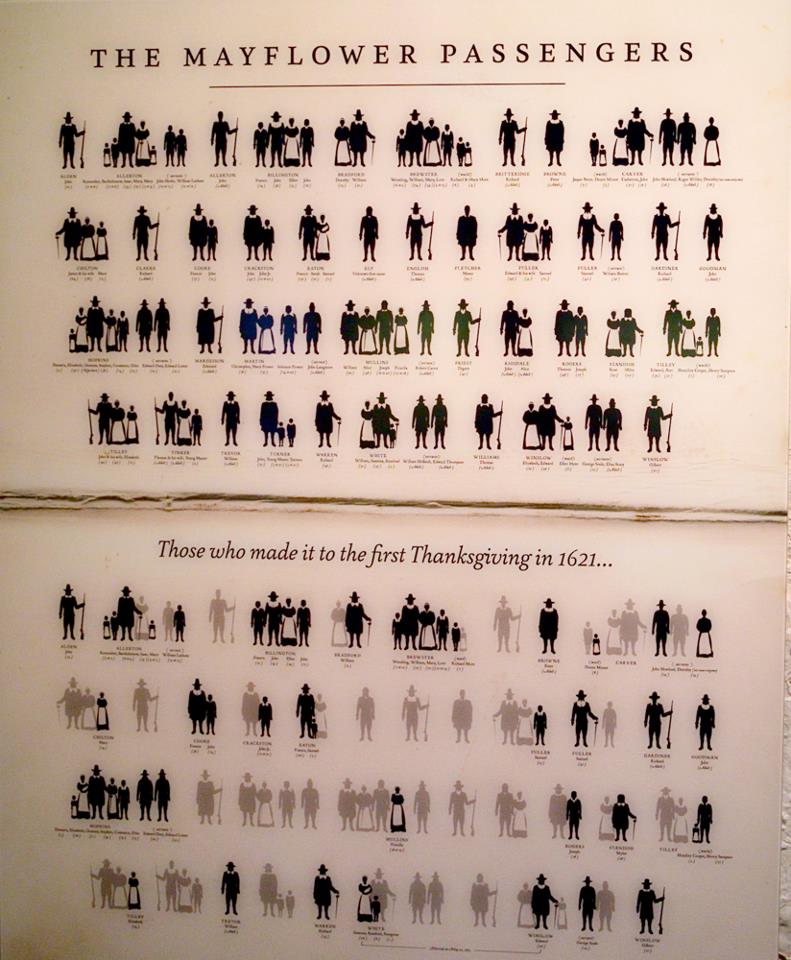
The pilgrims experiment with communism before the second Thanksgiving

The First Thanksgiving
Less than half the original pilgrims made it to the the first Thanksgiving

Here’s an article from The Stream about the second Thanksgiving, by Dante Witt. I like this article because it tells us so much about the character of the United States of America. Why are we so conservative about economics?

She briefly retells the story of how the pilgrims were helped by Squanto, which I blogged about in a previous Thanksgiving Day post, then she talks about the troubles they had next.

Excerpt:

Although Squanto’s farming techniques worked better than their old ones, the pilgrims still could not produce enough food. Was it bad luck? Bad soil? No. The Mayflower pilgrims were part of a joint stock company which stipulated that the pilgrims would pool their resources, and receive a share of the profit.

The strategy turned out to be deeply misguided, working about as well as various communist economic schemes hundreds of years later. The sad state of the colony after two years of communism, wrote William Bradford, “may well evidence the vanity of that conceit of Plato’s and the other ancients applauded by some of later times; that the taking away of property and the bringing of community into a commonwealth would make them happy and flourishing; as if they were wiser than God” (p. 121).

So the pilgrims amended their contract so that each family was now responsible for its own provision. The difference was stark. Bradford explained:

This had good success, for it made all hands very industrious, so that more corn was planted than could have been by any other means the Governor could use, and saved him a great deal of trouble, and gave far better content. The women now went willingly into the field, and took their little ones with them to set corn; which before would allege weakness and inability; whom to have compelled would have been thought great tyranny and oppression.

In fact, it’s estimated the colonists planted about six times the crops they would have planted otherwise.

That shows where Americans get their views of economics, but what about the praying and the gratitude?

More:

With new farming techniques and an amended government, the pilgrims did all they humanly could to ward off starvation. But they could not control the weather. A drought settled on the colony and threatened to kill the corn before the harvest. Recognizing with the Psalmist that “except the Lord build the house, they labor in vain that build it,” the colonists turned to God. According to Bradford, they “set apart a solemn day of humiliation to seek the Lord by humble & fervent prayer, in this great distress.” What was the outcome?

And he was pleased to give them a gracious & speedy answer, both to their own & the Indians admiration, that lived amongst them. For all the morning, and greatest part of the day, it was clear weather & very hot, and not a cloud or any sign of rain to be seen, yet toward evening it began to overcast, and shortly after to rain, with such sweet and gentle showers, as gave them cause of rejoicing, & blessing God. It came, without either wind, or thunder, or any violence, and by degrees in that abundance, as that the earth was thoroughly wet and soaked therewith. Which did so apparently revive & quicken the decayed corn & other fruits, as was wonderful to see, and made the Indians astonished to behold. (p. 131)

Seeing the speedy results of the Puritans’ prayers, an Indian named Hobanak said, “Now I see that the Englishman’s God is a good God, for he hath heard you, and sent you rain, and that without storms and tempests and thunder, which usually we have with our rain, which breaks down our corn, but yours stands whole and good still; surely your God is a good God.” (pp. 64-5)

Then William Bradford again proclaimed a day of Thanksgiving to God, the forerunner of the American tradition of Thanksgiving.

So, this story explains why the United States has this character that values the free enterprise system, hard work, individual achievement, prayer, and gratitude. These are the values that make us American, that made us into such a great nation.

Boys underperform at school because feminists block attempts to help them

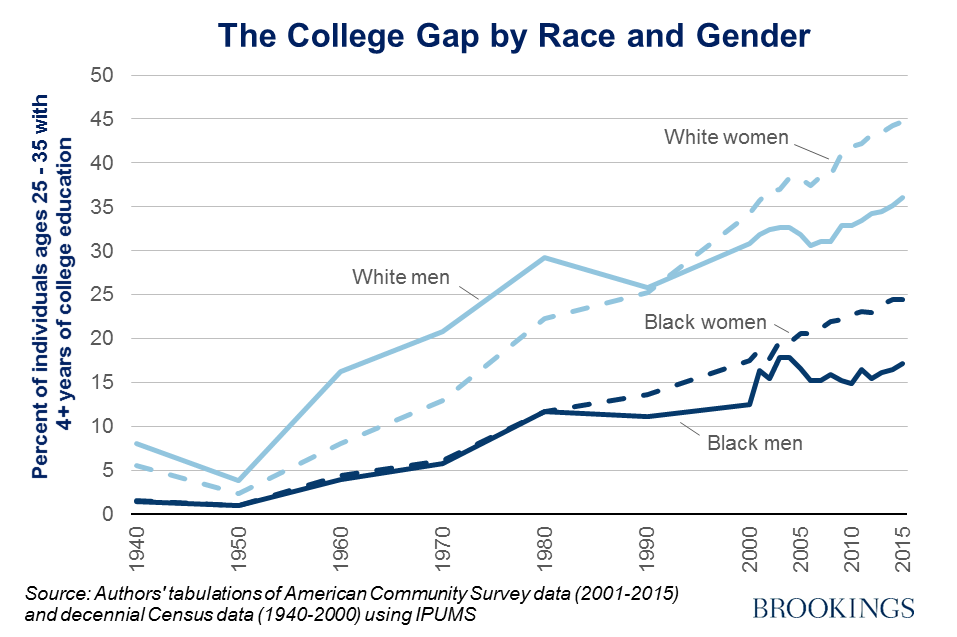
College graduation rates for men and women
College graduation rates for men and women (Source: Brookings Institute)

Britain is a country that is absolutely dominated by radical feminists. And it affects everything from their collectivist views on economic policy, to their pro-criminal views in the justice system, to their open-borders views on immigration, their preference for government-run healthcare, their hatred of self-defense, and so on. So, I wouldn’t expect to see an article about the plight of boys in a feminist society published in a British newspaper.

Nevertheless, here is an article from the UK Telegraph that explains how the public schools are handling the problem of underperforming boys.

It says:

Britain’s education system is failing to tackle the “astonishing” underperformance of boys as feminists have made the topic “taboo”, the former head of the university admissions service has warned.

Mary Curnock Cook, who was chief executive of Ucas until last year, said the fact that boys are falling behind in education is a national scandal – yet it is such an “unfashionable” topic to discuss that it has become “normalised”.

Girls outperform boys in all aspects of education, from primary school to GCSEs and A-level results. Last year, 57 per cent of women went to university compared to 43 per cent of men, a gap that has widened significantly over the last decade.

[…]Ms Curnock Cook said that the debate about gender equality tends to be dominated by issues such as the gender pay gap and the glass ceiling.

“But those are work issues, not education issues,” she said. “Quite often initiatives to support men do meet derision from feminists.”

When attempts are made to address men’s issues, they are ridiculed and are met with the “wrath” of feminist and gender equality groups, she said.

Last month the only university in the UK with a men’s officer scrapped the role after the candidate withdrew due to “harassment”.

But, it’s happening in America as well.

An article from 2013 appeared in the far-left The Atlantic. It explains how the school system punishes boys and favors girls – from kindergarten to the workplace, where women receive affirmative action preferences.

Excerpt:

Boys in all ethnic groups and social classes are far less likely than their sisters to feel connected to school, to earn good grades, or to have high academic aspirations. A recent working paper from the National Bureau of Economic Research documents a remarkable trend among high-achieving students: In the 1980s, nearly the same number of top male and female high school students said they planned to pursue a postgraduate degree (13 percent of boys and 15 percent of girls). By the 2000s, 27 percent of girls expressed that ambition, compared with 16 percent of boys. During the same period, the gap between girls and boys earning mostly A’s nearly doubled—from three to five percentage points.

This gap in education engagement has dire economic consequences for boys. A 2011 Brookings Institution report quantifies the economic decline of the median male: For men ages 25 to 64 with no high school diploma, median annual earnings have declined 66 percent since 1969; for men with only a high school diploma, wages declined by 47 percent. Millions of male workers, say the Brookings authors, have been “unhitched from the engine of growth.”  The College Board delivered this disturbing message in a 2011 report about Hispanic and African-American boys and young adults: “Nearly half of young men of color age 15 to 24 who graduate from high school will end up unemployed, incarcerated or dead.” Working-class white boys are faring only slightly better. When economist Andrew Sum and his colleagues at the Center for Labor Market Studies at Northeastern University examined gender disparities in the Boston Public Schools, they found that for the class of 2007, among blacks and Hispanics, there were 186 females for every 100 males attending a four-year college or university. For white students: 153 females to every 100 males.

Just like in the UK, American feminists oppose doing anything to help boys:

In the U.S., a powerful network of women’s groups works ceaselessly to protect and promote what it sees as female interest. But there is no counterpart working for boys—they are on their own.

Previously, I blogged about a study showing that female teachers grade boys lower than girls.

It’s important for parents to understand that the problem of boys underperforming in school and work is not caused by boys. It’s not with video games, it’s not with sports, or anything else that anti-male people might blame. The problem with boys not learning and boys not working is caused by an education system dominated by anti-male feminists who systematically discriminate against boys, making it harder for them to learn the skills they need to find work.

The problem isn’t going to be fixed by airhead feminist pastors and other male “leaders” telling boys to “man up”. The problem is going to be fixed when parents realize that radical feminism is hostile to boys, and that institutions that are dominated by radical feminism are damaging to boys. I have a Jewish friend named Ari who homeschools all his children. He spends a lot of time and effort on this. He told me that sending boys to public schools is child abuse. I used to laugh at him when he said that. What a funny exaggeration, I thought. Now I’m not so sure he was joking.