
How brief was the period in which the Cambrian phyla suddenly appeared?

Cambrian Explosion
Cambrian Explosion

The Cambrian explosion refers to the sudden appearance of new body plans in the fossil record. ID proponents think that the period is between 5-10 million years at the most. Naturalists want to stretch out the period in which the body plans appear to tens of millions of years. The two sides can’t both be right. What’s the truth?

Evolution News has the answer.

Excerpt:

To establish the length of the most explosive period of innovation within the Cambrian explosion itself, Meyer cites the work of MIT geochronologist Samuel Bowring and his colleagues as well the work of another group led by Smithsonian paleontologist Douglas Erwin. The Bowring-led study showed that (in their words) “the main period of exponential diversification” within the Cambrian lasted “only 5-6 million years” (emphasis added). Meyer explains:

An analysis by MIT geochronologist Samuel Bowring has shown that the main pulse of Cambrian morphological innovation occurred in a sedimentary sequence spanning no more than 6 million years. Yet during this time representatives of at least sixteen completely novel phyla and about thirty classes first appeared in the rock record. In a more recent paper using a slightly different dating scheme, Douglas Erwin and colleagues similarly show that thirteen new phyla appear in a roughly 6-million-year window. (p. 73)

[…][T]ake a look first at the following figure that Bowring and his colleagues included in their definitive 1993 article, published in the journal Science. They use radiometric methods to date the different stages of the Cambrian period, including the crucial Tommotian and Atdabanian stages in which the greatest number of new animal phyla and classes arise. Note that the so-called Manykaian stage of the Cambrian period lasts about 10-14 million years. Note also that the main pulse of morphological innovation didn’t begin during this stage but rather during the Tommotian and Atdabanian — a period that they describe as taking between “5 to 10 million years,” and in a more detailed passage as taking about 5-6 million years.

[…]In the figure above, the Tommotian and Atdabanian stages of the Cambrian period together span only about 5 million years, starting at about 530 and ending about 525 million years ago. Bowring’s figure also depicts the total number of classes and orders present at any given time during the Cambrian period. The biggest increases in morphological innovation occur during the Tommotian and Atdabanian stages. Indeed, during this period the number of known orders nearly quadruples. Moreover, Bowring and his colleagues also make clear that this period corresponds to the main pulse of Cambrian morphological innovation as measured by the number of new phyla and classes that first appear. They note that, while a few groups of animals do arise in the earliest Manykaian stage of the Cambrian, the most rapid period of “exponential increase of diversification,” corresponding to the Tommotian and Atdabanian stages, “lasted only 5 to 6 m.y.”

You can see the figure they are reference in the Evolution News article.

Also, check out these clips that explain the Cambrian explosion:

Part 1:

Part 2:

The first clip features James Valentine, a professor of biology at the University of California who just co-authored a new book on the Cambrian explosion and is not a proponent of intelligent design.

The consensus among scientists regarding the period of time in which the new body plans appear is 5-6 million years. Biologically speaking, that’s a blink of an eye. You aren’t going that kind of complexity and innovation in such a short period of time any more than you can expect to win the lottery by buying 5-6 million tickets when the odds of winning are 1 in a googol (10 to the 100th power – 1, followed by 100 zeroes). You don’t have enough lottery tickets to make winning the lottery likely. Similarly, 5-6 million years is not enough time for naturalistic mechanisms to code brand new body plans from scratch. It would be like trying to research and write a Ph.D thesis during a single lunch hour. It’s just not enough time to produce the amount of information that’s required.

Is Tim Keller right to say that New York City brings the gospel to Christians?

Can New York City can teach Christians about the gospel?
Can New York City teach Christians about the gospel?

(Source)

Here is a short guest post from my friend the software engineer.

Tim Keller dusted off an old pearl of wisdom of his and re-posted it on twitter. I discovered it on Facebook as many of my friends were making fun of it. One Twitter user remarked:

I think it’s been three years since the last time you tweeted this. I predict no misunderstanding this time.

To which Keller responded:

It happens every time. Hard to understand this–unless you realize how much the city can teach us and how much we learn about Christ through common grace, other Christians, the humbling that happens here. Oh well.

I can conjure up in my mind a way for this to not be meaningless tripe. It could be that Keller has in mind the number of ways men made in the image of god remind him of god’s grace and represent an opportunity to live out the sacrifice Jesus called us to.

But I have a hard time believing it doesn’t mean something else. That Keller has in mind here that we should allow the city and its emergent values to exert undue influence over us. I have a hard time believing this because I don’t see Keller’s church actively changing the culture around them and thereby setting an example for the rest of us to follow.

I would further submit that one of the reasons Tim Keller’s church has not been successful in changing the city is that they are too busy succumbing to the social justice influences that are popular today.

Why don’t people take churches like Keller’s seriously anymore? Perhaps it’s precisely because those churches have, as Keller tweeted, allowed the city to bring them the gospel.


OK That’s it for my friend’s post. I was supposed to add two of my beefs with Tim Keller. The first one is that he’s far left on questions of origins.

Here’s an article from Creation.com. I am not a young Earth creationist, I’m an old Earth creationist. Still, my YEC software engineer friend (a different software engineer) tells me that they are the best and largest YEC site.

They say:

Timothy Keller, author of The Reason for God (see our review), recently authored a paper for the theistic evolutionary organization Biologos (see Evolutionary syncretism: a critique of Biologos) titled “Creation, Evolution, and Christian Laypeople” (read the entire paper here). In this paper, he wrestles with how to present science to Christian laypeople in such a way that evolution and the Bible seem compatible.

[…]Keller devotes several pages to showing that believing that evolution happened as a biological process does not necessarily mean that one has to embrace the “Grand Theory of Evolution” involving naturalism and social Darwinism.

The young Earth creationists are concerned that evolution is not what God described in the Bible. Old Earth creationists think it’s worse than that. Not only does evolution not agree with the Bible, it doesn’t agree with good science either. The problem with Keller is his disagreement with what mainstream science shows about the origin of life, the Cambrian explosion, molecular machines, irreducible complexity, etc.

But that’s not the only problem with Tim Keller.

Here is what he says about a statement signed by conservative Christians disagreeing with “social justice”:

A controversial statement signed by more than 9,000 evangelicals and Christian organizations deploring social justice as a dangerous concept to the Gospel, belittles Christians who talk about race and justice, says Tim Keller, founding pastor of Redeemer Presbyterian Church in New York City.

[…]The Statement on Social Justice & the Gospel was released early this month with initial signers including John MacArthur of Grace Community Church, who recently denounced evangelicalism’s “newfound obsession” with social justice.

Among other things, the statement notes that: “Specifically, we are deeply concerned that values borrowed from secular culture are currently undermining Scripture in the areas of race and ethnicity, manhood and womanhood, and human sexuality. The Bible’s teaching on each of these subjects is being challenged under the broad and somewhat nebulous rubric of concern for ‘social justice.’

If you want to know what Tim Keller really thinks about moral issues, you can read his opinion / editorial in the far-left New York Times, where he has nothing to say about the traditional teachings of the Christian worldview (voluntary charity, chastity, pro-life, natural marriage, not coveting your neighbor’s wealth, limited government, people defined by the content of their character instead of the color of their skin).

Moderate conservative Doug Wilson notes:

So get the vantage of two hundred years from now, and have a doctoral student in American history examine Keller’s op-ed piece for any reference at all to abortion, or to the fact that Planned Parenthood, subsidized by our tax dollars, sells baby parts. It is not there.

[…]So why didn’t more churches apply what the Bible requires of slave-owners two hundred years ago? The answer is that back then it would have taken courage to do so, just as it would take courage today for Keller to denounce Planned Parenthood in The New York Times.

Keller does denounce sins in this piece. But he is still being careful because the sins he denounces are safe sins to denounce—we know this because they are all the sins that the secular world routinely uses to denounce the conservative Christian world. There is the sin of not working for “better public schools,” or not working for a “justice system weighted against the poor,” or “to end racial segregation,” or failing to “lift up the poor.” It is as though we found John the Baptist chiding the Israelites for failing to see the moral imperatives contained within Herod’s economic stimulus programs.

And that’s because the readers of the New York Times, and the residents of the city of New York are pro-abortion (which is the equivalent of slavery in our modern times).  In fact, New York is pro-infanticide – they have a law that allows infanticide. And this did not deserve a mention from Tim Keller in his New York Times editorial. Perhaps he thinks that infanticide is one of the things that New York city has to teach traditional Christians about the gospel.

Why should a woman marry a man while she’s still under 25?

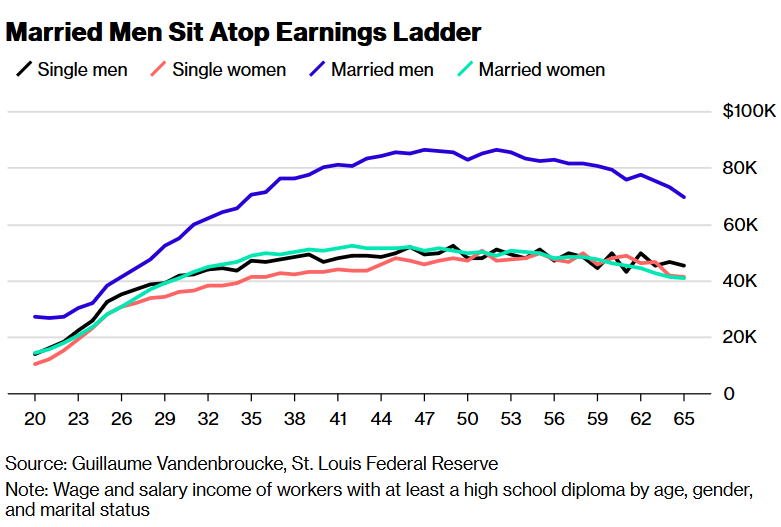
Married men seem to enjoy a boost in earnings from age 23-43
Married men seem to enjoy a boost in earnings between age 22-45

I saw a bunch of pro-marriage friends were tweeting about this article from the St. Louis Federal Reserve which talks about how well married men do financially compared to single men, and using it as a reason to argue that men should get married. The article from the St. Louis Reserve doesn’t have much commentary, but this article from the far-left Washington Post by Brad Wilcox has a lot to say.

Excerpt:

Marriage has a transformative effect on adult behavior, emotional health, and financial well-being—particularly for men.

[…]Men who get married work harder and more strategically, and earn more money than their single peers from similar backgrounds. Marriage also transforms men’s social worlds; they spend less time with friends and more time with family; they also go to bars less and to church more.

[…]Our research, featured in a recent report, “For Richer, For Poorer: How Family Structures Economic Success in America,” indicates that men who are married work about 400 hours more per year  than their single peers with equivalent backgrounds. They also work more strategically: one Harvard study found that married men were much less likely than their single peers to quit their current job unless they had lined up another job.

This translates into a substantial marriage premium for men. On average, young married men, aged 28-30, make $15,900 more than their single peers, and married men aged 44-46 make $18,800 more than their single peers.

That’s even after controlling for differences in education, race, ethnicity, regional unemployment, and scores on a test of general knowledge. What’s more: the marriage premium operates for black, Hispanic, and less-educated men in much the same way as it does for men in general.

For instance, men with a high-school degree or less make at least $17,000 more than their single peers.

So, what about these differences between married men and single men? Are men able to earn more if they have a wife to support them and care for their needs? Or is it just that women prefer men who are already able to take care of themselves?

Well, in most cases, it’s the former:

2. Married men are motivated to maximize their income. For many men, this responsibility ethic translates into a different orientation toward work, more hours, and more strategic work choices. Sociologist Elizabeth Gorman finds that married men are more likely to value higher-paying jobs than their single peers.

This is partly why studies find that men increase their work hours after marrying and reduce their hours after divorcing. It’s also why married men are less likely to quit a current job without finding a new job. Indeed, they are also less likely to be fired than their single peers.

3. Married men benefit from the advice and encouragement of their wives. Although there is less research on this, we suspect that men also work harder and more strategically because they are encouraged to do so by their wives, who have an obvious interest in their success. One study appears to buttress this point, finding that men with better-educated wives earn more, even after controlling for their own education.

4. Employers like married men with children.  There is evidence that employers  prefer and promote men who are married with children, especially compared to their childless male peers and to mothers. Married men are often seen as more responsible and dedicated workers and are rewarded with more opportunities by employers. While illegal bias and long-held stereotypes appear to play a role in this historic preference, it nonetheless helps explain why married family men get paid more.

Now what’s the purpose of me writing this? Well, I’m actually NOT writing this to pressure men to get married. Why not? Because although marriage was a pretty good deal 100 years ago, it’s not as good of a deal under the current laws and policies, e.g. – no-fault divorce, the threats of false accusations, the Sexual Revolution, etc. So I wouldn’t advise a man to rush into marriage to just anybody in order to get the financial (and health) benefits of having a wife. Marriage is only safe when you choose a woman carefully.

But I am writing this to women who are being told by the culture to delay marriage, and especially to delay marriage to use your youth and beauty to “have fun” with boys who won’t commit to marriage. If a woman loves a marriage-focused man and really wants to take care of him and support him, then early marriage is one of the very best ways to really help him during the years (22-45) when it really makes a difference. Marrying a man who wants marriage when you’re still young means that he will have many, many measurable benefits.

It’s important to marry a man when the marriage has the potential to do the most good for him in areas like health, career, finances and children. Men typically don’t want to marry women who are older, because they have more sexual experience and because they get used to giving a man sex in order to get him to do what she wants. Once a woman gets used to doing this, it becomes much harder to trust a good man to lead, and to give a man respect as a leader.

In addition, men know that women never change who they are really attracted to. If a woman chooses superficially attractive men who won’t commit over and over, then even if she “settles” for a man later on, she probably won’t be able to be attracted him. Men know not to choose women who won’t value them for their traditional moral values, conservative politics and ability to perform traditional male roles like providing. Men know that a woman who feels that she is “settling” for less than she deserves is more likely to disrespect him, and to withhold sex from him.

Now pro-marriage parents and pro-marriage pastors will typically tell you that they want to let their daughters decide when to marry, so that they will be happy having “fun” before marriage, and happy being provided for after marriage. But when those women are done playing the field and in their mid-thirties, their relatives and pastors are not thinking about what men’s interests are. They’re thinking about how to get this woman married, regardless of the man’s interests. And men know that. So they aren’t going to be bullied or shamed into a marriage after the window when it benefits them has closed. If parents and pastors want their daughters married AT ALL, then they need to encourage women to be self-controlled and marriage-focused EARLY.