Yale University computer science professor takes a look at protein formation probabilities

How did life begin?
How did life begin?

When I was in graduate school, we studied a book called “Mirror Worlds”, authored by famous computer science professor David Gelernter at Yale University. This week, I noticed that Dr. Gelernter had written an article in the prestigious Claremont Review of Books. In his article, he applies his knowledge of computer science to the problem of the origin of life.

Evolution, if it is going to work at all, has to explain the problem of how the basic building blocks of life – proteins – can emerge from non-living matter. It turns out that the problem of the origin of life is essentially a problem of information – of code. If the components of proteins are ordered properly, then the sequence folds up into a protein that has biological function. If the sequence is not good, then just like computer code, it won’t run.

Here’s Dr. Gelernter to explain:

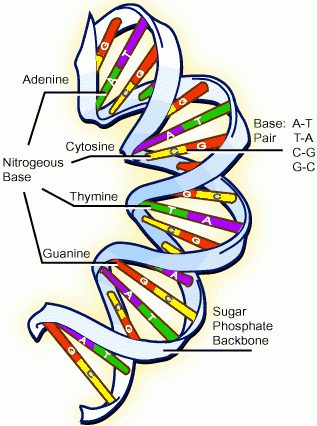
How to make proteins is our first question. Proteins are chains: linear sequences of atom-groups, each bonded to the next. A protein molecule is based on a chain of amino acids; 150 elements is a “modest-sized” chain; the average is 250. Each link is chosen, ordinarily, from one of 20 amino acids. A chain of amino acids is a polypeptide—“peptide” being the type of chemical bond that joins one amino acid to the next. But this chain is only the starting point: chemical forces among the links make parts of the chain twist themselves into helices; others straighten out, and then, sometimes, jackknife repeatedly, like a carpenter’s rule, into flat sheets. Then the whole assemblage folds itself up like a complex sheet of origami paper. And the actual 3-D shape of the resulting molecule is (as I have said) important.

Imagine a 150-element protein as a chain of 150 beads, each bead chosen from 20 varieties. But: only certain chains will work. Only certain bead combinations will form themselves into stable, useful, well-shaped proteins.

So how hard is it to build a useful, well-shaped protein? Can you throw a bunch of amino acids together and assume that you will get something good? Or must you choose each element of the chain with painstaking care? It happens to be very hard to choose the right beads.

Gelernter decides to spot the Darwinist a random sequence of 150 elements. Now the task the Darwinist is to use random mutation to arrive at a sequence of 150 links that has biological function.

[W]hat are the chances that a random 150-link sequence will create such a protein? Nonsense sequences are essentially random. Mutations are random. Make random changes to a random sequence and you get another random sequence. So, close your eyes, make 150 random choices from your 20 bead boxes and string up your beads in the order in which you chose them. What are the odds that you will come up with a useful new protein?

[…]The total count of possible 150-link chains, where each link is chosen separately from 20 amino acids, is 20150. In other words, many. 20150 roughly equals 10195, and there are only 1080 atoms in the universe.

What proportion of these many polypeptides are useful proteins? Douglas Axe did a series of experiments to estimate how many 150-long chains are capable of stable folds—of reaching the final step in the protein-creation process (the folding) and of holding their shapes long enough to be useful. (Axe is a distinguished biologist with five-star breeding: he was a graduate student at Caltech, then joined the Centre for Protein Engineering at Cambridge. The biologists whose work Meyer discusses are mainly first-rate Establishment scientists.) He estimated that, of all 150-link amino acid sequences, 1 in 1074 will be capable of folding into a stable protein. To say that your chances are 1 in 1074 is no different, in practice, from saying that they are zero. It’s not surprising that your chances of hitting a stable protein that performs some useful function, and might therefore play a part in evolution, are even smaller. Axe puts them at 1 in 1077.

In other words: immense is so big, and tiny is so small, that neo-Darwinian evolution is—so far—a dead loss. Try to mutate your way from 150 links of gibberish to a working, useful protein and you are guaranteed to fail. Try it with ten mutations, a thousand, a million—you fail. The odds bury you. It can’t be done.

Keep in mind that you need many, many proteins in order to have even a simple living cell. (And that’s not even considering the problem of organizing the proteins into a system).

So, if you’re a naturalist, then your only resources to explain the origin of life are chance and mutation. As Dr. Gelernter shows, naturalistic explanations won’t work to solve even part of the problem. Not even with a long period of time.  Not even if you use the entire universe as one big primordial soup, and keep trying sequences for the history of the universe. It just isn’t possible to arrive at sequences that have biological function in the time available, using the resources available. The only viable explanation is that there is a computer scientist who wrote the code without using trial and error. Something that ordinary software engineers like myself and Dr. Gelernter do all the time. We know what kind of cause is adequate to explain functioning code.

I’m learning about Bernie Sanders from his employees and supporters

This Bernie Sanders supporter shot Republican Congressmen at a baseball game

One way to learn about a political candidate is by looking at the kinds of people who work for them. Candidates don’t say anything in their campaign speeches or campaign ads that might hurt their chances of being elected. But if you listen to their employees, and look at the actions of their employees, you can find out where they stand. Let’s look at two employees of Bernie Sanders.

Here is the latest reported by the Daily Wire:

A far-left campaign staffer for 2020 Democratic Party presidential candidate Sen. Bernie Sanders (I-VT) appeared to repeatedly advocate for the use of extreme violence in an undercover video that was released on Tuesday by James O’Keefe’s Project Veritas.

Sanders campaign Iowa field organizer Kyle Jurek was busted making the following statements in a variety of settings:

  • On reaching people that he deems to be “fascists”: “The only thing that works, the only thing that fascists understand is violence. So, the only way you can confront them is with violence.”

  • On what happens if Trump is re-elected: “F***ing cities burn.”

  • On if Trump supporters should be “re-educated”: “I mean, we gotta try, so like, in Nazi Germany after the fall of the Nazi party there was a s**t ton of the populace that was f***ing Nazified. Germany had to spend billions of dollars re-educating their f***ing people to not be Nazis. Like, we’re probably going to have to do the same f***ing thing here. That’s kind of what Bernie’s whole f***ing like, ‘hey, free education for everybody!’ because we’re going to have to teach you to not be a f***ing Nazi.”

  • On Soviet gulags: “There’s a reason Joseph Stalin had gulags, right?”

  • On what will happen if Sanders does not win the Democratic nomination: “If Bernie doesn’t get the nomination or it goes to a second round at the DNC convention, f***ing Milwaukee will burn. It’ll start in Milwaukee and then when they f***ing, and when the police push back on that, other cities will just f***ing [explosion sound and gesture]. … Be ready to be in Milwaukee for the DNC convention. That’s all I’m gonna say. …”

  • On using violence against those who use offensive free speech: “Whatever it takes, and that’s why they’re like ‘oh, anti-fascists are violent,’ it’s because we’re willing to go above and beyond what the law says is acceptable, like oh free speech, yeah like they try to be like ‘oh you’re against free speech’ and no, we’re not against free speech, we’re against f***ing hate speech, and if your speech is something that like these people shouldn’t exist, then I don’t give a f*** if it’s free speech or not, you don’t need, like free speech has repercussions. … Yeah, there are consequences to your f***ing speech, right? And if your speech is calling for the elimination of people based on race, or gender, or religious like for whatever reason, things that people can’t change, then you should expect a f***ing violent reaction and you deserve a violent reaction because that’s just not an acceptable thing. It’s not acceptable.”

  • On wanting to “throw down”: “I’m ready to throw down now. I don’t want to wait and have to wait for f***ing DNC [against] the billionaire class. The f***ing media, pundits. Walk into that MSNBC studios, drag those motherf***ers out by their hair and light them on fire in the streets.”

  • On what will happen to those who oppose Sanders’ agenda: “Well, I’ll tell you what, in Cuba, what did they do to reactionaries? … Do you wants to fight against the revolution? You’re gonna die for it motherf***er.”

And here is the video:

OK, fine. So that’s what the people who work for Bernie Sanders say. But what about their actions? Do they actually put their words into practice in their actions?

The far-left Washington Post explains:

The man suspected of firing dozens of rounds into an Alexandria baseball field Wednesday morning has been identified by federal law enforcement officials as James T. Hodgkinson, 66, of Belleville, Ill.

A Facebook page belonging to a person with the same name includes pictures of Democratic presidential candidate, Bernie Sanders, and rhetoric against President Trump, including a post that reads: “Trump is a Traitor. Trump Has Destroyed Our Democracy. It’s Time to Destroy Trump & Co.”

Now, you might say, “well that’s not what Bernie Sanders believes, that’s just what his employees and supporters believe”. The thing is, Bernie Sanders has been defending communist regimes FOR DECADES, and those regimes kill millions and millions of innocent people. So you really have to look at what Bernie Sanders says about those murderous communist regimes if you want to know what he thinks is an acceptable cost for implementing the communism he admires so much.

Here is a good re-cap about what Bernie Sanders has said in the past about countries that adopted communism:

Naturally, Bernie Sanders is not going to say anything in an election campaign that would cause voters to not vote for him. That’s why it’s important to look at his employees, supporters, and previous statements.

New study: which group of voters correctly answered questions about basic facts?

Let's take a look at some data and learn how the world really works
Let’s take a look at some data and learn how the world really works

The non-partisan web site Just Facts has been cited as an authority by IBM, PBS, Vanderbilt University, the Wall Street Journal, etc. In their latest study, they tested conservative and progressive voters to see which group had reality-based views of education, taxes, healthcare, national debt, pollution, government spending, Social Security, global warming, energy, hunger, and poverty.

Here is what they measured:

The findings are from a nationally representative annual survey commissioned by Just Facts, a non-profit research and educational institute. The survey was conducted by Triton Polling & Research, an academic research firm that used sound methodologies to assess U.S. residents who regularly vote.

While most polls measure public opinion, this unique one measures voters’ knowledge of major issues facing the nation—such as education, taxes, healthcare, national debt, pollution, government spending, Social Security, global warming, energy, and hunger.

I just wanted to list out a few of the questions, so that you would be able to see the topics, and know that the answers are measurable quantities. This is important because we want to know which groups of voters understand just the facts about the world we live in.

Education sample question:

On average across the United States, how much do you think public schools spend per year to educate each classroom of students? Less or more than $150,000 per classroom per year?

Correct Answer: More than $150,000. The average cost to educate a classroom of public school students is about $332,000 per year.

Correct answer given by 36% of all voters, 26% of Democrat voters, 45% of Trump voters, 46% of males, 28% of females, 25% of 18 to 34 year olds, 40% of 35 to 64 year olds, and 33% of 65+ year olds.

Taxes sample question:

On average, who would you say pays a greater portion of their income in federal taxes: The middle class or the upper 1% of income earners?

Correct Answer: The upper 1%. The Congressional Budget Office, the U.S. Treasury, and the Tax Policy Center have all documented that households in the top 1% of income pay an average effective federal tax rate of about 33%, while middle-income households pay about 13%. These tax rates account for nearly all income and federal taxes.

Correct answer given by 18% of all voters, 6% of Democrat voters, 30% of Trump voters, 21% of males, 15% of females, 11% of 18 to 34 year olds, 19% of 35 to 64 year olds, and 19% of 65+ year olds.

Spending sample question:

Do you think the federal government spends more money on social programs, such as Medicare, education, and food stamps—or does the federal government spend more money on national defense, such as the Army, Navy, and missile defense?

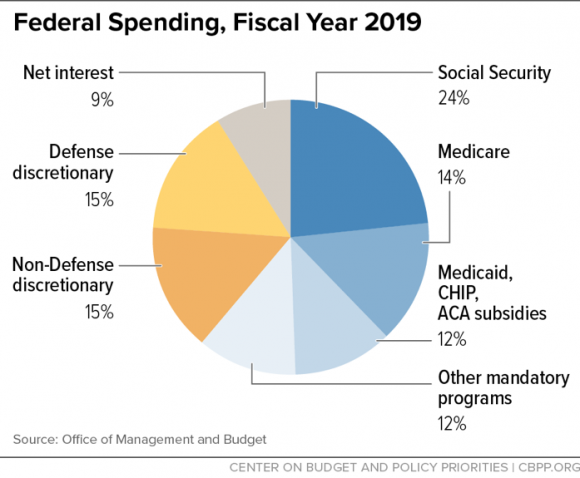
Correct Answer: Social programs. In 2018, 62% of federal spending was for social programs, and 18% was for national defense. In 1960, the opposite was true, and 53% of federal spending was for national defense, while 21% was for social programs.

Correct answer given by 36% of all voters, 14% of Democrat voters, 59% of Trump voters, 40% of males, 33% of females, 23% of 18 to 34 year olds, 36% of 35 to 64 year olds, and 41% of 65+ year olds.

National debt sample question: 

What about federal government debt? The average U.S. household owes about $122,000 in consumer debt, such as mortgages and credit cards. Thinking about all federal government debt broken down to a per household basis, do you think the average federal debt per U.S. household amounts to more or less than the average consumer debt per U.S. household?

Correct Answer: More than $122,000. Federal debt is now $23.1 trillion or about $180,000 for every household in the United States.

Correct answer given by 77% of all voters, 76% of Democrat voters, 81% of Trump voters, 75% of males, 80% of females, 84% of 18 to 34 year olds, 79% of 35 to 64 year olds, and 75% of 65+ year olds.

Global warming sample question: 

Thinking about the whole planet, do you think the number and intensity of hurricanes and tropical storms have generally increased since the 1980s?

Correct Answer: No. Comprehensive global data shows that the number and intensity of cyclones and hurricanes has been roughly level since the 1980s. This data was originally published in the journal Geophysical Research Letters in 2011 and updated this year. Likewise, the Intergovernmental Panel on Climate Change has reported: “There is low confidence in any observed long-term (i.e., 40 years or more) increases in tropical cyclone activity (i.e., intensity, frequency, duration), after accounting for past changes in observing capabilities.” Regional data that extends back for more than century shows the same.

Correct answer given by 32% of all voters, 4% of Democrat voters, 59% of Trump voters, 40% of males, 25% of females, 19% of 18 to 34 year olds, 36% of 35 to 64 year olds, and 30% of 65+ year olds.

Pollution sample question: 

Thinking about the United States, in your opinion, is the air generally more polluted than it was in the 1980s?

Correct Answer: No. EPA data shows that ambient levels of all criteria air pollutants have declined significantly since the 1980s. Criteria air pollutions are those that are deemed by the administrator of the EPA to be widespread and to “cause or contribute to air pollution which may reasonably be anticipated to endanger public health or welfare….” Likewise, combined emissions of hazardous air pollutants have declined by about 50% since the 1990s.

Correct answer given by 56% of all voters, 44% of Democrat voters, 67% of Trump voters, 67% of males, 46% of females, 47% of 18 to 34 year olds, 63% of 35 to 64 year olds, and 49% of 65+ year olds.

Energy sample question: 

Without government subsidies, which of these technologies do you think is the least expensive method for generating electricity? Wind turbines, solar panels, or natural gas power plants?

Correct Answer: Natural gas power plants. Determining the costs of electricity-generating technologies is complex, but data from the U.S. Energy Information Administration shows that natural gas is considerably less expensive than wind, and wind is considerably less expensive than solar.

Correct answer given by 40% of all voters, 23% of Democrat voters, 57% of Trump voters, 53% of males, 29% of females, 25% of 18 to 34 year olds, 43% of 35 to 64 year olds, and 41% of 65+ year olds.

Hunger sample question:

On an average day, what portion of U.S. households with children do you believe will have at least one child who experiences hunger? Less than 1%, 1% to 10%, or more than 10%?

Correct Answer: Less than 1%. Per the latest data from the USDA, 0.14% or less than one out of every 700 U.S. households with children have any child who experiences hunger on an average day. This includes children who are hungry due to poverty, not those who skip meals because they are late for school, don’t feel like eating, or are trying to lose weight.

Correct answer given by 12% of all voters, 2% of Democrat voters, 22% of Trump voters, 15% of males, 9% of females, 3% of 18 to 34 year olds, 12% of 35 to 64 year olds, and 13% of 65+ year olds.

Social Security sample question:

Some policymakers are proposing that individuals be allowed to save and invest some of their Social Security taxes in personal accounts instead of paying these taxes to the Social Security program. In your view, do you think such proposals generally improve or harm the finances of the Social Security program?

Correct Answer: Improve. As shown by analyses conducted by the chief actuary of the Social Security Administration and a bipartisan presidential commission, proposals to give Social Security an element of personal ownership generally strengthen the program’s finances. Although some tax revenues that would have gone to the program instead go to people’s personal retirement accounts, these tax revenues are more than offset by the savings of not paying these individuals full benefits.

Correct answer given by 22% of all voters, 11% of Democrat voters, 33% of Trump voters, 28% of males, 17% of females, 31% of 18 to 34 year olds, 20% of 35 to 64 year olds, and 23% of 65+ year olds.

Health care sample question:

In 2010, Congress passed and President Obama signed the Affordable Care Act, also known as “Obamacare.” This law uses price controls to save money in the Medicare program. Do you think these price controls will worsen Medicare patients’ access to care?

Correct Answer: Yes. As explained by Medicare’s actuaries, the price controls in the Affordable Care Act will cut Medicare prices for many medical services over the next three generations to “less than half of their level under the prior law.” The actuaries have been clear that this will likely cause “withdrawal of providers from the Medicare market” and “severe problems with beneficiary access to care.”

Correct answer given by 50% of all voters, 17% of Democrat voters, 80% of Trump voters, 53% of males, 46% of females, 38% of 18 to 34 year olds, 52% of 35 to 64 year olds, and 49% of 65+ year olds.

Poverty sample question:

Including government benefits and private charity, how much worth of goods and services do the poorest 20% of U.S. households consume on average each year? Less than $20,000, $20,000 to $40,000, or more than $40,000?

Correct Answer: According to the latest government data, the poorest 20% of U.S. households consumed an average of $57,049 of goods and services per household in 2010.

Correct answer given by 13% of all voters, 6% of Democrat voters, 20% of Trump voters, 13% of males, 14% of females, 15% of 18 to 34 year olds, 16% of 35 to 64 year olds, and 9% of 65+ year olds.

You can read the full methodology, references and results.

PLEASE SHARE the article if you liked it. There’s nothing in here to fight about, and no one should be offended.