

Book review of R.C. Sproul’s “If there’s a God, why are there atheists?”

I have a key that will unlock a puzzling mystery

Brian Auten has a book review posted up at Apologetics 315.

The book is “If There’s A God, Why Are There Atheists?”, by theologian R.C. Sproul. R.C. Sproul is one of my favorite theologians. The book in question has a very, very special place in my heart, because I think that it is one of the major reasons why I was able to resist pernicious ideas like religious pluralism and postmodernism for so long. Once you put on the glasses of Romans 1 and see for the first time what man is really doing with respect to God, you can never see things the same again. I’ll say more about this at the end, but let’s see what Brian wrote first.

The review

So often, you hear atheists complaining about religion is nothing but wish-fulfillment or some sort of crutch for people who are frightened by a variety of things. They think that God is invented to solve several problems. 1) how does the world work?, 2) is there meaning to suffering and evil?, 3) why should I be moral?, and 4) what will happen to me and my loved ones when I die?. On the atheistic view, God is just a crutch that people cling to out of weakness and ignorance. But is this really the case?

Sproul starts the book by investigating three atheists who sought to explain religious belief as a result of psychological factors.

Brian writes:

Before tackling the psychology of atheism, Sproul spends a chapter on the psychology of theism, from the perspective of Freud’s question “If there is no God, why is there religion?”11 What follows is an overview of various psychological explanations of theistic belief: Feuerbach’s “religion is a dream of the human mind.”12 Marx’s belief that religion is “due to the devious imagination of particular segment of mankind.”13 And Nietzche’s idea that “religion endures because weak men need it.”14 The author properly reiterates: “We must be careful to note that the above arguments can never be used as proof for the nonexistence of God. They can be useful for atheists who hear theists state that the only possible explanation for religion is the existence of God.”15 That being said, Sproul also reveals what these arguments presume:

Their arguments already presupposed the nonexistence of God. They were not dealing with the question, Is there a God? They were dealing with the question, Since there is no God, why is there religion?16

Sproul points out the weaknesses of each of these approaches and says “there are just as many arguments showing that unbelief has its roots in the psychological needs of man.”

Wow, could that really be true? What are the real reasons why people reject God? Does the Bible have anything to say about what those reasons are?

Brian cites Sproul’s contention:

The New Testament maintains that unbelief is generated not so much by intellectual causes as by moral and psychological ones. The problem is not that there is insufficient evidence to convince rational beings that there is a God, but that rational beings have a natural hostility to the being of God.

[…]Man’s desire is not that the omnipotent, personal Judeo-Christian God exist, but that He not exist.

In Romans 1:18-23, the apostle Paul explains what is really going on:

18The wrath of God is being revealed from heaven against all the godlessness and wickedness of men who suppress the truth by their wickedness,

19since what may be known about God is plain to them, because God has made it plain to them.

20For since the creation of the world God’s invisible qualities—his eternal power and divine nature—have been clearly seen, being understood from what has been made, so that men are without excuse.

21For although they knew God, they neither glorified him as God nor gave thanks to him, but their thinking became futile and their foolish hearts were darkened.

22Although they claimed to be wise, they became fools

23and exchanged the glory of the immortal God for images made to look like mortal man and birds and animals and reptiles.

On this blog, I regularly present many, many arguments for theism in general, and Christian theism in particular:

Sproul explains why atheists cannot allow themselves to live according to the evidence that is presented to them:

The cumulative effect of this knowledge that is clearly seen is to leave men ‘without excuse.’ Herein lies the basis of the universal guilt of man. No one can claim ignorance of the knowledge of God. No one can cite insufficient evidence for not believing in God. Though people are not persuaded by the evidence, this does not indicate an insufficiency in the evidence, but rather an insufficiency in man.

[…]The basic stages of man’s reaction to God can be formulated by means of the categories of trauma, repression, and substitution.

[…]If God exists, man cannot be a law unto himself. If God exists, man’s will-to-power is destined to run head-on into the will of God.

And this is the force that is animating atheists today. They don’t want to be accountable to God in a relationship, no matter what the evidence is. They have to deny it, so that they can be free to get the benefits of a universe designed for them, without having to give any recognition or acknowledgement back. If they have to lie to themselves to deny the evidence, they will do it. Anything to insulate themselves from the Creator and Designer who reveals himself in Jesus Christ.

The rest of the book review, and the book, deals with explaining in detail how atheists respond to an all-good, all-powerful, all-knowing Creator/Designer. I encourage you to click through and read the whole book review. You can read the review, and the book, and then investigate for yourself whether atheists really are like that.

My survey of atheists

By the way, did you all see my survey of atheists that I did a while back? It’s relevant because one of the questions I asked to my volunteers was “How you begin to follow Christ if it suddenly became clear to you that Christianity was objectively true?”. I got some very strange responses that dovetail nicely with Sproul’s book.

Here are a few of the responses:

  • I would not follow. My own goals are all that I have, and all that I would continue to have in that unlikely situation. I would not yield my autonomy to anyone no matter what their authority to command me.
  • I would not follow, because God doesn’t want humans to act any particular way, and he doesn’t care what we do.
  • I would not follow. Head is spinning. Would go to physician to find out if hallucinating.
  • I hope I would be courageous enough to dedicate my life to rebellion against God.
  • I would not have to change anything unless forced to and all that would change is my actions not my values.  I would certainly balk at someone trying to force me to change my behavior as would you if you were at the mercy of a moral objectivist who felt that all moral goodness is codified in the Koran.
  • He would have to convince me that what he wants for me is what I want for me.

This is all part of my series discussing whether morality is rationally grounded by atheism.

Well Spent Journey did a similar survey of atheists, inspired by mine, and got this result on the relevant question:

12. How would you begin to follow Jesus if it became clear to you that Christianity was true?

– Would follow (5)
– Wouldn’t follow (6)
– Might follow the teachings of Jesus, but that isn’t Christianity (2)
– It would depend on how this truth was revealed (3)
– Christianity can’t be true (3)
– No answer given (4)

…What would be the hardest adjustment you would have to make to live a faithful, public Christian life?

– Adjusting wouldn’t be that difficult; would eagerly welcome knowing that Christianity was true (2)
– Praying, since it seems weird, creepy, and strange
– Trying to figure out how the Bible became so corrupted

– Trying to convince myself that the God of the Bible is deserving of worship (2)
– Don’t think it would be possible to adjust

– No clear response, or not applicable (16)

Yes, they really think like that! Just ask an atheist questions and you’ll see how “objective” they really are. Atheism is entirely psychological. It’s adopted in order to feel sufficient and to operate with autonomy, with the goal of self-centered pleasure-seeking above all. Evidence has nothing to do with it.
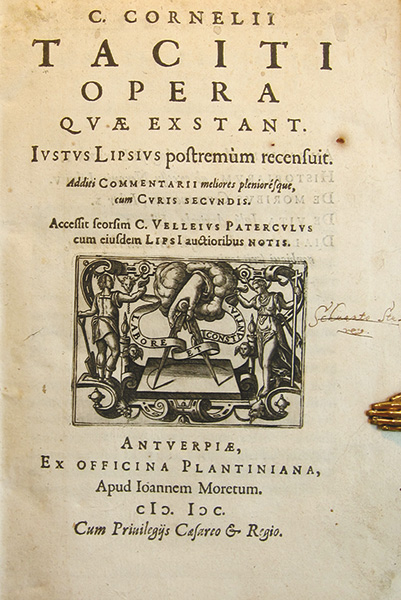

What do ancient non-Christian sources tell us about the historical Jesus?

The Annals, by Roman historian Tacitus

This article from Biblical Archaeology covers all the non-Christian historical sources that discuss Jesus.

About the author:

Lawrence Mykytiuk is associate professor of library science and the history librarian at Purdue University. He holds a Ph.D. in Hebrew and Semitic Studies and is the author of the book Identifying Biblical Persons in Northwest Semitic Inscriptions of 1200–539 B.C.E. (Atlanta: Society of Biblical Literature, 2004).

Here are the major sections:

  • Roman historian Tacitus
  • Jewish historian Josephus
  • Greek satirist Lucian of Samosata
  • Platonist philosopher Celsus
  • Roman governor Pliny the Younger
  • Roman historian Suetonius
  • Roman prisoner Mara bar Serapion

And this useful excerpt captures the broad facts about Jesus that we get from just the first two sources:

We can learn quite a bit about Jesus from Tacitus and Josephus, two famous historians who were not Christian. Almost all the following statements about Jesus, which are asserted in the New Testament, are corroborated or confirmed by the relevant passages in Tacitus and Josephus. These independent historical sources—one a non-Christian Roman and the other Jewish—confirm what we are told in the Gospels:31

1. He existed as a man. The historian Josephus grew up in a priestly family in first-century Palestine and wrote only decades after Jesus’ death. Jesus’ known associates, such as Jesus’ brother James, were his contemporaries. The historical and cultural context was second nature to Josephus. “If any Jewish writer were ever in a position to know about the non-existence of Jesus, it would have been Josephus. His implicit affirmation of the existence of Jesus has been, and still is, the most significant obstacle for those who argue that the extra-Biblical evidence is not probative on this point,” Robert Van Voorst observes.32 And Tacitus was careful enough not to report real executions of nonexistent people.

2. His personal name was Jesus, as Josephus informs us.

3. He was called Christos in Greek, which is a translation of the Hebrew word Messiah, both of which mean “anointed” or “(the) anointed one,” as Josephus states and Tacitus implies, unaware, by reporting, as Romans thought, that his name was Christus.

4. He had a brother named James (Jacob), as Josephus reports.

5. He won over both Jews and “Greeks” (i.e., Gentiles of Hellenistic culture), according to Josephus, although it is anachronistic to say that they were “many” at the end of his life. Large growth
in the number of Jesus’ actual followers came only after his death.

6. Jewish leaders of the day expressed unfavorable opinions about him, at least according to some versions of the Testimonium Flavianum.

7. Pilate rendered the decision that he should be executed, as both Tacitus and Josephus state.

8. His execution was specifically by crucifixion, according to Josephus.

9. He was executed during Pontius Pilate’s governorship over Judea (26–36 C.E.), as Josephus implies and Tacitus states, adding that it was during Tiberius’s reign.

Some of Jesus’ followers did not abandon their personal loyalty to him even after his crucifixion but submitted to his teaching. They believed that Jesus later appeared to them alive in accordance with prophecies, most likely those found in the Hebrew Bible. A well-attested link between Jesus and Christians is that Christ, as a term used to identify Jesus, became the basis of the term used to identify his followers: Christians. The Christian movement began in Judea, according to Tacitus. Josephus observes that it continued during the first century. Tacitus deplores the fact that during the second century it had spread as far as Rome.

I remember reading the 1996 book by Gary Habermas entitled “The Historical Jesus: Ancient Evidence for the Life of Christ“. This book is a little before the time of most of you young Christian apologists, but back before the time of Lee Strobel and J. Warner Wallace, this is the stuff we all read. Anyway, in the book he makes a list of all that can be known about Jesus from external sources. And fortunately for you, you don’t have to buy the book because you can read chapter 9 of it right on his web site.

From Tacitus he gets this:

From this report we can learn several facts, both explicit and implicit, concerning Christ and the Christians who lived in Rome in the 60s A.D. Chronologically, we may ascertain the following information.

(1) Christians were named for their founder, Christus (from the Latin), (2) who was put to death by the Roman procurator Pontius Pilatus (also Latin), (3) during the reign of emperor Tiberius (14 37 A.D.). (4) His death ended the “superstition” for a short time, (5) but it broke out again, (6) especially in Judaea, where the teaching had its origin.

(7) His followers carried his doctrine to Rome. (8) When the great fire destroyed a large part of the city during the reign of Nero (54 68 A.D.), the emperor placed the blame on the Christians who lived in Rome. (9) Tacitus reports that this group was hated for their abominations. (10) These Christians were arrested after pleading guilty, (11) and many were convicted for “hatred for mankind.” (12) They were mocked and (13) then tortured, including being “nailed to crosses” or burnt to death. (14) Because of these actions, the people had compassion on the Christians. (15) Tacitus therefore concluded that such punishments were not for the public good but were simply “to glut one man’s cruelty.”

And from Josephus he gets this:

(1) Jesus was known as a wise and virtuous man, one recognized for his good conduct. (2) He had many disciples, both Jews and Gentiles. (3) Pilate condemned him to die, (4) with crucifixion explicitly being mentioned as the mode. (5) The disciples reported that Jesus had risen from the dead and (6) that he had appeared to them on the third day after his crucifixion. (7) Consequently, the disciples continued to proclaim his teachings. (8) Perhaps Jesus was the Messiah concerning whom the Old Testament prophets spoke and predicted wonders. We would add here two facts from Josephus’ earlier quotation as well. (9) Jesus was the brother of James and (10) was called the messiah by some.

So when you are reading the New Testament, these facts are the framework that you read within. It’s a good starting point when dealing with people who have never looked into who Jesus was and what he taught and what his followers believed about him, right from the start.

Unmarried 35-year-old woman reflects on her adventurous life of fun, travel and serial cohabitation

Telling a woman how to make wise decisions protects her

I found an interesting article featuring a 35-year-old woman who is alarmed that her approach to life has left her in debt and single, with a gap-filled resume of short-term jobs. I thought it might be useful for young women to read this, and consider whether making “rash” decisions and being “adventurous” works out.

She writes:

I feel like a ghost. I’m a 35-year-old woman, and I have nothing to show for it. My 20s and early 30s have been a twisting crisscross of moves all over the West Coast, a couple of brief stints abroad, multiple jobs in a mediocre role with no real upward track. I was also the poster child for serial monogamy. My most hopeful and longest lasting relationship (three and a half years, whoopee) ended two years ago. We moved to a new town (my fourth new city), created a home together, and then nose-dived into a traumatic breakup that launched me to my fifth and current city and who-knows-what-number job.

Rash decisions, adventure, exploring…. and lots of debt:

For all these years of quick changes and rash decisions, which I once rationalized as adventurous, exploratory, and living an “original life,” I have nothing to show for it. I have no wealth, and I’m now saddled with enough debt from all of my moves, poor decisions, and lack of career drive that I may never be able to retire. I have no career milestones and don’t care for my line of work all that much anyway, but now it’s my lifeline, as I only have enough savings to buy a hotel room for two nights.

No STEM degree, which means she doesn’t like to study hard things that can be tested against the real world for correctness:

I used to consider myself creative — a good writer, poetic, passionate, curious. Now, after many years of demanding yet uninspiring jobs, multiple heartbreaks, move after move, financial woes, I’m quite frankly exhausted.

Surprised by aging and poor health:

Also, within the past year I’ve had a breast-cancer scare and required surgery on my uterus due to a fertility issue. On top of that, I’m 35 and every gyno and women’s-health website this side of the Mississippi is telling me my fertility is dropping faster than a piano falling out of the sky. Now I’m looking into freezing my eggs, adding to my never-ending financial burden, in hopes of possibly making something of this haunted house and having a family someday with a no-named man.

She’s still trying to be the sexpot 25-year-old she used to be:

I’m dating. I’m working out and working hard. Listening to music I enjoy and loving my cat. Calling my mom…. I’m drinking too much… And with men I date, I feel pressure to make something of the relationship too soon (move in, get married, “I have to have kids in a couple of years”; fun times!). All the while still trying to be the sexpot 25-year-old I thought I was until what seemed like a moment ago.

But her plan hasn’t worked out:

I used to think I was the one who had it all figured out. Adventurous life in the city! Traveling the world! Making memories! Now I feel incredibly hollow. And foolish. How can I make a future for myself that I can get excited about out of these wasted years?  What reserves or identity can I draw from when I feel like I’ve accrued nothing up to this point with my life choices?

Well, I’ve known women like this, and I think we’re going to see more and more women like this as the society becomes more secular and feminist. I want to say something about whether she is sincere about wanting to get married and have children, and what women should do to avoid ending up like her.

Do women today understand male nature and marriage?

This woman’s demonstrated life plan is that she chose whatever made her feel good from age 18-35+, and now wants to enter into a marriage some time after age 35. And what does marriage mean to her? Has she prioritized entering the traditional roles of wife and mother? Don’t listen to her words. Look at her actions. Her actions show that marriage and children were of NO importance to her. And her current approach to getting married and having kids is the same as ever – work out in order to look hot, and try to coerce a man who signs up for recreational sex with no commitment into becoming a man who makes a life-long commitment to provide for her and her children (which is the opposite of what he signed up for). She wants marriage now for the same reason that she’s wanted anything: for fun, thrills, adventure and to keep up with her girlfriends who are already married.

What kind of man should she have been pursuing from age 18 to 35, if she really wanted marriage and children? Well, the first thing to realize is that not all men want marriage. And the next thing to realize is that women who are serious about marriage need to focus ONLY on men who want to marry. All the men that the women quoted above wanted in her youth didn’t want to marry. They wanted premarital recreational sex with her, and that was fine with her – she chose them, and disregarded the men who were interested in marriage.

A man who was interested in marrying her would have:

  • ….told her no to sex before marriage (because the more sexual partners a woman has, the less happy she will be in marriage, and the more unstable her marriage will be).
  • …led her to become better at being a wife and mother, by discouraging her thrill-seeking, traveling and wasteful spending, and instead encouraging her focus on a STEM education, career and getting debt-free.
  • …led her to develop a Christian worldview in which she would understand the importance of marriage and children, and learn to sacrifice her own interests to love and care for others.

Was she interested in getting ready for marriage? No. She never chose those marriage-minded men. She didn’t want to be a wife. The men she chose were chosen for fun, for thrills, and to show off their outward appearance to her girlfriends.

So, who are the men in this group of marriage-minded men? How do you recognize them? Marriage-minded men are interested in marriage because they want to lead a home. They will have invested a lot of time learning how to protect others, how to provide, and how to debate and lead on moral and spiritual issues. Marriage-minded men see the marriage enterprise as a way of advancing the causes that they care about most. Women who really want to get married will recognize those men, and pursue those men. And they’ll do it early, so that they can invest in their husbands early and be young enough to have children.