A few weeks ago, I did a podcast on Tim Stratton’s show where I explained some of the reasons why America has been a good place for me as a non-white conservative. I also explained some of the decisions I made in order to succeed. Democrats don’t emphasize the goodness of America, or the importance of making good decisions in order to succeed. But Republicans do.
Just The News reports on the speech by Senator Tim Scott, a black Republican from the state of South Carolina:
“Our side is working on policy, while Joe Biden’s radical Democrats are trying to permanently transform what it means to be an American,” Scott said. “If we let them, they will turn our country into a socialist utopia, and history taught us that path only leads to pain and misery,” said Scott, “We must focus on the promise of the American journey.”
“We don’t give into cancel-culture, or the radical – and factually baseless – belief that things are worse today than in the 1860s or the 1960s,” he continued.
Scott spoke about how an early mentor in his life taught him valuable lessons about how, with hard work, he could improve not just his own standing in the world, but his community’s.
“He planted the seeds of what would become Opportunity Zones,” he said.
He called the American education system “magic,” for the opportunities it presents to all children, and reaffirmed his and the president’s support for school choice, “to make sure every child, in every neighborhood has a quality education.”
He spoke about how being the owner of a successful small business taught him to value a tax code that encourages growth. And he spoke about winning his first congressional primary against the son of Strom Thurmond, famed senator of South Carolina and notorious segregationist.
“Because of the evolution of the heart, in an overwhelmingly white district, the voters judged me on the content of my character, not the color of my skin,” Scott said.
[…]Throughout his speech, Scott stressed the progress that America has made and will continue to make. He said that despite living in “a world that only wants to you believe in the bad news, the truth is, our nation’s arc always bends back towards fairness.”
The senator closed by reaffirming his belief in the hope that America represents for its citizens, and represented for him personally.
“Our family went from Cotton to Congress in one lifetime. And that’s why I believe the next American century can be better than the last,” Scott said.
The full speech is here:
There were some other interesting events during the first night of the GOP Convention.
The Federalist reported on one speech that was considered very moving, and might have been the best speech of the night:
Maximo Alvarez, a successful American businessman who fled the communist regime of Cuba’s Fidel Castro, offered a powerful testimony Monday in support of President Donald Trump. Alvarez warned Americans of the alternative presented by the Democrats nomination of the most progressive ticket in recent memory.
“I’m speaking to you today because I’ve seen people like this before,” Alvarez told the convention. “I’ve seen movements like this before. I’ve seen ideas like this before and I’m here to tell you, we cannot let them take over our country.”
Throughout the seven-minute speech delivered on the first night of the Republican National Convention, Alvarez shared his family’s story fleeing the oppressive regime just 100 miles off Florida’s coast.
“I’ve heard the promises of Fidel Castro, and I cannot forget those who grew up around me, who looked like me, who suffered, and starved, and died because they believed those empty promises. They swallowed the communist poison pill,” he said.
“By the grace of God, I lived the American dream, the greatest blessing I ever had,” said Alvarez, who now serves as the president of Sunshine Gasoline Distributors. “My dad, who only had a 6th grade education told me, ‘Don’t leave this place. You will never be as lucky as me … There is no place to hide.’”
The video is here:
I hope that as the election nears, that you have a plan to do something to encourage people to vote Republican. We can’t afford to lose this election because we didn’t think it was our job to do something. At the very least, you should be sharing articles by e-mail and on social media. But it’s a good idea to contact your local GOP office and find out what you can do to help. Lawn signs, bumper stickers, donations, etc. are all positive steps to winning the election. If we stand by now, and the Democrats win, things will get a lot worse for us.
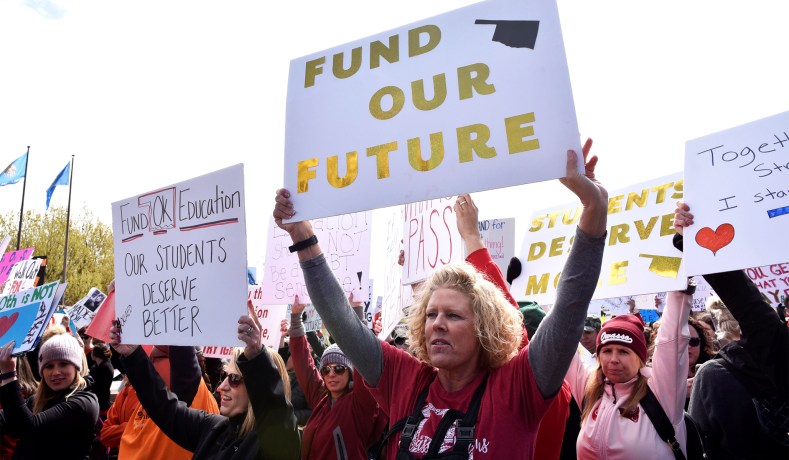
When I want a raise, I work harder, but teachers have a different approach
One of my friends has been having a debate with one of his former teachers about whether spending more money on government-run education improves tests scores. He tried posting some evidence, but she just dismissed that by claiming:
If we hadn’t spent more money, then the student test scores would have gone down instead of staying the same.
Most of the money that government spends on education goes to vouchers and private schools, not public schools
Economists at prestigious think tanks like that Cato Institute, the Heritage Foundation, and the American Enterprise Institute cannot be trusted to accurately cite the Bureau of Labor Statistics and the National Center for Education Statistics because of the Koch Brothers
You can’t compare the test scores of American students with the test scores of Asian students who outperform them, (for less government spending), because math is different in Asia compared to America
Let’s look at some data and see if her arguments are correct.
Does more spending mean higher student performance?
Comparing educational achievement with per-pupil spending among states also calls into question the value of increasing expenditures. While high-spending Massachusetts had the nation’s highest proficiency scores on the National Assessment of Educational Progress, low-spending Idaho did very well, too. South Dakota ranks 42nd in per-pupil expenditures but eighth in math performance and ninth in reading. The District of Columbia, meanwhile, with the nation’s highest per-pupil expenditures ($15,511 in 2007), scores dead last in achievement.
The student test scores are dead last, but National Review notes that “according to the National Center for Education Statistics, Washington, D.C. was spending an average of $27,460 per pupil in 2014, the most recent year for which data are available.” They are spending the most per-pupil, but their test scores are dead last.
CBS News reported on another recent study confirming this:
Decades of increased taxpayer spending per student in U.S. public schools has not improved student or school outcomes from that education, and a new study finds that throwing money at the system is simply not tied to academic improvements.
The study from the CATO Institute shows that American student performance has remained poor, and has actually declined in mathematics and verbal skills, despite per-student spending tripling nationwide over the same 40-year period.
“The takeaway from this study is that what we’ve done over the past 40 years hasn’t worked,” Andrew Coulson, director of the Center For Educational Freedom at the CATO Institute, told Watchdog.org. “The average performance change nationwide has declined 3 percent in mathematical and verbal skills. Moreover, there’s been no relationship, effectively, between spending and academic outcomes.”
The study, “State Education Trends: Academic Performance and Spending over the Past 40 Years,” analyzed how billions of increased taxpayer dollars, combined with the number of school employees nearly doubling since 1970, to produce stagnant or declining academic results.
“The performance of 17-year-olds has been essentially stagnant across all subjects despite a near tripling of the inflation-adjusted cost of putting a child through the K-12 system,” writes Coulson.
Where did the numbers come from? The Koch Brothers? No:
Data from the U.S. Department of Education incorporating public school costs, number of employees, student enrollment and SAT scores was analyzed to explore the disparity between increased spending and decreasing or stagnant academic results.
Well, at least government-run monopoly schools outperform private private schools, right? No:
[…][P]rivate schools, where students excel over public school peers, …manage to operate at budgets about 34 percent lower than taxpayer-funded schools, US Finance Post reports.
Public schools spend, on average, $11,000 per student, per year.
Coulson noted an Arizona study he conducted which showed that the average per-pupil spending at private schools was only about 66 percent of the cost of public schools.
When it comes to math, U.S. high school students are falling further behind their international counterparts, according to results released Tuesday of an ongoing study that compares academic achievement in 73 countries. And the news is not much better in reading and science literacy, where U.S. high schoolers have not gained any ground and continue to trail students in a slew of developed countries around the globe.
In the latest Program for International Student Assessment (PISA) measuring math literacy in 2015, U.S. students ranked 40th in the world. The U.S. average math score of 470 represents the second decline in the past two assessments — down from 482 in 2012 and 488 in 2009. The U.S. score in 2015 was 23 points lower than the average of all of the nations taking part in the survey.
More money is being spent, but the scores are DECREASING.
Now, why is it that increased government spending in the public school monopoly doesn’t improve student performance? Well, one reason is that very little of the money makes it to the classroom.
Where does all the money go?
Let’s look at four places where the money spent on the government-run public school monopoly ends up.
Administration
First, a lot of it gets paid to administrations who implement politically correct programs designed to turn the impressionable young people into little secular socialists.
Where does taxpayer money spent on the public school monopoly go?
I guess if a school wants to make things like Planned Parenthood sex education and LGBT indoctrination into priorities, then they would need more administrators.
Pensions
Second, education employees get enormous pensions, which are paid by taxpayers and negotiated by their unions. You would never see pensions this large in the private sector.
This figure shows we now spend nearly $1,100 per student on retirement benefits. The average public school student teacher ratio is 16 to 1. So we are spending about $17,000 per year per teacher in pension contributions.
[…]The National Council on Teacher Quality writes,
In 2014 teacher pension systems had a total of a half trillion dollars in unfunded liabilities—a debt load that climbed more than $100 billion in just the last two years. Across the states, an average of 70 cents of every dollar contributed to state teacher pension systems goes toward paying off the ever-increasing pension debt, not to future teacher benefits (p. iii).
While we are spending a huge amount to fund teacher pensions, most of that spending doesn’t go to attracting the best teachers. It’s paying off past debts.
We can’t hire good teachers, because all the education spending of today is paying for the gold-plated pensions of yesterday.
That was 2014. The numbers are even worse today. Teachers contribute very, very little to their pensions, but the benefits are enormous compared to what the private sector taxpayers get in Social Security. (Which is going to be bankrupt by 2034, as reported by the far-left PBS)
Teacher training
Third, a lot of it is spent on teacher training, because apparently teaching multiplication, Shakespeare or geography changes every year, so the teachers need tens of thousands of dollars in annual training.
A new study of 10,000 teachers found that professional development — the teacher workshops and training that cost taxpayers billions of dollars each year — is largely a waste.
The study released Tuesday by TNTP, a nonprofit organization, found no evidence that any particular approach or amount of professional development consistently helps teachers improve in the classroom.
[…]The school districts that participated in the study spent an average of $18,000 per teacher annually on professional development. Based on that figure, TNTP estimates that the 50 largest school districts spend an estimated $8 billion on teacher development annually. That is far larger than previous estimates.
And teachers spend a good deal of time in training, the study found. The 10,000 teachers surveyed were in training an average of 19 school days a year, or almost 10 percent of a typical school year, according to TNTP.
Maybe if more of the money spent on education were spent directly on hiring teachers, then we would see an improvement. Unfortunately, a lot of the money meant for teachers goes to the teacher unions. How do they spend that money?
Political Contributions
Finally, this is from OpenSecrets.org, concerning political contributions made in the most recent election cycle:
Top Political Contributors in 2016 election cycle
The two largest teacher unions came in at #9 and #11. Most of their donations go to Democrat Party. Democrats believe (against the evidence) that spending more money in the government-run public school monopoly will improve student performance on tests.
So, what’s the solution?
The solution is that we abolish the federal Department of Education, which has done nothing to improve the quality of education for students. We need to push the education of children back down to the state and local levels. We need to empower parents to choose the schools that work best for their children by giving parents vouchers. We need to increase tax-free education savings accounts to help parents with school expenses. We should also give free college tuition to homeschooled students who are admitted to STEM programs at any college or university. We can take the money from the pensions of the union administrators, after we abolish ever single public sector teacher union in the country, and seize all their assets and pensions. If that’s not enough money, then we can seize all the pensions of Department of Education employees – a just punishment for their failure to produce results while still taking taxpayer money.
Finally, we should allow people who already have private sector experience doing things like STEM to become teachers. Let’s face it: the departments that grant Education degrees have the lowest entrance requirements, and produce the least competent adults. People with years of private sector work experience teach better than people with Education degrees. Let’s open up teaching to people who have experience in the private sector doing software engineering, statistics, nursing, etc. and then we’ll have qualified teachers.
I have some experience dicussing Islam because my mother’s side of the family is all Muslim. My go-to argument has always been to confront them about the Qur’an’s claim that Jesus did not die of crucifixion. But I noticed a different argument from Laura Powell, who knows far more about this topic than I do. Do you think her approach is the best one?
The crux of the argument is this: The Qur’an affirms the inspiration, authority, and preservation of the New Testament Gospels;[2] yet the Qur’an also contradicts the Gospels on major theological and historical points. Therefore, the Qur’an cannot be reliable.
According to the Qur’an, the Gospel is the trustworthy, reliable revelation of God given as a guidance for mankind (Qur’an 3:3-4). These Scriptures from God were available and trustworthy when the Qur’an was revealed in the 7th century A.D., and those who had access to them were repeatedly told to obey them, judge by them, submit to their teaching, and stand fast upon them. In other words, according to the Qur’an, the Gospels are the inspired and authoritative words of God.
Qur’an 5:47 says, “And let the People of the Gospel judge by what Allah has revealed therein. And whoever does not judge by what Allah has revealed—then it is those who are the defiantly disobedient.”
Furthermore, Qur’an 5:68 states, “Say, ‘O People of the Scripture, you are [standing] on nothing until you uphold [the law of] the Torah, the Gospel, and what has been revealed to you from your Lord’” (see also 6:114; 3:3-4).
What I like about her argument is that she’s just taking the words of the Qur’an seriously, and asking the Muslims who claim to believe it what’s going on here. Why say that the gospels are unreliable today, when the Qur’an said that the gospels were reliable, yesterday.
My argument about the death of Jesus requires us to ask Muslims “where is the non-Muslim historian who thinks that Jesus did not die?” There isn’t one.
But my argument requires that the Muslim know something about historical scholarship, to know what non-Muslim historians think.Laura’s argument has wider appeal, because it doesn’t require that the Muslim have any knowledge about history – only knowledge about what their own holy book says.
She concludes with this:
What we see here is that the Qur’an teaches the inspiration, authority, and preservation of the Gospels. The Qur’an was intended as an Arabic version of the message of truth found in the Jewish and Christian Scriptures, but this presents a huge problem for Muslims because the Qur’an contradicts the Christian Scriptures on essential doctrines. Most notably, the Qur’an teaches that Jesus was not God incarnate, he did not die on a cross, and he was not raised from the dead (Qur’an 4:157; 5:116).
Here’s the dilemma for Muslims: If the Gospels are not trustworthy, then the Qur’an is false because it teaches that the Gospels are the inspired, perfectly preserved, authoritative words of God. But if the Gospels are trustworthy, then the Qur’an is false because it teaches contradictory, mutually exclusive facts about key issues. Either way, the Qur’an is false.
This, of course, is a huge problem for Muslims. The validity of Islam rests upon the reliability of the Qur’an, just as Christianity rests upon the truth of the divinity, death, and resurrection of Jesus. If the Qur’an is unreliable, then Islam is a false religion.
I like that she’s comfortable having disagreements with people. That’s not very common in the church today, in my experience.
By the way, this is the same Laura who wrote that really good article about how she found a better way to discuss her Christian worldview when she moved on from sharing her testimony. I blogged about it here.