
Should men prefer women who have earned STEM degrees?

A few people have asked me about my policy of preferring candidates for wife and mother who have earned STEM degree(s). In this post, I’ll explain 5 goals for my marriage. Then I’ll explain 6 reasons why a STEM degree helps me to execute that plan. Then I’ll answer 3 objections to the STEM degree requirement. Then I’ll explain the relevance of STEM for a woman’s marriage roles.

What is STEM?

So, to start, STEM is an acronym for Science, Technology, Engineering and Math. A STEM degree is a degree in a STEM field. This includes things like petroleum engineering, bioinformatics, and computer science. But it also includes things like economics, accounting and business. Basically, anything with math that involves solving problems in the real world. Anything that encourages logical reasoning and using evidence to sustain an argument.

My goals for marriage

So, here are my goals for marriage:

  • influence the church with apologetics
  • influence the university campus (students and professors) with apologetics
  • be involved in politics, advocate for conservative policy
  • open the house to students and neighbors to teach apologetics and demonstrate a loving marriage
  • raise 3-4 financially independent and influential children

Everything I want in a wife is related to this plan. I evaluate women according to these goals, because I want my marriage to make a difference for Christ and His Kingdom. I’m flexible on plans and requirements, so long as the proposed changes result in a greater impact for Christ and His Kingdom.
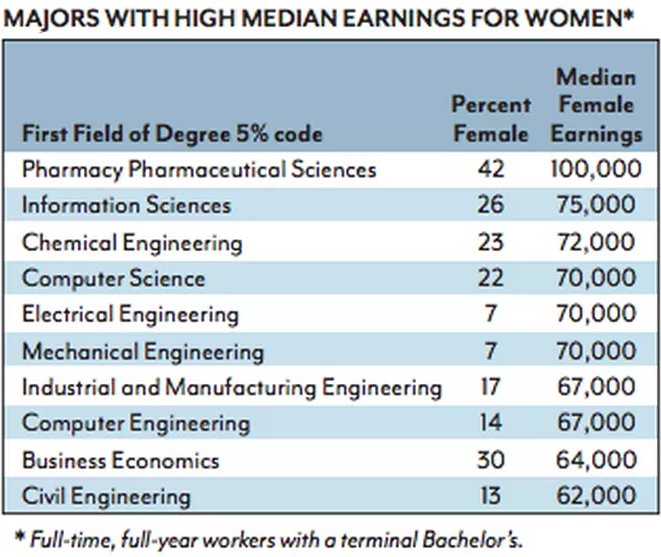
The best majors for women to avoid student loan debt

How a STEM degree relates to marriage

The plan is for my wife to earn a STEM degree, marry me, and work full-time until the first child is born. Then, she stops working and becomes a stay at home mom. She could return to work after the each child reaches 5 years old. My preference is that she not return to work, but instead homeschool the children, or at least monitor their education in private evangelical Christian schools as a stay-at-home mother.

So, how does a woman’s having a STEM degree help me to achieve my marriage plan goals?

Here are 6 ways:

1. STEM equips her to homeschool influential and effective children. A wife who has completed high school and college courses in math, science, engineering and/or technology will know how to either homeschool our kids, or monitor their homework and grades so they achieve good academic results. Think of how Asian families raise high-performing children. I want that.

2. STEM teaches her to produce results in the real world, e.g. – working code that solves a problem, lab results, bridges that support a load, etc. In the lab, decisions cannot be made based on feelings or peer approval. The lab doesn’t respect horoscopes, devotions, romance novels, essentual oils, romantic comedies, “The Secret” or “The Law of Attraction”.

3. STEM equips her to argue apologetics from her experience of using reason, evidence, reality-based testing. All Christians need to know how to defend their core beliefs (God exists, etc.) to non-Christians. That means doing what works. And what works is logical argumentation supported by evidence. The best kind of evidence is scientific evidence. Then historical evidence. Confidence comes from competence at practical, real-world disciplines.

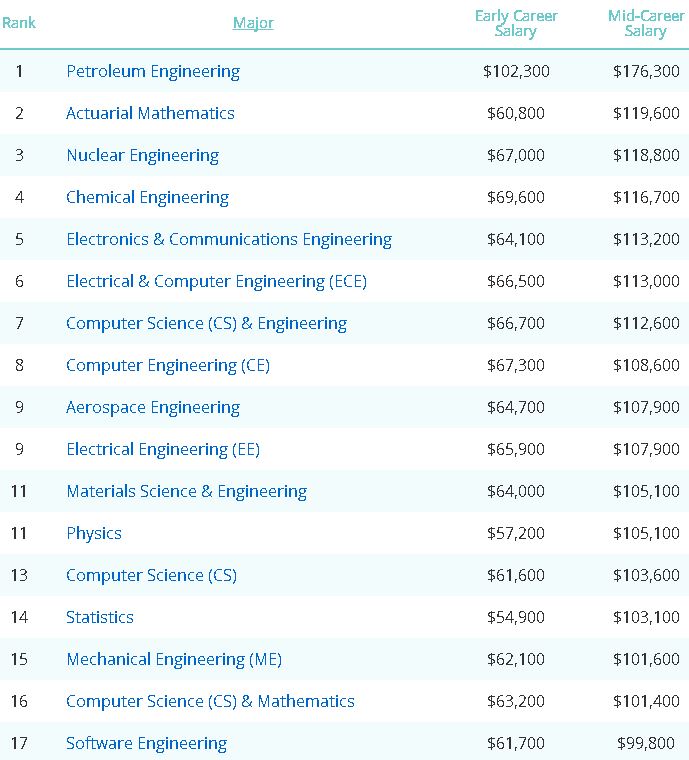
4. STEM degrees are a path to high paying jobs. Women who are debt-free are better to marry, because they don’t delay the process of buying a house and having children. Any kind of debt has to be paid off first. I’m not looking for a big spender, I’m looking for someone who can earn and save. The more children we can afford to have, the bigger our influence will be. Also, women who choose STEM demonstrate that they can delay gratification, and not be a slave to FOMO, YOLO, “living in the moment”, etc.

5. STEM equips women to find work easily, so she doesn’t feel pressured to accept a bad marriage proposal. She can move out and start saving money. She can buy apologetics books, lectures and debates. She can buy books on economics, marriage and parenting. She can prepare herself to attract the right man, and she can evaluate men to see if they are prepared for marriage.

6. Both the STEM departments AND the STEM workplaces less likely to be woke than non-STEM departments and workplaces. She will be able to hold to her convictions more easily in an environment where results matter more than having the “right” (left) opinions.

Objections to preferring a wife with a STEM degree

1. A woman with a STEM degree will not want to quit her job and become a stay at home mom during the critical period from birth to age 2, or even better, age 5.

2. A woman who takes years off for child-bearing and early childhood years will not be able to resume her job at the same level of pay.

3. Even in STEM departments, a woman will be exposed to an environment with secular left indoctrination, drunkenness and promiscuity. She is unlikely to come out of college as a virgin.

Responses to objections to the STEM requirement

Points 1) and 2) apply to every kind of degree, not just STEM. Any woman who does 4 years of college in any field will be “wasting” it if she stops working. First, in my plan, her education is to equip her to educate her children, because I trust her more than any teacher or stranger to do that important job. Teachers are not paid to produce results – they are unionized, and not paid based on performance. Second, even women with STEM degrees would generally prefer to work part-time or not at all. They want to stay with their young children. Third, we don’t need the money. That’s why I suffered through my BS and MS to earn 6 figures and have a 7 figure net worth. We don’t need her to work.

For point 3), I’m not saying that EVERY woman who graduates with a STEM degree is perfect for marriage. I’m saying that a STEM degree helps to have a marriage that is influential for Christ and His Kingdom. I’m open to other majors, so long as they address the concerns and goals I specified. I’m even open to a different plan. But the overriding concern is that the marriage count for something for the Boss. Even with a STEM degree, the man still has to ask the woman questions about politics and parenting. He still has to evaluate her sobriety, chastity and frugality. A STEM degree is just a starting point.

The difference STEM makes for apologetics

I think it’s obvious that having a wife who has taken courses and even worked a few years before the first child arrives helps her to be able to educate her kids and / or monitor their performance. But it also allows her use apologetics more persuasively on the university campus, in the church, and if we open up the home to college students and neighbors for movies / meals / discussions.

For example, take the fine-tuning argument. A knowledge of physics and chemistry helps you to explain why changing the fundamental forces results in a universe that does not support complex, embodied life. A knowledge of probability theory (e.g. – product rule) helps you to argue for intelligent design in the origin of life. And what about logic? Even in computer science, we had to study symbolic logic, the rules of inference, conditional proofs, Bayes’ Theorem, etc.

My wife’s job is to make the big picture of education clear to the kids, so they know what they can do in the real-world with what they are learning. So many Christians underperformed in school because they didn’t know the relevance of what they were learning for the task of defending their Christian worldviews. My wife’s job is to know how the material being taught relates to real-world goals, like defending Christianity. This is how parents produce children who grow up to be William Lane Craig, Stephen C. Meyer, Luke Barnes or Michael Licona. Boldness comes from knowledge.

Conclusion

First, I hope this post convinces women to start planning for their marriages early. You need to know things that matter for two reasons: 1) to attract a quality man, 2) to evaluate men and filter out the good ones. That means you need to know things like apologetics, politics, etc. Having money helps to buy learning material.

Second, I hope this post convinces men to stop choosing women based on youth and beauty. Your choice of wife will have a huge effect on your influence. Choose a capable, competent partner who complements your strengths with different strengths. Men spend their days in the workplace, where we cannot say much about religion and politics. If you marry an intelligent conservative Christian woman, she can be your voice to the university, the church, and the public square. Not to mention raising effective children. Therefore, choose wisely.

Acknowledgements

My wise friend Laura helped me with this post. Please check out her 10-part series for women on how to choose a husband.

Study: non-STEM college programs make students less religious

Lets take a closer look at a puzzle

Why do students turn away from Christianity in college? It might have something to do with what they choose to study.

Rice University reports on a new study conducted by sociologist Elaine Howard Ecklund.

Excerpt:

The public’s view that science and religion can’t work in collaboration is a misconception that stunts progress, according to a new survey of more than 10,000 Americans, scientists and evangelical Protestants. The study by Rice University also found that scientists and the general public are surprisingly similar in their religious practices.

The study, “Religious Understandings of Science (RUS),” was conducted by sociologist Elaine Howard Ecklund and presented today in Chicago during the annual American Association for the Advancement of Science (AAAS) conference. Ecklund is the Autrey Professor of Sociology and director of Rice’s Religion and Public Life Program.

“We found that nearly 50 percent of evangelicals believe that science and religion can work together and support one another,” Ecklund said. “That’s in contrast to the fact that only 38 percent of Americans feel that science and religion can work in collaboration.”

The study also found that 18 percent of scientists attended weekly religious services, compared with 20 percent of the general U.S. population; 15 percent consider themselves very religious (versus 19 percent of the general U.S. population); 13.5 percent read religious texts weekly (compared with 17 percent of the U.S. population); and 19 percent pray several times a day (versus 26 percent of the U.S. population).

[…]RUS is the largest study of American views on religion and science.

Meanwhile, Reasonable Faith has a podcast about the study, and what they discuss is how students who go into non-STEM university programs lose their interest in religion at a much higher rate than people who study STEM.

Here is the MP3 file.

And the relevant portion of the transcript:

DR. CRAIG: Right. If you look at their chart they give, where it shows the changes in religiosity by college major, it shows that in biology, engineering, and physical science and math they were mixed. The overall effect was neither negative nor positive. For some it was positive, some negative. But those majors did not seem to have a very significant effect upon the person’s religious behavior. The majors that had a very positive impact on religiosity were education, vocational or clerical education, business, and what is classified as “other.” All of those majors – whatever those are – have an overall positive impact upon students’ religiosity.

KEVIN HARRIS: And attendance as well – attendance to church services.

DR. CRAIG: Yes.

KEVIN HARRIS: The big fly in the ointment here is that “both the Humanities and the Social Sciences see dramatic declines in attendance and even more in religious beliefs.” It lowers church attendance, synagogue attendance, and even more in religious beliefs. What do we mean by the humanities and the social sciences?

DR. CRAIG: Humanities would include your non-scientific areas; for example, literature (hence the title of the article), politics.[3] I don’t know if they would include economics in this or not. Religious studies. In the social sciences are things like anthropology and sociology would be included there.

KEVIN HARRIS: The study of art?

DR. CRAIG: Yes, I suppose the arts would be in the humanities – that would be music and graphic arts. It is a big, big catch-all category.

And why does Dr. Craig think this is happening?

DR. CRAIG: […]It could well be that it is because it is in the humanities that the radicals of the 1960s were able to find a place in the university and become ensconced as professors with the relativism that they were championing. In areas like anthropology and sociology you find tremendous relativism where you simply study these cultures and societies without making any sort of judgment as to truth with regard to what they believe. This leads to the belief that it is all relative; there isn’t anything that is objectively true. John Searle is a very prominent philosopher at the University of California, Berkeley. Searle says that he believes that because of the commitment to the objectivity of truth and logic and the scientific method the hard sciences were barred to these radicals of the 1960s – getting into them and influencing them. But where they found an opening was in things like the Women’s Studies Department, Religious Studies, Anthropology, Sociology. These soft sciences. He says the professors in these disciplines are the children of the 1960s that have carried into it their relativistic views of truth. I noticed here the conclusion by the researchers of the University of Michigan (apparently who did this study), “Our results suggest that it is Postmodernism, not Science, that is the bête noir [the black beast or the hated thing] of religiosity.” The enemy of religiosity is postmodernism, not science.

KEVIN HARRIS: Postmodernism, as you’ve pointed out, was mainly a thing confined to literature and the soft sciences.

DR. CRAIG: Right. Women’s Studies, Religious Studies is rampant with Postmodernist perspectives. That has a real ring of truth to it, and could be the reason behind these statistics.

And this is why I recommend that people not drop math in high school, and pick a STEM field to study in college (or a trade in trade school). You are wasting your money when you let people in non-STEM areas indoctrinate you in fact-free irrationality. By the way, I love business administration as a major, for those who do not want to do the lab work. It attracts a lot of conservatives and entrepreneurs.

If you’re not worried about your faith, then you should at least be worried about your wallet:

Should you study philosophy?
STEM degrees are good for your finances as well

It’s much easier to have an influence as a Christian if you get your financial house in order. Having a degree that leads to a good paying job is certainly a good way to fund your life plan. Money also helps you to not worry too much about what the secular left can do to you. It’s good for offense and defense, in short.

What should Christians do in order to reduce fatherlessness and abortion?

Last week, I tweeted something that was very popular, although I got some disagreements with it. I tweeted that if we encouraged women to not have sex with men before the men married them, then there would be almost no fatherless children.

Here’s the exact tweet:

Fatherlessness is caused by women’s poor choices about men, sex, and marriage. If women married good men before having sex, there would be almost no fatherlessness. Strange that some “Christians” have sex before marriage, when that is prohibited in the Bible.

Now, the reason I focused on women in this tweet is because many women expect premarital sex to lead to a relationship, and eventually marriage. It is good for them to want a relationship and marriage. But the bad boys that many women tend to prefer aren’t choosing premarital sex in order to get to marriage or children. They have no desire for anything beyond the premarital sex. It seems reasonable to me that if I help women to see their mistaken view, then it would prevent a lot of fatherlessness (not to mention abortion and divorce) later on. If women prefer men who commit first instead of those who want commitment-free sex then we will see less sex outside marriage, less fatherlessness, and less abortion.

I decided to expand on my tweet in this post.

We need to teach young women that premarital sex does not cause men to become faithful husbands

Even women who have recreational sex with a lot of different men have this expectation that it will lead to relationships and eventually a committment, in which the man makes all their dreams come true and does whatever they want to make them feel happy at all times. This isn’t marriage, of course, but it is what they imagine that giving a hot bad boy premarital sex will lead to.

Here is what one 26-year-old writes: (language warning)

Age 19-22 Some boyfriends are somewhere in here. But it was where my body count really took off. If a guy liked me, which I now understand, was simple attraction, I thought sex would seal the deal, and they would get to know me more after, and fall in love with me. Let’s all pause to laugh together at my naivete. I promise you every (almost) guy, I thought I could have a relationship with. It never happened. At best they were regulars. Long-term I had 2 serious boyfriends.

A lot of women choose hot bad boys because the hot bad boys give them feelings “in the moment”, and impress their friends. They think that marriage is supposed to make them happy all the time, and so they want the bad boy to commit. This is why so many young women give the bad boys sex, to make the happy feelings last. And many think that they are on a path to marriage with the hot bad boy if they can keep him around by giving him premarital sex, or cohabitation.

But is this what marriage is about – making the woman feel happy in the long-term? Of course not. Marriage is about self-sacrificial love, self-denial, self-control, faithfulness, and raising children. So, women should be taught to choose men who prepare for actual marriage (men who have chosen chastity, gap-less resume, frugality, mentoring, no drugs or alcohol, apologetics). These traits are directly related to the responsibilities of a husband and father in a marriage (fidelity, love, fatherhood, provider, pastoring, etc). Fathers and pastors should be aware of the research about what traits and skills lead to stable and successful marriages, and be able to support their claims with studies when teaching women. For example, they should know about the studies showing how women’s number of premarital sex partners affects her contentedness in her marriage, the marriage quality, and the marriage stability.

That’s the point I was trying to make in my tweet.

Marriage requires self-sacrificial moral behavior

Fathers and pastors need to teach young people how to check a mate for the ability to behave morally, which is a necessary pre-requisite for a marriage commitment. The bare minimum foundation for moral behavior is a theistic worldview. A Designer of the universe. Objective moral laws. An immaterial soul that allows free choices. Accountability when you die. And meaningfulness of moral choices because of that ongoing relationship with the Designer in the afterlife. Moral behavior depends on the existence of God, so the mate-chooser should know evidence for that too, and be able to evaluate the mate on his knowledge of that evidence. People shouldn’t take the claim to be religious or spiritual at face value, they should want to see the reasons and evidence that support the claim. The rational grounding of moral behavior is important for marriage, and it needs to be checked, instead of just felt with intuitions. Young people should be taught to prefer mates who have demonstrated the ability to act morally in situations where it goes against their self-interest to be moral. After all, once the mate-chooser chooses a mate, every immoral thing he/she suffers from their chosen mate was a result of his/her choice of mate.

The goal is to prevent harm to children

Some Christian women disagree with my goal of stopping fatherlessness and abortion by telling women to make better choices. Instead, they want to support women who use premarital sex to try to land a hot bad boy.  They say that if the woman’s sex-first plan doesn’t work out, that’s not her fault, because all hot bad boys should feel obligated to marry after being given premarital sex. One woman wrote me 2500 words in response to my tweet to tell me (repeatedly, and in great detail) that the Bible is seen as  an authority even by hot non-Christian bad boys. If this is the kind of advice that young women are getting from older women, then it’s no wonder we have a 42% out-of-wedlock birth rate, and 1 million unborn children being killed every year.

But I don’t think that encouraging women to make feelings-based choices will work to reduce fatherlessness. When you’re dealing with hot bad boys, they don’t care about the Bible, and so you can’t try to convince them to do anything that the Bible says. The only solution is for good women to pass them by, and instead choose good men who want to make a commitment first. If women leave the hot bad boys alone, and concentrate on marriage-minded men, then we won’t have so much fatherlessness or abortion.