Mom explains how she pulled her daughter out of transgender spiral

I found a really interesting article in The Daily Signal, in which a mother explains how her daughter got into transgenderism, and how the mother got her out. When I read the story, I thought about how most mothers would not have the strength to do it. Most mothers tend to want their children to lead them, so the mothers will be liked This mom thought her daughter was wrong and fought her.

In the first part of the article, she talks about how her daughter got into the transgender lifestyle. The mom was very permissive and supportive, letting her daughter get exposed to all sorts of predators. Only later, when going through her daughter’s phone, did she realize her mistake:

I managed to get all of her passwords to all of her social media accounts. What I saw was jaw-dropping.

Almost everyone that she was conversing with was a stranger, except for the SacAnime friend, who sent her a self-made masturbation video. The discussions on the Discord platform online involved fetishistic sexual conversations. Kids were sending each other erotica, including involving incest and pedophilia.

Older girls were instructing younger girls how to sell nude photos of themselves to men for money.

Girls bragged about their different mental illnesses. They talked about which drugs do what. They talked about how they are really boys, not girls. They discussed “top surgery” (that is, having their breasts removed) and “packers” that create a bulge in one’s pants to imply the presence of a penis.

My daughter’s electronic devices were filled with TikTok videos and YouTubers talking about how great they feel now that they had “transitioned.”

There were messages in which strangers told her to kick my head in because I was a “transphobe” for refusing to call her a male name.

What I liked was the mother’s response. I am really surprised to see this, knowing what I know about how badly mothers want to not judge, and be liked by their children.

I went nuclear. I took the phone and stripped it of all social media—YouTube, Instagram, Discord, Reddit, Pinterest, Twitter. I even blocked her ability to get to the internet. I deleted all of her contacts and changed her phone number.

I sat next to her while she “attended” school online via Zoom. I deleted YouTube from the smart TVs and locked up the remotes. I took every anime book from her room. I threw away all of her costumes. I banned any friend who was even the slightest bit unsavory.

I involved the police about the porn. I printed out the law and informed her that if anyone sent her porn, I would not hesitate to prosecute.

She hated me like an addict hates the person preventing her drug fix. I held my ground, despite the constant verbal abuse.

After going through seven mental health professionals, I found an out-of-state psychiatrist who was willing to examine the causality for my daughter’s sudden trans identity.

I immersed myself in reading everything on the issue, talking to other parents and other professionals. I worked unceasingly to re-create the bond she and I used to share.

After a year and half of utter hell, my daughter is finally returning to her authentic self—a beautiful, artsy, kind and loving daughter.

I am not sure what the actual ingredients for the magic potion were for alleviating gender dysphoria in my daughter. The formula will vary, but what I did was, after a very brief misstep of using a male name, our family and all of the adults in my child’s life only used her birth name and corresponding pronouns.

We did not permit social transition, although we could not control the school setting. Unbelievably, our local Catholic high school refused to follow our edict.

She links to some helpful books that you should know about it you are facing the same problems with your children.

If there’s one lesson to take from this, it’s that parents should know that letting children be influenced by their peers is a recipe for disaster.

I blogged before about a Brown University study showing how transgenderism often happens quickly, as a result of peer pressure or social media pressure.

This month, a Brown University researcher published the first study to empirically describe teens and young adults who did not have symptoms of gender dysphoria during childhood but who were observed by their parents to rapidly develop gender dysphoria symptoms over days, weeks or months during or after puberty.

[…]The study was published on Aug. 16 in PLOS ONE.

The schools, counselors and hospitals are often against the parents. This story from Canada is typical of how schools handle parents who disagree with transgender grooming. Teachers see their primary goal as grooming children to fulfill the desires of sexual predators – they call this “compassion”. Once you realize that they think sexualizing your child is their goal, you’ll know how to respond to them. They are moral relativists. They don’t know right from wrong. They only believe in “compassion” – giving predators your children, in order to be liked by the predators.

How can you tell if Islam’s holy book – the Quran – is historically reliable?

On the weekend, I watched a new debate featuring famous Muslim scholar Shabir Ally, and a pastor named Anthony Rogers. This was a moderated debate, with timed speeches. I have been watching debates with Shabir Ally since 1997, when he took on William Lane Craig. So, I was anxious to see what he considered to be the strongest arguments for Islam after all his years of debating.

I found a great review of the arguments posted at Laura’s blog “An Affair with Reason”. In her post she linked to the video of the debate, summarized and evaluated the arguments, and then explained what she would have done, if she had been arguing Anthony’s position. I recommend reading the whole post, but let’s see Shabir’s arguments first. Or rather – argument – since, he only presented one.

Laura writes about Dr. Shabir Ally’s Argument:

To demonstrate his point, Dr. Ally gave a few examples of numerical patterns that exist in the Koran. For example, the number 7 and the number 19 both hold an important place in the Koran because Surah 15:87 mentions the number 7 and Surah 74:30 mentions the number 19. Additionally, the name Jesus appears in the Koran the same number of times as the name Moses appears. If we take note of where each name occurs, we find that the 7th appearance of the name Jesus coincides with the 19th appearance of the name Moses, and the 19th appearance of the name Jesus coincides with the 7th appearance of the name Moses. And on he went, sharing a few more mathematical coincidences.

Now, you might have seen this argument before. A couple of Christian neophytes wrote an entire book about it called “The Bible Code” a while back. It was panned by every single professional apologist as being an ineffective argument. They asserted that the same mathematical coincidences could be found in any book.

Here is one Christian response to the “Bible Code” from Dr. Robert C. Newman, in which he finds similar coincidences in “The Gettysburg Address” by Abraham Lincoln. Scientists call this “cherry-picking” data, and it’s frowned upon.

What’s so special about 7 and 19?

Now, you might be wondering what Dr. Ally’s source is for the significance of 7 and 19.

I asked Laura about where he got 19, and she replied to me so:

According to Muslim scholar Bilal Phillips, in order to arrive at a word count of parallels, one must follow “a haphazard system of word identification that totally contradicts both classical and modern rules of Arabic grammar.”

It’s true that the number of chapters in the Quran is divisible by nineteen and that the first chapter to be revealed to Muhammad—chapter ninety-six—does have nineteen verses, but such examples of repetition of a number can be found in nearly any book. Further, when one reads Quran 74:30 in context—that’s the verse that supposedly identifies the number nineteen as significant—we see that this verse refers to the number of angels who are wardens over the hellfire; it is not a reference to miraculous patterns throughout the Quran.

As Bilal Phillips stated, “It may be concluded that the theory of nineteen as a miraculous numerical code for the Quran has no basis in the Quran itself and the few instances where nineteen and its multiples do occur are merely coincidences which have been blown out of proportion.”

Not even Muslim scholars found this convincing.

Laura’s case against Islam

In her post, she also laid out a 4-point case against Islam that she would have used if she were debating Dr. Ally. You can check it out if you are interested in seeing how a professional would handle a formal debate situation.

I think it’s really important for Christians to get into the habit of watching debates on a wide variety of subjects, to help them decide what to believe, how to support their beliefs, and how to respond to objections. I’ve been watching debates since around 1995, and used to have them imported to the country where I am originally from. I have an old VHS tape of the Craig-Ally debate from 1997. Back then, we only had William Lane Craig and Michael Horner debates, and there was a good debate book featuring J. P. Moreland and Kai Nielsen, too. I’ve probably listened to over a hundred debates, on topics like the existence of God, Darwinism, intelligent design, origin of life, morality, philosophy of mind, problem of evil, New Testament reliability, rational grounding of objective morality, secular humanism, the resurrection of Jesus, Islam, Hinduism, etc.

Debates are great because not only do you learn how to debate, but your character also changes to become more tolerant of different points of view. You can think critically, and stay calm during disagreements. It’s good for Christians to be open-minded and tolerant, because the other side is growing increasingly incapable of it. Soon, everyone in the middle will be turning to us for discussions, because we’ll be the only ones left who are thoughtful and safe to talk to.

Why do men prefer to marry younger women instead of older women?

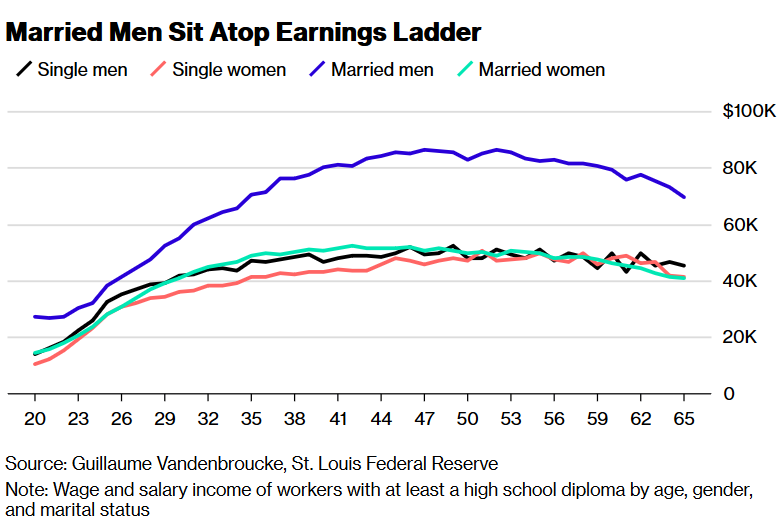
Married men seem to enjoy a boost in earnings from age 23-43
Married men seem to enjoy a boost in earnings between age 22-45

I saw a bunch of pro-marriage friends were tweeting about this article from the St. Louis Federal Reserve which talks about how well married men do financially compared to single men, and using it as a reason to argue that men should get married. The article from the St. Louis Reserve doesn’t have much commentary, but this article from the far-left Washington Post by Brad Wilcox has a lot to say.

Excerpt:

Marriage has a transformative effect on adult behavior, emotional health, and financial well-being—particularly for men.

[…]Men who get married work harder and more strategically, and earn more money than their single peers from similar backgrounds. Marriage also transforms men’s social worlds; they spend less time with friends and more time with family; they also go to bars less and to church more.

[…]Our research, featured in a recent report, “For Richer, For Poorer: How Family Structures Economic Success in America,” indicates that men who are married work about 400 hours more per year than their single peers with equivalent backgrounds. They also work more strategically: one Harvard study found that married men were much less likely than their single peers to quit their current job unless they had lined up another job.

This translates into a substantial marriage premium for men. On average, young married men, aged 28-30, make $15,900 more than their single peers, and married men aged 44-46 make $18,800 more than their single peers.

That’s even after controlling for differences in education, race, ethnicity, regional unemployment, and scores on a test of general knowledge. What’s more: the marriage premium operates for black, Hispanic, and less-educated men in much the same way as it does for men in general.

For instance, men with a high-school degree or less make at least $17,000 more than their single peers.

So, what about these differences between married men and single men? Are men able to earn more if they have a wife to support them and care for their needs? Or is it just that women prefer men who are already able to take care of themselves?

Well, in most cases, it’s the former:

2. Married men are motivated to maximize their income. For many men, this responsibility ethic translates into a different orientation toward work, more hours, and more strategic work choices. Sociologist Elizabeth Gorman finds that married men are more likely to value higher-paying jobs than their single peers.

This is partly why studies find that men increase their work hours after marrying and reduce their hours after divorcing. It’s also why married men are less likely to quit a current job without finding a new job. Indeed, they are also less likely to be fired than their single peers.

3. Married men benefit from the advice and encouragement of their wives. Although there is less research on this, we suspect that men also work harder and more strategically because they are encouraged to do so by their wives, who have an obvious interest in their success. One study appears to buttress this point, finding that men with better-educated wives earn more, even after controlling for their own education.

4. Employers like married men with children. There is evidence that employers prefer and promote men who are married with children, especially compared to their childless male peers and to mothers. Married men are often seen as more responsible and dedicated workers and are rewarded with more opportunities by employers. While illegal bias and long-held stereotypes appear to play a role in this historic preference, it nonetheless helps explain why married family men get paid more.

Now what’s the purpose of me writing this? Well, I’m actually NOT writing this to pressure men to get married. Why not? Because although marriage was a pretty good deal 100 years ago, it’s not as good of a deal under the current laws and policies, e.g. – no-fault divorce, the threats of false accusations, the Sexual Revolution, etc. The institutions of society are not doing as good of a job to prepare women for wife and mother roles as they used to do. Men have a much harder time finding someone who is prepared for marriage today. Men have to choose women more carefully.

But I am writing this to women who are being told by the culture to delay marriage, and especially to delay marriage to use your youth and beauty to “have fun” with boys who won’t commit to marriage. If a woman loves a marriage-focused man and really wants to take care of him and support him, then early marriage is one of the very best ways to really help him during the years (22-45) when it really makes a difference. Marrying a man who wants marriage when you’re still young means that he will have many, many measurable benefits. It’s hard to attract a man who is already rich, because so many women are competing for him. It’s much easier to marry a young man and build him up into a rich man, by supporting him.

Men know that a woman’s support has value. It’s important for women to marry when the marriage has the potential to do the most good for a man in areas like health, career, finances and children. Men typically don’t want to marry women who are older, because those women tend to have more sexual experience. They get used to giving a man sex in order to get him to do what she wants. They get used to breaking up instead of making things work. Once a woman gets used to doing this, it becomes much harder to trust a good man to lead, and to give a man respect as a leader.

So, what I would like to see is women understand that part of loving a man is committing to him early, and staying with him to build him up. Instead of trying to wasting your youth on hot bad boys, why not build up a good man into the fit, wealthy husband you want? It seems to me that building up a man into what you want is a lot easier than wasting your youth on bad boys, then trying to attract a good man when your attractive years are already behind you.