Welcome to episode 7 of the Knight and Rose podcast! I sound very excited in this episode, and that’s because I was really delighted to talk about male roles in a Christian marriage with Rose. If you like this episode, please subscribe to the podcast, and subscribe to our Youtube channel. We would appreciate it if you left us a 5-star review on Apple iTunes / Apple Podcasts.
Podcast description:
Christian apologists Wintery Knight and Desert Rose discuss apologetics, policy, culture, relationships, and more. Each episode equips you with evidence you can use to boldly engage anyone, anywhere. We train our listeners to become Christian secret agents. Action and adventure guaranteed. 30-45 minutes per episode. New episode every week.
Episode 7:
Episode 7 Summary:
Wintery Knight and Desert Rose discuss marriage from a Christian perspective. We talked about what WK is looking for in a wife, and what he wants to achieve with marriage. We talked about traditional husband roles: protector, provider, moral, and spiritual leader. We discussed “servant leadership” and “male headship”. Rose evaluated an email from a naïve proponent of male headship. We talked about what we learned from our engagement with a Christian feminist.
Speaker biographies
Wintery Knight is a black legal immigrant. He is a senior software engineer by day, and an amateur Christian apologist by night. He has been blogging at winteryknight.com since January of 2009, covering news, policy and Christian worldview issues.
Desert Rose did her undergraduate degree in public policy, and then worked for a conservative Washington lobbyist organization. She also has a graduate degree from a prestigious evangelical seminary. She is active in Christian apologetics as a speaker, author, and teacher.
Access Research Network is a group that produces recordings of lectures and debates related to intelligent design. I noticed that on their Youtube channel they are releasing some of their older lectures and debates for FREE. So I decided to write a summary of one that I really like on the Cambrian explosion. This lecture features Dr. Stephen C. Meyer and Dr. Marcus Ross.
The lecture is about two hours. There are really nice slides with lots of illustrations to help you understand what the speakers are saying, even if you are not a scientist.
Here is a summary of the lecture from ARN:
The Cambrian explosion is a term often heard in origins debates, but seldom completely understood by the non-specialist. This lecture by Meyer and Ross is one of the best overviews available on the topic and clearly presents in verbal and pictorial summary the latest fossil data (including the recent finds from Chengjiang China). This lecture is based on a paper recently published by Meyer, Ross, Nelson and Chien “The Cambrian Explosion: Biology’s Big Bang” in Darwinism, Design and Public Education(2003, Michigan State University Press). This 80-page article includes 127 references and the book includes two additional appendices with 63 references documenting the current state of knowledge on the Cambrian explosion data.
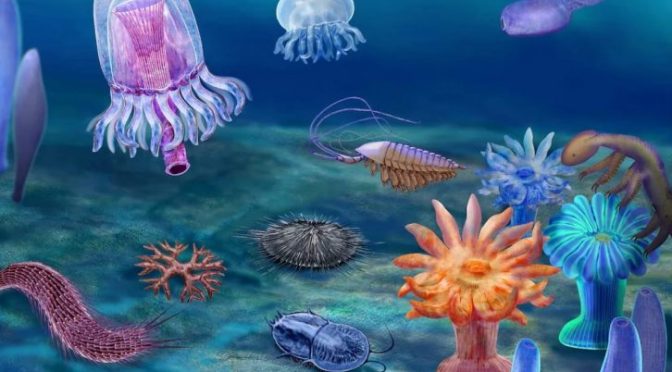
The term Cambrian explosion describes the geologically sudden appearance of animals in the fossil record during the Cambrian period of geologic time. During this event, at least nineteen, and perhaps as many as thirty-five (of forty total) phyla made their first appearance on earth. Phyla constitute the highest biological categories in the animal kingdom, with each phylum exhibiting a unique architecture, blueprint, or structural body plan. The word explosion is used to communicate that fact that these life forms appear in an exceedingly narrow window of geologic time (no more than 5 million years). If the standard earth’s history is represented as a 100 yard football field, the Cambrian explosion would represent a four inch section of that field.
For a majority of earth’s life forms to appear so abruptly is completely contrary to the predictions of Neo-Darwinian and Punctuated Equilibrium evolutionary theory, including:
the gradual emergence of biological complexity and the existence of numerous transitional forms leading to new phylum-level body plans;
small-scale morphological diversity preceding the emergence of large-scale morphological disparity; and
a steady increase in the morphological distance between organic forms over time and, consequently, an overall steady increase in the number of phyla over time (taking into account factors such as extinction).
After reviewing how the evidence is completely contrary to evolutionary predictions, Meyer and Ross address three common objections: 1) the artifact hypothesis: Is the Cambrian explosion real?; 2) The Vendian Radiation (a late pre-Cambrian multicellular organism); and 3) the deep divergence hypothesis.
Finally Meyer and Ross argue why design is a better scientific explanation for the Cambrian explosion. They argue that this is not an argument from ignorance, but rather the best explanation of the evidence from our knowledge base of the world. We find in the fossil record distinctive features or hallmarks of designed systems, including:
a quantum or discontinuous increase in specified complexity or information
a top-down pattern of scale diversity
the persistence of structural (or “morphological”) disparities between separate organizational systems; and
the discrete or novel organizational body plans
When we encounter objects that manifest any of these several features and we know how they arose, we invariably find that a purposeful agent or intelligent designer played a causal role in their origin.
Recorded April 24, 2004. Approximately 2 hours including audience Q&A.
I learned a lot by watching great lectures from Access Research Network. Their YouTube channel is here. I recommend their origin of life lectures – I have watched the ones with Dean Kenyon and Charles Thaxton probably a dozen times each. Speaking as an engineer, you never get tired of seeing engineering principles applied to questions like the origin of life.
If you’d like to see Dr. Meyer defend his views in a debate with someone who reviewed his book about the Cambrian explosion, you can find that in this previous post.
Further study
The Cambrian explosion lecture above is a great intermediate-level lecture and will prepare you to be able to understand Dr. Meyer’s new book “Darwin’s Doubt: The Explosive Origin of Animal Life and the Case for Intelligent Design“. The Michigan State University book that Dr. Meyer mentions is called “Darwin, Design and Public Education“. That book is one of the two good collections on intelligent design published by academic university presses, the other one being from Cambridge University Press, and titled “Debating Design: From Darwin to DNA“. If you think this lecture is above your level of understanding, then be sure and check out the shorter and more up-to-date DVD “Darwin’s Dilemma“.
I bought a new book by a famous environmentalist Dr. Michael Shellenberger. He used to be a huge advocate for renewable energy (wind and solar). The book is about why he changed his mind and now prefers nuclear power. He has a long pedigree of environmental activism. I agree with him, so I wanted to get the book to learn how to argue it. For you, I have a short video instead of the book.
Here’s the part I thought was the most interesting, where he explains the problems with solar and wind:
The first was around land use. Electricity from solar roofs costs about twice as much as electricity from solar farms, but solar and wind farms require huge amounts of land. That, along with the fact that solar and wind farms require long new transmissions lines, and are opposed by local communities and conservationists trying to preserve wildlife, particularly birds.
Another challenge was the intermittent nature of solar and wind energies. When the sun stops shining and the wind stops blowing, you have to quickly be able to ramp up another source of energy.
I was having a discussion with one of the software architects at my company, who LOVES wind power. I raised these objections with him, especially about the birds and the subsidies for wind and solar, and the higher electricity prices. His response was that he was confident that investing in the renewables would produce technological solutions to those problems.
Look what Schellenberger says, though:
What kills big, threatened, and endangered birds—birds that could go extinct—like hawks, eagles, owls, and condors, are wind turbines.
In fact, wind turbines are the most serious new threat to important bird species to emerge in decades.
[…]Solar farms have similarly large ecological impacts. Building a solar farm is a lot like building any other kind of farm. You have to clear the whole area of wildlife.
In order to build one of the biggest solar farms in California the developers hired biologists to pull threatened desert tortoises from their burrows, put them on the back of pickup trucks, transport them, and cage them in pens where many ended up dying.
[…][S]cientists recently warned that wind turbines are on the verge of making one species, the Hoary bat, a migratory bat species, go extinct.
More environmental impact:
You can make solar panels cheaper and wind turbines bigger, but you can’t make the sun shine more regularly or the wind blow more reliably. I came to understand the environmental implications of the physics of energy. In order to produce significant amounts of electricity from weak energy flows, you just have to spread them over enormous areas. In other words, the trouble with renewables isn’t fundamentally technical—it’s natural.
Higher costs:
Dealing with energy sources that are inherently unreliable, and require large amounts of land, comes at a high economic cost.
There’s been a lot of publicity about how solar panels and wind turbines have come down in cost. But those one-time cost savings from making them in big Chinese factories have been outweighed by the high cost of dealing with their unreliability.
Consumer electricity prices rise, disproportionately affecting the poor:
Consider California. Between 2011–17 the cost of solar panels declined about 75 percent, and yet our electricity prices rose five times more than they did in the rest of the U.S. It’s the same story in Germany, the world leader in solar and wind energy. Its electricity prices increased 50 percent between 2006–17, as it scaled up renewables.
The same thing happened in Canada, when they switched to renewables. According to a recent study, the province of Ontario saw a “21% increase in the overall average cost of power in the province over the period 2007-2013”.
Schellenberger likes nuclear energy:
Germany’s carbon emissions have been flat since 2009, despite an investment of $580 billion by 2025 in a renewables-heavy electrical grid, a 50 percent rise in electricity cost.
Meanwhile, France produces one-tenth the carbon emissions per unit of electricity as Germany and pays little more than half for its electricity. How? Through nuclear power.
Then, under pressure from Germany, France spent $33 billion on renewables, over the last decade. What was the result? A rise in the carbon intensity of its electricity supply, and higher electricity prices, too.
What about all the headlines about expensive nuclear and cheap solar and wind? They are largely an illusion resulting from the fact that 70 to 80 percent of the costs of building nuclear plants are up-front, whereas the costs given for solar and wind don’t include the high cost of transmission lines, new dams, or other forms of battery.
He talks a lot about whether nuclear power is safe, and what to do with the waste. I found it compelling. My architect friend didn’t ask me about that, but he did mention the cost of nuclear.
Here’s what I should have said (but didn’t):
All of the waste fuel from 45 years of the Swiss nuclear program can fit, in canisters, on a basketball court-like warehouse, where like all spent nuclear fuel, it has never hurt a fly.
By contrast, solar panels require 17 times more materials in the form of cement, glass, concrete, and steel than do nuclear plants, and create over 200 times more waste.
We tend to think of solar panels as clean, but the truth is that there is no plan anywhere to deal with solar panels at the end of their 20 to 25 year lifespan.
I did send him the lecture and the article after, though.
If you think this is an interesting topic, why not share the TED talk and the article with your friends? Some people vote Democrat just for renewable energy. I don’t like Democrat policies, so I have to be equipped to know how to respond to anything that anyone might like about them. Christian conservatives like me who care about things like abortion, marriage, religious liberty, etc. have to become experts at education policy, health care policy, energy policy, foreign policy, etc. I have to be able to debate anyone about any policy.




 WINTERY KNIGHT