Here is Dr. William Lane Craig giving a long-form argument for the historical event of the resurrection of Jesus, and taking questions from the audience.
The speaker introduction goes for 6 minutes, then Dr. Craig speaks for 35 minutes, then it’s a period of questions and answers with the audience. The total length is 93 minutes, so quite a long period of Q&A. The questions in the Q&A period are quite good.
Introduction:
Many people who are willing to accept God’s existence are not willing to accept the God of Christianity
Christians need to be ready to show that Jesus rose from the dead as a historical event
Private faith is fine for individuals, but when dealing with the public you have to have evidence
When making the case, you cannot assume that your audience accepts the Bible as inerrant
You must use the New Testament like any other ancient historical document
Most historians, Christian and not, accept the basic minimal facts supporting the resurrection of Jesus
Fact #1: the burial of Jesus following his crucifixion
Fact #1 is supported by the early creed found in Paul’s first letter to the Corinthians (1 Cor 15)
Fact #1 is supported by the early Passion narrative which was a source for Mark’s gospel
Fact #1 passes the criterion of enemy attestation, since it praises one of the Sanhedrin
Fact #1 is not opposed by any competing burial narratives
Fact #2: on the Sunday following his crucifixion, Jesus’ tomb was found empty by some women
Fact #2 is supported by the early Passion narrative which was a source for Mark’s gospel
Fact #2 is implied by the early creed found in Paul’s first letter to the Corinthians (1 Cor 15)
Fact #2 is simple and lacks legendary embellishment, which argues for an early dating
Fact #2 passes the criterion of embarrassment, because it has female, not male, witnesses
Fact #2 passes the criterion of enemy attestation, since it is reported by the Jewish leaders
Fact #3: Jesus appeared to various people in various circumstances after his death
Fact #3 is supported by the early creed found in Paul’s first letter to the Corinthians (1 Cor 15)
Fact #3 is supported by multiple, independent reports of the events from all four gospels
Fact #3 explains other historical facts, like the conversion of Jesus’ skeptical brother James
Fact #4: the earliest Christians proclaimed their belief in the resurrection of Jesus
Fact #4 explains why the earliest Christians continued to identify Jesus as the Messiah
Fact #4 explains why the earliest Christians were suddenly so unconcerned about being killed
Dr. Craig then asks which hypothesis explains all four of these facts. He surveys a number of naturalistic hypotheses, such as the hallucination theory or various conspiracy theories. All of these theories deny one or more of the minimal facts that have been established and accepted by the broad spectrum of historians. In order to reject the resurrection hypothesis, a skeptic would have to deny one of the four facts or propose an explanation that explains those facts better than the resurrection hypothesis.
I listened to the Q&A period while doing housekeeping and I heard lots of good questions. Dr. Craig gives very long answers to the questions. One person asked why we should trust the claim that the Jewish leaders really did say that the disciples stole the body. Another one asked why we should take the resurrection as proof that Jesus was divine. Another asks about the earthquake in Matthew, which Mike Licona and I doubt is intended to be historical, but is more likely to be apocalyptic imagery. Dr. Craig is also asked about the Jewish scholar Geza Vermes, and how many of the minimal facts he accepts. Another questioner asked about the ascension.
You can see this evidence used in an actual debate, against a historian who disagrees with Dr. Craig. That post contains a point by point summary of the debate that I wrote while listening to it.
Atheist Luke Muehlhauser interviews well-respect cosmologist Luke Barnes about the fine-tuning argument, and the naturalistic response to it.
Luke M. did a good job explaining the outline of the podcast.
Details:
In one of my funniest and most useful episodes yet, I interview astronomer Luke Barnes about the plausibility of 11 responses to the fine-tuning of the universe. Frankly, once you listen to this episode you will be better equipped to discuss fine-tuning than 90% of the people who discuss it on the internet. This episode will help clarify the thinking of anyone – including and perhaps especially professional philosophers – about the fine-tuning of the universe.
The 11 responses to fine-tuning we discuss are:
“It’s just a coincidence.”
“We’ve only observed one universe, and it’s got life. So as far as we know, the probability that a universe will support life is one out of one!”
“However the universe was configured, evolution would have eventually found a way.”
“There could be other forms of life.”
“It’s impossible for life to observe a universe not fine-tuned for life.”
“Maybe there are deeper laws; the universe must be this way, even though it looks like it could be other ways.”
“Maybe there are bajillions of universes, and we happen to be in one of the few that supports life.”
“Maybe a physics student in another universe created our universe in an attempt to design a universe that would evolve intelligent life.”
“This universe with intelligent life is just as unlikely as any other universe, so what’s the big deal?”
“The universe doesn’t look like it was designed for life, but rather for empty space or maybe black holes.”
“Fine-tuning shows there must be an intelligent designer beyond physical reality that tuned the universe so it would produce intelligent life.”
Download CPBD episode 040 with Luke Barnes. Total time is 1:16:31.
There is a very good explanation of some of the cases of fine-tuning that I talk about most on this blog – the force of gravity, the strong force, etc. as well as many other examples. Dr. Barnes is an expert, but he is also very very easy to listen to even when talking about difficult issues. Luke M. is very likeable as the interviewer.
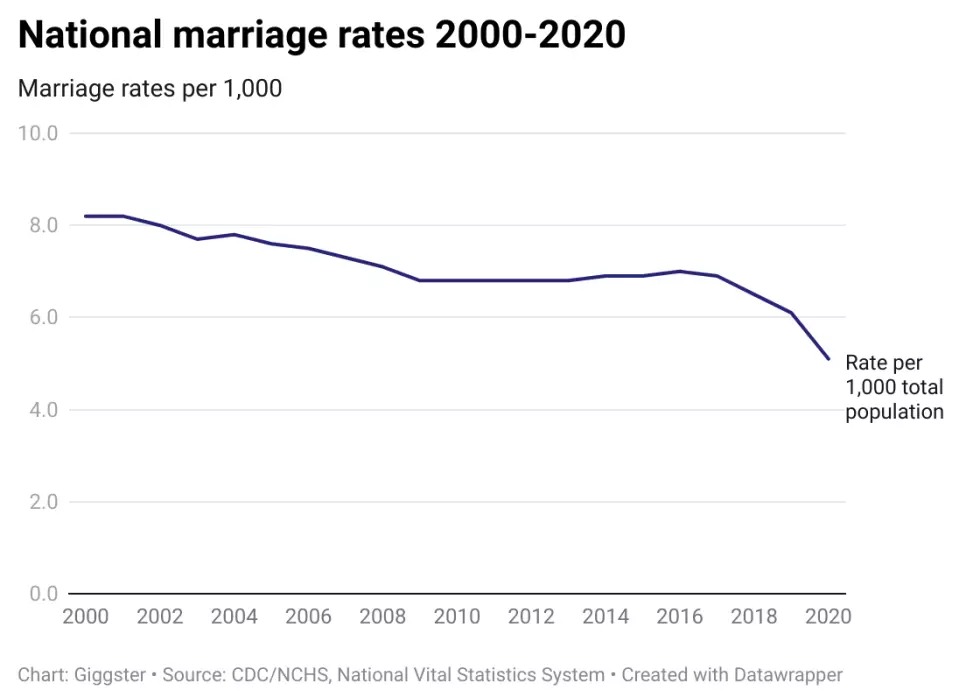
In this post, I want to look at a series of tweets from an ordinary pro-marriage pastor. He is concerned about declining marriage rates. He observed young people in his church, and he did some social science research. And he’s come up with a theory about why young Christians are delaying marriage, or not getting married at all.
First, here’s the marriage rate, accurate to 2020:
Marriage Rate in America through to 2020
This pastor is just talking about ordinary Christian men in his tweets below, not the ones who do a ton of research on apologetics, etc.
I saw this chart a while back and scratched out some rough thoughts…
Around 2010 or 2011, I noticed a significant shift in “the relationship marketplace.” I can sum up this shift with two trends I saw in my church circles.
First, I noticed that many (not all) average to above average Christian men in overall quality (e.g. health, looks, ambition, etc.) were struggling to get a girlfriend. At first, I thought these guys were just being too picky or had some other major deficiency. After all, there are a lot of lazy foolish men out there. This wasn’t the case with these men. They weren’t the top 1%. But they were quality and had very reasonable (perhaps too low) standards for a girlfriend.
Second, I noticed that many (not all) average to below average Christian women (I know me suggesting that such a thing exists is upsets a lot you) in overall quality (e.g. beauty, personality, temperament, etc.) had a fear of a committed relationship and were extremely picky. They would often complain that there weren’t any good men. But there were good men. They just thought those men were below them. They weren’t. The arrogance and pride of these women was shocking to me at the time. Not anymore.
I ran my concerns past a boomer pastor. He dismissed it. He thought all the women were just great and men needed to step up to win them. Man up and all that. That really was the moment I realized that there was some form of generational blindness related to what is happening. And that’s why I started tracking trends in sexuality not just generally but specifically as they related to dating (aka the relationship marketplace).
Now let me point out 2 particularly concerning trends that overturn older assumptions about the relationship marketplace.
First more and more women today are delaying marriage into their 30s. They, however, aren’t delaying sex. Very few of these unmarried women are virgins when they turn 30. Stats vary but it’s below 10% and perhaps closer to 5%. Moreover, these women have multiple sexual partners. It’s difficult to calculate the number but a survey of the material points toward between 7-14 sexual partners prior to getting married right around 30. Others say that is a low number. Regardless, the consequences of this are hard to overstate. This sort sexual promiscuity has intense negative emotional, spiritual, and even physical consequences in the lives of these women. Also, it means that a large number of these women are using hormonal birth control and having abortions.
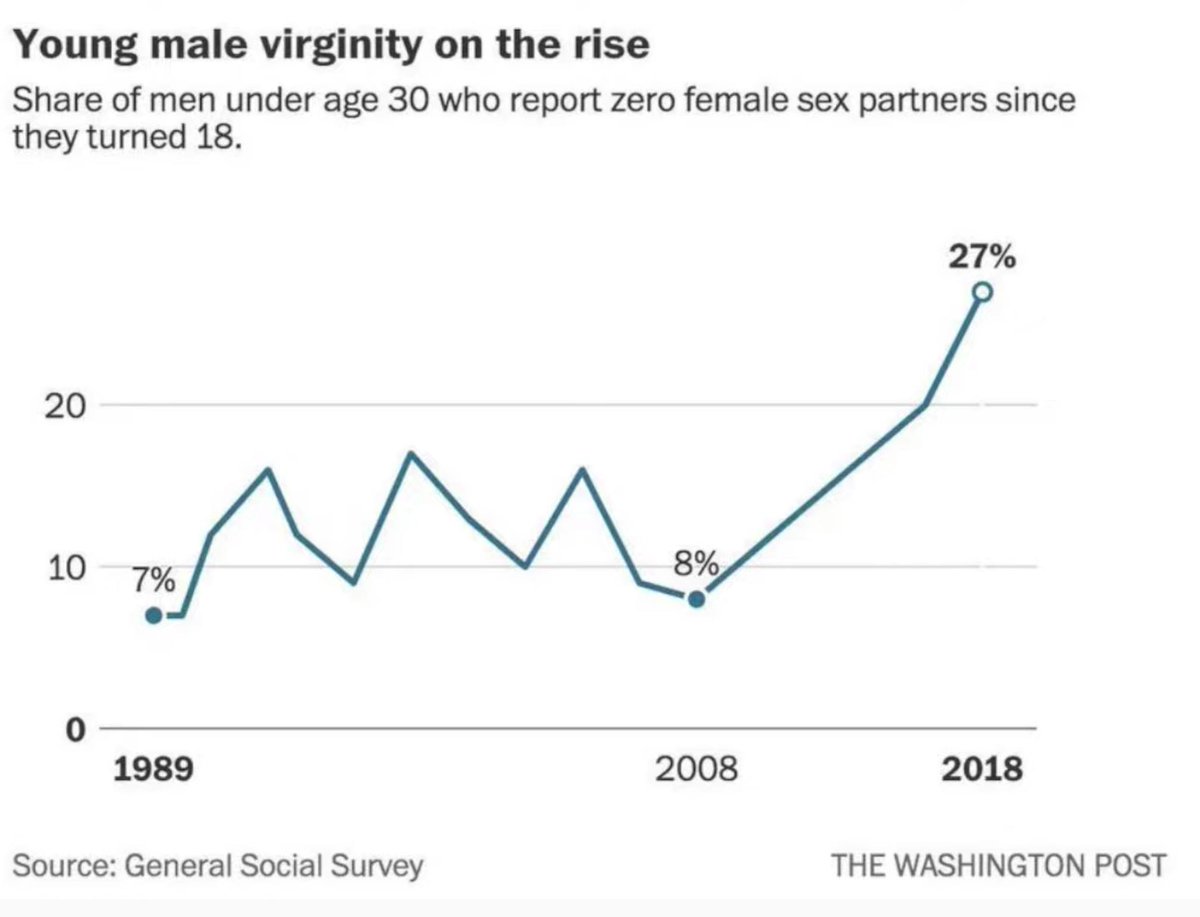
[…]Second, as you see in the chart above, male virginity between ages 18-30 has increased 20% since ’89. That’s good, right? No. It’s doubtful that this increase in virginity is directly connected to an increase in morality among men.
[…]So who are these women having sex with?
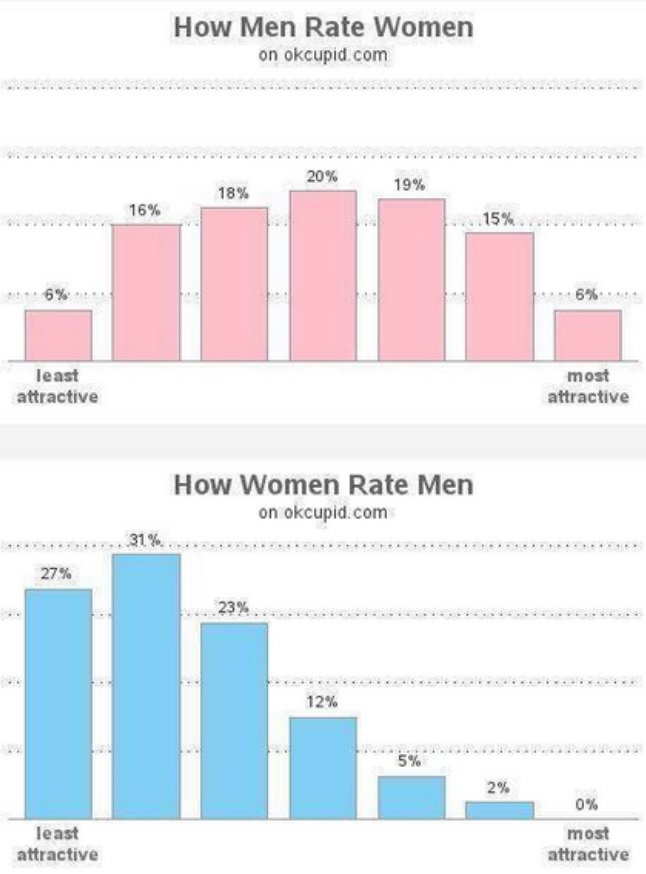
There appears to be men who are consider “top tier guys” by women who are having a lot casual sex with a lot of women. Supposedly, 20% of the men are having 80% of the sex.
The pastor mentions that 80% of the young women these days are chasing the “top” 20% of men. It’s important to understand that these are not the top 20% of men according to criteria like commitment ability, protecting, providing and moral / spiritual leading. These are the “top” 20% of men according to appearance. In fact, if a man has definite, defensible views on moral or spiritual issues, that is bad, because that means that he is strict, judgmental and boring. Not high status.
What do young women consider “high status”?
Look at this survey of women who use Bumble about where they set the minimum and maximum height of men they are seeking:
Women’s Height Preferences on Bumble Dating App
What this shows is that women have the height slider set to find men who are between 6 feet tall and 7 feet tall. The average height of a North American man is 5’9″. This is what they value in a man.
Again, the men with the highest status are judged by their appearances. And how do 80% of the women get the attention of these top 20% of men? Why, by giving them premarital sex, of course. Since these men are swimming in attention from 80% of the women, there is no need for them to commit first in order to get sex. Why buy the cow when you can get the milk for free? Although you might think that promiscuity makes men unstable, selfish and low status, you would be wrong. These are the men that women want.
But this analysis downplays the unbelievable gains women have lately made, and, more important, it forgets how much those gains depend on sexual liberation. Single young women in their sexual prime—that is, their 20s and early 30s, the same age as the women at the business-school party—are for the first time in history more successful, on average, than the single young men around them. They are more likely to have a college degree and, in aggregate, they make more money. What makes this remarkable development possible is not just the pill or legal abortion but the whole new landscape of sexual freedom—the ability to delay marriage and have temporary relationships that don’t derail education or career. To put it crudely, feminist progress right now largely depends on the existence of the hookup culture. And to a surprising degree, it is women—not men—who are perpetuating the culture, especially in school, cannily manipulating it to make space for their success, always keeping their own ends in mind. For college girls these days, an overly serious suitor fills the same role an accidental pregnancy did in the 19th century: a danger to be avoided at all costs, lest it get in the way of a promising future.
They aren’t looking for men who will commit until they reach their mid-30s or 40s, and feel peer pressure from their friends who are married and having kids. And many Christian women think that hooking up with hot bad boys is compatible with Christianity, because Christianity is just about God making women happy by letting them do whatever they feel like doing “in the moment”.
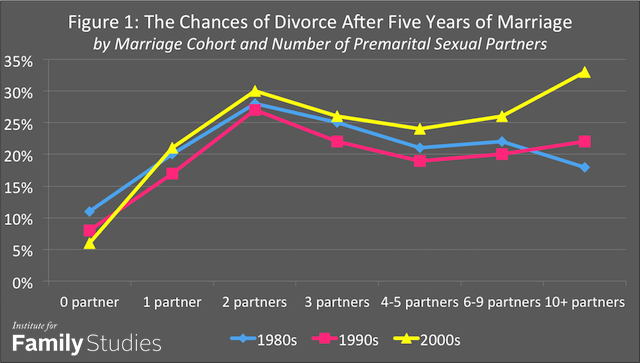
Study: virgins have the happiest marriages, more partners means less happinessEven one non-husband premarital sex partner raises risk of divorce
What Christian women, their parents and pastors believe
Here are some things I’ve heard over the years by Christian women, their parents, and their pastors:
there’s nothing wrong with women choosing men based on height, appearance, and bad boy character traits
bad boy character can easily be fixed by nagging, sex-withholding, and threatening divorce
marriage will magically happen when the woman feels like getting married, until then she should focus on casually “dating” attractive men, career, travel and fun
a woman’s ability to choose good men and be a good wife and mother isn’t harmed by having premarital sex with hot bad boys
men aren’t discouraged by a woman’s student loan debt or secular left indoctrination, or her desire to put the kids in daycare and public schools, so she can keep working after they are born
it’s wrong for men to have standards about what they want in a wife and mother, or to prefer early marriage
if Christian men want to attract women, they should spend more money on expensive cars, clothes and watches
women are just as likely to get pregnant at 35 as they are at 20, as long as they are in good shape and healthy
studies that show that past promiscuity causes the woman to be unhappy, and the marriage to be unstable, are all false
There are costs and risks to men who decide to marry. There are external threats from policy, courts, the workplace, the schools, etc. It’s become dangerous for men to advocate for Christian views, and having a family makes it even more risky. These risks make sense when the man gets early investment from a woman – support, investment and many well-raised children. These risks make NO sense when there is no early investment from a woman. A woman who chased “high status” men will never be attracted to a good man. She may eventually want to settle for one, but she will never respect him.






 WINTERY KNIGHT