
New study: more than half of all female-to-male transgender teens attempt suicide

A recent study by a researcher out of Brown University found that the exploding rates of transgender young people is being driven in part by social factors. In particular, coming out as transgender gives young people instant popularity, and everyone around them feels obligated to affirm them and agree with them. Or else. What’s missing? What’s missing is any sort of warning about the dangers of transgenderism.

The Daily Wire reports on a new study from the American Academy of Pediatrics.

Excerpt:

A new study from the American Academy of Pediatrics found an alarming number of teens who identify as transgender or nonbinary have attempted suicide at least once, showcasing the dangers of the transgender movement. More than half of all female-to-male transgender teens, for example, have attempted to end their lives.

Researchers behind the study used data collected from more than 600 teens over a 36-month period, June 2012 to May 2015, from the “Profiles of Student Life: Attitudes and Behaviors” survey.

The study found that female-to-male trans teens had the highest suicide attempt rate of all other identity groups surveyed: 50.8%. Unsurprisingly, other gender-confused teens had outrageously high rates of suicide attempts, too. Nonbinary adolescents, meaning teens who do not identify exclusively as female or male, were found to have a 41.8% suicide attempt rate; male-to-female trans teens had a 29.9% rate; and “questioning” teens had a rate of 27.9%.

By comparison, teens who identified as their biological sex and corresponding gender suffered relatively low (though still too high) rates: females were found to have a 17.6% rate while males had the lowest of any other group at 9.8%.

When I tell LGBT people about the health risks of their choices, and cite peer-reviewed studies, the most frequent response is that they get angry and even violent and demand approval. I have even heard threats that if I don’t approve of what they feel like doing, then they will kill themselves, and their blood will be on my hands.

The thing is, there is a study about that. Even though LGBT people think that approval will make them feel better about what they are doing, it’s not true. In societies where social approval and government support of LGBT behaviors are HIGHER than in America, the suicide rates are still extremely high.

Life Site News explains:

A study out of Sweden published last month has found that suicide risk among active homosexuals is high even in a region that is highly tolerant of same-sex behaviour.

Published in the European Journal of Epidemiology, the authors found that men in same-sex “marriages” were at three times greater risk of suicide than men who are married to women.

The authors note in their abstract:

Even in a country with a comparatively tolerant climate regarding homosexuality such as Sweden, same-sex married individuals evidence a higher risk for suicide than other married individuals.

Just in passing, what a strange way to respond to disagreement. I have people disagree with me on moral issues and conservative policies, etc. all the time. It never occurs to me to threaten to commit suicide if they don’t approve. I also don’t try to get them fired, insult them, shame them, vandalize their property, assault them, murder them, or drag them in front of a government-run political correctness panel. I don’t even mind that they use their free speech to disagree with me. After all, they are people made in the image of God, with an equal right to be in a relationship with God. I can’t do anything that is going to cause them to think that God doesn’t love them.

It’s useful to remember that the Christian view on life is not to neglect God’s design and tell people to do whatever they want. The Christian view is to tell people God’s design, set boundaries, and encourage people to make good decisions. Christians don’t believe in love as mere acceptance. Christians believe in “love warns”. And that applies to truth claims as well as moral claims. I tell young people not to run up student loan debt studying useless non-STEM degrees. They might feel bad, but it’s the truth: they won’t be able to find a job that allows them to pay the money back. Warning people about sexual issues is the same thing, in my mind.

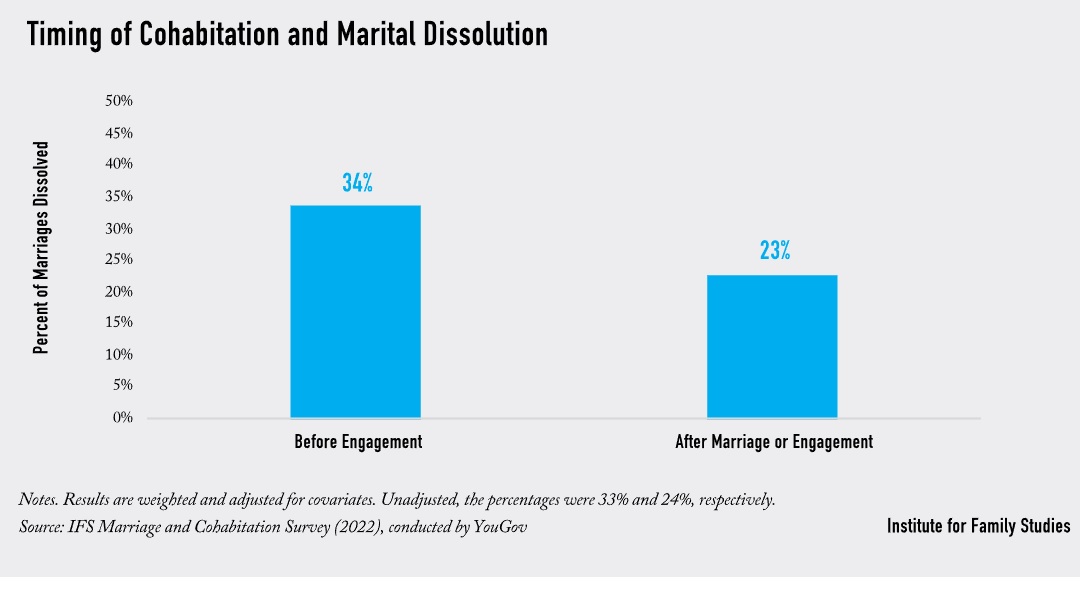
New study: couples who cohabitate before marriage have higher risk of marital dissolution

When I was in college studying computer science, there was a new idea going around called “design patterns”. Basically, this was a cookbook of component arrangements that were “best practices” for solving certain problems. Depending on your problem, you might try different patterns, like Observer, Visitor, Strategy, etc. And it turns out that there are design patterns for social issues, too.

Cohabition Instability

Here’s a new report from the Institute for Family Studies:

Fifty to 65% of Americans believe that living together before marriage will improve their odds of relationship success. Younger Americans are especially likely to believe in the beneficial effects of cohabitation, and to view living together as providing a valuable test of a relationship ahead of marriage. Yet living together before marriage has long been associated with a higher risk for divorce, contradicting the common belief that cohabitation will improve the odds of a marriage lasting.

[…]Using a new national sample of Americans who married for the first time in the years 2010 to 2019, we examined the stability of these marriages as of 2022 based on whether or not, and when, people had lived together prior to marriage. Consistent with prior research, couples who cohabited before marriage were more likely to see their marriages end than those who did not cohabit before marriage.

Key findings:

  •  34% of marriages ended among those who cohabited before being engaged, compared to 23% of marriages for those who lived together only after being either married or engaged to be married.

And this from the key takeaways was interesting:

  • Reasons for moving in together also matter: People who reported that their top reason for moving in together was either to test the relationship or because it made sense financially were more likely to see their marriages end than those who did so because they wanted to spend more time with their partner.
  • Having a greater number of prior cohabiting partners is associated with a higher likelihood of marriages ending.

I think the key point in these studies is that couples who decide to commit are moving in very different reasons than couples who just slide into cohabitation because it’s convenient.

It’s interesting because it shows that being cautious about commitment is more likely to cause instability. The attitude seems to be “I’ll keep doing this as long as it makes me happy”.

With commitment, the attitude is going to be more like “let’s decide to unite, and then it will be on us to make it work”. The old marriage vows were all about that commitment. I really have to wonder whether people mean it when they say those words today, they are so counter to our hedonistic culture.

I think what people should be looking for is a mate who thinks that the relationship works better if both people work at it. If you have one person who thinks that it is the other person’s job to make them happy, run from that relationship. Like, if you are always doing little things to help the other person do well in their tasks and purposes, and they never do anything to help you, then that’s a bad sign. You don’t want to commit to someone who thinks that relationships should be effortless, that they don’t have to do anything to put gas in your fuel tank in order to make you perform.

Ideally, you want someone who thinks that it’s fun to put fuel in your tank, and thinks that it’s their job to do that for you. Just because they like to see your engine run.

Is the definition of atheism “a lack of belief in God”?

First, let’s see check with the Stanford University Encyclopedia of Philosophy:

‘Atheism’ means the negation of theism, the denial of the existence of God.

Stanford University is one of the top 5 universities in the United States, so that’s a solid definition. To be an atheist is to be a person who makes the claim that, as a matter of FACT, there is no intelligent agent who created the universe. Atheists think that there is no God, and theists think that there is a God. Both claims are objective claims about the way the world is out there, and so both sides must furnish forth arguments and evidence as to how they are able to know what they are each claiming.

Philosopher William Lane Craig has some thoughts on atheism, atheists and lacking belief in God in this reply to a questioner.

Question:

In my discussions with atheists, they  are using the term that they “lack belief in God”. They claim that this is different from not believing in God or from saying that God does not exist. I’m not sure how to respond to this. It seems to me that its a silly word-play and is logically the same as saying that you do not believe in God.
What would be a good response to this?
Thank you for your time,

Steven

And here is Dr. Craig’s full response:

Your atheist friends are right that there is an important logical difference between believing that there is no God and not believing that there is a God.  Compare my saying, “I believe that there is no gold on Mars” with my saying “I do not believe that there is gold on Mars.”   If I have no opinion on the matter, then I do not believe that there is gold on Mars, and I do not believe that there is no gold on Mars.  There’s a difference between saying, “I do not believe (p)” and “I believe (not-p).”   Logically where you place the negation makes a world of difference.

But where your atheist friends err is in claiming that atheism involves only not believing that there is a God rather than believing that there is no God.

There’s a history behind this.  Certain atheists in the mid-twentieth century were promoting the so-called “presumption of atheism.” At face value, this would appear to be the claim that in the absence of evidence for the existence of God, we should presume that God does not exist.  Atheism is a sort of default position, and the theist bears a special burden of proof with regard to his belief that God exists.

So understood, such an alleged presumption is clearly mistaken.  For the assertion that “There is no God” is just as much a claim to knowledge as is the assertion that “There is a God.”  Therefore, the former assertion requires justification just as the latter does.  It is the agnostic who makes no knowledge claim at all with respect to God’s existence.  He confesses that he doesn’t know whether there is a God or whether there is no God.

But when you look more closely at how protagonists of the presumption of atheism used the term “atheist,” you discover that they were defining the word in a non-standard way, synonymous with “non-theist.”  So understood the term would encompass agnostics and traditional atheists, along with those who think the question meaningless (verificationists).  As Antony Flew confesses,

the word ‘atheist’ has in the present context to be construed in an unusual way.  Nowadays it is normally taken to mean someone who explicitly denies the existence . . . of God . . . But here it has to be understood not positively but negatively, with the originally Greek prefix ‘a-’ being read in this same way in ‘atheist’ as it customarily is in . . . words as ‘amoral’ . . . . In this interpretation an atheist becomes not someone who positively asserts the non-existence of God, but someone who is simply not a theist. (A Companion to Philosophy of Religion, ed. Philip Quinn and Charles Taliaferro [Oxford:  Blackwell, 1997], s.v. “The Presumption of Atheism,” by Antony Flew)

Such a re-definition of the word “atheist” trivializes the claim of the presumption of atheism, for on this definition, atheism ceases to be a view.  It is merely a psychological state which is shared by people who hold various views or no view at all.  On this re-definition, even babies, who hold no opinion at all on the matter, count as atheists!  In fact, our cat Muff counts as an atheist on this definition, since she has (to my knowledge) no belief in God.

One would still require justification in order to know either that God exists or that He does not exist, which is the question we’re really interested in.

So why, you might wonder, would atheists be anxious to so trivialize their position?  Here I agree with you that a deceptive game is being played by many atheists.  If atheism is taken to be a view, namely the view that there is no God, then atheists must shoulder their share of the burden of proof to support this view.  But many atheists admit freely that they cannot sustain such a burden of proof.  So they try to shirk their epistemic responsibility by re-defining atheism so that it is no longer a view but just a psychological condition which as such makes no assertions.  They are really closet agnostics who want to claim the mantle of atheism without shouldering its responsibilities.

This is disingenuous and still leaves us asking, “So is there a God or not?”

So there you have it. We are interested in what both sides know and what reasons and evidence they have to justify their claim to know. We are interested in talking to people who make claims about objective reality, not about themselves, and who then go on to give reasons and evidence to support their claims about objective reality. There are atheists out there that do make an objective claim that God does not exist, and then support that claim with arguments and evidence. Those are good atheists, and we should engage in rational conversations with them. But clearly there are some atheists who are not like that. How should we deal with these “subjective atheists”?

Dealing with subjective atheists

How should theists respond to people who just want to talk about their psychological state? Well, my advice is to avoid them. They are approaching religion irrationally and non-cognitively – like the person who enters a physics class and says “I lack a belief in the gravitational force!”.  When you engage in serious discussions with people about God’s existence, you only care about what people know and what they can show to be true. We don’t care about a person’s psychology.