William Lane Craig lectures against naturalism at the University of St. Andrews, Scotland

Note: if you have heard Dr. Craig’s arguments against naturalism before, then I recommend jumping right to the Q&A time, which starts 72 minutes in.

About Dr. William Lane Craig:

William Lane Craig (born August 23, 1949) is an American analytic philosopher, philosophical theologian, and Christian apologist. He is known for his work on the philosophy of time and the philosophy of religion, specifically the existence of God and the defense of Christian theism. He has authored or edited over 30 books including The Kalam Cosmological Argument (1979), Theism, Atheism and Big Bang Cosmology(co-authored with Quentin Smith, 1993), Time and Eternity: Exploring God’s Relationship to Time (2001), and Einstein, Relativity and Absolute Simultaneity (co-edited with Quentin Smith, 2007).

Craig received a Bachelor of Arts degree in communications from Wheaton College, Illinois, in 1971 and two summa cum laudemaster’s degrees from Trinity Evangelical Divinity School in Deerfield, Illinois, in 1975, in philosophy of religion and ecclesiastical history. He earned a Ph.D. in philosophy under John Hick at the University of Birmingham, England in 1977 and a Th.D. underWolfhart Pannenberg at the University of Munich, Germany in 1984.

Here is the full lecture with Q&A: (2 hours)

Summary:

  • Naturalism defined: the physical world (matter, space and time) is all that exists
  • Dr. Craig will present 7 reasons why naturalism is false
  • 1) the contingency argument
  • 2) the kalam cosmological argument
  • 3) the fine-tuning of the universe for intelligent life
  • 4) the moral argument
  • 5) the ontological argument
  • 6) the resurrection of Jesus
  • 7) religious experience

The Q&A time starts around 1:12:00.

Dr. Craig does mention an 8th argument early in the Q&A – the argument from the non-physicality of mental states (substance dualism), which is an argument that I find convincing, because a materialist conception of mind is not compatible with rationality, consciousness and moral agency. He gets a couple of questions on the moral argument early on – one of them tries to put forward an evolutionary explanation for “moral” behaviors. There’s another question the definition of naturalism. There is a bonehead question about the non-existence of Jesus based on a Youtube movie he saw – which Craig responds to with agnostic historian Bart Ehrman’s book on that topic. There’s a question about God as the ground for morality – does morality come from his will or nature. Then there is a question about the multiverse, which came up at the physics conference Dr. Craig attended the day before. There is a good question about the Big Bang theory and the initial singularity at time t=0. Another good question about transfinite arithmetic, cardinality and set theory. One questioner asks about the resurrection argument. The questioner asks if we can use the origin of the disciples belief as an argument when other religions have people who are willing to die for their claims. One of the questioners asks about whether the laws of nature break down at 10^-43 after the beginning of the universe. There is a question about the religious experience argument, and Craig has the opportunity to give his testimony.

I thought that the questions from the Scottish students and faculty were a lot more thoughtful and respectful than at American colleges and universities. Highly recommended.
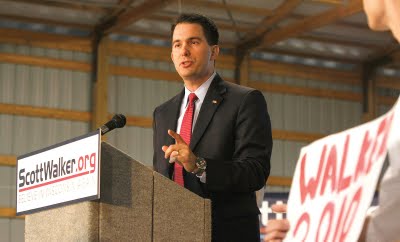
George Will: Governor Scott Walker is a good pick for Republicans in 2016

Wisconsin Governor Scott Walker

I like Scott Walker because he is a man who defeats Democrats and gets things done, and I like Senator Ted Cruz because he is a brilliant debater. Both are tough conservatives. But if I had to pick one of them right now for 2016, I’d pick Scott Walker. And I’m not alone.

Here’s an editorial from the St. Louis Dispatch that Dennis Prager discussed on Monday, authored by moderate conservative George Will.

Excerpt:

In 2011, tens of thousands of government employees and others, enraged by Gov. Scott Walker’s determination to break the ruinously expensive and paralyzing grip that government workers’ unions had on Wisconsin, took over the Capitol building in Madison. With chanting, screaming and singing supplemented by bullhorns, bagpipes and drum circles, their cacophony shook the building that the squalor of their occupation made malodorous. They spat on Republican legislators and urinated on Walker’s office door. They shouted, “This is what democracy looks like!”

When they and Democratic legislators failed to prevent passage of Act 10, they tried to defeat — with a scurrilous smear campaign that backfired — an elected state Supreme Court justice. They hoped that changing the court’s composition would get Walker’s reforms overturned. When this failed, they tried to capture the state Senate by recalling six Republican senators. When this failed, they tried to recall Walker. On the night that failed — he won with a larger margin than he had received when elected 19 months earlier — he resisted the temptation to proclaim, “This is what democracy looks like!”

[…]Walker has long experience in the furnace of resistance to the looting of public funds by the public’s employees. He was elected chief executive of heavily Democratic Milwaukee County after his predecessor collaborated with other officials in rewriting pension rules in a way that, if he had been re-elected instead of resigning, would have given him a lump-sum payment of $2.3 million and $136,000 a year for life.

To fight the recall — during which opponents disrupted Walker’s appearance at a Special Olympics event, and squeezed Super Glue into the locks of a school he was to visit — Walker raised more than $30 million, assembling a nationwide network of conservative donors that could come in handy if he is re-elected next year. Having become the first U.S. governor to survive a recall election, he is today serene as America’s first governor to be, in effect, elected twice to a first term.

The radically leftist New Republic has this to say about Governor Walker.

Excerpt:

Right now, the Republican Party is an increasingly factional place, divided between north and south, establishment and grassroots, Tea Party Conservatives and practical Conservatives, religious right and business, libertarians and populists.

[…]There’s another potentially unifying mainline conservative, though, and he lurks in Madison. Scott Walker, the battle-hardened governor of Wisconsin, is the candidate that the factional candidates should fear. Not only does he seem poised to run—he released a book last week—but he possesses the tools and positions necessary to unite the traditional Republican coalition and marginalize its discontents.

Walker has the irreproachable conservative credentials necessary to appease the Tea Party, and he speaks the language of the religious right. But he has the tone, temperament, and record of a capable and responsible establishment figure. That, combined with Walker’s record as a reformist union-buster, will appeal to the party’s donor base and appease the influential business wing. Walker’s experience as an effective but conservative blue state governor makes him a credible presidential candidate, not just a vessel for the conservative message. Equally important, his history of having faced down organized labor and beaten back a liberal recall effort is much more consistent with the sentiment of the modern Republican Party than Jeb Bush’s compassionate conservatism. Altogether, Walker has the assets to build the broad establishment support necessary for the fundraising, media attention, and organization to win the nomination. He could be a voter or a donor’s first choice, not just a compromise candidate.

The other mainline conservatives possess some of Walker’s characteristics, but not all. He’s more compelling and presidential, with more gravitas than Rubio or Jindal.

[…]But even though Walker’s political skills remain an open question, there are reasons why he might be a stronger candidate on paper. For one, he’s a more experienced politician—and the fact is that political skills and instincts are learned and honed under tough circumstances. By the time Walker’s wins reelection—which I expect—he will have won three competitive statewide contests in a tilt-blue state, under three different circumstances. He will have done so while campaigning and governing as a conservative. There are very few politicians who can claim as much.

We need to have someone who is a non-Romney – someone who likes to fight with the Democrats, and is able to beat them.

I found this article that lists six of his accomplishments.

Here’s are a couple:

#2 He passed a killer budget. Over the summer, he signed into law a state budget thatslashed taxes as well as unnecessary spending, including a $650 million income tax cut (part of nearly $1 billion in total tax cuts), Medicaid reform (see #4), the introduction of work requirements for people on food stamps, a freeze in university tuition and limits on residential property tax increases.

#3 He stands up to corruption. One of Walker’s first actions as governor was to create the Commission on Government Waste, Fraud, and Abuse, which was projected to save taxpayers $300 million. He also passed a law that prevents unions from using members’ dues to fund political campaigns.

I have placed his new book about his victories in Democrat-dominated Wisconsin on my wishlist. If you like politics, might be a good one for you as well.

Fast-food walk out ignores basic economics: minimum wage hike creates unemployment

Investors Business Daily explains what’s wrong with the plan of fast-food industry workers to strike for higher wages.

Excerpt:

Egged on by unions, fast-food workers plan to strike in dozens of U.S. cities for much higher wages. Sadly, they’re being used to do something that’s not in their own interests.

Sensing the time is ripe, the Service Employees International Union and union-funded front groups are organizing a walkout of workers at fast-food joints in about 100 cities to protest how tough it is to live on the federal minimum wage of $7.25 an hour.

They’d like that nearly doubled to $15 — and not just for fast food, but retailing and other industries too.

Sounds great. But even by the loopy logic of the left, this is economic insanity and would lead to greater misery, fewer jobs and fewer opportunities for all.

That’s not just our opinion. Economists David Neumark and William Wascher, in their comprehensive book “Minimum Wages,” looked at virtually all the scholarly and statistical evidence worldwide, digging up literally dozens of studies.

Their finding: Minimum wage laws almost always result in a “reduction in employment opportunities for low-skilled” employees while limiting “skill acquisition by reducing educational attainment and perhaps training, resulting in lower adult wages and earnings.”

And, they said, it reduces the total amount of human capital — a huge cost to society.

The minimum wage is so devastating that roughly 85% of all economists in a recent survey — from both the left and the right sides of the spectrum — said they think it’s a bad idea.

[…]The idea that working families depend on these jobs is false. Most of those working for minimum wage are young, ages 16 to 24. They live in middle-class homes with above-average household incomes.

And as James Sherk of the Heritage Foundation notes, two-thirds of minimum-wage earners get a raise in their first year. This is how they learn to show up, work hard and get along with others — valuable life skills young people acquire as they begin work and the very things that will make them a success later on.

A higher minimum wage would cost young workers jobs and opportunities. They’d be wise to ignore the unions’ siren song of higher wages for nothing.

From Investors Business Daily, an article by famous economist Thomas Sowell has more on this issue.

Excerpt:

Switzerland is one of the few modern nations without a minimum-wage law. In 2003, the Economist magazine reported: “Switzerland’s unemployment neared a five-year high of 3.9% in February.”

In February of this year, Switzerland’s unemployment rate was 3.1%. A recent issue of the Economist showed Switzerland’s unemployment rate as 2.1%.

Most Americans today have never seen unemployment rates that low. However, there was a time when there was no federal minimum-wage law in the United States.

The last time was during the Coolidge administration, when the annual unemployment rate went as low as 1.8%. When Hong Kong was a British colony, it had no minimum-wage law. In 1991 its unemployment rate was under 2%.

[…]Most people in the lower income brackets are not an enduring class. Most working people in the bottom 20% in income at a given time do not stay there over time. More of them end up in the top 20% than remain behind in the bottom 20%.

There is nothing mysterious about the fact that most people start off in entry-level jobs that pay much less than they will earn after they get some work experience.

But when minimum-wage levels are set without regard to their initial productivity, young people are disproportionately unemployed — priced out of jobs.

In European welfare states where minimum wages, and mandated job benefits to be paid for by employers, are more generous than in the United States, unemployment rates for younger workers are often 20% or higher, even when there is no recession.

Unemployed young people lose not only the pay they could have earned but, at least equally important, the work experience that would enable them to earn higher rates of pay later on.

Minorities, like young people, can also be priced out of jobs. In the United States, the last year in which the black unemployment rate was lower than the white unemployment rate — 1930 — was also the last year when there was no federal minimum-wage law.

Inflation in the 1940s raised the pay of even unskilled workers above the minimum wage set in 1938. Economically, it was the same as if there were no minimum-wage law by the late 1940s.

In 1948 the unemployment rate of black 16-year-old and 17-year-old males was 9.4%. This was a fraction of what it would become in even the most prosperous years from 1958 on, as the minimum wage was raised repeatedly to keep up with inflation.

A survey of American economists found that 90% of them regarded minimum-wage laws as increasing the rate of unemployment among low-skilled workers.

Harvard University economist Greg Mankiw puts the level of opposition to minimum wage hikes at 79% among professional economists across the ideological spectrum.

Learn economics for Christmas

By the way, if you’re looking for a really good drama that shows the business-owner vs union-leader conflict, I really recommend the BBC production of North and South. It’s a beautiful period drama that’s based on a Christian woman’s novel. The author of the book wrote in the time of Charles Dickens, and he even named the book for her. It’s rated 8.7/10 on IMDB. It’s $19.99 on Amazon, although it sometimes goes lower than that! A great way to communicate basic economics to your liberal spouse or significant other – especially on this minimum wage issue. Oh, apparently there is a love story in it, but I didn’t really pay any attention to that part of it, other than to be pleased that there was no sex or nudity at all – not even kissing! Perfect! This DVD is WK-approved. It is also Dina-approved, because she was the one who suggested it to me.

Just to give you an idea of how much I liked it, I tried watching Downton Abbey and stopped after two episodes. It’s boring nonsense. But North and South I rated 9.5/10 and could not stop watching it once I started. There are no wasted scenes, no fluff at all. Everything they did worked to develop the theme of the story. How different it is from the garbage they have in theaters today! The presentation of capitalism is absolutely heroic, and yet the union side is presented sympathetically as well. Of course, if you want to read an economics book instead, then just get Thomas Sowell’s “Basic Economics“. One of my friends (Letitia) is actually reading that now.