
My conversation with a leftist friend about basic economics and rent control

My conversation with a leftist friend about “Basic Economics: A Common Sense Guide to the Economy, 4th Edition“, by Thomas Sowell.

Him: I remember why I stopped reading that book when you asked me to read it.

Me: Why did you stop reading it?

Him: Because of the chapter on rent control.

Me: Chapter 3 is the chapter on price controls. It talks about rent control.

Him: I expect an economist to present both sides of rent control. He has to present the arguments for and against rent control.

Me: There are not two sides to rent control. There is only one side to rent control. He chose that because it is a clear cut example of the problems caused by price controls. Economists universally condemn rent control, across the ideological spectrum.

Him: No they don’t.

Me: The chair of the Department of Economics at Harvard University, Greg Mankiw, reports in his economics textbook that 93% of professional economists agree that rent control reduces housing supply and housing quality. It is the most agreed upon position among economists across the ideological spectrum, number one in his list of facts on which professional economists agree. And obviously they have reasons for agreeing on that, specifically the experience of trying rent control policies in different times and places. It has always failed.

Him: Somebody must like rent control, because they have it in New York city.

Me: Politicians and low-information voters support rent control. It makes politicians feel good, and it gets them elected, too – if the voters are economically illiterate enough, as they are in New York city.

Him: But what about global warming then? Isn’t the consensus against you there?

Me: There has been no global warming in the last 17 years, according to the New York Times. They were reporting on findings by the UN IPCC in 2013.

Him: The UN never said that. The New York Times never wrote that.

Me: Yes, they did. And I have the sources I can send them to you.

Him: I’ll bet you do. (walks away in a huff)

This is the relevant quote from the Greg Mankiw post from his survey of economists that appears in his textbook:

  1. A ceiling on rents reduces the quantity and quality of housing available. (93%)
  2. Tariffs and import quotas usually reduce general economic welfare. (93%)
  3. Flexible and floating exchange rates offer an effective international monetary arrangement. (90%)
  4. Fiscal policy (e.g., tax cut and/or government expenditure increase) has a significant stimulative impact on a less than fully employed economy. (90%)
  5. The United States should not restrict employers from outsourcing work to foreign countries. (90%)
  6. The United States should eliminate agricultural subsidies. (85%)
  7. Local and state governments should eliminate subsidies to professional sports franchises. (85%)
  8. If the federal budget is to be balanced, it should be done over the business cycle rather than yearly. (85%)
  9. The gap between Social Security funds and expenditures will become unsustainably large within the next fifty years if current policies remain unchanged. (85%)
  10. Cash payments increase the welfare of recipients to a greater degree than do transfers-in-kind of equal cash value. (84%)
  11. A large federal budget deficit has an adverse effect on the economy. (83%)
  12. A minimum wage increases unemployment among young and unskilled workers. (79%)
  13. The government should restructure the welfare system along the lines of a “negative income tax.” (79%)
  14. Effluent taxes and marketable pollution permits represent a better approach to pollution control than imposition of pollution ceilings. (78%)

And this is the relevant quote from the New York Times article, dated September 2013:

The global warming crowd has a problem. For all of its warnings, and despite a steady escalation of greenhouse gas emissions into the atmosphere, the planet’s average surface temperature has remained pretty much the same for the last 15 years.

As you might guess, skeptics of warming were in full attack mode as the Intergovernmental Panel on Climate Change gathered in Sweden this week to approve its latest findings about our warming planet. The skeptics argue that this recent plateau illustrates what they always knew — that complex global climate models have no predictive capability and that, therefore, there is no proof of global warming, human-caused or not.

The author of the NYT article (a leftist) goes on to attempt to explain he is not concerned by the 17 year period of no significant warming, but the point is that the 17 year (not 15 year) period of no significant warming is A FACT acknowledged by the UN IPCC that has to be explained by those who believe in catastrophic man-made global warming. The IPCC may not like the temperature measurements, but those facts are not in doubt. The global warming crowd might make predictions about the future, but they made predictions about the past before, and we now know for a fact that those predictions (polar ice caps melting, Himalayans melting, significant global warming, etc.) were FALSE. They have been falsified by evidence, and that’s not in doubt.

Economic illiteracy is the problem

When people on the left voted for Barack Obama in 2012, they did not know based on evidence that they could keep their doctors and keep their health plans and that insurance premiums would drop $2500. They did not know it because the economic studies contradicted Obama’s words. They even believed Obama when he said that the Benghazi incident was caused by a Youtube video. Obama-supporters had a sincere belief in the words of his passionate speeches. They were impressed by the visuals of him talking to large crowds of young people. They believed him because they had feelings about him. And voting for him made them have good feelings about themselves. They felt that they were going to achieve good things by voting for this good man. They meant well, but they did not know. They did not have evidence.

Before the 2012 election, people on the right pointed to evidence from studies (like this one) showing that Obama was lying, but his supporters were apparently not interested in economic studies. They want to preserve the feelings of being good people. They want to preserve the belief that you can embrace policies that sound good, and that words that sound good will necessarily lead to good results for people who are at a disadvantage. I don’t question the motives of people on the left – they mean well. But meaning well doesn’t produce good results without knowledge of economics. In economics, policies that sound appealing to well-meaning liberals (rent control, tariffs, protectionism, minimum wage, trillion-dollar deficits) actually produce bad results for poor people. And we know this for a fact from our experience across different times and places.

If we can get people to accept the authority of our observations of policy experimentation in different times and places over and above their feelings and intuitions, then we can save this country.
Is giving to charity more rational for religious people or atheists?

Well, let’s take a look at the numbers with this article by Arthur Brooks, published by the Hoover Institute at Stanford University.

Excerpt:

How do religious and secular people vary in their charitable behavior? To answer this, I turn to data collected expressly to explore patterns in American civic life. The Social Capital Community Benchmark Survey (SCCBS) was undertaken in 2000 by researchers at universities throughout the United States and the Roper Center for Public Opinion Research. The data consist of nearly 30,000 observations drawn from 50 communities across the United States and ask individuals about their “civic behavior,” including their giving and volunteering during the year preceding the survey.

From these data, I have constructed two measures of religious participation. First, the group I refer to as “religious” are the respondents that report attending religious services every week or more often. This is 33 percent of the sample. Second, the group I call “secular” report attending religious services less than a few times per year or explicitly say they have no religion. These people are 26 percent of the sample (implying that those who practice their religion occasionally make up 41 percent of the sample). The SCCBS asked respondents whether and how much they gave and volunteered to “religious causes” or “non-religious charities” over the previous 12 months. Across the whole population, 81 percent gave, while 57 percent volunteered.

The differences in charity between secular and religious people are dramatic. Religious people are 25 percentage points more likely than secularists to donate money (91 percent to 66 percent) and 23 points more likely to volunteer time (67 percent to 44 percent). And, consistent with the findings of other writers, these data show that practicing a religion is more important than the actual religion itself in predicting charitable behavior. For example, among those who attend worship services regularly, 92 percent of Protestants give charitably, compared with 91 percent of Catholics, 91 percent of Jews, and 89 percent from other religions.

Socioeconomically, the religious and secular groups are similar in some ways and different in others. For example, there is little difference between the groups in income (both have average household incomes around $49,000) or education level (20 percent of each group holds a college degree). On the other hand, the secular group is disproportionately male (49 percent to 32 percent), unmarried (58 percent to 40 percent), and young (42 to 49 years old, on average). In addition, the SCCBS data show that religion and secularism break down on ideological lines: Religious people are 38 percentage points more likely to say they are conservative than to say they are liberal (57 percent to 19 percent). In contrast, secular people are 13 points more likely to say they are liberal than to say they are conservative (42 percent to 29 percent).

It is possible, of course, that the charity differences between secular and religious people are due to these nonreligious socioeconomic differences. To investigate this possibility, I used a statistical procedure called probit regression to examine the role of religious practice in isolation from all other relevant demographic characteristics: political beliefs, income (and hence, indirectly, the tax incentives for giving), education level, gender, age, race, marital status, and area of residence. The data show that if two people — one religious and the other secular — are identical in every other way, the secular person is 23 percentage points less likely to give than the religious person and 26 points less likely to volunteer.

Honestly, I’ve always struggled to understand how giving to charity could be rational, on atheism. If you are only alive for 80 years, and the purpose of your life is to be happy, then the only reason I can think of to give anything away to anyone is because it makes you feel happier or more respected or something. Maybe because you like thinking of yourself as moral, or maybe because you want to be seen as moral, or maybe because you want a tax deduction, or maybe something else. But if this is the only life you are ever going to have, and people are just collections of atoms, then why care about what anyone is doing? We’re all just accidents anyway, on atheism, and we’re going to die out eventually. One set of atoms giving some atoms to another set of atoms, and then in the end all the atoms get scattered: who cares?

Here’s something interesting I found about the leaders of the two political parties in this country.

Excerpt:

In 2009, the Obamas gave 5.9 percent of their income to charity, about the same as they gave in 2006 and 2007. In the eight years before he became president, Obama gave an average of 3.5 percent of his income to charity, upping that to 6.5 percent in 2008.

The Obamas’ charitable giving is equally divided between “hope” and “change.”

George W. Bush gave away more than 10 percent of his income each year he was president, as he did before becoming president.

Thus, in 2005, Obama gave about the same dollar amount to charity as President George Bush did, on an income of $1.7 million — more than twice as much as President Bush’s $735,180. Again in 2006, Bush gave more to charity than Obama on an income one-third smaller than Obama’s.

In the decade before Joe Biden became vice president, the Bidens gave a total — all 10 years combined — of $3,690 to charity, or 0.2 percent of their income. They gave in a decade what most Americans in their tax bracket give in an average year, or about one row of hair plugs.

Of course, even in Biden’s stingiest years, he gave more to charity than Sen. John Kerry did in 1995, which was a big fat goose egg. Kerry did, however, spend half a million dollars on a 17th-century Dutch seascape painting that year, as Peter Schweizer reports in his 2008 book, “Makers and Takers.”

To be fair, 1995 was an off-year for Kerry’s charitable giving. The year before, he gave $2,039 to charity, and the year before that a staggering $175.

He also dropped a $5 bill in the Salvation Army pail and almost didn’t ask for change.

In 1998, Al Gore gave $353 to charity — about a day’s take for a lemonade stand in his neighborhood. That was 10 percent of the national average for charitable giving by people in the $100,000-$200,000 income bracket. Gore was at the very top of that bracket, with an income of $197,729.

When Sen. Ted Kennedy released his tax returns to run for president in the ’70s, they showed that Kennedy gave a bare 1 percent of his income to charity — or, as Schweizer says, “about as much as Kennedy claimed as a write-off on his 50-foot sailing sloop Curragh.” (Cash tips to bartenders and cocktail waitresses are not considered charitable donations.)

The Democratic base gives to charity as their betters do. At the same income, a single mother on welfare is seven times less likely to give to charity than a working poor family that attends religious services.

In 2006 and 2007, John McCain, who files separately from his rich wife, gave 27.3 percent and 28.6 percent of his income to charity.

In 2005, Vice President Cheney gave 77 percent of his income to charity. He also shot a lawyer in the face, which I think should count for something.

In a single year, Schweizer reports, Rush Limbaugh “gave $109,716 to ‘various individuals in need of assistance mainly due to family illnesses,’ $52,898 to ‘children’s case management organizations,’ including ‘various programs to benefit families in need,’ $35,100 for ‘Alzheimer’s community care — day care for families in need,’ and $40,951 for air conditioning units and heaters delivered to troops in Iraq.”

The Democrats are the non-religious party, the Republicans are the religious party. The Democrats are also the talking party, as you can see, and the Republicans are the doing party.

By the way, Arthur Brooks eventually turned this research into a book called “Who Really Cares?“, and it’s a good response to atheists when they tell you that they can be moral without God. If it doesn’t make sense to be moral, then atheists aren’t going to do it. You can read more about that book here.

New study: Obama’s proposed minimum wage hike could destroy 1 million jobs

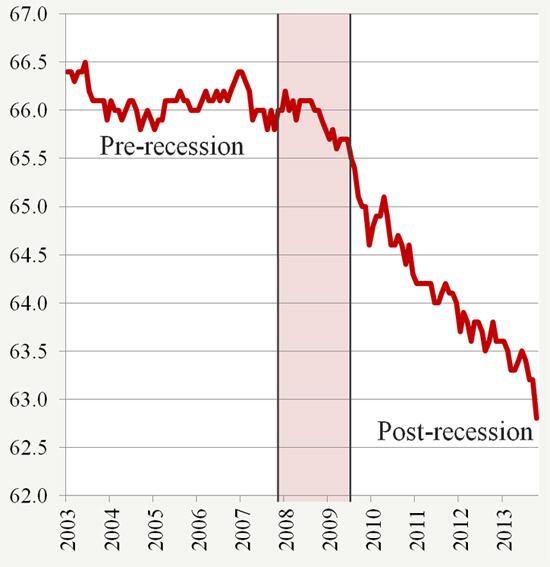
Labor Force Participation down to 62.8%

From the Daily Caller. (H/T Conway)

Excerpt:

The Obama administration’s proposal to raise the minimum wage to $10.10 an hour could result in as many 1,084,000 jobs eliminated from the work force, according to a new study conducted by the Employment Policies Institute (EPI)

“No amount of denial by the president and his political allies — and no number of ‘studies’ published by biased researchers — can change the fact that minimum wage hikes eliminate jobs for low-skill and entry-level employees. Non-partisan economists have agreed on this consensus for decades, and the laws of economics haven’t changed,” Michael Saltsman, research director at EPI, said in a statement.

He offered an alternative to the president’s plan: “Instead of raising small businesses’ labor costs and creating more barriers to entry-level employment, the president and the Senate should focus on policies that help reduce poverty and create jobs.”

The  study was released in the wake of an expected vote on a Senate bill that aims to raise the federal minimum wage from the current $7.25 an hour to $10.10 an hour — a nearly 40 percent increase.

Many Democrats argue that increasing the federal minimum will reduce poverty without having an adverse effect on unemployment.

EPI’s report, which used analysis from economists at Miami and Trinity University, reached a different conclusion.

Researchers used recently updated Census Bureau data from 2012 and 2013 to calculate how each individual state would be impacted by the proposed wage hikes. As a lump sum, Americans would see a loss of at least 360,000 jobs, and perhaps even over one million if hourly wages are increased to $10.10.

The number of job losses would be the most dramatic in large states, such as California and Texas. Economists found that California could lose as many as 100,016 jobs and Texas could see up to 128,617 jobs disappear from its economy.

This article from Investors Business Daily, written by the famous economist Thomas Sowell has more on the effects of raising the minimum wage.

Excerpt:

Switzerland is one of the few modern nations without a minimum-wage law. In 2003, the Economist magazine reported: “Switzerland’s unemployment neared a five-year high of 3.9% in February.”

In February of this year, Switzerland’s unemployment rate was 3.1%. A recent issue of the Economist showed Switzerland’s unemployment rate as 2.1%.

Most Americans today have never seen unemployment rates that low. However, there was a time when there was no federal minimum-wage law in the United States.

The last time was during the Coolidge administration, when the annual unemployment rate went as low as 1.8%. When Hong Kong was a British colony, it had no minimum-wage law. In 1991 its unemployment rate was under 2%.

[…]Most people in the lower income brackets are not an enduring class. Most working people in the bottom 20% in income at a given time do not stay there over time. More of them end up in the top 20% than remain behind in the bottom 20%.

There is nothing mysterious about the fact that most people start off in entry-level jobs that pay much less than they will earn after they get some work experience.

But when minimum-wage levels are set without regard to their initial productivity, young people are disproportionately unemployed — priced out of jobs.

In European welfare states where minimum wages, and mandated job benefits to be paid for by employers, are more generous than in the United States, unemployment rates for younger workers are often 20% or higher, even when there is no recession.

Unemployed young people lose not only the pay they could have earned but, at least equally important, the work experience that would enable them to earn higher rates of pay later on.

Minorities, like young people, can also be priced out of jobs. In the United States, the last year in which the black unemployment rate was lower than the white unemployment rate — 1930 — was also the last year when there was no federal minimum-wage law.

Inflation in the 1940s raised the pay of even unskilled workers above the minimum wage set in 1938. Economically, it was the same as if there were no minimum-wage law by the late 1940s.

In 1948 the unemployment rate of black 16-year-old and 17-year-old males was 9.4%. This was a fraction of what it would become in even the most prosperous years from 1958 on, as the minimum wage was raised repeatedly to keep up with inflation.

A survey of American economists found that 90% of them regarded minimum-wage laws as increasing the rate of unemployment among low-skilled workers.

Harvard University economist Greg Mankiw puts the level of opposition to minimum wage hikes at 79% among professional economists across the ideological spectrum.