Anti-government protesters shot to death by pro-Yanukovych gunmen in Ukraine

From the leftist New York Times.

Excerpt:

Security forces fired on masses of antigovernment demonstrators in Kiev on Thursday in a drastic escalation of the three-month-old crisis that left dozens dead and Ukraine reeling from the most lethal day of violence since Soviet times.

The shootings followed a quickly shattered truce, with enraged protesters parading dozens of captured police officers through Kiev’s central square. Despite a frenzy of East-West diplomacy and negotiations, there was little sign that tensions were easing.

President Viktor F. Yanukovych lost at least a dozen political allies, including the mayor of the capital, who resigned from his governing Party of Regions to protest the bloodshed. Mr. Yanukovych conferred with three foreign ministers from the European Union who had come to press for a compromise solution, practically within sight of the main conflict zone in downtown Kiev.

The sights of bullet-riddled bodies slumped amid smoldering debris, some of them shot in the head, and screaming medics carrying the dead and wounded to emergency clinics, including one in a hotel lobby, shocked the country and the world. The opposition said that at least 70 and as many as 100 people had been killed, while municipal authorities put the day’s death toll at 39.

[…]Sviatoslav Khanenko, a lawmaker and a head of the medical service of the National Resistance Headquarters, said by telephone that about 70 people had been killed and more than 1,000 had been wounded. Some news reports said 100 people had been killed.

The death tolls could not be corroborated. But even at the lower casualty numbers reported by Kiev’s municipal health authorities, Thursday was the most lethal day in Ukraine since independence from the Soviet Union more than 22 years ago.

Negotiations are underway, but no deal has been reached:

The foreign ministers of Germany, Poland and France met with Mr. Yanukovych for more than four hours on Thursday, and then announced that they would stay in Kiev overnight to continue their discussions. “Ahead of us is a night of heavy negotiations,” Marcin Wojciechowski, a spokesman for the Polish foreign minister, Radoslaw Sikorski, wrote on Twitter.

After the initial round of meetings, the Polish prime minister, Donald Tusk, said at a news conference in Warsaw that there were some indications that Mr. Yanukovych would be willing to schedule earlier parliamentary and presidential elections, something he had previously resisted. The presidential elections are scheduled for March 2015.

The great fear now is that the pro-Russia government will declare a “state of emergency”, which would mean the deployment of the army and more killing of innocent protesters.

The protests were started by the pro-Russia President’s refusal to sign a free trade deal with the European Union. A free trade deal would displease his Russian masters, even it would help lift Ukraine out of poverty. 

As usual, conservative Canadian prime minister Stephen Harper is leading the way.

Excerpt:

Canada is expanding a travel ban on senior members of the Ukrainian government and imposing economic sanctions on President Viktor Yanukovych, Prime Minister Stephen Harper announced in an emailed statement Thursday.​

“Canada continues to be outraged by the ongoing violence in Ukraine,” Harper said in the statement.

“Our government has responded by introducing a travel ban on the regime’s senior leaders and announcing medical aid to assist the protesters in their time of need.”

Ukrainian citizens, Harper said, “must be allowed to exercise their democratic right to peaceful protest without being subjected to deadly force and appalling brutality.”

The government is expanding travel restrictions originally announced on Jan. 28 and imposing economic sanctions on the Yanukovych regime and its supporters, the news release said.

The travel ban means the officials sanctioned won’t be allowed into Canada.

“You are not welcome in Canada and we will continue to take strong action until the violence against the people of Ukraine has stopped and democracy has been restored,” Citizenship and Immigration Minister Chris Alexander said at a press conference to announce the sanctions.

[…]The economic sanctions are to “freeze any assets in Canada belonging to senior Ukrainian government officials,” according to a release from Harper’s office.

Meanwhile, Secretary of State John Kerry gave a speech asserting that global warming is as big a threat to the world as terrorism.
Does a commitment to naturalism undermine rational thought and textual meaning?

Dr. William Lane Craig had a formal debate with an atheist philosopher named Alex Rosenberg a few months back that brought up an interesting idea. Rosenberg is a strong naturalist and he suggests all kinds of counterintuitive outworkings of naturalism in his book. Dr. Craig brought up a bunch of those strange views in his debate, and I listed them out in my summary of the debate as follows:

  1. The argument from the intentionality (aboutness) of mental states implies non-physical minds (dualism), which is incompatible with naturalism
  2. The existence of meaning in language is incompatible with naturalism, Rosenberg even says that all the sentences in his own book are meaningless
  3. The existence of truth is incompatible with naturalism
  4. The argument from moral praise and blame is incompatible with naturalism
  5. Libertarian freedom (free will) is incompatible with naturalism
  6. Purpose is incompatible with naturalism
  7. The enduring concept of self is incompatible with naturalism
  8. The experience of first-person subjectivity (“I”) is incompatible with naturalism

We are concerned with #1 and #2 in this post.

Now I was visiting my parents last week in my home town and Dad and I went to church on Sunday. He wanted to listen to some weird sing-song-voiced pastor on the drive there, but I plugged in my smartphone and we listened to these three podcasts by William Lane Craig instead.

Dr. Craig was explaining in part 3 (I think) about how he went on the offensive with the 8 points. One point caught my attention. Craig said that if naturalism is true, then nothing written down is meaningful. He also wanted to know why Dr. Rosenberg would write a book if his worldview entailed that nothing written down is meaningful.

The solution has to do with Rosenberg’s denial of “intentionality”, which is the idea that something can be about something else. For example, I can think about what I had for breakfast today on the way to church (two apples and coffee) or I can think about the sermon today in my home church and how good it was. A naturalist believes that the whole universe is made up of pure matter alone, and matter cannot be about anything. So Rosenberg denies this common sense view of “intentionality” or “aboutness” because there is no room for it on his naturalistic / materialistic / physicalist view of reality.

Here is a post by Bill Valicella on Maverick Philosopher blog that answers Dad’s questions.

First, Rosenberg’s own view from his book.

A single still photograph doesn’t convey movement the way a motion picture does. Watching a sequence of slightly different photos one photo per hour, or per minute, or even one every 6 seconds won’t do it either. But looking at the right sequence of still pictures succeeding each other every one-twentieth of a second produces the illusion that the images in each still photo are moving. Increasing the rate enhances the illusion, though beyond a certain rate the illusion gets no better for creatures like us. But it’s still an illusion. There is noting to it but the succession of still pictures. That’s how movies perpetrate their illusion. The large set of still pictures is organized together in a way that produces in creatures like us the illusion that the images are moving. In creatures with different brains and eyes, ones that work faster, the trick might not work. In ones that work slower, changing the still pictures at the rate of one every hour (as in time-lapse photography) could work. But there is no movement of any of the images in any of the pictures, nor does anything move from one photo onto the next. Of course, the projector is moving, and the photons are moving, and the actors were moving. But all the movement that the movie watcher detects is in the eye of the beholder. That is why the movement is illusory.

The notion that thoughts are about stuff is illusory in roughly the same way. Think of each input/output neural circuit as a single still photo. Now, put together a huge number of input/output circuits in the right way. None of them is about anything; each is just an input/output circuit firing or not. But when they act together, they “project” the illusion that there are thoughts about stuff. They do that through the behavior and the conscious experience (if any) that they produce. (Alex Rosenberg,The Atheists’ Guide to Reality: Enjoying Life Without Illusions.  The quotation was copied from here.)

And here is what Bill V. says about that:

Rosenberg is not saying, as an emergentist might, that the synergy of sufficiently many neural circuits gives rise to genuine object-directed thoughts.    He is saying something far worse, something literally nonsensical, namely, that the object-directed thought that thoughts are object-directed is an illusion.  The absurdity of Rosenberg’s position can be seen as follows.

  1. Either the words “The notion that thoughts are about stuff is illusory”  express a thought — the thought that there are no object-directed thoughts — or they do not.
  2. If the latter, then the words are meaningless.
  3. If the former, then the thought is either true or false.
  4. If the thought is true, then there there are no object-directed thoughts, including the one expressed by Rosenberg’s words, and so his words are once again meaningless.
  5. If the thought is false, then there are object-directed thoughts, and Rosenberg’s claim is false.

Therefore:

  • Rosenberg’s claim is either meaningless or false.  His position is self-refuting.

As for the analogy, it is perfectly hopeless, presupposing as it does genuine intrinsic intentionality.  If I am watching a movie of a man running, then I am under an illusion in that there is nothing moving on the movie screen: there is just a series of stills. But the experience I am undergoing is a perfectly good experience that exhibits genuine intrinsic intentionality: it is a visual experiencing of a man running, or to be perfectly punctilious about it: a visual experiencing AS OF a man running.  Whether or not the man depicted exists, as would be the case if the movie were a newsreel, the experience exists, and so cannot be illusory.

To understand the analogy one must understand that there are intentional experiences, experiences that take an accusative.  But if you understand that, then you ought to be able to understand that the analogy cannot be used to render intelligible how it might that it is illusory that there are intentional experiences.

What alone remains of interest here is how a seemingly intelligent fellow could adopt a position so manifestly absurd.  I suspect the answer is that he has stupefied himself  by  his blind adherence to scientistic/naturalistic ideology.

If you want to sort of double check the details, then go ahead and watch the debate or read my summary or listen to the debate audio, and then listen to Dr. Craig’s three podcasts that I linked above.

I know a lot of you are thinking right now “Hey! You cheater! That’s a presuppositional argument! You said they were bad!” Well, I didn’t say they were bad, I said that the epistemological view of presuppositionalism was bad. Presuppositional arguments are good. See below for a few posts about them. Use them all you can, but use the good scientific and historical evidence, too.

Obama silent as Venezuelan government violently represses democratic opposition

Socialism in Venezuela

From the Heritage Foundation.

Excerpt:

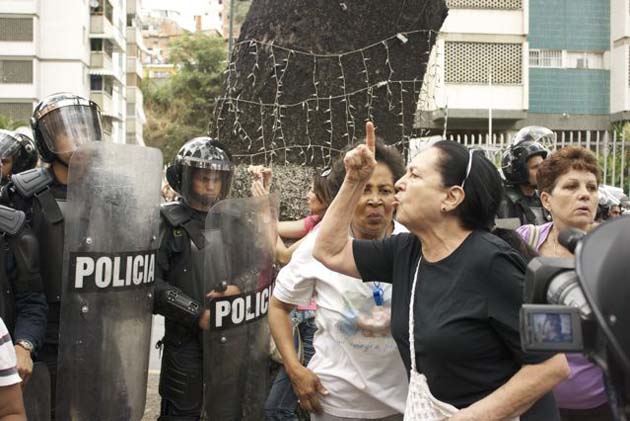
Thousands of supporters and opponents of Venezuela’s socialist government have taken to the streets this past week. Initiated by student groups, the protestors are voicing their grievances against soaring crime rates, high inflation, a shortage of basic goods, and a lack of political and economic freedom.

All the while, the Obama Administration has been relatively silent. The occasional press release from the State Department uses the same recycled lines of “deep concern” that we’ve come to expect from an indifferent Administration. Not even the expulsion of three U.S. diplomats Sunday evening could elicit a stronger statement.

So far, three people have been killed and hundreds have been arrested and tortured. Some even disappeared thanks to government security forces. Videos, pictures, and eyewitness testimony blame the governing regime for the deaths of two of the victims. Armed with automatic weapons, tear gas, grenades and even tanks, the military and police are using all means to silence the democratic opposition.

Much like the Arab Spring, demonstrators have taken to social media—mainly Twitter—to relay information to the international community.

Yet a few days into the demonstrations, the Venezuelan government shut down Twitter and one of the last private cable broadcasters, Colombia’s NTN24. The government has even called for the arrest of leading opposition figurehead Leopoldo Lopez.

At the helm of this sinking ship is Venezuela’s leader, Nicolas Maduro. The former union leader and bus driver-turned-ordained president, he was handpicked by his successor Hugo Chavez.

Meanwhile on Wednesday, CNS News reported on the latest developments.

Excerpt:

Violent clashes flared up across Venezuela on Wednesday as the nation waited to learn what charges jailed opposition leader Leopoldo Lopez will face for organizing mass protests that have breathed new life into the movement challenging socialist rule in the oil-rich nation.

[…]There was no immediate word on whether there were any new casualties, after a week of demonstrations and clashes that have resulted in at least six deaths and more than 100 injuries.

[…]The president also said he would take harsh measures in Tachira, an opposition stronghold on the western border with Colombia where there have been fierce clashes between National Guard troops and opposition protesters. Maduro said he is prepared to declare a “state of exception,” a form of martial law.

“If I have to decree a state of exception for Tachira and send in the tanks, I am ready to do it,” he said.

[…][I]n Valencia, the third largest city… National Guard troops fired rubber bullets and unknown gunman on motorcycles fired live rounds at protesters. Genesis Carmona, a 22-year-old university student who had been Miss Tourism 2013 for the state of Carabobo, was struck in the head and killed by a bullet, a death that reverberated in a country that prizes beauty queens.

You can always count on big government socialists to resort to violence when their communist policies fail.

Related posts