My church probably isn’t doing anything for Pulpit Freedom Sunday, because they are a gospel every week church. It’s really not clear to me whether my minister is even pro-life or pro-marriage, because he never talks about anything practical. However, I was able to dig up this 2012 sermon from Dr. Wayne Grudem, an amazing pastor who does have a position on many issues relevant to the Christian worldview.
The topic is “Moral and spiritual issues in the 2012 election”.
Here it is: (68 minutes, Dr. Grudem starts 4 minues in)
Details:
This message was delivered by Dr. Wayne Grudem at Calvary Chapel Chino Hills on Pulpit Freedom Sunday. Dr. Grudem addresses directly and poignantly the spiritual and moral issues we face in the upcoming 2012 Election. He urges believers to vote according to a Biblical world view. Dr. Grudem has an excellent understanding of not only the Bible and Theology, but also how the United States political system really works. He is author of the bestselling, “Systematic Theology” (used in numerous seminaries), “Politics According to the Bible,” and he is also the General Editor of the bestselling “ESV Study Bible.” Please dedicate an hour and listen to him; more importantly, please heed his wisdom and vote responsibly.
The sermon notes are free to download. (PDF) I recommend printing them to follow along with the sermon.
Here’s one of slides, just to show you what Wayne Grudem can do:
Pulpit Freedom Sunday: can your pastor do this?
Can your pastor do that? Mine can’t.
I think a lot of people like to think of Christianity as something that is about your personal well-being, or maybe your personal morality. If you attend a pretty typical gospel-every-week church, then you may never learn how the Christian worldview applies to the political issues of the day. It’s “too divisive”.
If you’re looking for the best book on the Bible and policy, it’s Wayne Grudem’s “Politics According to the Bible”. I really really endorse that book.
Carroll was as good of a speaker as Craig in terms of style. Very easy to listen to, very quick on his feet, very civil. There was no clear winner on style.
It was difficult to assess the truth value of scientific points being made, especially for the layperson. I explained a few of them in my posts earlier this week, but I think laypeople might struggle with them if they are hearing about these things for the first time.
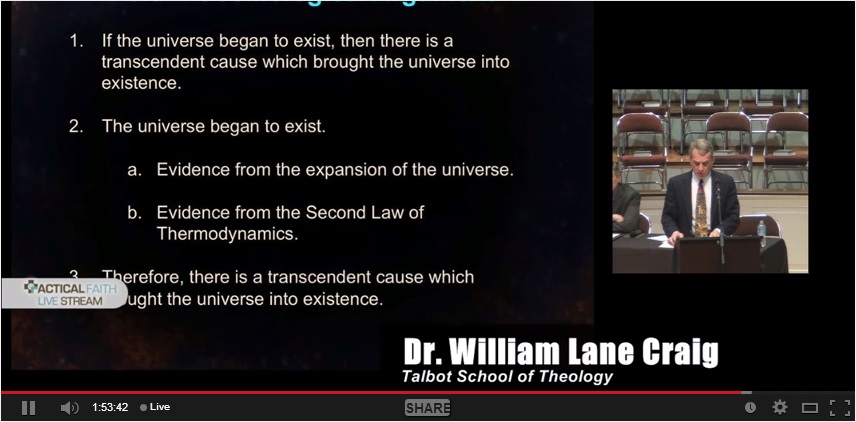
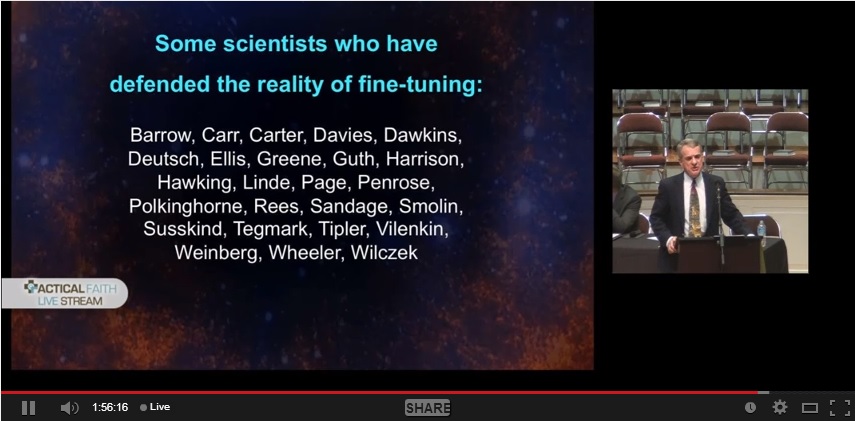
A couple of Craig’s slides: (click for larger images)
Slide 1 of 2:
Dr. Craig slide #1 of 2
Slide 2 of 2:
Dr. Craig slide #2 of 2
Quick summary: (this is not complete, because I couldn’t get everything they were saying noted)
Dr. Craig defended two arguments: 1) the kalam cosmological argument and the fine-tuning argument.
Dr. Craig supported the origin of the universe with 1) the expansion of the universe and 2) the second law of thermodynamics.
Dr. Craig said that the BGV theorem supports a beginning for the universe.
Dr. Craig said that the consensus of scientists did not accept Carroll’s naturalistic cosmology, quoting Stephen Hawking in support.
Dr. Craig said that multiverse models fall victim to the Boltzmann brain problem, where we should observe Boltzmann brains coming into existence and then phasing out again far more probably than embodied minds. But we observe embodied minds, and no Boltzmann brains.
Dr. Carroll said that science cannot study metaphysical questions.
Dr. Carroll said that science is about making models that may or may not be consistent with the experimental data.
Dr. Carroll said that the BGV theorem does not support a beginning for the universe.
Dr. Carroll proposed 17 alternative cosmologies, but did not provide a shred of scientific evidence for any of them, the way that Craig did for the standard model.
Dr. Carroll refuted Dr. Craig’s citation of Stephen Hawking, and Craig yielded the point.
Dr. Carroll speculated that science might progress to the point where the fine-tuning can be explained without an intelligent cause, and he gave an example of where that happened (inflation).
Dr. Craig argued that all 17 of the models suggested by Carroll either conflicted with evidence, had serious problems or did require a beginning.
Dr. Craig argued that Carroll’s own model required a beginning.
Dr. Craig argued that Carroll’s own model fell victim to the Boltzmann brain problem.
Dr. Craig argued that Carroll’s own model violated the second law of thermodynamics.
Dr. Craig re-stated his point that the baby universe spawning in Carroll’s model was speculative and incomplete, and cited Christopher Weaver’s work.
Dr. Carroll denied that things that pop into being out of nothing require a transcendent cause.
Dr. Carroll reiterated that science can only make naturalistic models, and that he did not have to answer questions about ultimate causes.
Dr. Carroll showed a photo of Alan Guth expressing his opinion that the universe is “probably” eternal. No evidence was given for this assertion.
Dr. Carroll said that the fine-tuning was not done in an optimal way, because one fine-tuned value was lower than it needed to be, and it should be exactly what it needed to be if God did it.
Dr. Carroll said that a finely-tuned universe is more probably in naturalism than in theism, because God can do anything he wants and doesn’t need a fine-tuned universe.
Dr. Carroll said he would stop defending his model now, and would instead defend Aguirre-Gratton.
Dr. Craig gave three reasons why the universe popping into being out of nothing requires a transcendent cause.
First, he said that nothing cannot cause anything to happen, because nothing is nothing.
Second, he said that if things pop into being out of nothing, then why don’t we see it happening all the time with other things.
Third, he said that we have no reason to dismiss the causal principle, especially when it is the basis of scientific inquiry and has been so fruitful in the progress of science.
Dr. Craig reiterated that baby universes in Carroll’s model would be dominated by Boltzmann brains, and we don’t observe that.
Dr. Craig said that even on the quantum gravity models that Carroll mentioned, there would still be a beginning.
Dr. Carroll said that Craig mustn’t say “popped into being” but instead that “there was a first moment of time”.
Dr. Carroll said that his model does indeed violate the second law of thermodynamics “YES!”.
At this point Carroll stopped talking about the topic of the debate and started expressing personal opinions about religion. It’s funny how often atheists do this in debates.
Dr. Carroll said that most theists don’t believe in God because of cosmology, but because of community and feelings.
Dr. Carroll said that science had learned a lot in the last 2000 years, so theism was false.
Dr. Carroll said that most philosophers don’t think that God exists, so theism was false.
Dr. Carroll said microscopes and telescopes were absent 2000 years ago, so theism was false.
Dr. Carroll said that religion should be about community and feelings, not about what is true.
Conclusion:
My conclusion was that Carroll lost because he is just satisfied to throw theories out and not to argue that they are true by citing evidence. Carroll never seemed to be interested in finding out what is true, but instead he just wanted to tell a story that didn’t include God, and assert that by Occam’s Razor, his story was a better explanation. I am not impressed with theoretical speculations, although the layperson might be. I kept waiting for him to respond to Craig’s points about how his model was falsified by experimental evidence and observations, e.g. – the Boltzmann brains or the baby universe generation, and he never cited the evidence I wanted him to cite. Craig did have some evidence for his views, but he could have been stronger in making his case. He could have shown the e-mail from Vilenkin that stated that he had understood the BGV theorem, and was using it correctly, for example.
For me the winning side comes down to evidence. The standard model is the standard model because of scientific evidence. Until that evidence is overturned, then speculative models are of no interest to anyone who is evidence-driven. Speculations are not science. A philosophical presupposition of metaphysical naturalism is not science.
The nice thing is that Robin Collins, one of Craig’s respondents, went deep into the science of the fine-tuning, especially on one of my favorite data points, the cosmic microwave background radiation. The paper he presented is now posted on his web site (H/T Christian Apologetics Alliance). I posted about the CMBR before in my post about particle physicist Michael Strauss lecture on cosmology and fine-tuning at Stanford University and the his more recent lecture at the University of Texas. Note that Strauss is an experimental physicist, not a theoretical physicist like Carroll.
Here’s another review of the debate by Randy Everist of Possible Worlds blog. He explains the back-and-forth over Boltzmann brains and the BGV theorem in more detail.
This comment by Gaza on the Elusive Wapiti blog deserves a post of it’s own. He is responding to the video posted in this post.
He writes [in full]: (one part redacted)
One thing that Helen seems to miss is how women value and prioritize marriage and what role this plays vis a vis the male corollary.
The “story” isn’t just about men being “on strike” or even (to Helen’s credit) rationally choosing to delay and/or avoid; it must also include how women treat marriage WRT their own valuation and prioritization and life decisions (NOT merely stated desires).
There are not swarms of 25 y/o female college-grads looking for a husband with no willing men within sight. There are, however, swarms of 25 y/o/ female college-grads looking to have fun, travel, chase dreams, build careers, and explore their options.
I’ve “dated” a few of these women; most (and their social circles included) are so focused on the self-indulgence (“experience”) and the status associated with sexual conquest/power that any mention of marriage is usually as a joke (enter the “boyfriends/husbands are boring/stupid/lazy” meme); marriage is merely some distant thing to be acquired at some seemingly distant age.
Sure, over time (cue: the wall), the distant thing becomes a stated desire, but the transition from stated-desire to behavioral change and actual prioritization often takes years. I meet women well into their 30’s who still can’t alter their behaviors to demonstrate congruence with their stated desires.
But that is when we start to hear how important marriage is, how men are avoiding commitment, why men should value marriage. All bacon-wrapped in various shaming mechanisms. The women singing the “Man-up and marry me” tune are not the 25 y/o versions; they are too busy singing the “you go girl” showtunes, exactly as prescribed by the Sandberg, lean-in, [binge drinking, continuous alpha male hookups, alpha male cohabitation], [and later, jump off the carousel into a marriage to a beta provider that makes her perpetually feel that she married down compared to the alphas that she used to hookup with while drunk].
So we can plainly see how something is valued based on the prioritization of one’s choices. Most young women value marriage as an idea, as a capstone to her personal journey; an indicator of status and achievement but not as a goal in-of-itself and not as a life decision that supersedes the accumulation of personal experience, the flexing her sexual and relationship power, or the kindling her optionality.
These women desire to “hang-out” with the most attractive men they can, under any number of relationship approximations while pursuing their personal journeys and then suddenly desire to elevate commitment and marriage as something paramount, right around the same time their ability to define and opt-in/out of those indulgent relationship approximations wanes. Hmm.
After 10+ years of treating men and relationships as consumable commodities, marriage is now so valuable? So sacred that it will magically be more robust in the face of challenges, requiring more giving and less taking than those previous marital approximations, and yet because it is now a “Marriage”, it won’t be treated as merely a vehicle for the pursuit of her apparently perpetually fleeting “happiness”? Convince me.
There is a false premise at work that assumes that it is men who are devaluing marriage. Sure, there is some truth to this, but woman are messaging their own valuation of marriage as well; in real-time, often in very overt means and often at the expense of men who are still clinging to some idealistic view of marriage.
And likely those are the very men who are willing and able to be husbands at 25. The very same men who will grow to become self-sufficient 35 y/o men feeling their own blossoming optionality, harvesting their own “experiences” with the 25 y/o versions of the suddenly-marriage-minded women, while a decade of observational and experiential evidence of what women truly value buries what remains of their marital idealism.
Tl:dr I’d consider marriage to a woman who has demonstrated through her choices, prioritization, sacrifice and delayed gratification that marriage is valuable to her and who can articulate how it would be valuable to me. [not holding breath]
What do you think? Is that something that you are seeing more of in the current generation of young, unmarried women? I have to confess, I see a lot of emphasis among Christian women on short-term missions trips and on careers, but not much planning on how to be prepared for marriage. In my experience, there is not much preparation work going on, and marriage is put off later and later. This is despite the fact that a woman’s fertility declines starting at age 27 and is pretty much dead at 35. IVF is very expensive, but has a higher risk of birth defects and and can often lead to too many embryos, some of which will then need to be aborted.
It would be nice if there were some wisdom being transferred from older, married women to young, unmarried women, but I don’t see it happening. What I see happening is young women, including ones raised in Christian homes, going off to college to binge drink and hookup and cohabitate, and always expressing the desire for marriage “some day”. But marriage is something you prepare for early with every decision. Some decisions are not good preparation for marriage. I get the impression that young, unmarried women think that marriage is “boring” and not the way to “make a difference”, and so in practice, they are trying other things.
Remember, the offer that a woman such as Gaza describes to a man is not the same as the offer of marriage that was made by 20-year-old women in the 1950s.
Being the legally and socially recognized head of the household.
An expectation of regular sex.
Legal rights to children.
Lifetime commitment.
That you are guaranteed a chaste bride on your wedding night.
Men liked the original version of marriage without the modern debasements. Should they feel obligated to settle for the new version of marriage which is influenced by radical feminism? I would have to be convinced.


 WINTERY KNIGHT