Is asking “Am I going to Hell?” a good response to scientific arguments for theism?

I want to use this woman’s story to show how sensible atheists reach a belief in God.

Excerpt:

I don’t know when I first became a skeptic. It must have been around age 4, when my mother found me arguing with another child at a birthday party: “But how do you know what the Bible says is true?” By age 11, my atheism was so widely known in my middle school that a Christian boy threatened to come to my house and “shoot all the atheists.” My Christian friends in high school avoided talking to me about religion because they anticipated that I would tear down their poorly constructed arguments. And I did.

As I set off in 2008 to begin my freshman year studying government at Harvard (whose motto is Veritas, “Truth”), I could never have expected the change that awaited me.

It was a brisk November when I met John Joseph Porter. Our conversations initially revolved around conservative politics, but soon gravitated toward religion. He wrote an essay for the Ichthus, Harvard’s Christian journal, defending God’s existence. I critiqued it. On campus, we’d argue into the wee hours; when apart, we’d take our arguments to e-mail. Never before had I met a Christian who could respond to my most basic philosophical questions: How does one understand the Bible’s contradictions? Could an omnipotent God make a stone he could not lift? What about the Euthyphro dilemma: Is something good because God declared it so, or does God merely identify the good? To someone like me, with no Christian background, resorting to an answer like “It takes faith” could only be intellectual cowardice. Joseph didn’t do that.

And he did something else: He prodded me on how inconsistent I was as an atheist who nonetheless believed in right and wrong as objective, universal categories. Defenseless, I decided to take a seminar on meta-ethics. After all, atheists had been developing ethical systems for 200-some years. In what I now see as providential, my atheist professor assigned a paper by C. S. Lewis that resolved the Euthyphro dilemma, declaring, “God is not merely good, but goodness; goodness is not merely divine, but God.”

Joseph also pushed me on the origins of the universe. I had always believed in the Big Bang. But I was blissfully unaware that the man who first proposed it, Georges Lemaître, was a Catholic priest. And I’d happily ignored the rabbit trail of a problem of what caused the Big Bang, and what caused that cause, and so on.

By Valentine’s Day, I began to believe in God. There was no intellectual shame in being a deist, after all, as I joined the respectable ranks of Thomas Jefferson and other Founding Fathers.

I wouldn’t stay a deist for long. A Catholic friend gave me J. Budziszewski’s book Ask Me Anything, which included the Christian teaching that “love is a commitment of the will to the true good of the other person.” This theme—of love as sacrifice for true good—struck me. The Cross no longer seemed a grotesque symbol of divine sadism, but a remarkable act of love. And Christianity began to look less strangely mythical and more cosmically beautiful.

So, I want to point out the progression of her beliefs from atheist to deist to Christian. First, she listened to the scientific arguments for God’s existence, which took her to deism, which is a variety of theism where God just creates the universe and then doesn’t interfere with it after. Those arguments, the Big Bang and the cosmic fine-tuning, were enough for her to falsify atheism and prove some sort of theism. After that, she remained open to the evidence for Christian theism, and finally got there after looking at other evidence.

But this makes me think of how some of the atheists that I talk to do the exact opposite of what she did. I start off by explaining to them scientific evidence for a Creator and Designer. I explain the mainstream discoveries that confirm an origin of the universe (e.g. – light element abundance predictions and observations), and I cite specific examples of fine-tuning, (e.g. – the gravitational constant). I explain protein sequencing and folding, and calculate the probabilities of getting a protein by chance. I explain the sudden origin of the phyla in the Cambrian explosion, and show why naturalistic explanations fail. I talk about the fine-tuning needed to get galaxies, solar systems and planets to support life. But many of these atheists don’t become deists like the honest atheist in the story. Why not?

Well, the reason why not is because they interrupt the stream of scientific evidence coming out of my mouth and they start to ask me questions that have nothing to do with what we can know through science. See, evangelism is like building a house. You have to start with the foundation, the walls, the plumbing, the electricity, etc., but you can’t know all the specific details about furniture and decorations at the beginning. But militant atheists don’t care that you are able to establish the foundations of Christian theism – they want to jump right to the very fine-grained details, and use that to justify not not building anything at all. Just as you are proving all the main planks of a theistic worldview with science, they start asking “am I going to Hell?” and telling you “God is immoral for killing Canaanite children”, etc. They want to stop the construction of the house by demanding that you build everything at once. But, it is much easier to accept miracles like the virgin birth if you have a God who created the universe first. The foundation comes first, it makes the later stuff easier to do.

So rather than adjust their worldview to the strong scientific evidence, and then leave the puzzling about Hell and Old Testament history for later, they want to refute the good scientific arguments with “Am I going to Hell?”. How does complaining about Hell and unanswered prayer a response to scientific evidence? It’s not! But I think that this does explain why atheists remain atheists in the face of all the scientific evidence against naturalism. They insulate their worldview from the progress of science by focusing on their emotional disappointment that they are not God and that God isn’t doing what they want him to do. That’s the real issue. Authority and autonomy. In my experience, they are usually not accountable to science, although there are, thank God, exceptions to that rule.
Decorated pilot faces discharge for telling lesbians to stop breaking Army rules

From the Washington Times.

Excerpt:

The Army is moving to discharge a decorated combat pilot who intervened to stop two lesbian officers from showing what he considered inappropriate affection on the dance floor during a full-dress formal ball at Fort Drum, New York, in 2012.

Lt. Col. Christopher Downey, who was once assigned to the White House and completed tours in the Iraq and Afghanistan wars, ended up being convicted administratively of assaulting a soldier trying to videotape the kissing and grabbing. Col. Downey’s attorney, Richard Thompson, says his client merely pushed down the camera to prevent photos and video that could end up on social media.

Mr. Thompson said Col. Downey’s commanding officer also convicted him of violating the directive that ended the ban on gays openly serving in the military.

“It’s political correctness run wild,” Mr. Thompson said. “Military rules do not apply to lesbian officers because of political correctness.”

Col. Downey won early battle with the Army last year. A special three-officer “show cause” board reviewed the punishment and unanimously ruled that the evidence showed he did not violate Army rules.

“The allegation of conduct unbecoming an officer … is not supported by the preponderance of the evidence,” the board wrote. “The findings do not warrant separation.”

Yet Col. Downey still faces separation by an Army forced-retirement board that began meeting this week.

On the night of April 14, 2012, seven months after President Obama lifted the ban on acknowledged gays in the military, Col. Downey moved to the dance floor to caution the two lesbian officers, a second lieutenant and a captain.

A warrant officer had approached Col. Downey and complained that their prolonged French kissing, buttocks grabbing and disrobing of Army jackets violated Army rules against inappropriate displays of public affection while in uniform on base, his attorney said.

He said the captain, who since has left the Army, complained that she and her girlfriend, whom she later married and then divorced, were victims of discrimination.

“Lt. Col. Downey gave his all to the Army and to the country he loves, yet the Army he so loyally served threw him under the bus merely to avoid negative press from the homosexual community,” Mr. Thompson said.

And the more important thing is thing about the chilling effect that a case like this has on others, and how this in-your-face sexuality coarsens the culture. It’s now the case that you can’t even disagree with homosexuality without losing your job.

One other thing about that couple that sued for discrimination. It’s not surprising to me that the two lesbians married and then divorced very quickly, as lesbians have an incredibly low stability rate for their relationships.

Note:

Other research says the same thing about relationship dissolution rates. A study of two generations of British couples (one born in 1958, the other 1970) in same-sex cohabiting, opposite-sex cohabiting, and heterosexual marriage relationships found the same-sex relationships are dramatically more likely to break up than the opposite-sex cohabiting and married relationships. The probabilities of the various relationships surviving to the four- and eight-year anniversaries are dramatic. After four years, 88 percent of married opposite sex couples are together, 67 percent of opposite-sex cohabiting couples, and only 37 percent of same-sex cohabitors. After eight years, those numbers fall to 82 percent, 60 percent, and 25 percent, respectively.

The author explains the magnitude of his findings “are consistent with previous research in other countries.” There were no significant differences between the two generational cohorts, indicating that issues of social stigma and growing social acceptance had no meaningful effect.

Other studies conducted by celebrated lesbian scholars find notable instability in lesbian homes, even those with children. The current National Longitudinal Lesbian Family Study (NLLFS) found “a significant difference” in family dissolution rates when comparing lesbian with mother-father headed families, 56 percent and 36 percent respectively.

Additional research by other scholars highlights a major comparative study between hetero and lesbian homes where, in the five-year period of the study, six of the fourteen lesbian mother-headed homes had broken up compared to only five of the thirty-eight mother“father headed homes. They creatively explain that this stability imbalance is likely due to the “high standards lesbians bring to their intimate unions.” Mundy says that “lesbians . . . tend to discuss things endlessly.” Whatever the reason, lesbian relationships are dramatically more volatile, fragile, and short-lived than heterosexual couples, whether cohabiting or married.

And lesbians also have a very high rate of domestic violence.

Look:

In 2013, the CDC released the results of a 2010 study on victimization by sexual orientation, and admitted that “little is known about the national prevalence of intimate partner violence, sexual violence, and stalking among lesbian, gay, and bisexual women and men in the United States.” The report found that bisexual women had an overwhelming prevalence of violent partners in their lives: 75 percent had been with a violent partner, as opposed to 46 percent of lesbian women and 43 percent of straight women. For bisexual men, that number was 47 percent. For gay men, it was 40 percent, and 21 percent for straight men.

That’s from an article by the left-leaning Atlantic, by the way. Why would anyone encourage a woman to enter this lifestyle?

Obamacare bronze plans up 15% on average, but there’s more wrong than just that

Sure, the cost of Obamacare health plans is higher, especially the cheapest bronze plans which are going up 15%.  But that’s not the only thing wrong with Obamacare. Here are 14 more ways Obamacare is a disaster, as reported by the Federalist.

The list:

  1. Premium Increases
  2. Exchange Subsidy Roller Coaster
  3. Reducing the Quality of Insurance
  4. Slashing Quality of Employer-Provided Insurance
  5. Here Come the Trial Lawyers!
  6. Enrollees Are Older and Sicker than Average
  7. People Dropping Exchange Coverage Are the Ones Exchanges Need Most
  8. The Exchanges Benefit Big Business at the Expense of Smaller Businesses
  9. Policy Cancellation Déjà Vu
  10. Medical Research Has Tanked
  11. Medicaid Still Provides Terrible Care for the Poor
  12. The Deficit Will Increase $131 Billion in the Next Ten Years
  13. Fewer Jobs for Low-Wage Workers
  14. More Economic Woes Ahead

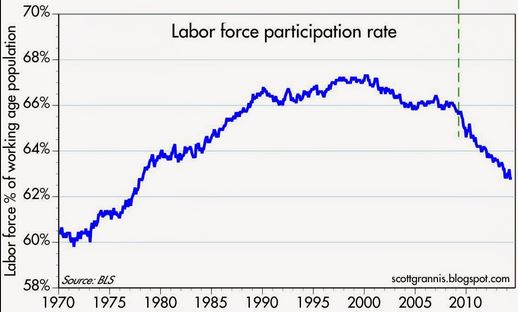
The last two stuck out to me, because they have to do with jobs.

Labor force participation rate

Thirteen:

Obamacare’s employer mandate requires employers with 50 or more full-time employees—“full time” defined as 30 hours or more per week—to provide their workers with health insurance or pay a fine. Critics claimed this would lead to an increase in part-time work leading up to the mandate’s imposition, but many liberal economists insisted part-time work was not increasing. Then Jed Graham of Investor’s Business Daily dug into the data and found that work hours had declined for employees in industries where the average hourly wage was $14.50 or less.

Graham showed that part-time work appeared stable because the decline in hours for low-wage workers was offset by an increase in hours for higher-paid workers. As Graham states, “Overall, in these low-wage industries which employ 30 million rank-and-file workers, the average workweek shrank to 27.3 hours per week in July [2014]…. For low-wage industry workers… the recovery in the workweek from a then-record low 27.5 hours in mid-2009 began to reverse in the latter half of 2012, and it’s been pretty much all downhill since then.” Employers appear to be limiting the work hours of employees who are least likely to have employer-provided insurance. Given the low wages, there are likely many workers in this group who are in need of full-time hours.

Fourteen:

The employer mandate is causing even more damage as its January 1, 2015 imposition nears. In August, the Federal Reserve Banks of Dallas, New York, and Philadelphia released survey data on how businesses in their regions were responding to the costs of Obamacare. Businesses that had or were expecting to increase part-time employees, outsourcing, and prices far exceeded the number that that had or intended to reduce them. More business also had or intended to reduce the total number of workers and/or wages in response to Obamacare than expected to increase them.

Obamacare is a job killer. And it hurts low-wage workers the most. Imagine what would happen if Obama did an executive order to raise the price of low-wage workers for employers – another incentive to get rid of them. What a disaster.