
373 children were victims of UK Muslim sex trafficking gang in Oxfordshire

The UK Labour Party
The UK Labour Party

This is reported by the ultra-leftist BBC, so they are very politically correct.

They write:

As many as 373 children may have been targeted for sex by gangs of men in Oxfordshire in the last 16 years, a serious case review found.

The investigation came after a sadistic sex gang of seven men were jailed in 2013 for abusing six girls in Oxford, between 2004 and 2012.

Thames Valley Police and Oxfordshire County Council made “many errors” in that case and could have acted sooner.

A victim of the gang said the issue had been “swept under the carpet”.

Of the 373 cases, the council said about 50 victims were boys.

[…]The report also called for research into why a significant proportion of people convicted in these kind of cases are of “Pakistani and/or Muslim heritage”.

In the Oxford case, known as Operation Bullfinch, two of the men were of east African origin and five of Pakistani origin.

Part of the problem with dealing with problems caused by unrestricted immigration from Muslim countries (e.g. – gang raping, sex-trafficking, terrorism) is that the leftist political parties don’t dare take action for fear of offending Muslims.

You’ll recall that our own State Department and President have both made statements to the effect that Islamic terrorists are only committing acts of terrorism because they are poor. Presumably, they also think that poor Christians and Jews would do the same if they were poor. It has nothing at all to do with an anti-West culture that is rooted in radical Islam. The solution – according to the secular left – is to give them jobs.

Let’s take a look at the story of Jihad John to see how well that worked:

Jihadi John family’s 20 years on benefits: How it’s cost taxpayers up to £400k to house fanatic and his relatives in upmarket areas

  • Mohammed Emwazi’s family granted asylum in 1996 after leaving Kuwait
  • They have since lived in five homes, one of which was worth £450 per week
  • Neither his father Jasem, 51, nor mother Ghaneya worked while in Britain
  • Westminster City Council is still paying rent on family’s £600,000 flat
  • One landlord described the family as ‘parasites’ and ‘tenants from hell’
  • MPs blasted family for ‘abusing hospitality’ and say payouts are ‘disgrace’

Jihadi John and his asylum-seeking family have milked the British benefits system for 20 years, the Mail can reveal today.

Housing the Islamic State executioner and his relatives in affluent parts of London has cost taxpayers up to £400,000.

One landlord said Mohammed Emwazi’s family were ‘parasites’ and ‘tenants from hell’. Incredibly, they are still believed to be pocketing £40,000 a year in handouts despite there being no sign of them in Britain.

Emwazi’s father Jasem, who has six children, is back in his native Kuwait – the country he claimed he fled fearing for his life.

Westminster City Council is still paying the rent on the family’s £600,000 flat even though the rules say housing benefit should normally be stopped after 13 weeks.

[…]The Mail investigation can also reveal that:

  • The family fled Kuwait after the first Gulf War, claiming persecution because they were seen to favour the Iraqi invasion in 1990;
  • They claimed asylum in the UK and won refugee status in 1996;
  • Five years later they were made British citizens and then started travelling back to Kuwait;
  • The family have claimed hundreds of thousands of pounds in benefits in Britain since their arrival in the country and lived in homes costing £450 a week;
  • Emwazi’s father is now back working in Kuwait while the family continues to receive state assistance for the home in Queen’s Park.

The owner of a house in Little Venice where they lived for four years said Westminster City Council paid £450 a week in rent for the family – £23,400 a year.

Two more of the five owners of homes they have lived in have confirmed their rent was paid by the council or through a housing association.

Assuming the same £23,400-a-year cost, then the bill over 20 years is £468,000.

I think what the secular left really means by “give them jobs” is “give them money for doing nothing”, i.e. – welfare. Political correctness is an ideology for wealthy elites, but it’s not so good for the poor people who actually have to deal with the consequences of the bad policies.

Now if you ask the Labour Party, who created these generous immigration policies and welfare programs, about their policies, they will tell you that this is all working as designed. It’s a feature, not a bug. They feel very good about themselves, calling good evil, and evil good. They are very generous handing out money they didn’t work for to people who then use it to kill the people who worked for the money. This is morally good, according to the secular left.

If we are really going to get serious about the problem, maybe we need leaders who aren’t so politically correct.
U.S. millennials perform horribly on technology tests compared to other countries

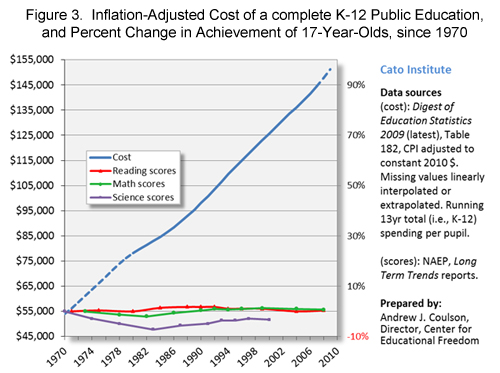
Education spending has tripled since 1970

This is from the leftist Washington Post.

Excerpt:

There was this test. And it was daunting. It was like the SAT or ACT — which many American millennials are no doubt familiar with, as they are on track to be the best educated generation in history — except this test was not about getting into college. This exam, given in 23 countries, assessed the thinking abilities and workplace skills of adults. It focused on literacy, math and technological problem-solving. The goal was to figure out how prepared people are to work in a complex, modern society.

And U.S. millennials performed horribly.

That might even be an understatement, given the extent of the American shortcomings. No matter how you sliced the data – by class, by race, by education – young Americans were laggards compared to their international peers. In every subject, U.S. millennials ranked at the bottom or very close to it, according to a new study by testing company ETS.

“We were taken aback,” said ETS researcher Anita Sands. “We tend to think millennials are really savvy in this area. But that’s not what we are seeing.”

The test is called the PIAAC test. It was developed by the Organization for Economic Co-operation and Development, better known as the OECD. The test was meant to assess adult skill levels. It was administered worldwide to people ages 16 to 65. The results came out two years ago and barely caused a ripple. But recently ETS went back and delved into the data to look at how  millennials did as a group. After all, they’re the future – and, in America, they’re poised to claim the title of largest generation from the baby boomers.

U.S. millennials, defined as people 16 to 34 years old, were supposed to be different. They’re digital natives. They get it. High achievement is part of their makeup. But the ETS study found signs of trouble, with its authors warning that the nation was at a crossroads: “We can decide to accept the current levels of mediocrity and inequality or we can decide to address the skills challenge head on.”

The challenge is that, in literacy, U.S. millennials scored higher than only three countries.

In math, Americans ranked last.

In technical problem-saving, they were second from the bottom.

“Abysmal,” noted ETS researcher Madeline Goodman. “There was just no place where we performed well.”

Nope. U.S. millennials with master’s degrees and doctorates did better than their peers in only three countries, Ireland, Poland and Spain. Those in Finland, Sweden and Japan seemed to be on a different planet.

Top-scoring U.S. millennials – the 90th percentile on the PIAAC test – were at the bottom internationally, ranking higher only than their peers in Spain. The bottom percentile (10th percentile) also lagged behind their peers.

Now the problem can’t be to spend more money on education – we already spend more money than all the other countries.

Excerpt:

The United States spent more than $11,000 per elementary student in 2010 and more than $12,000 per high school student. When researchers factored in the cost for programs after high school education such as college or vocational training, the United States spent $15,171 on each young person in the system — more than any other nation covered in the report.

That sum inched past some developed countries and far surpassed others. Switzerland’s total spending per student was $14,922 while Mexico averaged $2,993 in 2010. The average OECD nation spent $9,313 per young person.

So the solution has to be something else. What could it be? Previously, I linked to some ideas from Bobby Jindal. I think that’s the direction that we need to go in if we are to solve the problem. It’s pretty clear that raising taxes and throwing more money at teachers who can never be fired no matter how badly they perform is not the answer. It’s probably a good idea for kids to focus less on indoctrinating kids in leftist ideology, e.g. – sex education, postmodern skepticism and moral relativism. It’s probably a better idea for parents to take more responsibility for raising their kids and making sure that they do their homework and develop a love of learning. But that would require that we teach children as projects and have goals for them that we push them towards.

What if you only had four minutes to defend Israel’s attack on the Canaanites?

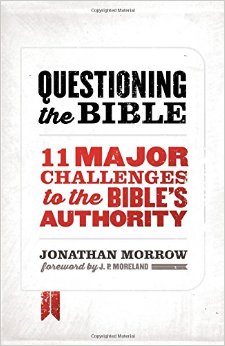
Questioning the Bible by Jonathan Morrow
“Questioning the Bible” by Jonathan Morrow

Jonathan Morrow is giving you just four minutes to respond to a well-known challenge to belief in the Christian God.

Can you handle it?

If not, here is a podcast to help you get ready.

Description:

Is the God of the Old Testament violent and bloodthirsty? Did God really command genocide? Why did Israel attack the Canaanites? These are just a few of the tough questions I tackle in this episode of the think Christianly podcast. Learn how to respond to one of the most challenging and emotional objections to Christianity in under 10 minutes.

Summary:

  • quotes Richard Dawkins to set up the objection
  • response: does God have the authority to give and take life?
  • response: after the Fall, things in the world are not the way they are supposed to be
  • response: Old Testament commands for the Jews to judge other nations are specific to them in that time
  • response: “genocide” and “ethnic cleansing” are not accurate descriptions of the attack on Canaan
  • response: the attack on the Cannanites takes place in the context of redeeming the whole world

Here is the Christian Post article he was interviewed for, where he had to answer:

Jonathan Morrow, author of Questioning the Bible: 11 Major Challenges to the Bible’s Authority, says readers are often perplexed by Old Testament scripture because “sometimes we just picture a God where anger and love can’t co-exist.” Yet he explains, “We all have seen people who have been taken advantage of and that makes us angry [because] we love them. So those emotions can co-exist.”

[…]Along that same line, Morrow clarifies that God’s instructions to the Israelite army in Deuteronomy 20 to destroy the people occupying the land of Canaan is “about judgment, not genocide.”

“The Bible teaches clearly that all people are sinful and in rebellion, kind of living in open rebellion against God, and God is just to judge anyone,” says Morrow. “But in this particular case with the Canaanites, there’s several things going on there, but one of those things was the wickedness of the people which was well documented – child sacrifices to Moloch and others, and bestiality and a lot wickedness.”

He says this judgment was necessary because “Israel’s national survival was crucial so that the Messiah – we would know Jesus as the Messiah – and God’s saving purposes of redemption to the world could one day be born because if the Messiah was supposed to come through the lineage of Israel and Israel co-mingled with this wicked people and was ultimately destroyed, that promise of hope and blessing to the whole world could not have been realized.”

[…]Morrow recognizes that Old Testament questions are particularly challenging. “We live in a sound bite culture and so this is one of those questions where it kind of gets thrown out for people, why does God command genocide, and that’s really easy to say and then it takes some time to respond to because there’s some context.”

Morrow says his sound bite answer is: “These passages are about judgment; they’re not about genocide.”

However, he encourages believers to find out the asker’s real interest in this question. “I would ask them, you know, it sounds like this is a pretty emotional question for you, why is that. Let them talk about it some so you can better understand because that’s the goal. We’re not just trying to win an argument; we’re trying to understand and help people.”

It the asker is after truth, Morrow advises Christians to “ask them … are you interested in kind of walking through and getting kind of messy about looking at the evidence for this because I’d love to share that with you, and sometimes they’ll go, ‘yeah, that’ll be great.'”

Other times, Morrow says, the asker is simply looking for “space and distance from God and this question allows them to put space between them and God.”

By the way, Morrow and McDowell’s basic apologetics book – “Is God Just a Human Invention?” – is my first pick when mentoring new people in apologetics.

UPDATE: J.W. Wartick has reviewed the 11 Questions book on his blog.