Senate Majority Leader Mitch McConnell has never been a favorite of conservatives. Those who see him as a “squishy” compromiser more interested in placating President Barack Obama and K Street lobbyists than the Republican base had more fuel tossed on that fire when he blocked amendments to the Highway Bill Tea Party members wholeheartedly support.
One amendment would defund Planned Parenthood, the nationwide abortion provider which receives more than a half billion dollars in taxpayer subsidies annually. McConnell has previously said he supports defunding Planned Parenthood, which was recently the subject of undercover sting videos in which executives with the organization can be heard discussing the sale of organs from aborted babies. But the leader blocked an amendment to the Highway Bill that would have defunded the organization.
At a time when we have the public behind us on defunding Planned Parenthood, McConnell blinks. What good is he?
As if the social issues were not bad enough, he’s screwed up fiscal issues as well.The Senate revived the Export-Import Bank on Sunday, which is just a nightmare of crony capitalism and corporate welfare. Thankfully, the conservatives in the House of Representatives killed it, and stopped McConnell from screwing the conservative base of the Republican party again.
I hope everyone understands that big corporations are not conservative, and we should not be helping them in any way. If anything, the government should be pushing for more choice and competition, and lowering barriers to entry for new start-ups.
What do we do about Mitch McConnell?
Next time he is up for election, he should be primaried. If you get a request for donations from anything remotely related to the Senate, send it back with a note that says “not till McConnell steps down as majority leader”.
What do you need in order to have a planet that supports complex life? First, you need liquid water at the surface of the planet. But there is only a narrow range of temperatures that can support liquid water. It turns out that the size of the star that your planet orbits around has a lot to do with whether you get liquid water or not.
A heavy, metal-rich star allows you to have a habitable planet far enough from the star so the planet can support liquid water on the planet’s surface while still being able to spin on its axis. The zone where a planet can have liquid water at the surface is called the circumstellar habitable zone (CHZ). A metal-rich star like our Sun is very massive, which moves the habitable zone out further away from the star.
If our star were smaller, we would have to orbit much closer to the star in order to have liquid water at the surface. Unfortunately, if you go too close to the star, then your planet becomes tidally locked, like the moon is tidally locked to Earth. Tidally locked planets are inhospitable to life. So we need a star massive enough to give us a nice wide habitable zone far away from the Sun itself.
But even with the right size star, which we have in our solar sytem, we still have CHZ problems. Just because a planet starts off in the circumstellar habitable zone, it doesn’t mean that it will stay there.
Jay Richards tweeted about this new article from the New Scientist, which talks about that very problem.
Excerpt: (links removed)
Earth’s comfortable temperatures may be thanks to Saturn’s good behaviour. If the ringed giant’s orbit had been slightly different, Earth’s orbit could have been wildly elongated, like that of a long-period comet.
Our solar system is a tidy sort of place: planetary orbits here tend to be circular and lie in the same plane, unlike the highly eccentric orbits of many exoplanets. Elke Pilat-Lohinger of the University of Vienna, Austria, was interested in the idea that the combined influence of Jupiter and Saturn – the solar system’s heavyweights – could have shaped other planets’ orbits. She used computer models to study how changing the orbits of these two giant planets might affect the Earth.
Earth’s orbit is so nearly circular that its distance from the sun only varies between 147 and 152 million kilometres, or around 2 per cent about the average. Moving Saturn’s orbit just 10 percent closer in would disrupt that by creating a resonance – essentially a periodic tug – that would stretch out the Earth’s orbit by tens of millions of kilometres. That would result in the Earth spending part of each year outside the habitable zone, the ring around the sun where temperatures are right for liquid water.
Tilting Saturn’s orbit would also stretch out Earth’s orbit. According to a simple model that did not include other inner planets, the greater the tilt, the more the elongation increased. Adding Venus and Mars to the model stabilised the orbits of all three planets, but the elongation nonetheless rose as Saturn’s orbit got more tilted. Pilat-Lohinger says a 20-degree tilt would bring the innermost part of Earth’s orbit closer to the sun than Venus.
So the evidence for a our solar system being fine-tuned for life keeps piling up. It’s just another factor that has to be just right so that complex, embodied life could exist here. All of these factors need to be just right, not just the orbits of any other massive planets. And you need at least one massive planet to attract comets and other such unwelcome intruders away from the life-permitting planets.
Here’s a good clip explaining the circumstellar habitable zone:
The factor I blogged about today is just one of the things you need in order to get a planet that supports life.
Here are a few of the more well-known ones:
a solar system with a single massive Sun than can serve as a long-lived, stable source of energy
a terrestrial planet (non-gaseous)
the planet must be the right distance from the sun in order to preserve liquid water at the surface – if it’s too close, the water is burnt off in a runaway greenhouse effect, if it’s too far, the water is permanently frozen in a runaway glaciation
the solar system must be placed at the right place in the galaxy – not too near dangerous radiation, but close enough to other stars to be able to absorb heavy elements after neighboring stars die
a moon of sufficient mass to stabilize the tilt of the planet’s rotation
plate tectonics
an oxygen-rich atmosphere
a sweeper planet to deflect comets, etc.
planetary neighbors must have non-eccentric orbits
This article from the radically leftist Washington Post unapologetically praises public school teachers for pushing their vision of sex and marriage onto children as young as four years old.
It says:
As young children develop their understanding of the world, they tend to rely heavily on binaries. If we understand the binaries a child is working within, we can encourage that child to think of counterexamples or introduce counterexamples ourselves into the conversation. These provide useful stumbling blocks that encourage them to expand their thinking.
[…]As the year unfolded, my students continued to play at themes of love and marriage. The conversations expanded and both kids and I were able to introduce new and different stumbling blocks: One can be in love and not get married, not all married people are moms or dads, and not all moms and dads are married. The conversations shifted based on what information the kids had internalized.
The author relays an example conversation about same-sex marriage and incest marriage, which she participates in, trying to undermine the traditional views expressed by the children.
More:
As this deeply layered conversation moved on, many points of view were stated, more questions were posed, and the children were able to articulate what they thought. I made a mental note to myself about topics to revisit, including finding a way to talk about inherited traits and Jane’s ideas about the dangers of incest. There’s always a new challenge!
[…]It’s easy to feel vulnerable or overwhelmed when children ask questions about identity, but when we don’t engage the issues involved, we are sending a message that the subjects are taboo. In terms of gender and sexuality, avoidance and silence can be particularly harmful for students who are or will later identify as LGBTQ (Lesbian/Gay/Bisexual/Transgender/Queer) or who come from families with LGBTQ family members. Silence is not a neutral response.
Is this a conversation that you want a secular public school teacher having with your kids?
Regardless of what you do with your own kids, your tax dollars are going to be paying for these kinds of conversations. They are, in fact, undermining the natural desire of most parents under the parents’ noses. Although leftist educators tend to have fewer children than conservatives, or even no children, they can push their ideas into the next generation by running the public schools.
Public schools tend to do a woeful job of teaching the useful skills that parents really want, but they do a great job of pushing leftist values onto children, and the earlier the better. In fact, they are not being paid on the basis of whether your child learns math and science and engineering and is able to get a job. Public school teachers are paid regardless of student performance, because public schools are a monopoly. This is not a free market which service providers compete to give customers more quality for less money. Public schools are totally insulated from the demands of consumers, that’s why public school teachers are free to push whatever values they want on kids.
If you want to see how far the gay left intends to go with this, take a look at the province of Ontario, Canada, where the sex education curriculum was designed by an education minister who was convicted for child pornography. The Ontario premier is a lesbian, and she is a strong defender of that sex education curriculum, over and against the protests of traditional-minded parents. But somehow, she got elected, and somehow, the child-pornographer became the minister of education. Somebody decided that he was the right person for the job, and somebody decided that public school teachers have a right to push his curriculum on children. And the taxpayers are paying for this indoctrination of young, impressionable kids.
Now, take a look at this story that I got from my friend Ari, about a gay rights conference in Iowa, held at a very rural public school.
Read it:
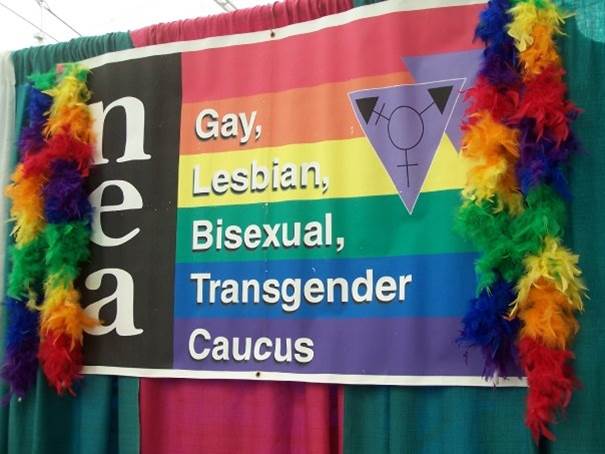
In rural, small-town Iowa, a group of parents and community leaders is seeking to prevent students from the local taxpayer-funded middle school and high school from attending future versions of an anti–bullying conference for lesbian, gay, bisexual and transgender teens.
The last one — in April — left many of the denizens of Humboldt, Iowa up in arms, reports Des Moines NBC affiliate WHO-TV.
Iowa Safe Schools, an activist group out of Des Moines, hosted the conference.
[…]Among the nearly two dozen speakers, “only two” addressed bullying, one attendee estimated, according to EAGnews.org.
The rest of the sessions involved issues such as “how to pleasure their gay partners.”
Middle school girls from Humboldt (pop.: 4,690) had the opportunity to learn “how to sew fake testicles into their underwear in order to pass themselves off as boys.”
One speaker wore a dress made out of condoms to which could be “used as needed.” . . .
Nate Monson, executive director of Iowa Safe Schools, said parents who worry about middle school kids hearing about anal sex with strap-ons and analingus are “disgusting.”
“It’s incredibly frustrating that adults are being the problem and being the bully,” Monson told the Des Moines NBC affiliate. “
The mission statement of “Iowa Safe Schools” makes it clear that this is about pushing early sexual activity and the broader gay agenda onto children in the public schools:
The mission of Iowa Safe Schools is to: a) improve school climate in order to increase the personal safety, mental health, and student learning of lesbian, gay, bisexual, transgender, and allied (LGBTA) and all other students; b) increase awareness and understanding among current and future educators, school administrators, and key community agents of inequities regarding the safety of LGBTA students and their family member(s) in schools and communities throughout Iowa. Iowa Safe Schools also seeks to empower these key actors with effective, research-based tools and strategies to combat intolerance and safety inequities.
That’s what’s happening in public schools. Should we be voting to send more money to these public schools? Will more money result in kids having better math, science and engineering skills? It seems to me that public schools have nothing to do with teaching math, science and engineering, and everything to do with normalizing the gay lifestyle, against the wishes of most traditional parents. Make sure that when you are voting, you vote for school choice, not a government-run public school monopoly. Let parents get the money, and let the parents decide where to send their kids based on what the kids need to learn valuable skills and get real jobs.



 WINTERY KNIGHT