New study: adopted kids struggle, even with well-educated, wealthy parents

I’ll explain why I am posting this below, but for now, let’s take a look at the study, which is discussed at Family Studies. (H/T Brad Wilcox tweet)

Excerpt:

To expand what we know about adopted students, for this Institute for Family Studies research brief, I carried out a fresh analysis of data from a large longitudinal study of 19,000 kindergarten students that was conducted by the National Center for Education Statistics beginning in 1998.

[…]Kindergarten and first-grade teachers were asked to rate the classroom behavior of children in the ECLS-K sample—how well they got along with other children in a group situation. In both the fall of kindergarten and the spring of first grade, adopted children were more likely than biological ones to be reported to get angry easily and often argue or fight with other students.

Here’s the first chart:
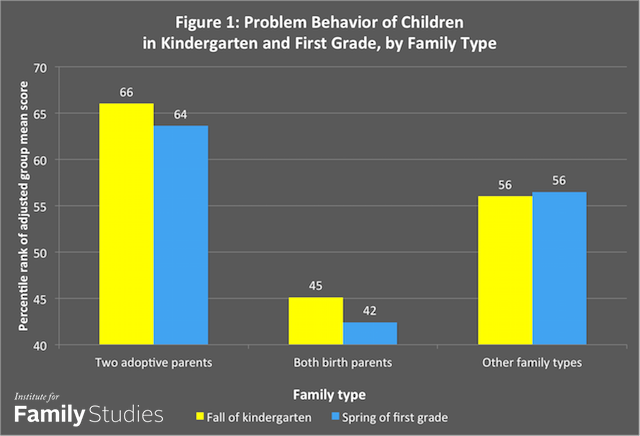
Adopted kids struggle in school
Adopted kids more likely to engage in problem behaviors

And more results:

Children in the ECLS-K were also rated by their teachers on how well they paid attention in class, whether they seemed eager to learn new things, and whether they persisted at challenging learning tasks. Scores on these measures have proven to be predictive of later academic performance and career success beyond elementary school.5 Adopted children were rated less highly with respect to such positive approaches to learning than were children being raised by both birth parents.

Here’s the second chart:
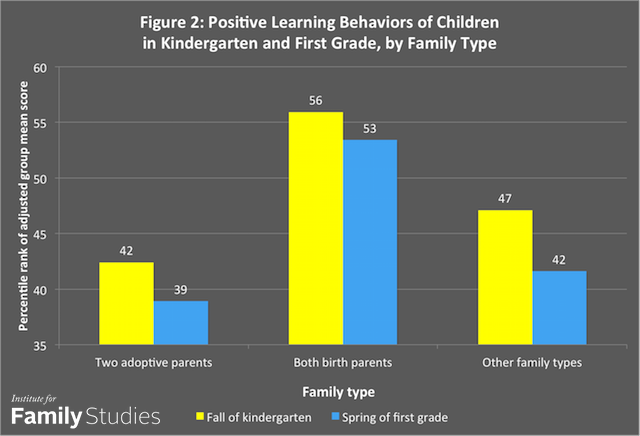
Adopted kids struggle to pay attention in class

And even more results:

As the participating children began kindergarten, the ECLS-K assessed their pre-reading skills, such as recognizing letters by name, associating sounds with letters, identifying simple words by sight.

Here’s the third chart:
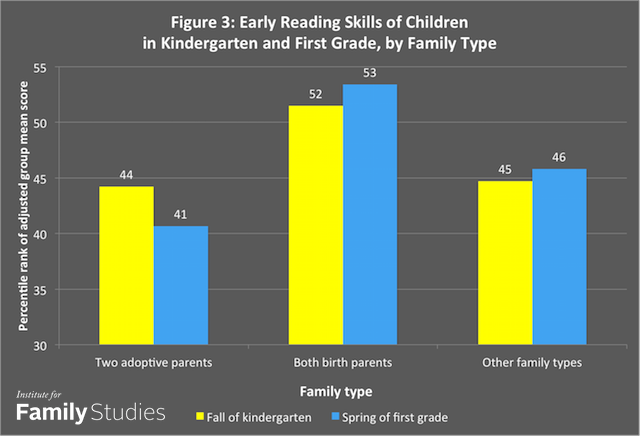
Adopted kids struggle with reading skills

And now math results:

In the fall of their kindergarten year, the ECLS-K assessed children’s pre-arithmetic skills like counting by rote, recognizing written numerals, and understanding greater, lesser, and equal relationships.

Here’s the fourth chart:
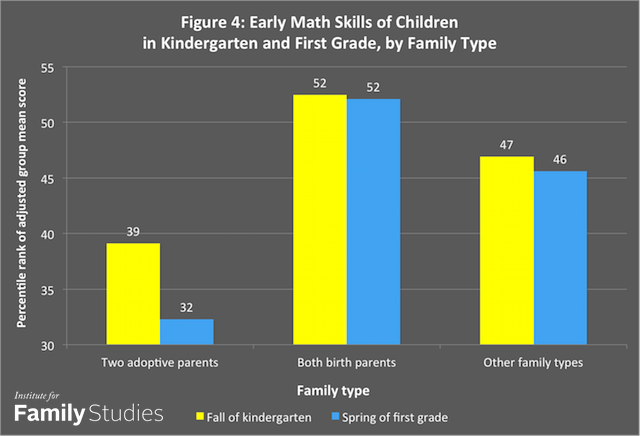
Adopted kids struggle with math skills

The article concludes:

Attachment theory holds that a warm, intimate, and continuous relationship with at least one adult, usually the mother, is essential for the mental health of infants and young children. Children who do not develop a stable and secure bond during early childhood, or have the bond disrupted, are subject to both short-term distress reactions and longer-term abnormalities in their feelings and behavior toward other people. Not having a stable maternal bond is apt to produce long-lasting deficits in the child’s social development, deficiencies that are not easily remedied by a new home environment, no matter how favorable.

Some adopted children experienced neglect, abuse, or other stressful events prior to their adoption. According to traumatic stress theory, the likelihood of long-term emotional scars depends on the intensity and duration of the stress. Severe or prolonged early stress can have long-lasting effects on a child’s development, effects that a supportive adoptive family may only partly ameliorate.

So what do I want to say about this? I want to warn young women, especially young Christian women, that children work best when grown-ups plan their lives in such a way that they can provide for what the children need, at the time they need it. And if you miss the window of opportunity to have your own kids and raise them yourself, then you can’t just fix it at the last minute with ad hoc alternatives.

But for some reason, I get a lot of kickback from young women when I tell them what studies say about things like marriage, premarital sex, cohabitation, infertility, day care, and on and on and on. The Christian women in particular dismiss all the facts with stuff like:

God is leading me to choose fun and thrills now. That’s what my feelings say (and all my friends and family tell me that my feelings are God speaking to me). Tingles and peer-approval rationalize my choice to delay marriage and child-bearing. Who cares about stuff evidence? I don’t like to hear about constraints and deadlines. So I’ll just keep up this plan to run up debts, go on missionary trips, and have fun traveling till I’m 90 years old. God always calls people to do what feels good. I’m going on an adventure! And it will be easy to find a good husband and raise happy and effective kids later – whenever I feel like it. Er, I mean when God leads me to feel like it. Yeah.

So even though all of these studies show the need for timings, pre-conditions, best practices, and so on, that can all be dismissed because the feelings are God speaking to her, and God can somehow magically make all the data not apply to her. One of my married friends once wrote to a young, single fun-seeking feminist telling her about the risks of delaying marriage and child-bearing for too long, and the fun-seeker came back to me dismissing the whole letter because “I don’t like the feeling that I am being constrained”. So, the advice of old Christian women (Titus 2:4) can be dismissed because the young adventurous feminist didn’t like the feeling of being confronted by reality by someone who had more wisdom and experience than she did.

What young children need is their mom, and a Dad who can provide for her to stay home during the crucial first 5 years of their lives. That is more important than pursuing fun and thrills, then grabbing for children as if they were handbags at the last second after natural child-bearing becomes impossible. The right thing to do is to use your 20s preparing financially and otherwise to have kids when you are young, and to be financially set up to stay home with them during the critical years. Choosing a man who can provide, and who understands the best practices for having and raising children is vital, if you want your children to be effective and influential for Christ and his kingdom.

I do think that if a couple is intentionally adopting because they want the challenge and want to help a child who really needs it, then it’s praiseworthy to do that. I just don’t want someone who isn’t ready for the challenge thinking that adoption is the same, so they can delay marriage and children.I know that I am lazy, and I always want to do things the easy way. E.g. – I buy new cars, not used cars. I will buy hand-fed birds, not rescue birds. I would buy a new house, not a fixer-upper. I’m just not cut out for doing things that are hard. I have no ability to struggle through when there is resistance. When I face rejection or resistance to trying to grow or lead someone, I just give up. I think what I was saying to young women was – don’t delay marriage and child-bearing, you’ll get better results with less work.

Related posts

Ted Cruz questions Sierra Club President about global warming science

Now, Ted Cruz is currently my #2 choice behind the excellent Governor of Louisiana, Bobby Jindal. However, this 10-minute video of Ted Cruz doing what I think he does best must be blogged.

Here is the video (10 minutes):

And the Daily Signal has the story.

Excerpt:

Sen. Ted Cruz’s questioning of Sierra Club President Aaron Mair turned contentious Tuesday, then went viral when the Texas Republican posted the nearly 10-minute exchange.

Cruz repeatedly pressed Mair to address satellite data that found an 18-year pause in global warming, countering the Sierra Club’s claim of a warming trend. He asked the green group to retract its assertion that the “planet is cooking” in light of scientific evidence suggesting the opposite.

Mair stonewalled the question each time, answering only that his group supports the “97 percent of scientists that say the exact opposite.”

“So if the data are contrary to your testimony, would the Sierra Club issue a retraction?” Cruz asked.

“Sir, we concur with the 97-percent scientific consensus with regards to global warming,” Mair responded.

The two battled back and forth in a contentious exchange until Cruz concluded in frustration that Mair was unwilling to rescind his claim.

“You know, Mr. Mair, I find it striking that for a public policy organization that purports to focus exclusively on environmental issues, that you’re not willing to tell this committee that you would issue a retraction if your testimony is objectively false under scientific data,” Cruz said. “That undermines the credibility of any organization.”

Now, the knock on Cruz is that he has not been able to accomplish much as a legislator. I am looking for someone who can craft legislation that gets enough votes between the two parties to move forward and either get vetoed, or get turned into law. Cruz sounds so good when he talks, but I want a candidate who has more policy accomplishments and has successfully defended his policies and decisions from attacks.

Bobby Jindal is my top pick for exactly that reason. Rather than merely saying the things I want to hear, he adds doing the things I want to be done to his words.

Take a look at this article from the Washington Post, which looks at which candidate was the most effective at moving legislation, and getting bills turned into laws.

It says:

Jindal got 1.7 laws passed for every year he spent in the House, far more than anyone else.

By sponsored bills, he also comes out on top, though John Kasich also had a relatively high percentage of the bills he sponsored in the House see the president’s pen.

So who is the most effective legislator running for president? By this metric, we’ll give it to Jindal.

Here’s the graph:

Governor Bobby Jindal is the best at getting things done

Let’s look a bit more at the differences between Cruz and Jindal. First, Jindal is a policy guru, and has got things done in education and health care policy going back as far as 1996, when he was only 24 years old and go the job to take over state-level health care policy in Louisiana. He knocked it out of the park. As Governor of Louisiana, he put into place a state-wide voucher program and privatized many wasteful, bloated government programs. And he was willing to battle against the Obama administration to keep his “parent’s choice” education plan. He is the only GOP primary candidate with a detailed plan to repeal and replace Obamacare, and because of his past success, we know that he is competent to do that job. We don’t have to just believe his words, we can look at his accomplishments. And Jindal is the most socially conservative candidate in the race. Whether it’s on abortion or gay marriage, we don’t have to trust mere words. We have something better: actions. Cruz does not have the record on social issues that Jindal has. And what’s more, I don’t think that Cruz is as conservative on social issues as Jindal is.

So, that’s why Jindal is my number one pick right now, and Cruz is number two. We are losing a lot of experience and achievements if we have to fall back to Cruz. He would make a good attorney general, but he is not the best qualified conservative in the primary. Jindal is.

New study: negative effects of day care on children not caused by quality of day care

Does government provide incentives for people to get married?
Mom is staying home because Dad can afford to let her: do kids benefit?

New study using National Institute of Child Health and Human Development data is discussed on the Family Studies web site.

First, let’s get the two views:

Parents, policymakers, and academics interested in how day care and preschool affect child development often embrace one of two competing—and exaggerated—claims about the childrearing circumstances that are now normative in America: that of non-family care being initiated early in a child’s first year of life on a full-time or near-full-time basis and continuing, in one form or another (e.g., family day care, center care, preschool), until the start of formal schooling.

Critics of such arrangements highlight the fact that developmental risks, like increased rates of insecure attachment and elevated levels of aggressive behavior, have been found to be associated with the extensive use of non-family care in America. Advocates, in contrast, stipulate, usually without qualification, that if the quality of care is good, then children benefit; and, indeed, that it is the limited quality of care available to too many parents in the USA that is responsible for any negative effects on children that emerge in the research literature.

All right, so the big-government, anti-family people say that day care as such isn’t bad for kids, the negative effects that are observed are not caused by too much day care, but by the low quality of the day care. The conservative, pro-family, limited-government crowd thinks that quality doesn’t matter as much as quantity – too much day care is bad for kids, regardless of quality.

The study details:

[…][T]he National Institute of Child Health and Human Development (NICHD) funded, to the tune of at least $150 million, the NICHD Study of Child Care and Youth Development. It recruited more than 1,000 children (along with their mothers) in 1991 from 10 different research sites, and followed them from the first month of life to age 15. Among other purposes, the NICHD Study was designed to investigate the claim that long hours of day care initiated very early in life posed risks to children’s social and emotional development; and, should this prove so, to evaluate the proposition that such negative effects would be due to the poor quality of care that children received, not the quantity of care they experienced across the first five years of life.

And the conclusion:

NICHD Study’s findings on the effects of day care proved more consistent than inconsistent with my “developmental risk” claim. And they provided virtually no support for the idea that it was poor quality care that accounted for the negative effects of “early, extensive, and continuous” care (initiated very early in life, for long hours, and continuing for many years).2 Specifically, our many research reports revealed that the more time children spent in any kind of non-familial child care, and sometimes specifically in centers, the more aggressive and disobedient they proved to be at two (but not three) and 4.5 years of age, as well as across their elementary school years; and the more impulsive they proved to be at age 15, at which age they also engaged in more “risky” behavior than children who experienced far less non-familial care across their first five years of life. Critically, despite spending millions to carefully measure the quality of care, using methods and measures developed by the proponents of the “it’s quality, stupid” view, the study never found that the quality of care accounted for these quantity-of-care effects. In other words, the problem behavior associated with early, extensive, and continuous care emerged irrespective of whether quality of care was good or bad.

Read the whole thing, and don’t feel guilty if you can’t do the best for your kids. I am sure that everyone reading this post is going to do the best they can for their kids. But for those who have not yet had kids, let this be a lesson to you about what you should be studying in school, where you should be working, how much you should borrow, how much you should spend. A stay-at-home mom is expensive. It cannot be finessed with feelings and following your heart to fun and thrills.

When it comes to children, money is important

I know there are lots of Christians around the world who read the Bible and understand that there are certain goals laid out in the Bible for Christian parents who are raising their kids. As far as I can tell, young Christians seem to think that these goals will sort themselves out all by themselves through God’s mysterious predestination, or some other such fideistic wishing. What it really boils down to is that young people want to do what they want to do, and they can sound pious about it by saying God will somehow make their crazy plan work out. Well, that’s not effective, and young Christians would never act so ineffectively in any other area of their lives – ignoring how things really work.

Look the Bible has information about the specification that God expects you to implement. Part of that spec involves requirements for your kids. If you decide that the Bible is not trying to give you a spec, you’ll fail to deliver. If you decide that you don’t need to read studies to know how the world works, you’ll fail to deliver. If you decide that following your heart is something that God rewards more than intelligent thought, you’ll fail to deliver. You cannot feelings your way out of this assignment, you’ve got to solve the problem, and that means reading the studies and making a plan that delivers results.

So, young people. If you want to do the best for your kids, you better stop doing what feels good, and start engaging in some serious self-denial and self-sacrifice. Fumbling around chasing happy philosophy bubbles to Europe through your teens, 20s and 30s is not the right way to prepare professionally and financially for kids. Your love for your future kids begins with your decision to grow up and do hard, boring things that need to be done. You won’t be able to fix the child care costs problem at the 11th hour if you follow your heart for the first 10 hours. Keep in mind what child care looks like in places like Ontario, and what your children would be learning, and who they would be learning it from. Make a plan now.