Is there any evidence to support the Bible’s teaching about divorce?

Does government provide incentives for people to get married?
Is there any evidence that supports the Bible’s teaching about divorce?

So, the topic for this post is whether it’s OK to get divorced.

What does the Bible say?

I noticed a lot of people getting divorced these days in the church, and trying to justify why they are allowed to divorce and why they should be allowed to pursue remarriage. So I’m first going to quote from an article from Focus on the Family by Amy Tracy.

She writes:

God is very clear, however, that He hates divorce (Malachi 2:16). He also says, “So they are no longer two, but one. Therefore what God has joined together, let man not separate” (Matthew 19:6). According to the New Testament, there are two justifications for divorce: infidelity (Matthew 5:32) and desertion (1 Corinthians 7:15).

Now, I had always taken the rule of Dr. Laura for this. She says that you can get divorced for adultery and abandonment (as above), but she allows allows for physical abuse and drug addiction. But it looks like the Bible is more strict than Dr. Laura, even.

What does the evidence say?

So let’s see if there is any reason outside the Bible that explains why the Bible tells people not to get divorced. The UK Daily Mail reports on a study on the effects of divorce.

Excerpt:

Divorcing parents who try to maintain an amicable relationship for the sake of their children are doing nothing to help them, a major study suggests.

The impact of the split on youngsters is the same whether or not the mother and father keep cordial links, it found.

[…]The new study, the first in 20 years to examine how the behaviour of separated parents affects their children, was carried out by US academics.

It covered 270 parents who were divorced or separated between 1998 and 2004 in an unnamed US state that compels divorcees to take part in an education programme on ‘co-operative co-parenting’.

Of these, 31 per cent considered their relationship with their ex-spouse as ‘co-operative and involved’; 45 per cent were ‘moderately engaged’ with their divorced partner, with some conflict between them; and 24 per cent said their co-operation was ‘infrequent but conflictual’.

They were asked to say how their break-up had affected the youngest child in their family. The average age of children involved was eight years.

The study, published in the academic journal Family Relations, said that children of divorced parents are more likely than others to suffer ‘external’ symptoms such as behaviour problems or drug abuse, more likely to have ‘internal’ difficulties like anxiety or depression, and more likely to do badly at school.

But the researchers, headed by Dr Jonathon Beckmeyer of Indiana University, found that these children’s problems were no worse if their parents continued to row and bicker with each other after the divorce.

The study said ‘despite the expectation that children fare better’ if their divorced parents develop a co-operative relationship, the behaviour of children as assessed by their parents ‘did not significantly differ’ between the friendly and the fighting groups of divorcees.

So the take-home lesson is this: there is no such thing as a divorce that doesn’t hurt the children. If you’re thinking of divorce and you have children, just don’t do it. And the Bible sides with the children against the selfish desires of their parents – telling the parents to be careful who they marry, and to give up their happiness in order to provide stability for the children.

One more thing. I run into a lot of people who think that life is unpredictable, and that you just have to pursue happiness, fun and adventures and how that somehow the universe or God or whatever will make all the selfish hedonism “work out”. That’s false. Marriage is not like a slot machine. There are things you can do now to prepare your character for marriage. There are things that your marriage candidate should be able to do to be prepared for marriage as well. If both people practice self-control, self-denial and self-sacrifice before marriage, that’s a good sign that they will be able to make a commitment that lasts. Indulging your desire to sky-dive, surf, zip-line and travel for adventure does nothing to prepare your character for what marriage will require of you.

Marriage is not an engine for personal fulfillment and happiness. You don’t get out of it when you don’t feel happy. Marriage is about changing your character to make you more mature, and providing a safe, stable environment for children to grow up in. The reason so many people are divorcing today is because they think that marriage is a consumer good – that it should be fun. But it’s not designed to be fun, it’s designed to be a challenge. If you stay committed to it, it does produce a return in the long run.
Are illegal immigrants more likely to commit crimes than the general public?

Kathryn Steinle was murdered by an illegal immigrant.

So we had a case in the news where an illegal immigrant who had been arrested and deported numerous times was allowed to stay in the U.S. thanks to San Francisco’s very Democrat “sanctuary city” policy. All the people running for the Democrat presidential nomination support sanctuary cities, and amnesty for illegal immigrants as well. But how do these policies affect American taxpayers?

Breitbart News has the numbers from the U.S. Sentencing Commission.

Excerpt:

While illegal immigrants account for about 3.5 percent of the U.S population, they represented 36.7 percent of federal sentences in FY 2014 following criminal convictions, according to U.S. Sentencing Commission data obtained by Breitbart News.

According to FY 2014 USSC data, of 74,911 sentencing cases, citizens accounted for 43,479 (or 58.0 percent), illegal immigrants accounted for 27,505 (or 36.7 percent), legal immigrants made up 3,017 (or 4.0 percent), and the remainder (about 1 percent) were cases in which the offender was either extradited or had an unknown status.

Broken down by some of the primary offenses, illegal immigrants represented 16.8 percent of drug trafficking cases, 20.0 percent of kidnapping/hostage taking, 74.1 percent of drug possession, 12.3 percent of money laundering, and 12.0 percent of murder convictions.

Now a lot of those convictions will be related to immigration… what happens when we take those out?

The sentencing rate is still higher than normal:

Eliminating all immigration violations, illegal immigrants would account for 13.6 percent of all the offenders sentenced in FY14 following federal criminal convictions — still greater than the 3.5 percent of the population illegal immigrants are said to make up.

All that crime is not only dangerous and expensive, but we have to pay for the fails and law enforcement to catch them, too. Now, let’s review Hillary Clinton’s views on illegal immigration.

The Washington Times reports that she favors amnesty:

Democratic presidential hopeful Hillary Rodham Clinton vowed Tuesday that if elected, she would try to expand President Obama’s deportation amnesty to more illegal immigrants, saying this administration has left out a number of aliens who deserve to be granted legal status.

Speaking in Las Vegas at a Cinco de Mayo meeting focused on immigration, Mrs. Clinton also called for granting attorneys to illegal immigrants facing the complex immigration system, and said she would like to re-examine detention to ensure more illegal immigrants are released as they await deportation.

Mrs. Clinton delivered on just about every question from immigrant rights activists, who had been pressing her to reject Mr. Obama’s detention policies and go beyond his amnesty.

The Daily Caller reminds us that she also supports sanctuary cities:

Clinton last weighed in publicly on sanctuary cities during the 2008 presidential campaign.

“You would allow the sanctuary cities to disobey the federal law?” Clinton was asked by Tim Russert during a Sept. 6, 2007, debate at Dartmouth College.

“Well, I don’t think there is any choice,” she responded.

Clinton said she backed the sanctuary city concept because without it, illegal immigrants refuse to cooperate with police because they are afraid of being deported.

“Local law enforcement has a different job than federal immigration enforcement,” Clinton said. “The problem is the federal government has totally abdicated its responsibility.”

Clinton again expressed her support for sanctuary cities in a 2008 interview with Fox’s Bill O’Reilly.

“Are you going to crack down on the sanctuary cities?” O’Reilly asked.

“No, I’m not,” Clinton said, eliciting a shocked response from the host.

I’m all for more skilled immigration, but that’s not what is happening on our southern border. If Hillary becomes president, that situation will only get worse.

U.S. Marine Capt. William E. Barber earned the Medal of Honor fighting communists in North Korea

First, let’s go from the top down to set the context for the profile of William E. Barber.

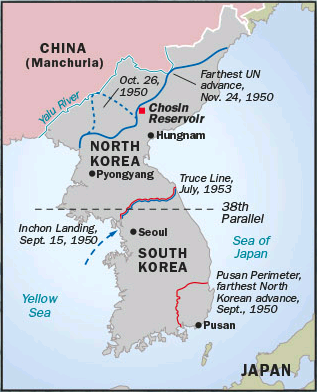
Map of the Korean War

In the summer of 1950, North Korean communists launch a completely unprovoked attack across the 38th parallel against their peaceful, democratic neighbors, the South Koreans. The Americans immediately sent an invasion force by sea to drive them out. The North Koreans easily manage to take over the capital Seoul, and the allies are left with only one port in the southeast – Pusan. In September of 1950, American forces land an invasion force at Inchon, cutting off the North Korean invasion force surrounding Pusan. The North Koreans retreat, and there is hope that American forces will be home by Christmas. But then, unbeknownst to the Americans, the Chines communists  invade North Korea from the north and surround the American forces near the Chosin reservoir, threatening to annihilate an entire Marine division.

The Marines at Yudam-Ni are surrounded and must retreat to Hagaru-Ri

As you can see from the map, there are a whole bunch of American troops fighting to the north/east and south/west of the Chosin Reservoir. The marines near Yudam-Ni need to retreat along a road called the MSR (main supply road) back to Hagaru-Ri. But in order to conduct that retreat, they have to hold onto the vital Toktong pass, which is overwatched by Fox company from their position on Fox Hill. Can Charlie company and Fox company hold off the entire Chinese 59th division (10,000 men) with only two companies (about 250 men each)?

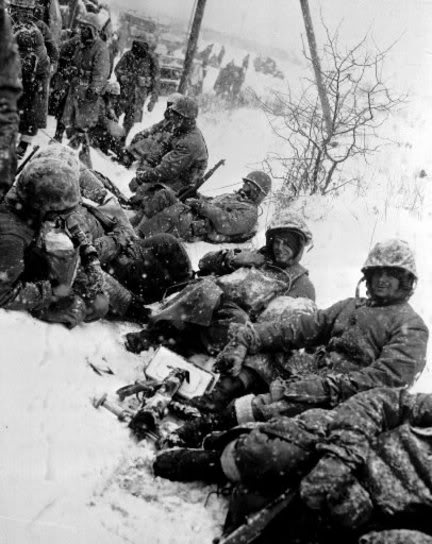
U.S. Marines "The Chosin Few", December 1950
U.S. Marines “The Chosin Few”, December 1950

Well, the book I read (which Dina gave me for Christmas), was about Fox company and their defense of the Toktong pass. This is what the leftist New York Times had to say about the man in charge of Fox company (“F company”) in a 2002 article:

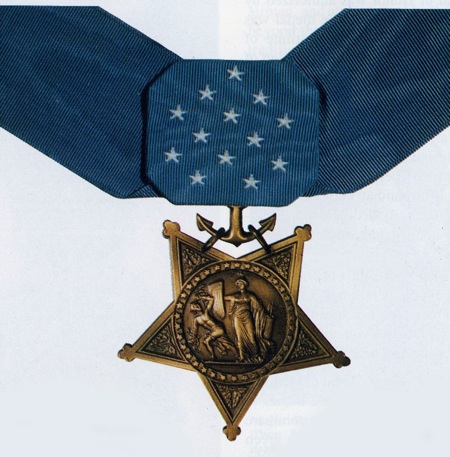
Col. William E. Barber, who won the Medal of Honor for his leadership of a vastly outnumbered company under siege on a snowy hilltop in one of the worst defeats in Marine history, the Battle of the Chosin Reservoir in 1950, died on April 19 at his home in Irvine, Calif. He was 82.

The cause was bone-marrow cancer, said Jerry Courtier, a friend who hopes to write Colonel Barber’s biography.

The reservoir is south of the Yalu River, which separates North Korea from China. After the Americans had pushed the North Koreans almost to the Yalu, 150,000 Chinese troops unexpectedly crossed the river into North Korea. Colonel Barber’s unit, Company F of the Second Battalion of the Seventh Marines, First Marine Division, was on a hill that commanded the Toktong Pass, a vital gap between Yudam Ni and Hagaru Ri, two towns separated by 78 miles.

The stakes were huge. If F Company yielded its position, 8,000 marines at Yudam Ni would be cut off from the 3,000 at Haguru Ri by tens of thousands of Chinese troops.

Through five days and six nights in subzero weather and often swirling snow, Colonel Barber, then a captain, inspired his men, outnumbered more than five to one, to cling to their tenuous positions. He was shot in a bone near his groin on the second day but continued to make the rounds of the hill. He likened the wound to a bee sting.

When the unit was ordered to withdraw and fight its way to safety, Captain Barber refused. Three times, the enemy broke through the line, only to be repulsed.

”I knew that we could probably hold, and I knew that if we didn’t hold we could exact a very heavy toll,” he said in an interview in 1976 with The Los Angeles Times.

His citation for the nation’s top medal said that he commanded his men from a stretcher. But Hector A. Cafferata Jr., who as a rifleman won the Medal of Honor in the same battle, insisted that Captain Barber refused the stretcher.

”He walked the line, he kept us together,” said Mr. Cafferata, who was beside Captain Barber when he was shot.

In the mayhem, the Chinese blew whistles, beat cymbals and tooted bugles as they repeatedly attacked. Coffee froze before men could drink it, and some of the wounded died because plasma froze with no way to thaw it.

When the battle was over, more than 1,000 enemy soldiers were dead. Of Captain Barber’s original 240 men, 82 were able to walk away.

Gen. Raymond G. Davis, who was a lieutenant colonel in the Marines, received a Medal of Honor for leading the unit that rescued F Company.

William Earl Barber was born on Nov. 30, 1919, in Dehart, Ky. He attended what is now Morehead State University in Morehead, Ky., for two years and enlisted in the Marines, at the age of 21, in 1940.

He was so good at shooting a rifle that he was made a weapons instructor. After volunteering for parachute training, he demonstrated such proficiency that he became a parachute instructor.

In World War II, he was promoted to sergeant in 1942 and commissioned a second lieutenant in 1943. He was a rifle platoon commander at Camp Pendleton, Calif., when his unit was shipped to the Pacific.

Colonel Barber was in the first wave to hit Iwo Jima, where he was wounded twice. He received the Silver Star for bravery in addition to two Purple Hearts. At a ceremony on the 50th anniversary of the battle in 1995, he said:

”I am older now, as you are, but I can still see the colors of that February morning. The sky. The island. And sometimes I think I can hear the noise of battle.”

He was treated in Japan for his wounds and returned to the United States, where he worked as a recruiter, among other positions. He was promoted to captain in 1949 and was in the force that occupied Japan.

When he joined F Company in Korea, he saw a raggedy unshaven bunch and immediately ordered the the troops to shave, shine their shoes and look like marines. He suggested that his new charges resembled Pancho Villa’s bandits.

”He was one tough guy,” Mr. Cafferata said. ”He was by the book.”

He was by the book. He enlisted in the Marines because he was grateful to his country for allowing him to escape poverty and go into college, and he wanted to give something back.

You can read a review of the book I read about Fox company, and read about some of the details of what it was like for those men. You’ll never look at your own troubles the same way again. You can also read about Barber’s Medal of Honor citation here.

The Medal of Honor, Navy and Marines variant

So, now that I am done with that book, I have moved on to another Korean War book that Dina gave me, this one about George company. The Korean War might have been our most just war – defending a peaceful democratic ally from a totalitarian communist regime. You just have to compare North Korea and South Korea today to understand the stakes. North Korea is basically a godless concentration camp that tortures and murders its people if they so much as think the wrong thoughts about the atheist state. South Korea is free and prosperous, where the people have human rights, like the right to free speech and freedom of religion.

It’s important for me to read about the hardships that real heroes face, so that I don’t complain too much about my own tiny struggles. When you read about the struggles of great American soldiers, so many good things happen to you. Your own problems get smaller, your humility and gratitude get bigger. And you are reminded about why America is a great country, and what American character is really like. These things are not taught by leftists in the public schools. They are not talked about by leftists in the mainstream media. They are not presented by leftists in the Hollywood film industry. If you want to know the real America, you have to find it yourself.