My friend Terrell sent this article to me from the Lafayette Journal & Courier. It talks about a change to Purdue’s student assistance program that will help students to think twice about what they are majoring it, and whether it will pay off.
Excerpt:
Purdue University is close to bringing income share agreements to campus by the next academic year.
Purdue Research Foundation is finalizing a contract with a partner firm that will fund student tuition in return for a percentage of income for several years after graduation, Brian Edelman, PRF’s chief financial officer, said Tuesday.
Purdue announced in August it was seeking a partner to launch the agreements as an alternative to student loans. The university received seven “expressions of interest” and narrowed the search down to one finalist, although Edelman said it’s too early to identify the firm and how the partnership might work.
But more details about how Purdue might implement the alternative have come available. PRF will complete a sample term sheet in the next few weeks and begin planning with a pilot of 100-300 students as early as this spring, Edelman said. Those students could receive funding for the entire 2016-17 year.
During a University Senate meeting Monday, Edel estimated what a contract might look like for students: A $10,000 investment might cost 3 percent to 5 percent of income for five to seven years. An individual earning $48,500 a year — the median income among college graduates in 2013, according to the National Center for Education Statistics — would be on the hook for as little as $7,275 or as much as $16,975, depending on the terms.
This part made me laugh:
Other faculty members expressed concern that such agreements might favor STEM or business students, who typically have higher incomes and better job prospects after graduation, and steer the university and faculty toward producing graduates who earn more income.
Well of course the faculty don’t want students to think about getting a return on their degree – because then most of them would be out of a job! College education only makes sense if you can get a return on your investment. In theory, you could study anything and get a return on your investment. In practice, you’re better off with STEM degrees – lower post-graduation unemployment, and better starting and median salaries.
Look:
Starting and Mid-Career salaries by profession (click for larger image)
I love this idea by Purdue, it will really help students to think about what they are studying, and that is good for taxpayers, because something tells me that we are going to get the bill for the $1 trillion in outstanding student loans.
My friend William shared this excellent article from The Federalist, which talks about how public schools, under the influence of Common Core, are exposing children to pornography in order to advance a leftist culture agenda. The article has the stories of several heroic mothers who stood up to the school system and got the pornographic materials removed. Let’s look at one of them, and then I’ll comment on how public school administrators and teachers should be viewed, then I’ll comment on the issue of financing these public schools, then I’ll talk about planning for schooling of your children.
Excerpt:
In 2012, Lebanon, Oregon, mother of two Macey France began studying the nationwide implementation of Common Core. While looking through a document titled “Common Core Appendix B” that contained reading exemplars, Macey found the book, “The Bluest Eye” listed as an example of appropriate assigned literature for eleventh- and twelfth-grade students.*
France, a contributor to the website PolitiChicks, took to her keyboard and typed up a scathing condemnation of the book as not high-school appropriate, including quotes directly from the book, such as:
I am not putting pornographic excerpts from public school books on this blog, duh.
We continue:
As a result, her article “Common Core-Approved Child Pornography” was viewed and shared hundreds of thousands of times and Macey was nominated for a CPAC blogger award for Best Sunlight Post of 2013.
“This is when I first became a ‘target’ for the progressives who support public education and minimize parental rights,” said France, who had a hard time understanding how her well-researched, truthful article could make her the target of the kind of emotional, hateful rhetoric she experienced. It frustrated her to be personally attacked for wanting to protect her kids. It also frustrated her to find many parents who weren’t concerned about their teens reading “The Bluest Eye” because they believed school officials knew more about what was best for their children than they did.
“I was called names, accused of being backwards, racist [Toni Morrison is a black woman], ignorant, a flat-earther, and even received private messages on Facebook telling me how hateful I was,” France said. “I was first introduced to the phrase ‘white privilege.’ At one point, I was called Hitler. I was misunderstood and accused of wanting to ban and burn books [even though] I went out of my way to convey that I am not an advocate for banning literature. I am a huge parental rights advocate. I got the distinct impression I was not supposed to question the manner in which they [educators] related to my kids.”
My problem with public school is not that education school graduates are selecting high brow reading material that is above me. I love Shakespeare and Spenser and Dickens and Austen and other classical writers. The problem I have with public schools is that some of the teachers, and most of the administrators, have this agenda to break down traditional morality and sexualize children at earlier and earlier ages. This is part of the secular progressive agenda – they know that sexualizing children makes them less likely to become conservative, less likely to marry, less likely to have children who are raised by a mom and dad, and who are therefore more resistant to the will of the secular leftist government.
Public schools are leftist indoctrination seminaries
A good example of how this works can be found in the province of Ontario, Canada. There, the Liberal Party government is led by a lesbian woman who left her husband and children to move in with her lover. The Liberal Party decided to re-write the education curriculum so that it would be more in line with their supporters in the Sexual Revolution crowd, e.g. -secularists, LGBT activists, abortion providers, etc. And so, they hired a convicted child pornographer to re-write the curriculum. They didn’t see the public school’s priority as teaching children how to get the skills needed to find jobs that pay. They wanted the public schools to make children non-judgmental about the immoral behaviors of the selfish adults.
It’s very important for parents to understand that people don’t just find themselves in education programs and then in public schools by accident. Sometimes they are in there because they couldn’t find real work in the private sector. Sometimes they are there because they want to indoctrinate your kids with their left-wing ideology. You can’t assume that the people in public schools want to partner with you to pass on prudent and practical Judeo-Christian wisdom to your children. The public school monopoly attracts those who are looking for job security and insulation from the disapproval of their customers. It’s true that some teachers are there to educate students so they have useful skills in order to find good jobs. But in my experience, many of teachers aren’t, and most of the administrators aren’t.
Note: private school teachers and administrators have to compete with other schools, so they are sensitive to meeting the needs of parents. At least you have a choice about where you send your kids, so they have to care what you want for your kids, and how much you are able to pay.
Don’t vote for bigger government if you value quality education
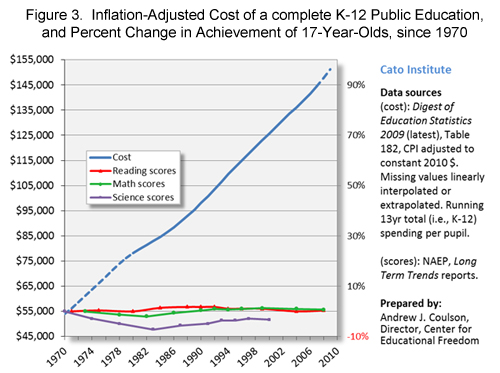
So how do these public schools get their funding? Well, it’s simple. They appeal to voters by saying that the more they spend on public schools, the more children will learn. This actually works on voters who don’t bother to familiarize themselves with the facts:
Education spending has tripled since 1970
The truth is that parents who want children to do well should always vote for smaller government, lower taxes, and the pushing down of decision-making in education policy to the state and local level. We shouldn’t be swayed by “it’s for the children” rhetoric, because throwing more money at the problem only gives us more sexual revolution indoctrination and more gay rights agenda. Most of the new money goes to administrators anyway – not to the teachers in the classrooms. You might think that the public schools are there to help your children to get a job, but that’s not what they public school administrators think they are there for.
Getting married? Make a plan to provide for your kids’ education
One final point. I am finding myself surrounded by male Christian apologists who want to get married, and who are not interested in being providers. They’ve spend their entire 20s in school as students, they’ve taken money from their parents, they’ve never worked a day in their lives, they have outstanding student loans, they have no savings, and yet they all talk to women they like about marriage. My view is that Christian men should not be allowed to talk to women – even to ask them the time of day or for directions – until they have a STEM degree, 2 years of private sector work experience, all debts paid off, a car and some savings. And why not? Well, for reasons like this article on the public schools.
The public schools are what they are, and Christian parents cannot rely on them to educate our kids. If a man is talking about marriage without having taken steps to get a STEM degree, STEM private sector work history, and an investment account that is added to every month, then he has no business talking to a woman about marriage. He has to be able to show her that he is serious about providing the children with homeschooling or a private school education. How parents plan to educate their kids is a major issue in marriage – it affects whether the children will be effective and influential, or not. A woman should not trust the promises of any man who has not taken practical steps in the past to prepare for the needs of his children in the future. She cannot accept intentions and promises that make her feel good, she has to see evidence of his ability to put aside his ambitions in order to provide for her and the children – that is his obligation as a man (1 Tim 5:8). A man who wants marriage should prepare well in advance for it by having a career that will allow him to earn and save so that his wife and children will not be threatened in their worldview more than they can bear. If he has to give up some student stuff and some ministry stuff in order to prepare for husband / father responsibilities, then he should do that – before the wedding day.
When people are looking for a significant other, they often try to find someone whose values, education, earnings, hobbies and even height match their own. But new research suggests there’s one promising measure for finding a committed partner that most daters overlook — credit scores.
A credit score is a number that is supposed to reflect the risk of lending money to someone, based mostly on their past history of borrowing, repaying and defaulting on debt. Banks have long used credit scores to evaluate customers, but these days potential employers, landlords, insurance companies, cellphone companies and many other businesses do, too.
A new working paper from the Federal Reserve Board that looks at what role credit scores play in committed relationships suggests that daters might want to start using the metric as well. The researchers found that credit scores — or whatever personal qualities credit scores might represent — actually play a pretty big role in whether people form and stay in committed relationships. People with higher credit scores are more likely to form committed relationships and marriages and then stay in them. In addition, how well matched the couple’s credit scores are initially is a good predictor of whether they stay together in the long term.
The paper analyzed a large proprietary data set of 12 million randomly selected U.S. consumers from the credit reporting agency Equifax over a period of about 15 years. Researchers used an algorithm to find a swathe of committed couples, including some who live together and are not legally married.
They found that people with higher (i.e. better) credit scores are more likely to form a committed relationship, as the chart below shows. This was true even after controlling for other differences between partners, like education level, race or income.
The researchers also found that having higher credit scores when they started the relationship meant that couples were less likely to separate over the next few years… In fact, for every extra 100 points in the couple’s average credit score when beginning the relationship, their odds of splitting in the second year fell by around 30 percent.
So what do I want to say about this story? I want to tell you that marriage is not something that you just jump into when you feel like it, without any preparation. Relationships work well when both people have trained their character to be ready to do the most important thing in a relationship: to commit. And your credit score is a good measure of your ability to do that.
A high credit score is an excellent measure of a person’s ability to be responsible with money, and to take their obligation to pay their money back seriously. Marriage is all about whether two people are comfortable with being responsible, and whether two people can put aside their desire for fun and thrills and meet their obligations, even when they don’t feel like it. If a person is uncomfortable with marriage obligations, because it is too “transactional” and they want to be feelings-led, that’s a clear sign they are not ready for a commitment through thick and thin. The credit score is a measure of one’s ability to be responsible to others regardless of feelings and desires, and that’s what you need to commit.
When I meet someone I am interested in for marriage, if they have problems with their education, career or finances, the first thing I do is to try to push them to study for a degree with a good employment rate, and good starting salaries. I push them to get good jobs with reputable companies, and to work in the summer if they are students. I push them to pay off their debts and start investing. I do this because I am trying to make them marriage-ready. That is, I am trying to get them to be comfortable with responsibilities, expectations and obligations.
One girl I used to mentor just got married. She started out living with her parents, doing degrees in English, and working minimum wage service jobs. Then something happened. She moved out of her parents house, got a real job, cut expenses, and married an employed non-student who works and saves money. They are both paying down debt like crazy, and she has a plan to invest soon. Most of what she did was self-directed, all I did was cheer, make suggestions and send the occasional gift. But she never viewed this advising and rewarding as “manipulative”. She was happy to get the opinion of someone with qualifications in those areas. She didn’t rebel against people who were leading her upward, she embraced it. Now she’s committed to a man for life and they are executing a sound plan to have an influence as Christians. It has not been easy for her. She is punching well above her weight now, though.
If you want to get married, you need to develop the ability to commit. That means that you need to get comfortable with self-sacrifice and self-denial. You need to change your character through studying hard things, working boring jobs, saving instead of spending, and investing early. These are the life experiences that change your character so that you are able to commit to another person for life.