
New study: father absence is a strong predictor of depression for young girls

Does government provide incentives for people to get married?
If you want your children to grow up happy, commit yourself to marriage

The study is here on PubMed.

And here’s an article about it posted at The Family in America, a public policy journal.

Excerpt:

Who has benefitted from the war radical feminists have waged against marriage? Certainly not young women. A very large new Canadian study concludes that one of the strongest predictors of depression among young women is the loss of a biological parent. And it is the easy divorces that feminists have pushed for that have typically occasioned such a loss.

Conducted by researchers at the University of Northern British Columbia, this new study isolates the factors predicting depression among Canadians ages 16 to 20. The researchers limn these factors by scrutinizing data collected between 1994 and 2007 from a nationally representative sample of 1,715 individuals tracked during this 13-year period.

Predictably, the researchers adduce evidence that such things as parental rejection and childhood anxiety predict depression between a young person’s 16th birthday and his or her 21st.  But gender makes a difference: consistent with other inquiries, this study finds that “girls reported more [depression] than boys.” However, not all girls are equally vulnerable: the data reveal that “The loss of a parent by the ages of 4 to 8 years predicted depression at ages 16 to 20 years for girls [p = 0.008] but not for boys.”

Of course, a girl can lose a parent through death. But the researchers realize that such tragedy occurs far less often than the trauma of parental divorce. Consequently, they know how to interpret parental loss as a predictor of girls’ depression at the threshold between adolescence and young adulthood. This is a finding, they realize, that fits hand-in-glove with the results of a 2008 study establishing that “the effects of parental divorce . . . differ between genders in respect to the development of depression with risk increasing for girls but not for boys.” They further realize that their study harmonizes with a 1997 study concluding that “young women whose parents had divorced reported higher levels of depression compared to young men from divorced families.”

Given the paralyzing effects of depression as “a leading cause of disability worldwide,” the researchers hope their study will lead to “targeted, specific and personalized intervention” that will curb such depression. More particularly, they hope that “girls may benefit from interventions designed to address parental loss due to death, divorce, and other causes.”

But since nothing takes a parent away from a daughter more often in the 21st century than does parental divorce, it is very clear that the kind of intervention girls most need is the kind that will keep their parents together. Just how quickly that intervention comes will depend heavily on how much reality can puncture feminist ideology.

This study makes me think of the problems that we have these days getting married and staying married. I think that there are three kinds of challenges. The first challenge is ideology, e.g. – radical feminism. The second challenge is cultural, e.g. – the hook-up culture on campus. The third challenge is political, e.g. – no-fault divorce. It seems likes the odds are really stacked against marriage-minded people.

Most people like the idea of having someone of the opposite sex commit to them for life. I write a lot about what people should be looking for in a mate. Factors that predict a person’s ability to commit, what their worldview should be, etc. But we also have to remember that we have to be turning ourselves into people who are suited to a lifetime commitment, involving self-denial and self-sacrifice.

A lot of people seem to think that if they meet the right person – the person who makes them feel good – then they won’t have to do any self-denying or any self-sacrificing. But that’s not true. Feelings change. It’s possible for two serial killers to feel good about each other, and to having things in common, but marriage isn’t about whether you “like” the other person and whether they “like” you. Marriage works when you have two people who are comfortable making commitments. Two people who are comfortable with responsibilities, expectations and obligations.

The point I am trying to make here is that not only must we be looking for someone who can be faithful, loyal, commitment through thick and thin, but we must also prepare to become a person like that. If we make choices for our own happiness every day – fun and thrills – then we are not making ourselves into the kind of people who take responsibility and make commitments.

The strange thing is that those who choose fun over and over and over again seem to make the worst decisions when it comes to choosing mates. Of course it’s easier to pick someone who is not too moral and not too religious. Then they won’t be able to judge you. They’ll just let you do whatever you want and never shame you for anything.

The problem is that marriage works best when two people are comfortable with moral obligations to others. You have to be someone who is comfortable with obligations over the long term. And you have to choose someone who has a strong sense of morality, otherwise they won’t honor their moral obligations to others. Commitment means doing what is right regardless of how you feel about it, It means giving up on the pursuit of fun, in order to build something strong that will take you into your old age.

Texas and Oklahoma sue Obama administration over transgender public school decree

Obama speaks to the Human Rights Campaign

The Daily Signal reports:

Texas, joined by eight other states and officials from two other states, sued President Barack Obama’s administration on Wednesday over the president’s national school bathroom directive that threatens to take away federal school funding for districts that do not follow new transgender student guidance.

“This is an overreach of the federal government,” Harrold Independent School District Superintendent David Thweatt told The Daily Signal in a phone call Wednesday afternoon.

Texas and the Harrold Independent School District in Texas were joined by the states of Alabama, Wisconsin, West Virginia, Tennessee, Oklahoma, Louisiana, Utah, and Georgia, as well as the Arizona Department of Education, Heber-Overgaard Unified School District in Arizona, and Maine Governor Paul LePage, a Republican, in the lawsuit filed in the Northern District of Texas, Wichita Falls Division U.S. district court.

“This federal money obviously is our money to start with,” Thweatt said. “It’s coming from income taxes, et cetera and [the Obama administration] is taking this and using our own money against us to try to blackmail us into some kind of social engineering and social experimentation in public schools.”

[…]Superintendent Thweatt expressed concern to The Daily Signal that Obama administration’s directive creates security and safety issues for the “privacy and dignity” of the approximately one hundred kindergarten through 12th grade students that attend and use restrooms at Harrold Independent School District.

“Not only do we have students in these restrooms, but we are also having visitors to our schools at programs and sporting events,” Thweatt said. “If we open our restrooms, we could very well have grown men in our restrooms with young girls.”

If you live in Texas or Oklahoma, then congratulations – your states are actually doing something about the problem:

Texas Attorney General Ken Paxton, a Republican, along with Oklahoma Attorney General Scott Pruitt and West Virginia Attorney General Patrick Morrisey, sent a letter on May 17 to the Obama administration expressing legal concern over the transgender student directive.

“The president of United States has no authority under the Constitution to change the law,” Paxton told The Daily Signal in a phone call Wednesday afternoon.

Paxton says that his state will wait to hear if there is a response from the Obama administration and “hopefully they’ll back off.”

“If not, we’ll go to the court and we’ll put our case in front of a judge and we’ll let the court decide,” Paxton said.

The lawsuit is filed against the Education and Justice Departments, the United States Equal Employment Opportunity Commission, the Department of Labor, and officials at the respective agencies.

I doubt that people who voted for Obama are bright enough to explain what the concept of federalism is, or why it is responsible for our special success as a nation.  People don’t seem to care much for the Constitutional limits on power any more. They just vote for the party that hands them goodies, and to Hell with morality and protecting the vulnerable.

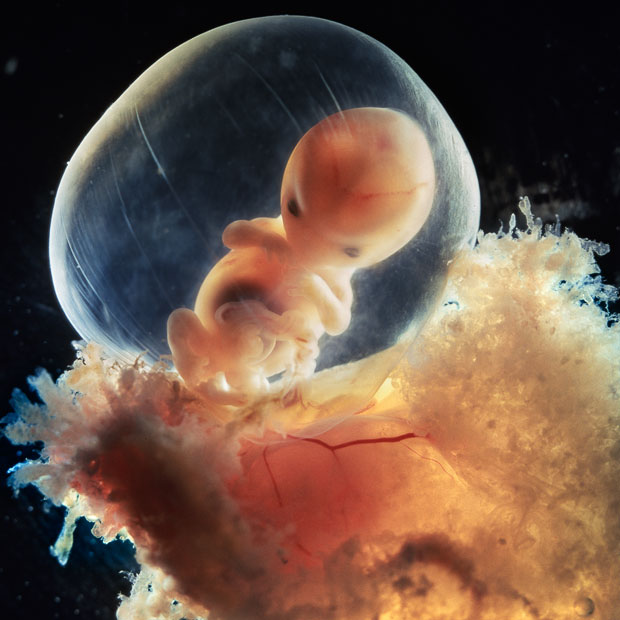
If unborn babies don’t have consciousness or don’t feel pain, may we kill them?

Unborn baby scheming about pro-life apologetics

Was having a conversation by e-mail yesterday with a pro-abortion atheist, and he gave two reasons why he supported abortion in the first and second trimester. First, he said that unborn babies can’t feel pain, so it’s OK to kill them. Second, he said that unborn babies don’t have consciousness, so it’s OK to kill them. I thought it might be useful to link to something that answers both of these objections.

Frank Beckwith is the author of “Defending Life: A Moral and Legal Case Against Abortion Choice“. He wrote that book for Cambridge University Press, a top academic press. But before Cambridge University Press, Beckwith wrote four easy-to-understand essays for the Christian Research Journal. Part IV is the one that has the response to the two questions raised by my atheist friend.

Part I. The Appeal to Pity

Part II. Arguments from Pity, Tolerance, and Ad Hominem

Part III. Is The Unborn Human Less Than Human?

Part IV. When Does a Human Become a Person?

Excerpt:

Some ethicists argue that the unborn becomes fully human sometime after brain development has begun, when it becomes sentient: capable of experiencing sensations such as pain. The reason for choosing sentience as the criterion is that a being that cannot experience anything (i.e., a presentient unborn entity) cannot be harmed. Of course, if this position is correct, then the unborn becomes fully human probably during the second trimester and at least by the third trimester. Therefore, one does not violate anyone’s rights when one aborts a nonsentient unborn entity. [13]

There are several problems with this argument. First, it confuses harm with hurt and the experience of harm with the reality of harm. [14] One can be harmed without experiencing the hurt that sometimes follows from that harm, and which we often mistake for the harm itself. For example, a temporarily comatose person who is suffocated to death “experiences no harm,” but he is nevertheless harmed. Hence, one does not have to experience harm, which is sometimes manifested in hurt, in order to be truly harmed.

Second, if sentience is the criterion of full humanness, then the reversibly comatose, the momentarily unconscious, and the sleeping would all have to be declared nonpersons. Like the presentient unborn, these individuals are all at the moment nonsentient though they have the natural inherent capacity to be sentient. Yet to countenance their executions would be morally reprehensible. Therefore, one cannot countenance the execution of some unborn entities simply because they are not currently sentient.

Someone may reply that while these objections make important points, there is a problem of false analogy in the second objection: the reversibly comatose, the momentarily unconscious, and the sleeping once functioned as sentient beings, though they are now in a temporary state of nonsentience. The presentient unborn, on the other hand, were never sentient. Hence, one is fully human if one was sentient “in the past” and will probably become sentient again in the future, but this cannot be said of the presentient unborn.

There are at least three problems with this response. First, to claim that a person can be sentient, become nonsentient, and then return to sentience is to assume there is some underlying personal unity to this individual that enables us to say that the person who has returned to sentience is the same person who was sentient prior to becoming nonsentient. But this would mean that sentience is not a necessary condition for personhood. (Neither is it a sufficient condition, for that matter, since nonhuman animals are sentient.) Consequently, it does not make sense to say that a person comes into existence when sentience arises, but it does make sense to say that a fully human entity is a person who has the natural inherent capacity to give rise to sentience. A presentient unborn human entity does have this capacity. Therefore, an ordinary unborn human entity is a person, and hence, fully human.

Second, Ray points out that this attempt to exclude many of the unborn from the class of the fully human is “ad hoc and counterintuitive.” He asks us to “consider the treatment of comatose patients. We would not discriminate against one merely for rarely or never having been sentient in the past while another otherwise comparable patient had been sentient….In such cases, potential counts for everything.” [15]

Third, why should sentience “in the past” be the decisive factor in deciding whether an entity is fully human when the presentient human being “is one with a natural, inherent capacity for performing personal acts?” [16] Since we have already seen that one does not have to experience harm in order to be harmed, it seems more consistent with our moral sensibilities to assert that what makes it wrong to kill the reversibly comatose, the sleeping, the momentarily unconscious, and the presentient unborn is that they all possess the natural inherent capacity to perform personal acts. And what makes it morally right to kill plants and to pull the plug on the respirator-dependent brain dead, who were sentient “in the past,” is that their deaths cannot deprive them of their natural inherent capacity to function as persons, since they do not possess such a capacity.

These four essays are a very good introduction to common responses to pro-abortion arguments. I recommend that people get familiar with this, as once you look into it, you will see that the abortion issue can be debated with as much confidence as William Lane Craig defends Christian theism. You will have the same access to scientific evidence and rational arguments on this topic, and so you will have the upper hand. And that’s fun.

The best introductory book on the abortion / right to life issue is “The Case for Life” by pro-life debater Scott Klusendorf. The best comprehensive book is a tie between “The Ethics of Abortion” by Christopher Kaczor, and Frank Beckwith’s “Defending Life: A Moral and Legal Case Against Abortion Choice“.