Category Archives: Videos

Frank Turek lectures on the case against same-sex marriage

About the speaker Frank Turek:

Dr. Frank Turek is a dynamic speaker and award-winning author or coauthor of four books: Stealing from God:  Why Atheists Need God to make their Case, I Don’t Have Enough Faith to be an Atheist, Correct, Not Politically Correct and Legislating Morality. As the President of CrossExamined.org, Frank presents powerful and entertaining evidence for Christianity at churches, high schools and at secular college campuses that often begin hostile to his message. He has also debated several prominent atheists including Christopher Hitchens and David Silverman, president of American Atheists.

Frank hosts an hour-long TV program each week called I Don’t Have Enough Faith to Be an Atheist that is broadcast Wednesday nights on DirecTV Channel 378 (the NRB Network). His radio program called CrossExamined with Frank Turek airs on 122 stations every Saturday morning at 10 a.m. eastern and is available continuously on the free CrossExamined App.

A former aviator in the US Navy, Frank has a master’s degree from the George Washington University and a doctorate from Southern Evangelical Seminary.  He and his wife, Stephanie, are blessed with three grown sons.

He’s one of my favorite speakers, and I admire him for being willing to take a public stand on controversial issues like gay marriage. He’s actually had to pay a price for that in his professional life, and I blogged about that before.

Here’s the lecture on gay marriage, featuring Christian apologist Frank Turek. It was presented in July 2015, after the Supreme Court decision.

[youtub=https://www.youtube.com/watch?v=z3YmHAIgVfg]

Outline:

Outline of Frank Turek's lecture on same sex marriage
Outline of Frank Turek’s lecture on same sex marriage

Introduction:

  • how to present your case against marriage safely
  • Christians are required to go beyond tolerance
  • loving another person can mean opposing the person when they want to do something wrong, even if they hate you
  • what did Jesus say about marriage? (see Matt 19:4-6)
  • what did Jesus say about sexual morality? (Matt 15, Matt 19)

Summary:

  • the same-sex marriage debate is about whether to compel people who disagree with the gay lifestyle to validate and normalize it
  • P1: the government has an interest in marriage because it perpetuates and stabilizes society – this is the purpose of marriage
  • P2-4: government can take 3 kinds of stances towards behaviors: promote, permit or prohibit
  • government promotes behaviors when it has an interest in them
  • same-sex relationships should be permitted, but not promoted
  • Q1: if same-sex marriage had serious negative consequences, would you reconsider their position?
  • Q2: are heterosexual relationships the same as homosexual relationships?
  • Q3: what would society be like if everyone married according to the natural marriage definition: one woman, one man, for life?
  • Q4: what would society be like if everyone married according to the same-sex marriage definition: man/man and woman/woman?
  • Should Christians care about law and politics? or should they just preach the gospel?
  • They should care because people often get their cues about what is moral and immoral based on what is legal and illegal
  • Many of the social problems we see today can be traced back to problems with marriage and family
  • Children do much better when they have a relationship with their mother and their father
  • Same-sex marriage necessarily destroys the relationship between a child and its mother or its father
  • When a country embraces same-sex marriage, it reinforces the idea that marriage is not about making and raising children
  • same-sex marriage shifts the focus away from the needs of the children to the feelings of desires of the selfish adults
  • does homosexuality impose any health and mental health risks?
  • what has the impact of legalizing same-sex marriage been in Massachusetts to individuals, schools, businesses and charities?
  • how same-sex marriage poses a threat to religious liberty
  • how should you respond to the view that homosexuality is genetic?

My biggest concern is religious liberty, and we are seeing how same-sex marriage has proven to be incompatible with religious liberty. But I also care about children… I want them to have mothers and fathers who put their needs first. How did we ever get to this point where the ever-changing feelings and desires of adults are somehow linked to marriage? Marriage is about a commitment – it is the subjugation of feelings and desires to responsibilities and obligations. It is a promise. A promise to commit to love your spouse and children regardless of feelings and desires. It requires more self-denial, self-control and self-sacrifice. Not less.
Robin Collins lectures on fine-tuning for discoverability from particle physics

Here’s the lecture:

This lecture is 29 minutes long, the Q&A is 15 minutes. I highly recommend this lecture to all audiences of all levels of ability, for the simple reasons that apart from the content, this lecture is a how-to clinic in the tone, body language, slides and so on for you to use when trying to be persuasive when making your case. Science is king in this lecture. The scientific method is defined and applied in a winsome way. Making science understandable should be the bread and butter approach to Christian apologetics, and this lecture rivals the Mike Strauss lecture at Stanford University and the Mike Strauss lecture at the University of Texas – Dallas as the ideal lectures for showing that. It’s not just the scientific material that makes this lecture by Collins work, it’s the narrative and the style that make the lecture work.

About Robin Collins:

Robin Collins (PhD, University of Notre Dame, 1993), is professor of philosophy at Messiah College, Grantham, PA specializing in the area of science and religion.  He has written over twenty-five articles and book chapters on a wide range of topics, such as the fine-tuning of the cosmos as evidence for the existence of God, evolution and original sin, the Doctrine of Atonement, Asian religions and Christianity, and Bohm’s theory of quantum mechanics.  Some of his most recent articles/book chapters are “Philosophy of Science and Religion” in The Oxford Handbook of Science and Religion, “Divine Action and Evolution” in The Oxford Handbook of Philosophical Theology (2009)  “The Multiverse Hypothesis: A Theistic Perspective,” in Universe or Multiverse? (Cambridge University Press), and “God and the Laws of Nature,” in Theism or Naturalism: New Philosophical Perspectives (Oxford University Press, forthcoming).  He recently received a grant from the John Templeton Foundation to finish a book that presents the case for design based on physics and cosmology,  tentatively entitled The Well-Tempered Universe: God, Cosmic Fine-tuning, and the Laws of Nature.

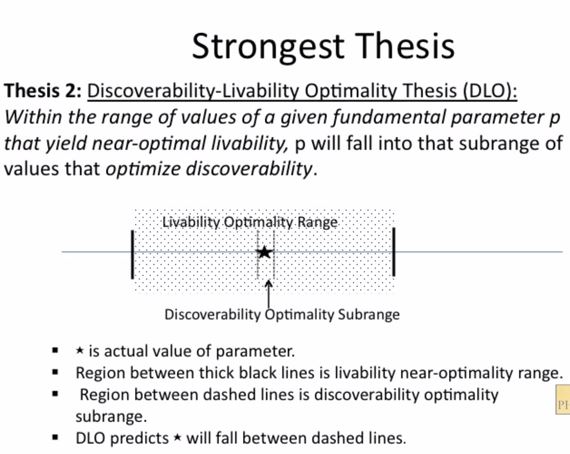
His thesis in one slide:

Fine-tuning for discoverability
Fine-tuning for discoverability – the DLO thesis

Summary:

  • Thesis: the universe is more intelligible than we would expect it by chance
  • The regular fine-tuning argument says that complex embodied observers are very rare
  • But the number of highly-discoverable universes that have complex embodied observers is rarer still
  • Why do we exist in a highly-discoverable universe?
  • Can we quantify and test discoverability?
  • Yes: by varying fundamental parameters and seeing how it affects discoverability
  • Conclusion of his calculations: The Discoverability-Liveability Optimality range is an even smaller range within the Liveablity Optimality range of the standard fine-tuning argument
  • Fine-tuning #1: the fine structure constant, governs the strength of the electro-magnetic force
  • If larger, wood-burning fire becomes impossible because fires won’t stay lit, and therefore forging metals becomes unlikely
  • If smaller, wood-burning fires won’t go out, e.g. – from lightning strikes, so that wood would be less accessible
  • Other constraints: smaller value decreases effectiveness of light microscopes, drastically lowers efficiency of transformers and motors
  • Fine-tuning #2: the cosmic microwave background radiation (CMBR), radiation left over from the Big Bang
  • humans need to discover the CMBR in order to confirm the Big Bang creation out of nothing, and it depends on baryon/pothon ratio
  • his calculations show that the actual value of CMBR is exactly at the peak for detectability by humans
  • if baryon/photon ratio larger, CMBR is less discoverable
  • if baryon/photon ratio smaller, CMBR is less discoverable
  • Fine-tuning #3: parameters related to subatomic particles are fine-tuned for their discovery and usefulness, e.g. – the bottom quark, the charm quark, the tau lepton and the Higgs Boson
  • the lifetime of the particles affects their usefulness to scientists who want to investigate the Standard Model of physics
  • decay rates of these subatomic particles are related to several of the finely-tuned parameters
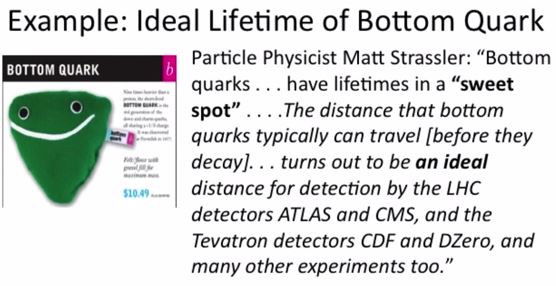
  • for example, the mass of the bottom quark is finely-tuned for its discoverability by scientists
  • the tau lepton and the charm quark are similarly fine-tuned for disoverability
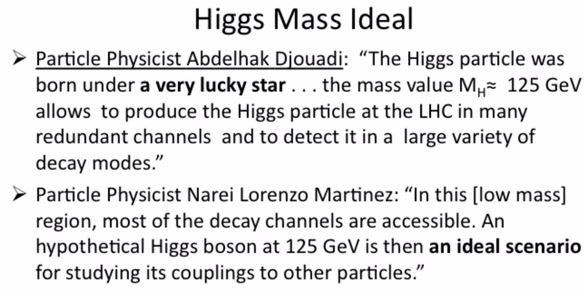
  • the mass of the Higgs boson is finely-tuned for discoverability and for making further discoveries
  • Conclusion: the DLO thesis is strongly confirmed – this is an even greater degree of fine-tuning that the already astonishing probabilities of the fine-tuning for complex, embodied intelligent beings
  • The formalized version of the philosophical argument based on this evidence is impervious with some of the traditional objections to the standard fine-tuning argument
  • #1 multiverse/selection effect: it is not subject to multiverse / observer selection objections
  • #2 normalizeability: it is not subject to the McGrew-Vestrup objection because the range of possible values is finite not infinite
  • #3 falsifiability: it makes falsifiable predictions, and in fact Collins’ earlier calculations of the CMBR discoverability contained an error that falsified the thesis – until he found the error and corrected for it
  • #4 usefulness: it gives clues about the Creator’s purpose for us, namely that the universe was created for us to be able to do science and find evidence of the Creator’s existence – there is no expectation for us to exercise blind faith, trust in God is meant to be a plausible deduction from the progress of experimental science

Sample slide:

Fine-tuning of the bottom quark for discoverability
Bottom quark lifetime is finely-tuned for discoverability

And another:

Higgs boson mass is finely-tuned for discoverability

Earlier, I blogged about a Robin Collins lecture on the fine-tuning that allows complex, embodied life to exist. Another must-see lecture. If you are looking for something to study in university, and you have funding, then physics, mathematics and philosophy are the best places to be for a Christian scholar.

Mike Licona lectures on historical methods and the New Testament

Here’s a quick overview of Michael Licona’s latest book on the resurrection, entitled “The Resurrection of Jesus“.

60 minutes of lecture, 20 minutes of Q&A.

Summary:

  • Dr. Licona’s background and education
  • The definition of history and philosophy of history
  • Postmodern approaches to history
  • Historical bedrock: facts that are historically demonstrable
  • Historical criterion 1: Explanatory scope
  • Historical criterion 2: Explanatory power
  • Historical criterion 3: Plausibility
  • Historical criterion 4: Ad Hoc / Speculation / non-evidenced assumptions
  • Inference to the best explanation
  • Investigating miracle claims: is it possible? How?
  • Objection of James D.G. Dunn
  • Objection of Bart Ehrman
  • New Testament sources: Gospels and Paul’s letters
  • The Gnostic gospels: are they good sources?
  • The minimal facts
  • The hallucination hypothesis
  • The best explanation

While watching this lecture, it struck what good preparation it was for understanding debates. This lecture is more about historical methods, but if you’re interested in Mike’s minimal facts case for the resurrection, here’s a video on that:

This is the case he uses in his debates with Richard Carrier, Dale Allison, Bart Ehrman, etc.

Mike Licona’s ministry is here: Risen Jesus.

If you are looking for a good book to read on the resurrection of Jesus, the best introductory book on the resurrection is “The Case for the Resurrection of Jesus” and the best comprehensive book is “The Resurrection of Jesus“.