Category Archives: Polemics

Abortion debate: a secular case against legalized abortion

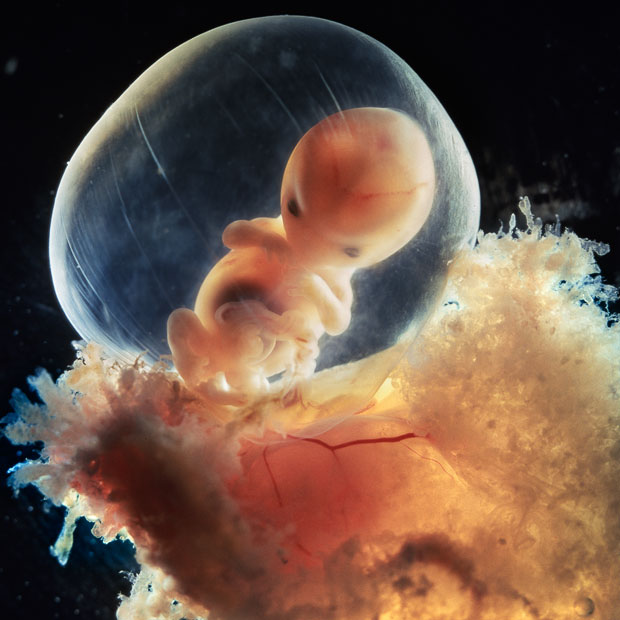
Unborn baby scheming about being only two months old

Note: this post has a twin! Its companion post on a secular case against gay marriage is here.

Now, you may think that the view that the unborn deserve protection during pregnancy is something that you either take on faith or not. But I want to explain how you can make a case for the right to life of the unborn, just by using reason and evidence.

To defend the pro-life position, I think you need to sustain 3 arguments:

  1. The unborn is a living being with human DNA, and is therefore human.
  2. There is no morally-relevant difference between an unborn baby, and one already born.
  3. None of the justifications given for terminating an unborn baby are morally adequate.

Now, the pro-abortion debater may object to point 1, perhaps by claiming that the unborn baby is either not living, or not human, or not distinct from the mother.

Defending point 1: Well, it is pretty obvious that the unborn child is not inanimate matter. It is definitely living and growing through all 9 months of pregnancy. (Click here for a video that shows what a baby looks like through all 9 months of pregnancy). Since it has human DNA, that makes it a human. And its DNA is different from either its mother or father, so it clearly not just a tissue growth of the father or the mother. More on this point at Christian Cadre, here. An unborn child cannot be the woman’s own body, because then the woman would have four arms, four legs, two heads, four eyes and two different DNA signatures. When you have two different human DNA signatures, you have two different humans.

Secondly, the pro-abortion debater may try to identify a characteristic of the unborn that is not yet present or developed while it is still in the womb, and then argue that because the unborn does not have that characteristic, it does not deserve the protection of the law.

Defending point 2: You need to show that the unborn are not different from the already-born in any meaningful way. The main differences between them are: size, level of development, environment and degree of dependence. Once these characteristics are identified, you can explain that none of these differences provide moral justification for terminating a life. For example, babies inside and outside the womb have the same value, because location does not change a human’s intrinsic value.

Additionally, the pro-abortion debater may try to identify a characteristic of the already-born that is not yet present or developed in the unborn, and then argue that because the unborn does not have that characteristic, that it does not deserve protection, (e.g. – sentience). Most of the these objections that you may encounter are refuted in this essay by Francis Beckwith. Usually these objections fall apart because they assume the thing they are trying to prove, namely, that the unborn deserves less protection than the already born.

Finally, the pro-abortion debater may conceded your points 1 and 2, and admit that the unborn is fully human. But they may then try to provide a moral justification for terminating the life of the unborn, regardless.

Defending point 3: I fully grant that it is sometimes justifiable to terminate an innocent human life, if there is a moral justification. Is there such a justification for abortion? One of the best known attempts to justify abortion is Judith Jarvis Thomson’s “violinist” argument. This argument is summarized by Paul Manata, one of the experts over at Triablogue:

Briefly, this argument goes like this: Say a world-famous violinist developed a fatal kidney ailment and the Society of Music Lovers found that only you had the right blood-type to help. So, they therefore have you kidnapped and then attach you to the violinist’s circulatory system so that your kidneys can be used to extract the poison from his. To unplug yourself from the violinist would be to kill him; therefore, pro-lifers would say a person has to stay attached against her will to the violinist for 9 months. Thompson says that it would be morally virtuous to stay plugged-in. But she asks, “Do you have to?” She appeals to our intuitions and answers, “No.”

Manata then goes on to defeat Thomson’s proposal here, with a short, memorable illustration, which I highly recommend that you check out. More info on how to respond to similar arguments is here.

Here is the best book for beginners on the pro-life view.

For those looking for advanced resources, Francis Beckwith, a professor at Baylor University, published the book Defending Life, with Cambridge University Press, 2007.

What theory of truth should a Bible-believing Christian accept?

Investigation in progress

I was just thinking to myself this week about why I keep running into people who identify as Christians who are open and unrepentant about habitual sin. Now, I’m not perfect, but you don’t see me out there in public saying that the Bible is wrong. I would not claim that some behavior that was condemned by all previous generations of Christians is suddenly ok.

So, I thought and thought and thought about it, and here is what I came up with. Somehow, people have come to a view of Christianity that tells them that Christianity is not something that is true about the universe out there. Instead, Christianity is “true” in the sense that it “works for them”.

So they aren’t saying that God actually exists or that Jesus actually rose from the dead, because they don’t know if those things are objectively true. They’re just saying that they like some Christian words and behaviors because those things make them feel good. Christianity is not something they could defend as objectively true to any non-Christian using reason and evidence. They like how the idea of a loving God makes them feel. Or maybe they like invoking the idea of “do not judge” when someone questions their destructive choices or immorality. But they don’t actually submit to these ideas as “true” in the same way that they take the instructions on a medicine bottle as true.

Here’s a post by Aaron Brake at Stand to Reason, that explains three different views of truth. He calls the view that I talked about the “pragmatic view of truth”. He says that the pragmatic view is that things are true if they “work” for the individual. So, in the case of my Christians-who-deny-Jesus-as-Lord, these people pick and choose things that work for them out of Christianity, e.g. – the love of God, the “do not judge” fragment, the women taken in adultery, etc. But they leave out the moral obligations that Christians have believed for thousands of years, e.g. – no sex before marriage, marriage is between a man and woman for life, divorce is pretty much always unjustified, and adultery is never OK under any circumstances.

Here is the view of truth that he thinks is best:

Finally, there is the correspondence theory of truth: truth is when an idea, belief, or statement matches (or corresponds with) the way the world actually is (reality).

This may rightly be labeled the “common sense” view of truth. While not taught explicitly in Scripture, it is assumed throughout both the Old and New Testaments. The correspondence theory of truth states that an idea, belief, or statement is true if it matches, or corresponds with, reality. In this sense, reality is the truth-maker, and the idea, belief, or statement is the truth-bearer. When the truth-bearer (an idea) matches the truth-maker (reality), they are said to stand in an “appropriate correspondence relationship,” and truth obtains.

Consider the following statements:

  1. Donald Trump is the current President of the United States.
  2. The city of Los Angeles is located in California.
  3. Elective abortion kills an innocent human being.

Are these statements true? They are if, in fact, they match reality. Statement number 1 is true if, in reality, Donald Trump is the current President of the United States. Statement 2 is true if, in fact, the city of Los Angeles is located in California. And statement 3 is true if elective abortion really does kill an innocent human being. Easy enough, right? Aristotle put it this way:

To say of what is that it is not, or of what is not that it is, is false, while to say of what is that it is, and of what is not that it is not, is true; so that he who says anything that it is, or that it is not, will say either what is true or what is false.

A Case for Correspondence

Christian philosopher J.P. Moreland notes two main arguments which have been advanced in favor of the correspondence theory of truth: the descriptive and the dialectical.

The descriptive argument simply presents specific cases that help illustrate the concept of truth. For example, in Moreland’s bookstore case, an individual named Joe has the thought “Richard Swinburne’s book The Evolution of the Soul is in the bookstore.” When Joe enters the bookstore and sees the book, he actually experiences truth, a correspondence relation between his thought and reality. Again, this is the “common sense” definition of truth since it is the view we all presuppose in our daily actions and speech; i.e., everyone assumes the correspondence theory of truth when reading a medicine label or dialing a phone number.

That theory of truth is the normal theory of truth, and it’s the one used in the Bible, e.g. – Elijah on Mount Carmel, Jesus calling his resurrection the Sign of Jonah. If the Bible teaches something, then that teaching is true, because it conforms to the way the world really is. Objective reality makes the Bible’s statements true or false. It’s true whether people like it or not.

Here’s what I suspect is true of all the liberal Christians that I’ve met. None of them will have looked into things like the existence of God or the resurrection to see if they are objectively true. They’ll not even be interested in lifting a finger to study in order to find out whether those things are true. If they evangelize, they’ll tell stories about their own life experiences and feelings, and try to “sell” Christianity based on felt needs being met. They’ll not waste a second on studying the laws of logic, or science or history in order to demonstrate Christian claims as true – especially the ones that don’t “ring true” to them.

It makes me think of that post that I wrote about John Searle and his suspicion about why people become postmodern relativists. He thinks it’s so that they can deny reality if reality constrains their will to pursue happiness. I’ve actually seen this when people break all the rules in their selfish pursuit of happiness, and then when it all explodes in their face, they claim that life is unpredictable, and it wasn’t their fault. The rejection of the correspondence theory of truth is – I think – rooted in this desire to dismiss anything that could act as a brake on their hedonism. They don’t care that you can produce studies after studies showing that fatherlessness is bad for children. If God didn’t give them a husband, then they are perfectly justified in having children through a sperm donor, and raising the fatherless child with welfare money. The simplest way out of your Bible verses and fatherlessness studies is for them to say that doing wrong “works for them” and so it’s “true for them”.

Robin Collins lectures on the fine-tuning argument at Pepperdine University

Christianity and the progress of science

Details:

Dr. Robin Collins is a Professor of Philosophy and Chair of the Department of Philosophy at Messiah College. Collins is the foremost defender of what is known as the teleological argument for the existence of God. He has a background in both physics and philosophy and will be discussing how the specific physical constants and conditions in the universe are finely-tuned for intelligent life and how this “fine-tuning” gives us reason to believe in a Creator.

Here is the video:

Topics:

  • the constants and quantities set at the origin of the universe is fine-tuned for conscious, embodied intelligences like us
  • three kinds of fine-tuning: 1) laws of nature, 2) constants, 3) quantities
  • examples of 1): gravity, electromagnetism, strong force, quantization, Pauli exclusion principle
  • examples of 2): gravitational constant, cosmological constant,
  • examples of 3):  initial distribution of mass-energy
  • in addition to fine-tuning for life, there is also fine-tuning for discoverability
  • Naturalistic response to the evidence: the multiverse hypothesis
  • problems with the multiverse hypothesis
  • additional topics

I put the ones I am ready to speak on in bold. I recommend you learn those as well in order to illustrate the fine-tuning with evidence when you present it. It’s important to understand that if the constants and quantities change, it’s not that you still have life, but just with pointy ears and/or green skin. It’s that you don’t have stars or planets or heavy elements or chemical reactions. Things that are necessary for complex, intelligent life forms of any conceivable kind.