Category Archives: Podcasts

How long are the days of Genesis? Hugh Ross and Jason Lisle debate

Two bears fight it out, and may the best bear win!

I found this radio debate about the age of the Earth on the Apologetics 315 Twitter feed.

Speakers:

Jason Lisle

Dr. Lisle graduated summa cum laude from Ohio Wesleyan University where he double-majored in physics and astronomy, and minored in mathematics. He did graduate work at the University of Colorado where he earned a Master’s degree and a Ph.D. in Astrophysics. While there, Dr Lisle used the SOHO spacecraft to investigate motions on the surface of the sun as well as solar magnetism and subsurface weather. His thesis was entitled “Probing the Dynamics of Solar Supergranulation and its Interaction with Magnetism.” Among other things, he discovered a previously unknown polar alignment of supergranules (solar convection cells), and discovered evidence of solar giant cells. He has also authored a number of papers in both secular and creation literature.

Hugh Ross

At age seventeen he became the youngest person ever to serve as director of observations for Vancouver’s Royal Astronomical Society. With the help of a provincial scholarship and a National Research Council (NRC) of Canada fellowship, he completed his undergraduate degree in physics (University of British Columbia) and graduate degrees in astronomy (University of Toronto). The NRC also sent him to the United States for postdoctoral studies. At Caltech he researched quasi-stellar objects, or “quasars,” some of the most distant and ancient objects in the universe.

So both have impeccable scientific credentials.

The MP3 file is here. (This is the updated version that Brian Auten fixed to remove the commercials!)

I don’t always agree with Frank Pastore, (only 95%), but he knows the topic of the debate back to front, and guides the discussion in an incredibly useful, accurate way. This is a fine debate to listen to! You will learn a lot. And you will have fun learning.

The Bible and the early church fathers

Jason Lisle

  • we take Genesis literally
  • the starting point of YEC is Scripture
  • the plain meaning of Scripture is that the earth was made in 6 24-hour days
  • science has to be interpreted in a way that fits a plain reading of Genesis 1
  • the evidence for an old universe and old Earth must be rejected a priori

Hugh Ross

  • we take Genesis literally
  • the Hebrew word for day (yom) can mean 24 hours or a long period of time
  • there are multiple creation accounts in the Bible
  • interpreting yom as long periods of time harmonizes all the accounts
  • the Bible says that the seventh day is not even ended
  • we believe in a literal Adam and Eve living thousands of years ago

Jason Lisle

  • there’s only 1 account of creation in the Bible: Genesis
  • the normal view in church history is 6 24-hour days
  • there are some early church fathers who that the days are long
  • the other places where creation is discussed are not real accounts

Hugh Ross

  • the early church did not spend a lot of time talking about the age of the Earth
  • there is not unanimous agreement about the age of the Earth
  • there is no definitive statement on the age of the Earth until Isaac Newton
  • Newton strongly favored an old earth, hundreds of years before Darwin
  • there are other creation accounts, Job 38-39
  • Pslam 104 is a creation account

Jason Lisle

  • a Psalm is not written in the genre of historical narrative
  • Psalm 104 is not a creation account – it talks about ships, etc
  • it’s talking about the modern era, not a creation account

The evidence from science

Hugh Ross

  • both of us believe in an absolute beginning of time, space and matter
  • both of us believe that space is expanding now
  • stars form as matter coalesces during the expansion of the universe
  • star formation requires a universe aged on the order of billions of years

Jason Lisle

  • if you pre-suppose my interpretation of Genesis, then the universe is young

Hugh Ross

  • the speed of the expansion of the universe proves an old universe
  • the light emitted from the oldest stars also proves an old universe

Jason Lisle

  • if you pre-suppose my interpretation of Genesis, then the universe is young

Was the universe made with the appearance of age

Jason Lisle

  • any evidence for an old universe is wrong
  • stars didn’t form gradually, they were created by God instantly
  • stars have the appearance of age, but they’re actually young

Hugh Ross

  • God doesn’t lie in the Bible or in the book of nature
  • Scientists can look back in time by looking further out into the universe
  • Because light takes a long time to travel to the Earth, we can see the past
  • we can see a time when there were no stars yet
  • stars formed slowly over time, not instantaneously
  • we have photos of the universe before stars and after stars
  • we can see a history of the universe by looking closer and further away

Does nature provide us with knowledge about creation?

They discuss Psalm 19 now, so here’s Psalm 19:1-5:

1 The heavens declare the glory of God; the skies proclaim the work of his hands.

2 Day after day they pour forth speech; night after night they display knowledge.

3 There is no speech or language where their voice is not heard.

4 Their voice goes out into all the earth, their words to the ends of the world.
In the heavens he has pitched a tent for the sun,

5 which is like a bridegroom coming forth from his pavilion, like a champion rejoicing to run his course.

Jason Lisle

  • nature isn’t a book
  • nature doesn’t provide knowledge about God
  • Psalm 19 doesn’t say that nature communicates to us
  • verse 3 says “There is no speech nor language”

Hugh Ross

  • If you read all of verse 3, it says the exact opposite of what you just said it says
  • Verse 1: “The heavens declare the glory of God; the skies proclaim the work of his hands”
  • Verse 2: “Day after day they pour forth speech; night after night they display knowledge.”
  • Verse 3: “There is no speech or language where their voice is not heard.
  • Verse 4: “Their voice goes out into all the earth, their words to the ends of the world.”

Jason Lisle

  • You can’t take the Bible literally all the time

How important is the age of the Earth?

Hugh Ross

  • it’s a non-essential because it has nothing to do with salvation or inerrancy
  • both sides of the debate affirm the same views of salvation and inerrancy
  • professional scientists have multiple lines of evidence saying the universe is old
  • the only reason it matters is that young earth creationism is a barrier to faith
  • if you have to deny science to be a Christian, then it stops people from being saved
  • young earth opposition to science has been used by secularists to marginalize Christianity

Jason Lisle

  • there was no death in the Garden of Eden, animal or human, before the Fall
  • the Bible says that death was a consequence of Adam’s sin
  • so there was no death before the Fall, according to the Bible
  • old earth people believe in death before the Fall

Consider Romans 5:12:

12Therefore, just as sin entered the world through one man, and death through sin, and in this way death came to all men, because all sinned—

Hugh Ross

  • Romans 5:12 says that Adam’s sin caused death to come to all men
  • old earth people believe that only animal death existed before the Fall, not human death
  • plant and animal death existed before the Fall – Adam and Eve were eating!

Jason Lisle

  • I interpret the Bible to say that plants aren’t living creatures

What about dinosaurs, the Flood, and Noah’s ark?

Jason Lisle

  • dinosaurs were created on the 6th day
  • dinosaurs lived alongside humans and were vegetarians before the Fall
  • dinosaurs were on the Ark – they’re not that big – just take baby dinosaurs
  • it’s a global flood

Hugh Ross

  • dinosaurs were created on the 5th day
  • they were extinct before before humans ever appeared
  • nobody in history ever wrote about dinosaurs until 200 years ago
  • it’s a local flood

How can we get single men and husbands to be interested in church and ministry?

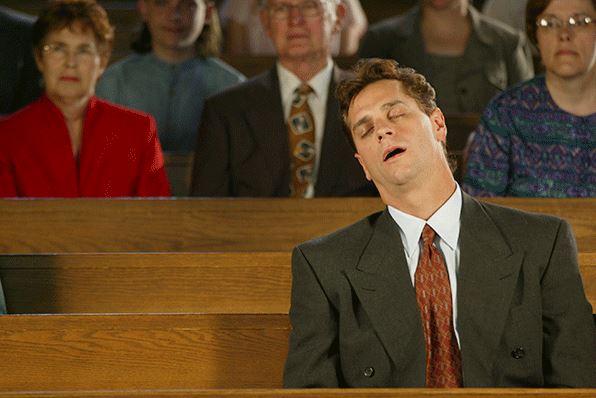
Church sucks, that's why men are bored there
Church is ineffective and impractical, and that’s why men are bored there

Consider this passage from William Lane Craig’s April 2013 newsletter, which made me very excited and happy. (H/T Triablogue)

Here it is:

One overwhelming impression of these engagements is the way in which the intellectual defense of Christian faith attracts men. Both at Texas A&M and again at Miami every single student who got up to ask a question was a guy! I wondered if the girls are just shy. But then I remembered a lengthy clip Jan and I watched of cast members of Downton Abbey doing a Q&A with an audience in New York. Almost every person who came to the microphone at that event was a woman! It wasn’t until late into the evening that a man finally asked a question, which was remarked by all the cast members. Why the difference between that session and the ones I experienced?—simply because the Downton Abbey program is highly relational, which is more appealing to women, whereas my talks were principally intellectually oriented, which is more appealing to men.

Churches have difficulty attracting men, and the church is becoming increasingly feminized. I believe that apologetics is a key to attracting large numbers of men (as well as women) to church and to Christ. By presenting rational arguments and historical evidences for the truth of the Gospel, by appealing to the mind as well as the heart, we can bring a great influx of men into the Kingdom. I’m so pleased that the church in Canada seems to be awakening to this challenge! I’m convinced that we have the opportunity to revolutionize Western Christianity by reclaiming our intellectual heritage.

Now, I hear a lot of complaints from women in the church and pastors in the church about men not being interested in going to church. I think that the problem is that church is hostile to men’s natures. Men thrive on conflict and competition. Men prefer strict rules and moral judgments. Men prefer to shame people who underperform, rather than coddle them. Men are practical and results focused. So how should the church accommodate the different nature that men have? Apologetics is one way to appeal to the male nature.

Let’s take a look at it.

Pastors: church as it is now is abrasive to men’s male nature

In a recent William Lane Craig podcast, at time 8:47, the WLC tells Kevin Harris about how he and his wife Jan asked about six of the young men who attend his “Defenders” apologetics class which morning service they attended: traditional or contemporary. ALL of the young men said that they attended neither service, because they go to church to learn something and the service has no educational value to them. The only attend the Defenders class. The apologetics class taught them things they could actually use – things they could actually use to think better, and fight better. This is my experience as well, although I am looking for a better church that does have some appeal to men. I might even have to move to find a decent church that has apologetics.

There is absolutely nothing going on in most churches that is valuable to a man. Men, by and large, only pray as a last resort, after we have done everything we can to solve the problem ourselves. We pay the most attention to the parts of the Bible that help us debate with non-Christians, or that give us things to do. We like to find evidence in the real world that connects with what the Bible is saying. We are interested in planning, execution and results. We are not very interested in feelings, singing, devotions, or bending the rules to make people doing bad things feel good. Now that’s not necessarily true for all men, but it is true for the majority of men.

And lest some people worry that fighting makes enemies, it doesn’t. Fighting with non-Christians has two effects: 1) they respect Christianity more, and 2) they want to be your friends and talk to you about spiritual things. Atheists see your standing up for what you believe in and living consistently with it indicative of authenticity. That is not the exception, Christian women and pastors – that is the rule. Atheists don’t think that standing up for what you believe in makes Christianity look fake, they think it makes Christianity look authentic. Well, at least the ones who are worth talking to think that.

Wives: don’t choose men who had no interest in advocating for Christianity before you married them

A related problem I see is the problem of wives marrying the wrong men then complaining that the men they freely chose to marry are not interested in church. This is actually the woman’s fault. Most women don’t think about what is best for God when they think about who to marry and have children with, they think about what makes them feel good. They don’t have any kind of plan where they match the man’s ability to the roles he will play as husband and father – they just pick who makes them feel good. This works about as well as buying and selling stocks based on which make you feel good, or choosing electronics and computers based on the color, or choosing a job or a church based on what the building looks like. The Bible lays out a few minimal requirements for a man: chastity, self-sacrificial love, providing for family, leading on moral and spiritual issues. Most young, unmarried women don’t value those things. If a woman picks a man who doesn’t make any demands on them, and who doesn’t judge them, then she cannot depend on him to show spiritual and moral leadership later on in the marriage. So don’t pick a man like that.

Wives: men respond to attention, recognition and approval from women

The reason that most husbands don’t engage in Christianity is because most wives (not my married friends of course) haven’t approached Christianity as something that is objectively true. Men don’t create illusions for themselves in order to feel better – they are more practical than that. Men only invest in things that they think are true, and where they can see that their practical efforts will make a difference. Men are turned off by the view that Christianity is just something that helps families and communities bond, and makes people feel comfort. We think that’s weakness, and we abhor weakness. Once men get the idea that a woman thinks of Christianity as feelings-fulfillment, we stop trying to achieve anything for the Kingdom of God. Men don’t want to be roped into Christianity if all it means is helping people get along and feel good. But they very much want to be roped into a demanding relationship with God where their efforts to achieve results count with God and gets them recognition and approval from their wives.

So how do wives learn to recognize and approve of what men do as Christians? Well, women need to learn apologetics and they need to practice debating with non-Christians. That will teach them to value conflict and competition, and to see how engagement and authenticity drives relationships with non-Christians forward. If women show an interest in objective truth, moral goodness and theological correctness, then men will become interested in these things, too. They will do it because men are addicted to pleasing women, and they want to help women more than anything in the world, second only to pleasing God. Men will enthusiastically engage in whatever will get them praise and recognition from women, and that means that women have to care about Christianity beyond their personal emotional experience of it and beyond their social cohesion experience of it. Initially, wives must be ready to praise and encourage their husbands, and then once the husbands get it, then they will be self-motivated and move out on their own. It will be self-sustaining.

Matt Dillahunty debates David Robertson on atheism, morality and evil

Two horses fight it out, may the best horse win!

OK. So I think it’s safe to say that of all the Christian apologists out there, David Robertson is my least favorite debater. Why? Many reasons, but mostly because he does not bring in evidence, especially scientific evidence. And he seems to make these clever quips like G. K. Chesterton. I like evidence. I would rather that he talk about scientific and historical evidence.

Dina asked me to listen to this debate a while back, between David Robertson and agnostic Matt Dillahunty (he’s not an atheist, he’s just an agnostic). I went in absolutely convinced that Robertson was going to have his ass handed to him by Matt Dillahunty. And I could not have been more wrong.

Here’s the debate posted on YouTube (audio only):

This snarky summary is just a paraphrase from certain parts of the debate, it is not designed for accuracy, but for fun – to make you listen to the debate. Listen to the debate to get the exact words in context.

Summary:

  • Matt Dillahunty: he’s an agnostic who calls himself an atheist
  • David Robertson: he’s from Scotland, could we not get someone better?
  • Robertson opening statement is incredibly weak, as you might expect, he only had two arguments embedded in a long list of nonsense: 1) origin and design of the universe 2) reality of evil requires objective morality

1) Creation/Design:

Robertson: The fact is that matter exists. There are 3 views that could account for this fact: 1) created, 2) eternal, 3) self-generated out of nothing. Option 3) is self-contradictory, 1) requires a Creator, and 2) is falsified by the Big Bang cosmology. So what’s your view?

Dillahunty: You’re trying to get me to say what my view is, but I can just say “I don’t know” and get out of having to take any position on how matter got here.  I can say “I don’t know” to all the scientific evidence for the Big Bang cosmology, too!

2) Evil requires objective morality, requires a moral lawgiver:

Robertson: evil exists, e.g. – the Holocaust. If atheism is true, objective morality is impossible. Richard Dawkins agrees. Therefore, theism is the best explanation for the existence of evil.

Dillahunty: In my opinion, morality means doing what helps people have well-being. And I think that the Holocaust is obviously bad, because it hurts the well-being of the victims.

Robertson: The problem is that on your view, different people decide what well-being is to them. If you were raised in the Social Darwinism of the Nazi regime, you would believe that the Holocaust was the best for the well-being of the society as a whole.

Dillahunty: Isn’t it obvious that killing people is bad for their well-being?

Robertson: Is it bad for the well-being of unborn children to kill them?

Dillahunty: Yes

Robertson: So you’re against abortion, then?

Dillahunty: No

Robertson: So you think that killing the child in the womb is against the well-being of the child, but you’re for that?

Dillahunty: I don’t know! I don’t know!

Then Dillahunty tried to claim Hitler was a Christian:

Dillahunty: here is a quote by Hitler saying that secular schools are bad, and religious schools are good – see, he’s a Christian!

Robertson: when was that said and to whom?

Dillahunty: I don’t know, I don’t know!

Robertson: It was said in 1933, during an election campaign, to Catholic authorities – he was a politician, looking for votes from Catholics so he could become Chancellor.

Good and evil on atheism:

Dillahunty: good actions results in states with more well-being, and evil actions result in states with less well-being.

Brierley: but when the Nazis slaughtered all those people, they believed they were increasing well-being

Dillahunty: But you could demonstrate to them that their action is not going to increase well-being. Survival of the fittest is descriptive of what happens, but it’s not prescriptive.

Robertson: Whose well-being will human beings think about most, if not their own? Do you really think that you can stop people like Charles Manson from being evil by sitting down and trying to prove to them that they are not helping their victim’s well-being?

(A BIT LATER)

Robertson (to Dillahunty): Is it a fact that Dachau (a concentration camp) was morally wrong?

Dillahunty: (literally, not a paraphrase) I DON’T KNOW

My thoughts:

When I listened to this debate, the overwhelming conviction that emerges is that Matt Dillahunty is not someone who forms his worldview based on evidence. His rejection of the Big Bang cosmology with “I don’t know” is just atrocious. His comments about slavery in the Bible and Hitler being a Christian show that his investigations of these issues is far below the level of a responsible adult. His dallying with the Jesus-never-existed view just shows him to be fundamentally anti-intellectual, as even atheist historian Bart Ehrman denies that view. His definition of faith has nothing to do with the Bible, or Christian authorities, or Christian scholars – he invented a definition of faith that allows him to mock Christians as morons. That’s just irresponsible – letting the desire to mock others cause you to distort the definition of a word. When asked to state his positions or respond to specific evidence, his response is very often “I don’t know”. It seems to me that atheism, to him, means not pursuing truth with the aim of grasping it. He wants to keep reality at a safe distance – that’s why he says “I don’t know” so often.

On morality, it’s even worse. It’s not surprising to me that he is pro-abortion and has no opinion about concentration camps being objectively evil. Most atheists are pro-abortion, by the way. When it comes to morality, Dillahunty only has his own personal opinions, and they refer to nothing outside his own mind. (His opinion of morality as related to well-being is utilitarianism – a very problematic view – but moreover, it is his subjective view – he isn’t offering it as any sort of objective moral system that would be prescriptive instead of descriptive. Without an after-life, there is no reason for anyone to care about the moral point of view when it goes against their self-interest, anyway. Atheists use moral language, but their statements are not referring to any objective, prescriptive moral reality. Atheism is materialistic and therefore deterministic – it does not even ground the free will that is needed to make moral choices. Their view is Darwinian survival of the fittest, that’s what emerges from their origins story – and it does not rationally ground morality. The strong kill the weak, if they can. I’ve written before about how difficult it is for atheists to rationally condemn things like slavery, and nothing in Dillahunty’s presentation led me to believe that he had solved that problem.

Anybody can be an intellectually-satisfied atheist with an empty head – it’s knowledge that causes people to conform their beliefs to reality. If one strives to keep one’s head as empty as possible, then of course one can believe anything one wants. I’m glad, speaking as a Christian theist, that I get to follow the evidence wherever it leads. It seems to me that we should do that, rather than decide how we want to live first, and then invent a worldview to justify our desires.

Positive arguments for Christian theism