Scott Klusendorf is the director of the excellent Life Training Institute, and he’s been interviewed by Brian Auten on Apologetics 315.
Details of the interview:
Today’s interview is with Scott Klusendorf, president of Life Training Institute. LTI is the first place to look for excellent resources to get better equipped to defend the pro-life position. Scott talks about defining abortion and its terms, the issue of the debate, the legal history of abortion, defending the pro-life view using science and philosophy, the four pillars of the pro-life argument, answering a litany of objections to the pro-life position, the right and wrong use of emotional appeals, taking on the right tone in the debate, how to get better equipped, and more.
BA: Great stuff. Now I want you to go into these pillars if you will of defending the pro-life position with science and philosophy, and in your web site prolifetraining.com one of the things that you provide is sort of a four point acronym, some would say sled S-L-E-D. Can you lay out what those main pillars are and their relevance to the issue?
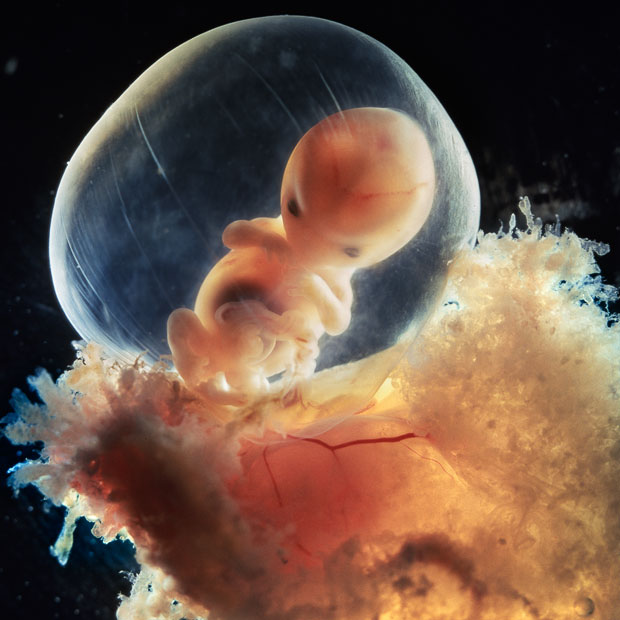
SK: Well as I mentioned a moment ago, pro-life advocates argue that elective abortion unjustly takes the life of a developing human being, and we defend that claim using science and philosophy. We use science to determine what kind of thing the unborn is, and we use philosophy to show that there’s no relevant deference between the embryos we once were and the adults we are today that would justify killing us at that earlier stage of development. Scientifically, as I mentioned just moments ago embryology text books worldwide indicate that from the very beginning you and I were distinct living whole human beings. You can’t see that I’m doing this right now, Brian, but at the moment I’m picking cells off the back of my hand. These cells, which we call somatic cells, contain my entire DNA and coding. But you don’t thing I just committed mass murder by sending a couple hundred of those puppies hurling to their deaths on the floor in front of me. And the reason is, you know that these cells though they contain my DNA and coding are merely part of a larger human being, me. They are not distinct whole living organisms the way that you were when you were an embryo. The way I was when I was an embryo. In other words, there is a difference in kind between each of our bodily cells and the embryonic human beings we once were. That’s what science teaches us; that’s what the science of embryology lays down for us.Philosophically, we argue using that SLED acronym that you mentioned a moment ago that there’s no difference between that embryo we once were and the adult we are today. The adults we are today that justify killing us at that earlier stage of development and as Steven Schwarz points out, the differences between that embryo and the adult that you are today are one of size, level of development, environment and degree of dependency. Think of the acronym SLED and you will remember those four differences. Size, yeah you were smaller as an embryo, but since when does body size determine the rights that you have. Shaquille O’Neal, the seven foot two basketball star with the Boston Celtics, is a foot taller than I am, but he doesn’t have a greater right to life simply because he’s bigger.
Level development? Sure, we were less developed as embryos but since when is a matter of principal does that mean we can kill you? Two-year-old girls are less developed than twenty-year-old young women. We don’t think though the two year old girl has less to a right to life simply because she can’t function at the level that the twenty year old can. Level of size, I should say level of development. What about environment; where you are located there is the letter “E” in that SLED acronym. You were once in the womb now you’re out but sense when does were you are determine what you are? When you walk from your living room into the studio to do this interview. You changed location but you didn’t stop being you. When I jump on an airplane and fly from Atlanta to London’s Heathrow airport. I get off the plane I’m in a new location, but I’m the same being as I was when I left Atlanta. If that’s true how does a journey of eight inches down the birth canal suddenly change me from non-human, non-valuable thing that we can kill? To a valuable human being that we can’t kill. And the answer is, if I wasn’t already human and valuable I’m not going to get there by changing my address. And then finally, degree of dependency—yes we depended on our mother for survival but sense when does dependency on another human being mean we can kill you? Conjoined twins depend on each other for survival and unless one of the twins is killing its partner we don’t go ahead and slit the throat of both twins simply because they can’t live independent of each other. Size, level of development, environment, degree of dependency, think “SLED” those are the only four differences between that embryo you once were and the adult you are today. And the pro-lifer would argue that not one of those four differences justifies killing you at that earlier stage.
And if you like that interview, I have some more things for you to read from Dr. Francis Beckwith.
Learn more by reading
Frank Beckwith is the author of “Defending Life: A Moral and Legal Case Against Abortion Choice“. He wrote that book for Cambridge University Press, a top academic press. But before Cambridge University Press, Beckwith wrote easy-to-understand essays for the Christian Research Journal.
Here are four essays that answer common arguments in favor of legalized abortion.
Walter Bradley (B.S., Ph.D. University of Texas at Austin) is Distinguished Professor of Engineering at Baylor. He comes to Baylor from Texas A&M University where he helped develop a nationally recognized program in polymeric composite materials. At Texas A&M, he served as director of the Polymer Technology Center for 10 years and as Department Head of Mechanical Engineering, a department of 67 professors that was ranked as high as 12th nationally during his tenure. Bradley has authored over 150 refereed research publications including book chapters, articles in archival journals such as the Journal of Material Science, Journal of Reinforced Plastics and Composites, Mechanics of Time-Dependent Materials, Journal of Composites Technology and Research, Composite Science and Technology, Journal of Metals, Polymer Engineering and Science, and Journal of Materials Science, and refereed conference proceedings.
Dr. Bradley has secured over $5.0 million in research funding from NSF grants (15 yrs.), AFOSR (10 years), NASA grants (10 years), and DOE (3 years). He has also received research grants or contracts from many Fortune 500 companies, including Alcoa, Dow Chemical, DuPont, 3M, Shell, Exxon, Boeing, and Phillips.
He co-authored The Mystery of Life Origin: Reassessing Current Theories and has written 10 book chapters dealing with various faith science issues, a topic on which he speaks widely.
He has received 5 research awards at Texas A&M University and 1 national research award. He has also received two teaching awards. He is an Elected Fellow of the American Society for Materials and the American Scientific Affiliation (ASA), the largest organization of Christians in Science and Technology in the world. He is President elect of the ASA and will serve his term in 2008.
Below, I analyze a lecture entitled “Is There Scientific Evidence for an Intelligent Designer?”. Dr. Bradley explains how the progress of science has made the idea of a Creator and Designer of the universe more acceptable than ever before.
1. The correspondence of natural phenomena to mathematical law
All observations of physical phenomena in the universe, such as throwing a ball up in the air, are described by a few simple, elegant mathematical equations.
2. The fine-tuning of physical constants and rations between constants in order to provide a life-permitting universe
Life has certain minimal requirements; long-term stable source of energy, a large number of different chemical elements, an element that can serve as a hub for joining together other elements into compounds, etc.
In order to meet these minimal requirements, the physical constants, (such as the gravitational constant), and the ratios between physical constants, need to be withing a narrow range of values in order to support the minimal requirements for life of any kind.
Slight changes to any of the physical constants, or to the rations between the constants, will result in a universe inhospitable to life.
The range of possible ranges over 70 orders of magnitude.
Although each individual selection of constants and ratios is as unlikely as any other selection, the vast majority of these possibilities do not support the minimal requirements of life of any kind. (In the same way as any hand of 5 cards that is dealt is as likely as any other, but you are overwhelmingly likely NOT to get a royal flush. In our case, a royal flush is a life-permitting universe).
Examples of finely-tuned constants and ratios: (there are more examples in the lecture)
a) The strong force: (the force that binds nucleons (= protons and neutrons) together in nucleus, by means of meson exchange)
if the strong force constant were 2% stronger, there would be no stable hydrogen, no long-lived stars, no hydrogen containing compounds. This is because the single proton in hydrogen would want to stick to something else so badly that there would be no hydrogen left!
if the strong force constant were 5% weaker, there would be no stable stars, few (if any) elements besides hydrogen. This is because you would be able to build up the nuclei of the heavier elements, which contain more than 1 proton.
So, whether you adjust the strong force up or down, you lose stars than can serve as long-term sources of stable energy, or you lose chemical diversity, which is necessary to make beings that can perform the minimal requirements of living beings. (see below)
b) The conversion of beryllium to carbon, and carbon to oxygen
Life requires carbon in order to serve as the hub for complex molecules, but it also requires oxygen in order to create water.
Carbon is like the hub wheel in a tinker toy set: you can bind other elements together to more complicated molecules (e.g. – “carbon-based life), but the bonds are not so tight that they can’t be broken down again later to make something else.
The carbon resonance level is determined by two constants: the strong force and electromagnetic force.
If you mess with these forces even slightly, you either lose the carbon or the oxygen.
3. Fine-tuning to allow a habitable planet
A number of factors must be fine-tuned in order to have a planet that supports life
Initial estimates predicted abundant life in the universe, but revised estimates now predict that life is almost certainly unique in the galaxy, and probably unique in the universe.
Even though there are lots of stars in the universe, the odds are against any of them supporting complex life.
Here are just a few of the minimal requirements for habitability: must be a single star solar system, in order to support stable planetary orbits, the planet must be the right distance from the sun in order to have liquid water at the surface, the planet must sufficient mass in order to retain an atmosphere, etc.
The best non-theistic response to this argument is to postulate a multiverse, but that is very speculative and there is no experimental evidence that supports it.
Evidence #2: The origin of the universe
1. The progress of science has shown that the entire physical universe came into being out of nothing (= “the big bang”). It also shows that the cause of this creation event is non-physical and non-temporal. The cause is supernatural.
Atheism prefers an eternal universe, to get around the problem of a Creator having to create the universe.
Discovery #1: Observations of galaxies moving away from one another confirms that the universe expanded from a single point.
Discovery #2: Measurements of the cosmic background radiation confirms that the universe exploding into being.
Discovery #3: Predictions of elemental abundances prove that the universe is not eternal.
Discovery #4:The atheism-friendly steady-state model and oscillating model were both falsified by the evidence.
And there were other discoveries as well, mentioned in the lecture.
The best non-theistic response to this argument is to postulate a hyper-universe outside of ours, but that is very speculative and there is no experimental evidence that supports it.
Evidence #3: The origin of life
1. The progress of science has shown that the simplest living organism contains huge amounts of biological information, similar to the Java code I write all day at work. This is a problem for atheists, because the sequence of instructions in a living system has to come together all at once, it cannot have evolved by mutation and selection – because there was no replication in place prior to the formation of that first living system!
Living systems must support certain minimum life functions: processing energy, storing information, and replicating.
There needs to be a certain amount of complexity in the living system that can perform these minimum functions.
But on atheism, the living system needs to be simple enough to form by accident in a pre-biotic soup, and in a reasonable amount of time.
The minimal functionality in a living system is a achieved by DNA, RNA and enzymes. DNA and RNA are composed of sequences of proteins, which are in turn composed of sequences of amino acids.
Consider the problems of building a chain of 100 amino acids
The amino acids must be left-handed only, but left and right kinds are equally abundant in nature. How do you sort out the right-handed ones?
The amino acids must be bound together using peptide bonds. How do you prevent other types of bonds?
Each link of the amino acid chain needs to be carefully chosen such that the completed chain with fold up into a protein. How do you choose the correct amino acid for each link from the pool of 20 different kinds found in living systems?
In every case, a human or other intelligence could solve these problems by doing what intelligent agents do best: making choices.
But who is there to make the choices on atheism?
The best current non-theistic response to this is to speculate that aliens may have seeded the Earth with life at some point in the past.
The problem of the origin of life is not a problem of chemistry, it is a problem of engineering. Every part of car functionality can be understood and described using the laws of physics and chemistry. But an intelligence is still needed in order to assemble the components into a system that has the minimal requirements for a functioning vehicle.