Democrats celebrating shutting down the government for illegal aliens
By now I guess everyone has heard about the Senate Democrats deciding to shut down the government. What’s surprising to me about this is why they are choosing to do it, and what it shows about their priorities. Who are they really working for?
Here’s Genevieve Wood’s article about it at the Daily Signal:
As you may have heard, a government shutdown is looming here in D.C. Many of you out there watching probably think, “So what? That can be a good thing. Less of Washington, fewer bureaucrats telling us what to do and how to spend our money.” Those are all good points.
But that is not why Democrats are threatening to shut down the government.
Let’s keep in mind this is the same party that is always telling us if we shut down the government, this will be a travesty for millions of Americans, so many government programs and services will be unmet.
But yet they’re still willing to do so. Why is that?
Well, it’s because their liberal base is demanding that in this election year they put the needs and desires of those who are here in this country illegally before anybody else.
So if you’re an American who wants to live in a safe community and wants a safe border, too bad for you. If you’re a man or woman serving in our military, sworn to protect us around the world, well, we’re just not going to get those funds in that the military may need. And if you’re somebody who is not an American citizen but you’re standing in line because you, too, want to have a chance at the American dream and you’re trying to do it the right way? To all of those folks, Democrats are saying, “Get to the back of the line. ”
Democrats don’t just want increased illegal immigration, they want chain migration, too. When you allow chain migration, you’re not selecting people to come into the country who can speak English, who have college educations, who can perform skills in short supply. Chain migration doesn’t require immigrants to speak English or be able to work. It doesn’t require anything beyond a family connection.
On this week’s Fox News Sunday panel, Heritage Foundation leader Michael Needham clarifies the dispute which led to the government shutdown, explaining that from the start the president has called for an end to chain migration, “this crazy system where people are allowed to bring distant relatives like cousins into the country.”
“This is a shutdown over whether or not we could give amnesty to illegal immigrants who are here, and have chain migration allowing them to bring distant relatives. That’s not going to work out well in November [for Democrats] if they say they are the party in favor of amnesty and distant relatives,” he added.
Countries like Canada and Australia only allow in immigrants who can speak English and who have skills that are in demand, like information technology or medicine. That’s the way immigration should work. We shouldn’t be bringing in people who will cause the rest of us to have to carry them through life. We should be focused on skilled immigrants, but the Democrats are focused on unskilled immigrants and the family members of those unskilled immigrants.
How much profit does the average American corporation make?
A while back, there was a story about how Americans vastly overestimate how many people in the USA are homosexual. According to Gallup polls in 2011, Americans estimated that 25% of the people in America were homosexual. In 2015, it was 23%. The actual number is about 3%. So it’s very clear that Americans can have wildly inaccurate perceptions about reality. Why are Americans so wrong? I think it’s because they see a lot of gay people in high profile areas, particularly in the entertainment industry.
I thought about this failure to perceive reality when I saw a story about how much profit Americans think that corporations make. My guess was that the average corporation makes about 5-10% profit margin. I know this because I used to buy and sell stocks regularly and that’s one of the numbers I would look at. Most Americans own stocks, so I thought they most Americans would know the number as well. But it turns out that American perceptions of corporate profits are wildly off the mark.
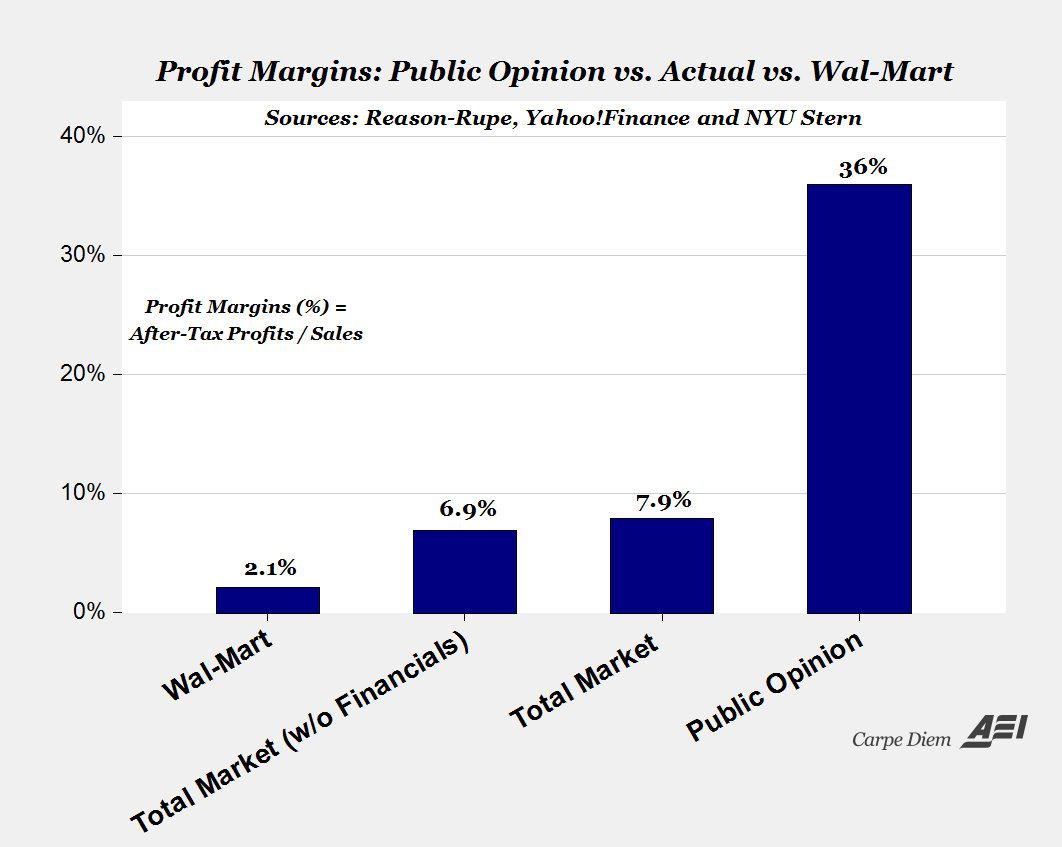
When a random sample of American adults were asked the question “Just a rough guess, what percent profit on each dollar of sales do you think the average company makes after taxes?” for the Reason-Rupe poll in May 2013, the average response was 36%! That response was very close to historical results from the polling organization ORC International polls for a slightly different, but related question: What percent profit on each dollar of sales do you think the average manufacturer makes after taxes? Responses to that question in 9 different polls between 1971 and 1987 ranged from 28% to 37% and averaged 31.6%.
How do the public’s estimates of corporate profit margins compare to reality? Not surprisingly they are off by a huge margin. According to this NYU Stern database for more than 7,000 US companies (updated in January 2018) in many different industries, the average profit margin is 7.9% for all companies and 6.9% for more than 6,000 companies excluding financials (see chart above).
[…]“Big Oil” companies make a lot of profits, right? Well, that industry (Integrated Oil/Gas) had a below-average profit margin of 5.6% in the most recent period analyzed, and separately, the Production and Exploration Oil/Gas industry is losing money, reflected in a -6.6% profit margin. For the general retail sector, the average profit margin is only 2.3% and for the grocery and food retail industry, it’s even lower at only 1.6%. And evil Walmart only made a 2.1% profit margin in 2017 (first three quarters) which is less than the industry average for general retail, possibly because grocery sales now make up more than half of Walmart’s revenue and profit margins are lower on food than general retail.
Sometimes, the government makes MORE from the sale of goods or services than the company that does ALL the work:
Interestingly, Walmart’s profit margin of 2.1% is actually less than one-third of the 6.5% the average state/local government takes of each dollar of Walmart’s retail sales for sales taxes. Think about it – for every $100 in sales for Walmart, the state/local governments get an average of $6.50 in sales taxes (and as much as $10.12 in Louisiana and $9.45 in Tennessee, see data here), while Walmart gets only $2.10 in after-tax profits!
I think that Americans are getting their false anti-corporation views from listening to the mainstream media. The mainstream media is overwhelmingly leftist according to recent studies of their political donations. I think that the anti-corporate views of the average American comes from their uncritical consumption of mainstream media propaganda. They think they are getting objective news reporting, but what they’re really getting is socialist propaganda.
Here is a short little video that explains more about profit margins, and what would happen if a socialist like Bernie Sanders were put in charge of a corporation:
If you’d like to help with this problem of anti-business economic illiteracy, please watch the video and share it, or share the AEI article, which contains the video. America will be a better country when Americans have accurate, informed beliefs about important issues.
In preparation for this blog post, I read an article from a far-left source about the decline of women’s happiness.
Excerpt:
As women gain political, economic and social freedoms, one would expect that they should feel even more contented relative to men. But this isn’t so.
The “paradox of declining female happiness” was pointed out by economists Betsey Stevenson and Justin Wolfers, who also happen to share a house and kids. They analyzed the happiness trends of US citizens between 1970 and 2005 and found a surprising result.
Stevenson and Wolfers discovered that American women rated their overall life satisfaction higher than men in the 1970s. Thereafter, women’s happiness scores decreased while men’s scores stayed roughly stable. By the 1990s, women were less happy than men. This relative unhappiness softened after the turn of the century, but men continue to enjoy a higher sense of subjective wellbeing that is at least as high — if not higher — than women’s.
Those 35 years saw advances in American women’s rights and financial power.
Let’s take a look at a recent study that the Daily Wire reported on, to see what really makes women happy:
Despite the onslaught of propaganda telling young girls otherwise, a recent research paper distilling data from over 30 European countries concluded that mothers find homemaking preferable to working full-time.
Doc. PhDr. Dana Hamplová, Ph.D., a senior scientist at the Institute of Sociology, ASCR, and a current representative of the Czech Republic in the International Social Science Program, authored the paper. Addressing Betty Friedan’s narrative in the book The Feminine Mystique, which claims that women are happiest and most fulfilled at work, Hamplová “explores the link between employment and subjective well-being among mothers with children under 3 years of age,” reads the paper’s abstract.
“Analyzing multiple measures of subjective well-being, the paper shows that homemakers are generally happier than full-time workers,” the scientist found.
“Contrary to our expectations, homemaking was positively associated with happiness particularly among mothers who left higher quality employment for childcare. Though some variation across countries exists, it is not linked to the provision of formal childcare, duration of parental leave, or tax system,” Hamplová explains.
[…]”Thus, similarly to several other studies, the ESS [European Social Survey] data do not corroborate Betty Friedan’s idea that domesticity and housekeeping leaves women unhappy and unsatisfied,” she writes. “As all 12 measures of happiness/satisfaction point to the same direction, the conclusion that mothers with younger children tend to be better off if they are not engaged in paid employment seems to be robust.”
We’ve had lots of advancements in women’s power, often coming at the expense of men (i.e. – husband candidates). For example, anti-male schools staffed by feminist administrators and feminist teachers might be great for women, but they don’t produce high-earning men for women to marry. And when women vote to expand government, taxes must increase to pay for all the spending. This reduces even further the pool of men who can take on a wife and family shrinks even more because of the increased tax burden.
This article from the leftist The Atlantic explains:
In the view that has prevailed in American education over the past decade, boys are resented, both as the unfairly privileged sex and as obstacles on the path to gender justice for girls. This perspective is promoted in schools of education, and many a teacher now feels that girls need and deserve special indemnifying consideration.
[…]A review of the facts shows boys, not girls, on the weak side of an education gender gap. The typical boy is a year and a half behind the typical girl in reading and writing; he is less committed to school and less likely to go to college. In 1997 college full-time enrollments were 45 percent male and 55 percent female. The Department of Education predicts that the proportion of boys in college classes will continue to shrink.
Data from the U.S. Department of Education and from several recent university studies show that far from being shy and demoralized, today’s girls outshine boys. They get better grades. They have higher educational aspirations. They follow more-rigorous academic programs and participate in advanced-placement classes at higher rates. According to the National Center for Education Statistics, slightly more girls than boys enroll in high-level math and science courses. Girls, allegedly timorous and lacking in confidence, now outnumber boys in student government, in honor societies, on school newspapers, and in debating clubs. Only in sports are boys ahead, and women’s groups are targeting the sports gap with a vengeance. Girls read more books. They outperform boys on tests for artistic and musical ability. More girls than boys study abroad. More join the Peace Corps. At the same time, more boys than girls are suspended from school. More are held back and more drop out. Boys are three times as likely to receive a diagnosis of attention-deficit hyperactivity disorder. More boys than girls are involved in crime, alcohol, and drugs. Girls attempt suicide more often than boys, but it is boys who more often succeed. In 1997, a typical year, 4,483 young people aged five to twenty-four committed suicide: 701 females and 3,782 males.
It’s important to note that women are not victims here, they are actually the ones who created the shortage of men who could earn enough money to support a family, and allow them to stay home with their children. Their “advancements in power” came at a cost: they undermined the system that produced men who were capable of handling the financial demands of a family where the wife can raise her own children.
Look at this study of how women have voted to expand government and therefore raise taxes on working men for social programs that replace husbands:
This paper examines the growth of government during this century as a result of giving women the right to vote. Using cross‐sectional time‐series data for 1870–1940, we examine state government expenditures and revenue as well as voting by U.S. House and Senate state delegations and the passage of a wide range of different state laws. Suffrage coincided with immediate increases in state government expenditures and revenue and more liberal voting patterns for federal representatives, and these effects continued growing over time as more women took advantage of the franchise. Contrary to many recent suggestions, the gender gap is not something that has arisen since the 1970s, and it helps explain why American government started growing when it did.
Bigger government means higher taxes means men earn less money, after taxes. How are you supposed to keep your wife home to watch over the little ones when taxes are higher? You can’t.