Category Archives: News

Democrat Nancy Pelosi joins the mainstream media in defending MS-13 gang from Trump

By now, everyone has heard that Donald Trump, in answering a question about MS-13 from Fresno, CA police, called MS-13 gang members “animals”. The Democrats and their allies in the mainstream media disagreed with characterizing MS-13 gangsters as animals. Let’s see a few reactions from the Democrats and their allies in the mainstream media, then we’ll see what MS-13 does.

First, the facts, from the non-partisan Real Clear Politics:

House Democratic Leader Nancy Pelosi responded to President Trump calling violent MS-13 gang members “animals,” at her weekly press briefing Thursday morning. Pelosi says Trump’s comments as reported are a new low, and make her wonder if the president believes “we are all God’s children” or not.

“When the president of the United States says about undocumented immigrants, ‘these are not people, these are animals,’ you have to wonder, does he not believe in the spark of divinity? In the dignity and worth of every person? ‘These are not people, these are animals,’ from the president of the United States.”

“Every day you think you’ve seen it all, along comes another manifestation of why their policies are so inhumane,” she said.

“Calling people animals is not a good thing,” she said, before ending the news conference and walking out.

Even radically leftist CNN makes it clear that Trump was talking about MS-13:

CNN agrees: Trump was calling MS-13 "animals"
CNN agrees: Trump was calling MS-13 “animals”

But that makes no difference to Nancy Pelosi. She wants to open the borders to let them in, because they have a “divine spark”. Pro-amnesty groups joined Pelosi in denouncing Trump’s condemnation of MS-13. Liberal journalists from National Affairs and Huffington Post and Business Insider and CNBC and MSNBC and Think Progress and the New York Times and NBC News (Andrea Mitchell) the Washington Post (Jennifer Rubin) and CBS News defended MS-13. (See this Daily Wire article for all the tweets from those sources)

Here’s MSNBC anchor Lawrence O’Donnell:

Trump is Hitler, says the mainstream news media

Those tweets are still up! This is not a misunderstanding – they know Trump was talking about MS-13.

So what does MS-13 do, exactly?

Beating little girls with baseball bats: (ABC News)

The source explained Ayala-Rivera, a high-ranking local MS-13 leader who goes by the nickname “Noctorno,” pimps out a number of underage girls from a number of states. On Aug. 1, 2017, the source said Pena-Rodriguez, Romero-Rivera, Ayala-Rivera, plus two other men, used a solid bat to beat the girl behind the single-family home along Valley View Avenue. The men reportedly took turns whacking the 15-year-old girl’s flailing body — 28 swings in total. Her injuries included an “indented” buttocks, discolored arms and legs, and visible bleeding from the neck down.

A second unnamed source would later tell cops that Ayala-Rivera (‘Noctorno’) ordered the backyard clubbing because he felt the victim was “not doing a good job as an MS-13 prostitute.” The same source revealed Ayala-Rivera (‘Noctorno’) raked in a lot of money by trafficking teenage girls to men of all ages.

[…]According to U.S. Immigration and Customs Enforcement (ICE), Romero-Rivera is in the United States illegally.

Gang-raping little girls: (Washington Post)

The petite young woman was a 16-year-old Laurel High School student three years ago when she decided to skip classes one day to join two other girls at a party at a Hyattsville apartment.

At the party, she said, Oscar Ramos “Casper” Velasquez took her into a bedroom, where he kissed her and told her that if she didn’t have sex with him, as many as 15 other teenagers and young men at the gathering would have sex with her.

When she resisted, two more young men entered the room, the woman told jurors yesterday in federal court. One man threw her on the bed and choked her, the other held down her arms and “Oscar pulled out a gun,” she testified.

“He put it to my head, and he said if I didn’t shut up, he was going to kill me,” the woman told jurors.

Eight men raped her, the 19-year-old woman said. Two assaulted her simultaneously. Outside the room, she said, she heard one man say, “Five minutes each.”

Murdering little girls: (ABC News)

An MS-13 gang member has been convicted in the 2001 murder of a 13-year-old Whittier girl.

On June 28, 2001, the naked body of Jacqueline Piazza was found in Elysian Park. She had been shot twice in the head, a statement from the district attorney’s office said.

Her murder remained unsolved for nearly a decade, until the Los Angeles Police Department uncovered new information and presented it to the district attorney’s office, the statement said. Four men were charged in the crime in 2012.

Prosecutors said the men kidnapped the victim the night before she was found and drove her to a remote area of the park, where they allegedly sexually assaulted and killed her.

On Thursday, a jury found Jorge Palacios, 39, guilty of one count of first-degree murder and one count of kidnapping to commit rape.

Sex-trafficking little girls: (Washington Post)

The 12-year-old runaway was desperate — she was out of money and had no place to stay. So she turned to the one man her friends said could help: a top MS-13 gang member.

The day after they met at a party, the man drove the girl home, let her take a shower and gave her some fresh clothes. Then he told her, “We’re going to work.”

At first, the girl didn’t understand what the man meant. But everything became horribly clear after they pulled into a pharmacy parking lot and she watched another gang member return to the car with a box of condoms. The next stop was her first customer.

For three months, the girl was prostituted almost daily in dingy apartments, motels and even at an auto repair shop.

[…]The 12-year-old was one of dozens of prostitutes, many juveniles, being sold for sex in the Washington area by members of Mara Salvatrucha, also known as MS-13, the region’s largest and most dangerous street gang.

Lots more here.

Democrats and their mainstream media allies support sanctuary cities for MS-13. Anyone who disagrees is “Hitler”.

Watch Nancy Pelosi defend MS-13 in her own words:

Leftists are generous with other people’s money and other people’s lives. It’s not the rich Democrat elites and their rich allies in the mainstream media who suffer from MS-13. Nancy Pelosi has a net worth of nearly $30 million. The Democrat Party elites and the mainstream media talking heads live in gated communities, and have security systems and armed guards. They’re safe from MS-13. They little girls who run away from home don’t matter to them.

How long do people wait to be treated in a single-payer health care system?

Instead of talking about single payer health care in the abstract (“wouldn’t it be nice if health care were free?”), let’s discuss a concrete case of a single payer health care system. Canada’s health care system is a pure government-funded system.  Canadian residents pay money into the system via taxation. And when they get sick, they go into a government-run hospital and ask for government-run health care. The idea of single payer health care makes a lot of politicians feel good, and it draws applause when they talk about it in the abstract. But forget the abstract. How well does it work in reality?

Here’s an article from a Canadian health care policy expert, Sally C. Pipes.

She writes:

The Canadian single-payer regime subjects thousands of patients to life-threatening delays for treatment.

Our northern neighbors’ wait times grow longer with each passing year. According to the Fraser Institute, a Canadian think tank, the typical patient in need of specialist treatment last year waited 21.2 weeks after referral from a general practitioner — a record high. In 1993, the median wait time was less than half that figure — 9.3 weeks.

In British Columbia, the median wait is even longer — a grand total of 26.5 weeks from referral from a general practitioner to receipt of treatment from a specialist.  That’s more than half a year.

Lengthy delays are a hallmark of single-payer. Demand for care is essentially limitless when someone else is paying the bill.

But the provincial and federal governments in Canada don’t have limitless resources. So they typically set a global budget for care.  Doctors and hospitals can only provide so much care before their costs exceed their revenue from the government. And they can only afford to keep a limited amount of equipment operational, such as MRI machines or CT scanners.

Demand for care inevitably outstrips supply. So the government has to establish wait lists.

Long waits aren’t merely inconvenient; they’re dangerous. Consider the case of Walid Khalfallah, a British Columbian boy with severe scoliosis profiled by the Vancouver Sun in 2012. The Sun reported that he faced a three-year wait for spinal surgery, even though medical guidelines recommended a maximum wait of three months.

Delays can even prove fatal. Long waits have contributed to the deaths of more than 44,000 Canadian women in the past two decades, according to a Fraser Institute study.

Many patients would gladly pay extra to receive care more quickly. But British Columbian law makes it effectively impossible to do so.

The hardest thing to explain to Americans who are only familiar with private insurance is that if the government tells you no in a single-payer system, your only option is to take whatever money you have left (after being taxed for the single-payer system) and go outside the country. A lot of Canadian socialist politicians do exactly that, when they need reliable health care. Like Bernie Sanders, they say one thing to their naive followers, and do something else in their private lives.

So how good is American health care? Maybe Canadians are waiting in line because their health care is so much better than ours.

American health care

One of the best health care policy experts writing today is Avik Roy, who writes for Forbes magazine.

Here is a recent column, which I think is useful for helping us all get better at debating health care policy.

Excerpt:

It’s one of the most oft-repeated justifications for socialized medicine: Americans spend more money than other developed countries on health care, but don’t live as long. If we would just hop on the European health-care bandwagon, we’d live longer and healthier lives. The only problem is it’s not true.

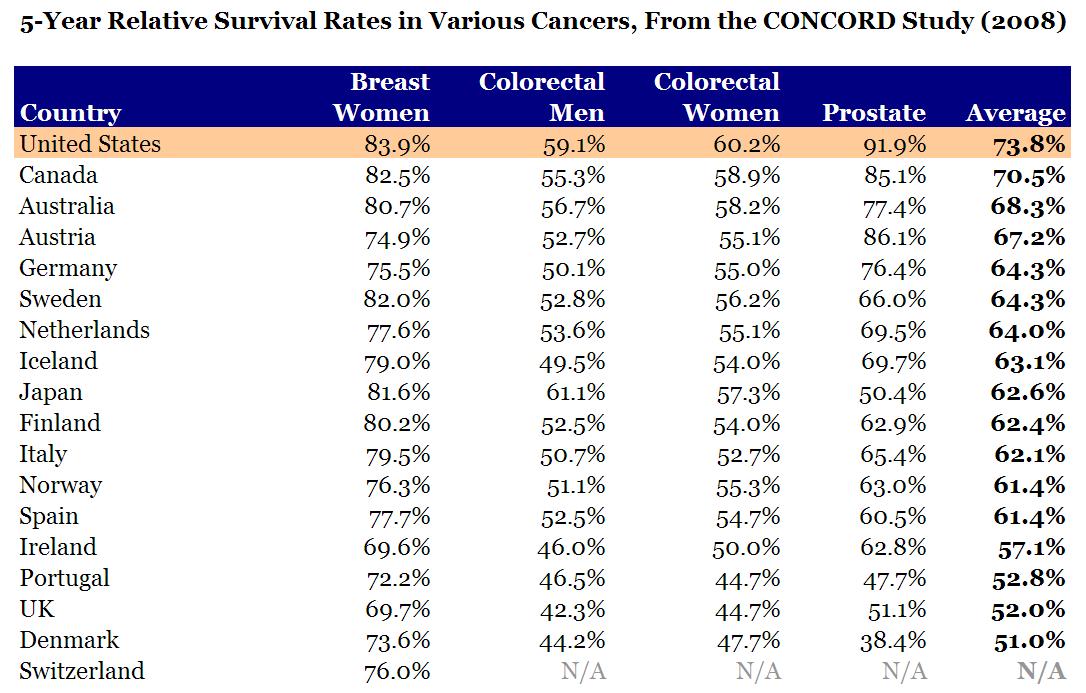
[…]If you really want to measure health outcomes, the best way to do it is at the point of medical intervention. If you have a heart attack, how long do you live in the U.S. vs. another country? If you’re diagnosed with breast cancer? In 2008, a group of investigators conducted a worldwide study of cancer survival rates, called CONCORD. They looked at 5-year survival rates for breast cancer, colon and rectal cancer, and prostate cancer. I compiled their data for the U.S., Canada, Australia, Japan, and western Europe. Guess who came out number one?

Here is the raw data:

Health care outcomes
Health care outcomes by country and type of treatment

Click here to see the larger graph.

So, what explains this?

The article continues:

Another point worth making is that people die for other reasons than health. For example, people die because of car accidents and violent crime. A few years back, Robert Ohsfeldt of Texas A&M and John Schneider of the University of Iowa asked the obvious question: what happens if you remove deaths from fatal injuries from the life expectancy tables? Among the 29 members of the OECD, the U.S. vaults from 19th place to…you guessed it…first. Japan, on the same adjustment, drops from first to ninth.

It’s great that the Japanese eat more sushi than we do, and that they settle their arguments more peaceably. But these things don’t have anything to do with socialized medicine.

Finally, U.S. life-expectancy statistics are skewed by the fact that the U.S. doesn’t have one health-care system, but three: Medicaid, Medicare, and private insurance. (A fourth, the Obamacare exchanges, is supposed to go into effect in 2014.) As I have noted in the past, health outcomes for those on government-sponsored insurance are worse than for those on private insurance.

To my knowledge, no one has attempted to segregate U.S. life-expectancy figures by insurance status. But based on the data we have, it’s highly likely that those on private insurance have the best life expectancy, with Medicare patients in the middle, and the uninsured and Medicaid at the bottom.

Certainly, the life expectancy in our 100% government-run health care system, the Veteran’s Affairs health care system, is really, really low. They just kill the patients, give themselves bonuses, and then cover-up their failures when the investigators come.

I know that my readers who like to dig deep into economics and policy will love the links at the bottom of the article:

For further reading on the topic of life expectancy, here are some recommendations. Harvard economist Greg Mankiw discusses some of the confounding factors with life expectancy statistics, citing this NBER study by June and Dave O’Neill comparing the U.S. and Canada. (Mankiw calls the misuse of U.S. life expectancy stats “schlocky.”) Chicago economist Gary Becker makes note of the CONCORD study in this blog post. In 2009, Sam Preston and Jessica Ho of the University of Pennsylvania published a lengthy analysis of life expectancy statistics, concluding that “the low longevity ranking of the United States is not likely to be a result of a poorly functioning health care system.”

If we’re going to discuss health care, then let’s discuss facts. We shouldn’t be picking a health care system from the campaign speeches of politicians who tell us that we can keep our doctor, and keep our health plan, and our premiums will go down. We tried electing a charismatic deceiver in 2008, and it didn’t work out. We lost our doctors, lost our health plans, and our premiums went up enormously. We can do better than single-payer health care. We can do better than socialism.

Is the vastness of the universe evidence against God’s existence?

Apologetics and the progress of science

Physicist Hugh Ross writes about it in Salvo Magazine.

First a quick blurb about Hugh Ross:

Hugh Ross launched his career at age seven when he went to the library to find out why stars are hot. Physics and astronomy captured his curiosity and never let go. At age seventeen he became the youngest person ever to serve as director of observations for Vancouver’s Royal Astronomical Society. With the help of a provincial scholarship and a National Research Council (NRC) of Canada fellowship, he completed his undergraduate degree in physics (University of British Columbia) and graduate degrees in astronomy (University of Toronto). The NRC also sent him to the United States for postdoctoral studies. At Caltech he researched quasi-stellar objects, or “quasars,” some of the most distant and ancient objects in the universe.

Now back to the topic “Is the vastness of the universe incompatible with God’s existence?”

Here’s Ross’ introduction:

Scientists seem more difficult to please than the golden-haired girl of fairy-tale fame. While Goldilocks troubled herself over the just-right porridge, chair, and bed, astronomers appear preoccupied with the size of the universe.

In the days before telescopes, when an observer could count a few thousand stars in the night sky, many considered the universe too small and unimpressive to be the work of an almighty, all-knowing Creator. Only an infinite cosmos, they said, would befit an infinite deity. But then, others argued, an infinite cosmos might eliminate the need for a Creator.

Thanks to the Hubble space telescope, scientists now see that the universe contains roughly 200 billion large- and medium-sized galaxies and about a hundred times as many dwarf galaxies. The stars in those galaxies add up to about fifty billion trillion, and they comprise a mere one percent of the mass of the observable universe.

Because of the travel time of light, the universe humans can observe is really the universe of the past. What researchers know about the expansion and geometry of the universe informs us that the universe of today is at least several hundred times more enormous than the universe we can see. The universe is trillions of trillions of times larger and more spectacular than what the earliest astronomers presumed!

And yet, this new knowledge of the vastness of the universe has led to new complaints. In his book, God: The Failed Hypothesis, Victor Stenger says, “If God created the universe as a special place for humanity, he seems to have wasted an awfully large amount of space.” Stephen Hawking, in the best-selling science book of all time, A Brief History of Time, shares Stenger’s view: “Our solar system certainly is a prerequisite for our existence. . . . But there does not seem to be any need for all these other galaxies.” So now the universe is too big to befit the all-wise, all-powerful God of the Bible.

I like how he quotes an atheist physicist to get the challenge right. No sense in caricaturing the claim of your opponent.

I formalized Stenger’s argument like this:

  1. If all things in the universe are not done the way that Victor Stenger likes them, then there is no God.
  2. All things in the universe were not done the way Victor Stenger likes them.
  3. Therefore, there is no God.

I would deny premise 1, there, since there is no reason to believe that’s it’s true.

Anyway, let’s see what Hugh Ross says:

The hot big bang model (now firmly established by observations) tells us that at the moment of cosmic creation, the universe was infinitely or near-infinitely hot and compressed, and all the ordinary matter existed in the form of hydrogen. As the universe expanded, it cooled. The rate at which the universe expanded and cooled depended in large part on its mass—the greater the mass, the slower the expansion and cooling rate. The slower the expansion and cooling rate, the more time the universe would spend in the temperature range (13–150 million degrees Centigrade) at which nuclear fusion can occur.

Because of its mass, the universe spent about twenty seconds in the nuclear fusion temperature range when it was between three and four minutes old. As a result, 24.77 percent of the universe’s hydrogen (by mass) fused into helium. Thus, when stars began to form—about 380,000 years later—they started off composed of about 75 percent hydrogen, 25 percent helium, and trace amounts of deuterium, lithium, and beryllium.

In the nuclear furnaces of the stars themselves, more hydrogen fused into helium, and, in addition to the extra helium, all the rest of the elements that appear in the periodic table were synthesized (created). The capacity of stellar nuclear furnaces to produce an abundance of elements heavier than helium (all but two of the elements) depended critically on how much of the universe’s initial hydrogen was fused into helium and heavier elements during the first several minutes after the cosmic creation event. How much fusion of the universe’s primordial hydrogen actually occurred at this time depended, in turn, on the universe’s mass or mass density.

If the universe’s mass (or cosmic mass density) had been even the slightest bit less than a hundred times the fifty billion trillion stars occupying the observable universe, nuclear fusion during the first several minutes of its existence would have proceeded less efficiently. Thus, the cosmos would have been forever incapable of generating elements heavier than helium—elements such as carbon, nitrogen, oxygen, phosphorus, sodium, and potassium—all of which are essential for any conceivable kind of physical life.

On the other hand, if the universe’s mass had been even the slightest bit greater, nuclear fusion during the first several minutes after its beginning would have been too productive, and all the hydrogen in the universe eventually would have been fused (after just two generations of stars) into elements as heavy as iron or heavier. Again, all the most life-essential elements, including hydrogen itself, would have ceased to exist.

Basically, your body is made up of heavier elements, and if the universe was not as massive as it is (and as old as it is), then there would not be enough heavy elements to make you, or to make massive stars like our Sun which burn steady for long periods of time. We need the heavy elements and we need the steady source of heat.

Dr. Ross has another reason why God would use vast space and long periods of time, and if you want to read that, you can click here. I think that it’s important for us all to get used to the idea that we all need to understand science apologetics. God put these evidences into the universe for us to discover and use.