Category Archives: News

DHS whistleblower: Obama more concerned with protecting Islamists than Americans

Is Barack Obama focused on protecting the American people?

This PJ Media article is by Debra Heine.

Excerpt:

Philip Haney, the Homeland Security whistleblower whose investigation into Islamic infiltration of the U.S. might have prevented the San Bernardino attack, has written an important op-ed for The Hill, warning of President Obama’s misplaced priorities when it comes to national security. In brief, says Haney, “the Obama administration is more concerned with the rights of non-citizens in known Islamist groups than with the safety and security of the American people.”

There are terrorists in our midst and they arrived here using legal means right under the noses of the federal law enforcement agencies whose mission is to stop them. That is not due to malfeasance or lack of effort on the part of these officers; it is due to the restrictions placed on them by the Obama administration.

Not only did the Obama administration shut down an important investigation that could have connected enough dots to prevent the San Bernardino terrorist attack, they went back and erased the dots Haney was “diligently connecting.” Worse yet, when he complained to the DHS inspector general, the DHS and the Department of Justice subjected him “to a series of investigations and adverse actions, including one by that same inspector general.”

None of them showed any wrongdoing; they seemed aimed at stopping me from blowing the whistle on this problem.

Debra (Nice Deb) was one of the first people to blogroll me when I was first starting out with blogging.

She links to Gates of Vienna, another of my blogroll friends, and quotes them about that:

The “behavioral indicators” listed to help DHS agents identify potential domestic terrorists include carrying around a copy of the Constitution, promoting First and Second Amendment rights, having a Gadsden flag sticker on one’s car, and advocating for a minimal federal government.

[The Obama administration’s approach] is thus designed to serve a dual purpose: (1) to protect Muslim Brotherhood organizations and their operatives who have penetrated federal, state, and local governments, and (2) to help the Obama administration crack down on its real enemies, domestic conservatives who want to re-establish constitutional governance.

Debra wrote a couple of prior articles on this DHS whistleblower, one from 12/14 and one from 12/11.

So is it really true that the Obama administration – in their mad rush to let in immigrants from countries that don’t like us very much – is not serious about keeping terrorists out?

CBS News reported that 5 different Obama administration agencies failed to detect one of the San Bernadino terrorists:

Tashfeen Malik arrived in the United States with her fiance Syed Farook in July 2014. Just two months earlier, her U.S. government background check found no suspected ties to terrorism.

She was granted a K-1 visa, even though the FBI now believes she was radicalized before she met Farook.

The State Department says Malik was thoroughly questioned during an interview at the U.S. embassy in Pakistan.

[…]Five U.S. agencies also vetted her, checking her fingerprints against two databases. Neither her name nor image showed up on a U.S. terror watch list.

One can only imagine that the questions were like “do you believe in the Constitution?” or “do you attend a Christian church?” or “do you think that abortion should be restricted?”. She would be rejected if she affirmed any of those, of course, but affirming Islamic jihad is nothing to be concerned about – if you’re a Democrat.
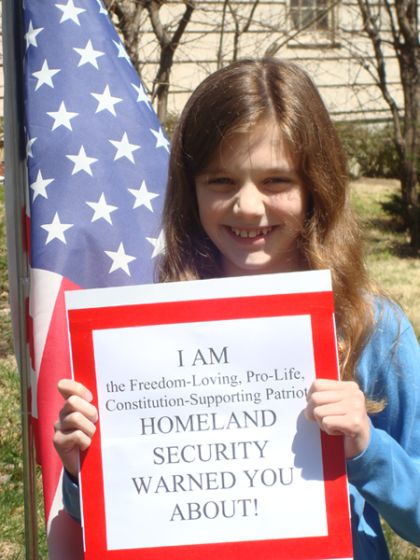
Homeland Security's new enemy!
Homeland Security’s new enemy! This little girl who supports the Constitution.

It seems to me our national security agencies have been indoctrinated by their Democrat leaders to target conservative taxpayers instead of radicalized Islamists. And in fact we have evidence of that, reported in the Washington Times way back in 2009:

The Department of Homeland Security is warning law enforcement officials about a rise in “rightwing extremist activity,” saying the economic recession, the election of America’s first black president and the return of a few disgruntled war veterans could swell the ranks of white-power militias.

A footnote attached to the report by the Homeland Security Office of Intelligence and Analysis defines “rightwing extremism in the United States” as including not just racist or hate groups, but also groups that reject federal authority in favor of state or local authority.

“It may include groups and individuals that are dedicated to a single-issue, such as opposition to abortion or immigration,” the warning says.

[…]The nine-page document was sent to police and sheriff’s departments across the United States on April 7 under the headline, “Rightwing Extremism: Current Economic and Political Climate Fueling Resurgence in Radicalization and Recruitment.”

It says the federal government “will be working with its state and local partners over the next several months” to gather information on “rightwing extremist activity in the United States.”

The joint federal-state activities will have “a particular emphasis” on the causes of “rightwing extremist radicalization.”

According to Democrats, radical Islam is not the real threat. American taxpayers who want to not pay for abortions are the real threat. And it turns out that many Democrat voters think that this is correct, even in an age of Islamic terrorism.

Nile Gardiner writes about a recent Rasmussen Reports poll in the UK Telegraph.

Excerpt:

[A]mong those who approve of the president’s job performance, just 29% see radical Muslims as the bigger threat. Twenty-six percent (26%) say it’s the Tea Party that concerns them most. Among those who Strongly Approve of the president, more fear the Tea Party than radical Muslims.

[…]Twenty percent (20%) of government workers see the Tea Party as the nation’s bigger terror threat.

That’s what we voted for, when we voted for Barack Obama.

Is the Bible’s definition of faith opposed to logic and evidence?

Theology that hits the spot

Probably the biggest misconception that I encounter when defending the faith is the mistaken notion of what faith is. Today we are going to get to the bottom of what the Bible says faith is, once and for all. This post will be useful to Christians and atheists, alike.

What is faith according to the Bible?

I am going to reference this article from apologist Greg Koukl of Stand to Reason in my explanation.

Koukl cites three Biblical examples to support the idea that faith is not blind leap-of-faith wishing, but is based on evidence.

  1. Moses went out into the wilderness and he had that first encounter with the burning bush, and God gave him the directive to go back to Egypt and let his people go. Moses said, Yeah, right. What’s going to happen when they say, why should we believe you, Moses?God said, See that staff? Throw it down.Moses threw it down and it turned into a serpent.God said, See that serpent? Pick it up.And he picked it up and it turned back into a staff.God said, Now you take that and do that before the Jewish people and you do that before Pharaoh. And you do this number with the hail, and the frogs, and turning the Nile River into blood. You put the sun out. You do a bunch of other tricks to get their attention.And then comes this phrase: “So that they might know that there is a God in Israel.”
  2. [I]n Mark 2 you see Jesus preaching in a house, and you know the story where they take the roof off and let the paralytic down through the roof. Jesus said, “Your sins are forgiven.” And people get bugged because how can anyone forgive sins but God alone?Jesus understood what they were thinking and He said this: What’s harder to say, your sins are forgiven, or to rise, take up your pallet and go home?Now, I’ll tell you what would be harder for me to say : Arise, take up your pallet and go home. I can walk into any Bible study and say your sins are forgiven and nobody is going to know if I know what I am talking about or not. But if I lay hands on somebody in a wheelchair and I say, Take up your wheelchair and go home, and they sit there, I look pretty dumb because everyone knows nothing happened.But Jesus adds this. He says, “In order that you may know that the Son of Man has the power and authority to forgive sins, I say to you, arise, take up your pallet and go home.” And he got up and he got out. Notice the phrase “In order that you may know”. Same message, right?
  3. Move over to the Book of Acts. First sermon after Pentecost. Peter was up in front of this massive crowd. He was talking about the resurrection to which he was an eyewitness. He talked about fulfilled prophecy. He talked about the miraculous tongues and the miraculous manifestation of being able to speak in a language you don’t know. Do you think this is physical evidence to those people? I think so. Pretty powerful.Peter tells them, These men are not drunk as it seems, but rather this is a fulfillment of prophecy. David spoke of this. Jesus got out of the grave, and we saw him, and we proclaim this to you.Do you know how he ends his sermon? It’s really great. Acts 2:36. I’ve been a Christian 20 years and I didn’t see this until about a year ago. This is for all of those who think that if you can know it for sure, you can’t exercise faith in it. Here is what Peter said. Acts 2:36, “Therefore let all the house of Israel know for certain that God has made him both Lord and Christ, Messiah, this Jesus whom you crucified.” There it is again. “Know for certain.”

What is faith according to Bible-based theologians?

I am going to reference this article from theologian C. Michael Patton of Parchment and Pen in my explanation.

Patton explains that according to Reformation (conservative, Bible-based) theologians, faith has 3 parts:

  1. notitia – This is the basic informational foundation of our faith. It is best expressed by the word content. Faith, according to the Reformers must have content. You cannot have faith in nothing. There must be some referential propositional truth to which the faith points. The proposition “Christ rose from the grave,” for example, is a necessary information base that Christians must have.
  2. assensus – This is the assent or confidence that we have that the notitia is correct… This involves evidence which leads to the conviction of the truthfulness of the proposition… This involves intellectual assent and persuasion based upon critical thought… assensus… says, “I am persuaded to believe that Christ rose from the grave.”
  3. fiducia – This is the “resting” in the information based upon a conviction of its truthfulness. Fiducia is best expressed by the English word “trust.”… Fiducia is the personal subjective act of the will to take the final step. It is important to note that while fiducia goes beyond or transcends the intellect, it is built upon its foundation.

So, Biblical faith is really trust. Trust(3) can only occur after intellectual assent(2), based on evidence and thought. Intellectual assent(2) can only occur after the propositional information(1) is known.

The church today accepts 1 and 3, but denies 2. I call this “fideism” or “blind faith”. Ironically, activist atheists, (the New Atheists), also believe that faith is blind. The postmodern “emergent church” denies 1 and 2. A person could accept 1 and 2 but deny 3 by not re-prioritizing their life based on what they know to be true.

How do beliefs form, according to Christian philosophers?

I am going to reference a portion of chapter 3 of J.P. Moreland’s “Love Your God With All Your Mind” (i.e. – LYGWYM).

J.P. Moreland explains how beliefs form and how you can change them.

  1. Today, people are inclined to think that the sincerity and fervency of one’s beliefs are more important than the content… Nothing could be further from the truth… As far as reality is concerned, what matters is not whether I like a belief or how sincere I am in believing it but whether or not the belief is true. I am responsible for what I believe and, I might add, for what I refuse to believe because the content of what I do or do not believe makes a tremendous difference to what I become and how I act.
  2. A belief’s strength is the degree to which you are convinced the belief is true. As you gain ,evidence and support for a belief, its strength grows for you… The more certain you are of a belief… the more you rely on it as a basis for action.

But the most important point of the article is that your beliefs are not under the control of your will.

…Scripture holds us responsible for our beliefs since it commands us to embrace certain beliefs and warns us of the consequences of accepting other beliefs. On the other hand, experience teaches us that we cannot choose or change our beliefs by direct effort.

For example, if someone offered you $10,000 to believe right now that a pink elephant was sitting next to you, you could not really choose to believe this… If I want to change my beliefs about something, I can embark on a course of study in which I choose to think regularly about certain things, read certain pieces of evidence and argument, and try to find problems with evidence raised against the belief in question.

…by choosing to undertake a course of study… I can put myself in a position to undergo a change in… my beliefs… And… my character and behavior… will be transformed by these belief changes.

I think definition of faith is important, because atheists seemed to want to substitute their own definition of faith as blind belief for this Biblical definition, but there is no evidence for their view that faith is belief without evidence. I think this might be another case of projection by atheists. Blind faith is how they arrive at their views, so they are trying to push it onto us. But the Bible is clearly opposed to it.

Positive arguments for Christian theism

New study: parrots capable of using and sharing tools

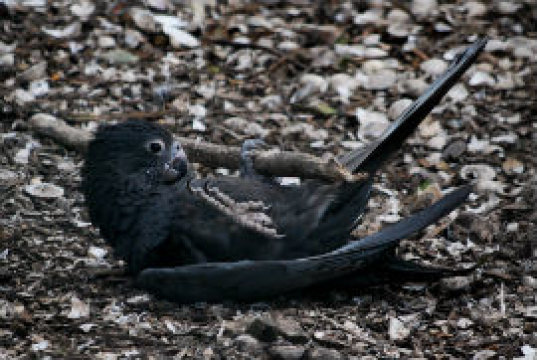
Greater vasa parrot using a tool to extract calcium
Greater vasa parrot using a tool

All right, well, awareness of my tremendous affection for all things bird-related has spread to all my friends, and now whenever there is an interesting bird study, (or funny video of owls blinking), I can expect to be informed about it.

My friend Melissa, who is doing a degree in STEM, and just got all As, sent me this new study from Science Daily.

It says:

Psychologists at the University of York and University of St Andrews have uncovered the first evidence of tool use by greater vasa parrots (Coracopsis vasa).

Studying ten captive parrots, researchers in the Department of Psychology at York observed the birds adopt a novel tool-using technique to acquire calcium from seashells and also the active sharing of tools among themselves.

The birds used small pebbles or date pits to grind calcium powder from the shells or to break off small pieces of shell to ingest. This behaviour, never before seen in this species, is the first evidence of a nonhuman using tools for grinding, and one of the few reports of nonhuman animals sharing tools directly.

Observing and filming the parrots over an eight month period (March to October), researchers documented their interactions with cockle shells on the floor of their aviary. Shells are a known source of calcium for birds.

Five out of ten birds were documented using tools, placing either pebbles or date pits inside shells to grind against the shell, or using them as a we

Yes, this is actually really important if you are a bird owner, as I am. Male parrots tend to have problems that are specific to their breed, but female parrots of any breed seem to run into this egg-laying problem where they law so many eggs, that they run out of calcium to make the eggshells. This is called “egg binding” and it can kill your bird if it’s not caught early.

Now, what do you think that a ambitious and chivalrous male parrot would do about egg binding when courting a delightful female parrot?

This:

Interest in the shells was greatest from March to mid-April, just before the breeding season — this may be due to calcium supplementation being critical for egg-laying. Researchers were therefore initially surprised to find that it was the males, not the females who showed the greatest interest in shells.

However, observation of the parrots’ breeding behaviour showed that males often engaged in regurgitative feeding of females before copulating with them, thus potentially passing on the calcium benefits.

Megan Lambert, PhD student in York’s Department of Psychology and lead author on the study, said: “The use of tools by nonhuman animals remains an exceedingly rare phenomenon. These observations provide new insights into the tool-using capabilities of parrots and give rise to further questions as to why this species uses tools.

“Tool use could reflect an innate predisposition in the parrots, or it could be the result of individual trial and error learning or some form of social learning. Whether these birds also use tools in the wild remains to be explored, but ultimately these observations highlight the greater vasa parrot as a species of interest for further studies of physical cognition.”

That’s right!

Here is a video linked in the article:

Now, do you know what this reminds me of? It reminds me of that post on love that I wrote a while back. When a man loves a woman, he tries to take away her trouble, or to take trouble for her, so that she is protected and her life is easier. He does things that will help her because he cares about her. It would be nice if more men acted like these birds, and tried to show that they cared by protecting and providing. And it would be nice if more women looked for protecting and providing, and were attracted by them.