Category Archives: Mentoring

What’s in an apologetics book?

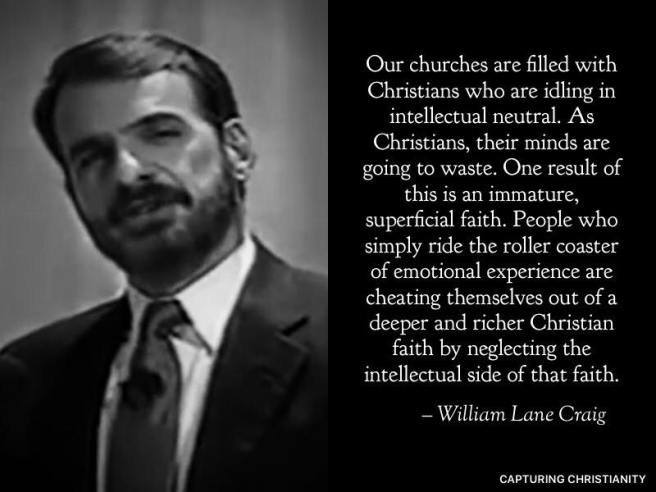
Dr. William Lane Craig says churches aren't preparing Christians to give an answer
Dr. W. L. Craig: churches don’t prepare Christians to answer skeptics

Let’s look at the table of contents of my favorite introduction to Christian apologetics, which is “Is God Just a Human Invention?” written by Sean McDowell and Jonathan Morrow.

In that book, you will find 18 topics.

  1. Is Faith Irrational? (Commentary by: Gregory Koukl)
  2. Are Science and Christianity at Odds? (Commentary by: John Warwick Montgomery)
  3. Are Miracles Possible? (Commentary by: Gary R. Habermas)
  4. Is Darwinian Evolution the Only Game in Town? (Commentary by: William A. Dembski)
  5. How Did the Universe Begin? (Commentary by: R. Douglas Geivett)
  6. How Did Life Begin? (Commentary by: Fazale R. Rana)
  7. Why Is the Universe Just Right for Life? (Commentary by: Jay W. Richards)
  8. Has Science Shown There Is No Soul? (Commentary by: Dale Fincher and Jonalyn Fincher)
  9. Is God Just a Human Invention? (Commentary by: Garry DeWeese)
  10. Is Religion Dangerous? (Commentary by: Douglas Groothuis)
  11. Does God Intend for Us to Keep Slaves? (Commentary by: Paul Copan)
  12. Is Hell a Divine Torture Chamber? (Commentary by: Frank Turek)
  13. Is God a Genocidal Bully? (Commentary by: Clay Jones)
  14. Is Christianity the Cause of Dangerous Sexual Repression? (Commentary by: Kerby Anderson)
  15. Can People Be Good Without God? (Commentary by: Mark D. Linville)
  16. Is Evil Only a Problem for Christians? (Commentary by: Randy Alcorn)
  17. What Good Is Christianity? (Commentary by: Glenn S. Sunshine)
  18. Why Jesus Instead of the Flying Spaghetti Monster? (Commentary by: Darrell L. Bock)

Prominent atheist scholars are quoted in each chapter to introduce the challenges, and then scholarly arguments and evidence are presented to defend the Christian worldview. The language is simple enough, but the material is solid enough to use in a real debate. I would say that introductory books like this one are more than enough to equip you for everyone who will challenge you.

Why are these 18 topics important? Because these are the questions that atheists ask. These are the questions that cause Christians to leave the faith. These are the questions that your children will face in high school and college, which might cause them to leave the faith.

Let’s start with chapter one. One of the most prominent arguments by atheists is that faith is irrational. This chapter allows you to define faith using the Bible’s definition of faith, which relies on logic and evidence.

Atheists also say that Christianity is at war with science. In chapter 2, they discuss the history of science and how Christianity provided the framework that allowed scientific method to take root and flourish.

Atheists like to claim that miracles are impossible. Chapter 3 defends the view that God, if he exists, is capable of interacting with his created world.

Atheists love to put forward Darwinism as means to deny that God is the designer of life. Chapter 4 explains the concept of intelligent design, and why intelligent design is a better explanation for the history of life.

Atheists love to talk about how the universe has always existed, and there’s no need for a Creator. Chapter 5 contains a philosophical argument that is supported by mainstream science to argue that the universe had a beginning, just like the Bible says.

Atheists love to argue that life can emerge from non-life, and the process is simple. Chapter 6 is written by a biochemist, and it takes a look at the real complexity of the simplest living cell.

Atheists like to argue that the universe itself is just an accident, and there is no need for a Designer. Chapter 7 introduces the scientific evidence for fine-tuning and habitability.

Atheists like to say that there is no soul and no afterlife. Chapter 8 gives some arguments for the existence of the soul.

Atheists like to argue that Christians invent God because God makes them feel good. But chapter 9 explains that having an all-powerful God who can hold humans accountable is the last thing any human would want to invent.

Atheists like to talk about how religion, with it’s habit of teaching to believe in things that can’t be tested, causes religious people to do a lot of harm. Chapter 10 takes a look at the real record of Christianity as a force for good in the world.

Atheists like to talk about slavery in the Bible. Chapter 11 talks about what the Bible really says, and provides some rational responses to the accusation.

Atheists like to talk about eternal punishment in Hell isn’t a just punishment for just getting a few questions wrong on a theology exam. Chapter 12 provides an explanation and defense of the concept of Hell.

Atheists love to talk about how God commanded the Israelites to attack their enemies in the Bible. Chapter 13 explains who their enemies really were, and what was really happening in those wars.

Atheists feel that unrestricted sexual activity is very healthy and normal, and that the Biblical prohibitions outside of male-female marriage are repressive and unhealthy.  Chapter 14 explains why God has these rules in place, and supports his rules with evidence.

Atheists love to assert that they don’t need God, because they can behave morally on their own. Chapter 15 explains how to answer this claim by talking about how well atheism grounds objective moral values, objective moral duties, free will and moral accountability: the minimum requirements for objective morality.

Atheists think that the mere existence of natural disasters and human immorality are incompatible with the God of the Bible. Chapter 16 explains why this argument doesn’t work, and why even the concept of evil requires God to exist.

I have an atheist friend in my office who can’t defeat my scientific arguments for the origin of the universe, the fine-tuning and the origin of life. But still, he says to me, even if God exists, why would that matter to my life? Chapter 17 explains what difference Christianity makes in a person’s life.

Atheists think that the life of Jesus has no relevance to their life, and that he has nothing to offer them anyway. Chapter 18 explains the uniqueness of Jesus and explains why his resurrection is relevant to our lives today.

It’s important to understand that this book is not on the level of A. W. Tozer, G.K. Chesterton, Francis Chan, John Piper, etc. Those authors write for a Christian audience and therefore they do not equip you to answer realistic challenges from non-Christians. But the apologetics book we looked at actually equips you to answer challenges from non-Christians using logical arguments and evidence from mainstream history and science. You can use the material in that book in discussions outside the confines of your home and your church.


A new series of posts about the adventures of an effective Christian woman

If you want to have conversations with people, prepare
If you want to have conversations about Christianity, then prepare

I try to encourage my Christian friends to study topics related to the Christian worldview, and to make connections between the Christian worldview and topics like economics, science, politics, etc. I want them to have deep conversations with non-Christians. Well, I just noticed that Laura, who writes at An Affair With Reason, started a series of posts about her experiences having these conversations.

She has two posts so far. In the first, she provides an introduction to the series:

By the grace of God, an ordinary day for me includes at least one significant spiritual conversation. The conversations are spontaneous, and the people I talk to are those I come across in the mundane activities of life: construction workers I see while walking my dog, neighbors out mowing their lawn, CrossFit coaches and athletes, my husband’s coworkers, the pest control man, the UPS man, the woman at the grocery store, and the customer service representative who took my call.

[…]Because spiritual conversations are so fun for me, I enjoy sharing them with others. People ask me often, “How did you get into that conversation?” and “How does this happen to you nearly every single day?”

In one sense these conversations do “happen to me” in that I don’t plan them, but it would be far more accurate to say that I create these conversations by living my life in a way that causes me to always be prepared to make a defense to anyone who asks me for a reason for the hope that is in me, and then paying attention for opportunities to get a foot in the door. Hence, many people have suggested that I publicly share what I’m doing with others so that they may benefit from practical, real life examples of conversations that they may seek to emulate in their own lives.

I’m so delighted with this, because I am always urging my Christian friends to read more, listen to more podcasts, and watch more debates, so that they are equipped to have these sorts of adventures.

Laura posted the first conversation in the series, with her previous pastor:

For two years I had tried to persuade my pastor to allow me to teach a small group or conference on apologetics. I set up appointments so he and his staff could get to know me. I shared my background and experiences, gave them opportunities to ask me questions, and even offered references from other churches where I had taught. I offered to show videos and facilitate discussions on the teachings of well-known apologists like Greg Koukl, Frank Turek, and J. Warner Wallace so the church leadership wouldn’t need to worry about platforming a heretic, and I shared my blog so they could see my work for themselves. Several months later, the entire church leadership admitted they had not read my blog and probably never would.

Over the next couple of years I continued to offer to introduce apologetics to our congregation through any format deemed appropriate, but nothing came of it. Eventually, my husband was relocated and our pastor, along with a dozen others, helped us load our moving truck in exchange for pizza, soda, and one last evening of fellowship.

During our conversation, as we were sitting on the empty floor, eating pizza on paper plates and drinking soda from plastic cups, my pastor mentioned that he frequently visited a certain coffee shop in the area that was very unfriendly to Christianity. The owners even had a sign on the wall that said, “No crazy talk”, which they had made clear included talk of Jesus, miracles, and the gospel. I commented that it seemed like the ideal place to share truth with people who needed to hear it, and I asked if that had been his experience.

“How do you even begin to discuss those things in an environment where the gospel isn’t welcome,” he replied.

“Personally, I would go with the Cosmological Argument, but you could always share the Teleological Argument. If you’re talking to college students, though, I’d definitely look for opportunities to share the Moral Argument. Young people seem to relate most to that line of reasoning,” I said.

“Sorry, what did you say,” he asked, as if I had just begun speaking in tongues in front of his Presbyterian congregation.

“The Cosmological Argument,” I repeated.

Blank stare.

“And the Teleological Argument”

“Teleo-what,” he asked quizzically.

“It means having a purpose or a design,” I explained.

“So how would you go about sharing these arguments with non-Christians,” he asked.

It was getting late and we were all exhausted, but this was important. This is what I had wanted to share for two straight years. I looked at my watch and told them I needed four minutes per argument in order to explain adequately. I was given the green light, and for the next twelve minutes I summarized for my pastor and about ten others what I had not been able to share with the congregation.

So she doesn’t really spend much time describing the conversation, because that’s not what this series is about. You can ask her for book recommendations if you want to handle it like she did. But the rest of the post explains why she prepared to have this conversation, and what pastors can do to equip people in the church to have these conversations.

This is not the first time I’ve linked to her, I also did here for her post about apologetics and here for her post about talking to Muslims. What I like about her is that she has a mature view of the Christian life that I really respect. When I read her writing, I can tell that she is not involved in Christianity to feel good or to be liked. She has a goal in mind, and she has done hard things to be prepared to reach it.

I have also tried to get apologetics into the church. I normally try to bring in the Focus on the Family True U DVDs, which feature Dr. Stephen C. Meyer. Without success. In my experience, pastors tend to not really understand challenges to Christianity, or they don’t know how to respond to them, or they just don’t want people in the church to get upset by having to do work. Read the rest of Laura’s post to get her solution to the problem.

The surprising pro-masculinity message in the “Far From the Madding Crowd” film

Man helping a woman with proper handgun marksmanship

So, I have about a half-dozen older and/or experienced Christian women who advise me and assist me in various ways. The wisest and most experienced is calm and thoughtful Dina. She has a very stressful job dealing with demanding women, and what she admires most in men is “masculinity”, which she defines as a man’s ability to tell a woman what is right and wrong, what God expects from her, what she should be doing with her life, and guiding her and providing for her through the steps to get there.

What makes Dina angry is when a man makes a fool of himself for youth and beauty, abdicating his role as moral and spiritual leader because of attraction / lust. According to Dina, men who have self-control think about what a woman should do that is morally right, with the goal of her producing a return for God. Men who are swayed by youth and beauty are willing to give up that leadership role in exchange for attention and/or sex.

So, with that said, Dina asked me to watch a recently-made movie called “Far From the Madding Crowd“, based on a novel by Thomas Hardy. I immediately said “no” because I know about Thomas Hardy from Tess of the D’Urbervilles, where he presents Tess as the helpless victim of Providence. I really hate that view of women, where they can do reckless, selfish things and then blame everyone but themselves for the destructive consequences of their own free-will decisions. But Dina said “wasn’t I right about the debate between David Robertson and Matt Dillahunty?” I said yes, and watched the movie. And of course, she was right, as she almost always is. This movie is a punch in the face to the radical feminism that seems to have infected so many young women, even in the church.

Here is a review of the movie by Rebekah, posted at her blog. Unfotunately, the post has been deleted, but here is an excerpt.

Rebekah writes:

What does this 19th century tale offer to modern audiences?  This latest rendering emphasizes something actually surprising and unexpected given that it is made in our age of radical feminism.  It is Gabriel Oak’s character that shines the most, not the proto-feminist Bathsheba.  […]In Bathsheba and Gabriel we see how men and women support one another in such a way as to ensure a flourishing in any role that fate might thrust on them.

[…]The relationship between Gabriel and Bathsheba, though unequal in earthly terms of authority and wealth, is one of mutual dependence.  We see Oak taking on a role of both counselor and conscience with Bathsheba – roles that in her striving towards independence she struggles to admit her need for.  She is not unlike the modern feminist in this regard, nor is she unlike all of us in our relationship with the Lord.  Her struggle is best seen in the various times she repels Gabriel only to find herself in desperate situations in which only he can help.  The filmmakers’ clever use of a recurring theme of Bathsheba galloping after Gabriel on a horse when he is needed is particularly moving (and surprising) here.  In the end, the film resists the urge to pander to our more extreme modern views on what women require to thrive.

Gabriel Oak also seems to be an embodiment of the biblical virtue of selflessness.  We see in his actions towards Bathsheba the Philippians admonition to refrain from “being motivated by selfish ambition or vanity,” but rather “in humility, be moved to treat one another as more important than yourself.” Indeed, vanity itself can be seen as a fateful character flaw of every major character apart from Gabriel.  He alone is able to move past rejection and carry on.  In fact, he is required to go so far as to be under the authority of the very woman who rejected his offer of marriage and, despite his continuing affections for her, witness her being courted and then married by another far less worthy man, Frank Troy.  No other major character is able to accomplish this challenge to their pride.  Though Bathsheba does eventually overcome the rejection of her husband, she only does so after tremendous tragedy and with the selfless and steady support of Gabriel.

Gabriel respects her independence, but, like a good shepherd, stays close by to protect and guide her.  Though he cannot protect her from her free-will choices, he does warn her.  He then remains faithful to her in the midst of the trouble she brings upon herself.  In this, he is not unlike our God, for he allows her to stray, all the while letting her know of a better course when asked.  And, she does ask.

In an important scene at a party, where Bathsheba must decide whether or not to marry a particularly obsessive suitor, when she asks, “Tell me what to do, Gabriel,” he simply tells her to “Do what is right.”  Is that not like our Lord?  Gentle shepherd, indeed, for our wild, independent hearts.  In this, I see Gabriel as most suitable for the role as the husband written of in the epistle to the Ephesians.  He loves Bathsheba “just as Christ loved the church and gave himself for her…”

Men and women both struggle with self-centeredness, but men usually work themselves out of it by studying hard things in school, and doing hard work that pays. Men have a natural desire to provide for others, and it is actually a duty laid out for them in the Bible. As a result of studying and working at things they don’t like, men typically are better at resisting their feelings and desires. In fact, if you ever want to make a woman less self-centered and emotional, leading her to study STEM and work a demanding job is a good plan. Dina has multiple STEM degrees, and a very difficult, challenging work history.

I would be suspicious of men who don’t prioritize providing, (as in 1 Tim 5:8), because working and saving gives a man practical experience at self-denial. When a man gets accustomed to working to share with others, it helps helps him to lead a woman to do the same: deny her feelings and desires, and make prudent decisions that will allow her to love and serve others – including God – in a sustainable way. Over the long-term, this practice of effective, self-sacrificial love will be worth more to the woman than the short-term pursuit of fun and thrills. To provide for a woman means to look into her future, and make a decision today to set aside something that will help her to deal with what the future has in store for her.

Dina’s advice to young women

I asked Dina to take a look at the draft of this post before I hit “Schedule” and Dina said:

What I would advise to all young women is not to expect a Gabriel Oak to be waiting for you at the end of your reckless years of hooking up, partying and wasting your youth on fun and men who have no desire to lead you to God or guide you to goodness. Don’t expect the hot stud that your friends approve of to turn into someone with the character of Oak with the magic powers of your premarital sex life. Find a man who doesn’t give in to your every whim, because if he does, you will only resent him for it, and blame him, for being what you thought you wanted him to be.  Find a man who leads, one who demonstrates self control, self denial, who can provide and protect. And most importantly, respect him for doing it.

Emphasis mine.

Sound advice from the Dina, young ladies. By the way, Dina’s favorite drama is the BBC production of “North and South” from 2004. I also give it a 10/10.