
Category Archives: Mentoring

The apologetics adventures of Matt and Madeleine Flannagan in New Zealand

Posted at the Christian Apologetics Alliance.

Excerpt:

Here in New Zealand, I am often told by evangelical leaders that we now live in a post-modern society, which has moved beyond “arguments” and that Apologetics is an outdated “modernist concept.” They say we need instead to “tell the story” so that people will see the “meta-narrative of scripture”—whatever exactly that means.

Last night, Madeleine and I were invited to a Christmas function for new lawyers, organised by the Law Society, the professional association for lawyers in New Zealand. The function was in a major law firm in central Auckland’s business district. So I was right in the thick of the up-and-coming legal professionals in New Zealand.

Anyway, Madeleine struck up a conversation with some young lawyers who were working for an arm of the government. They discussed aspects of their respective legal professions. Then one of them turned to me and asked me, “what do you do?” I answered that I was a theologian. Immediately, this caused them to pause (it often has this effect) and one told me he had been reading a book called The God Delusion by Richard Dawkins. Without thinking, I said, “Oh, that book, it’s crap.” He replied, “Yeah, but you have to say that, don’t you?” I responded, “No I don’t actually.” I then mentioned to him the works of some other atheists to whom I would not respond in that fashion, despite the fact I disagreed with their conclusions.

Then, for the next thirty minutes, these lawyers began asking me genuine questions about the Christian faith.

You have to click through to read all the interesting questions and answers, but here is the conclusion:

Sometimes being an apologist in New Zealand is surreal. I commented to Madeleine on the way home that we, two people from west Auckland—a theologian who did not have full time employment and very little resources to support my ministry, and a lawyer from a tiny firm who largely does legal work for poor people who don’t pay handsomely—were at a function at one of the largest law firms in the country, in the central heart of Auckland city, sharing our faith with some of the most successful up-and-coming lawyers in NZ, many who worked for the government. How can Apologetics be boring when stuff like that happens? I also wonder, however, how many of my “post-modernist” colleagues with their youth churches and really “cool” music, would have been able to have that conversation with any real meaning with the urbane elite of Auckland.

I also have to say that this is not the first time something like this has happened. In the last few years Madeleine and I have frequently found similar things have happened over and over. Apologetics is not “dead”.  It is not a “thing of the past”.  It’s extremely relevant. What’s irrelevant are those who are so culturally out of touch that they don’t realise that the questions apologists address are being asked, and answers to those questions assumed, in the conversations of some of the top lawyers in New Zealand; and those people, ostensibly secular liberals, are hungry and interested in credible answers to those questions.

I can sense some of the frustration that Matt and Madeleine feel, because I also know what it is to do what actually works with no support or recognition. In my case, the problem is with the Church, which is largely opposed to apologetics and scholarship in general.

I was having a chat about Matt’s post with my friend Dina Monday night, and I told her that I believed that Christians are not entitled to many of the things that the world considers fun. We aren’t entitled to popularity, we aren’t entitled to happiness, we aren’t entitled to a life of comfort. But we are entitled to the joy of defending our faith to interested skeptics in a world that is chock-full of logic, historical evidence, and scientific evidence. That is one source of happiness that we are fully allowed to draw on. If we put in the time to study the laws of logic, and the evidence from mainstream science and history, then these wonderful encounters become possible. Anyone who has had a good encounter will tell you that it is a good feeling. It doesn’t make up for the difficult side of being a Christian, but it is something.

Here are a few Bible verses that I think are relevant to Matt’s post:

1 Peter 3:15-16:

15 But in your hearts revere Christ as Lord. Always be prepared to give an answer to everyone who asks you to give the reason for the hope that you have. But do this with gentleness and respect,

16 keeping a clear conscience, so that those who speak maliciously against your good behavior in Christ may be ashamed of their slander.

Matthew 10:32-33:

32 “Whoever acknowledges me before men, I will also acknowledge him before my Father in heaven.

33 But whoever disowns me before men, I will disown him before my Father in heaven.

1 Corinthians 4:1-2:

So then, men ought to regard us as servants of Christ and as those entrusted with the secret things of God.

Now it is required that those who have been given a trust must prove faithful.

I like the third one especially.

God expects us to testify about his existence and character. And not by sharing our personal experiences, but with evidence. Fortunately, our task is easier because there is plenty of evidence available to us. This is the world that God has made, and his fingerprints are all over it. It is a joy to be asked questions and to have studied and prepared in order to know the answer. It good for us to be called by God to give a defense, and to be found faithful. Cultivating our intelligence through difficult and often dull study is one of the ways that we show God that we are his friends. We show him that when push comes to shove, we side with him. We are his friends and his allies.
Why Christian parents should not teach their children that Santa Claus is real

From Dr. Lydia McGrew, who blogs at What’s Wrong with the World.

Excerpt:

Here’s another anecdotal example of a child’s linking belief in God and in Santa Claus dangerously: In March a young girl visited my (small) church, and my eldest daughter spent some time talking with her. My daughter ended up much concerned about her. The younger girl, age 9, had clearly been trying to test the waters to see what the 16-year-old wanted her to say. At one point she said, “I’m not even sure I believe in God. Well, I sort of believe in Him. I sort of believe in God and Santa Claus.” This was not reassuring.

Consider what it means to teach a young child to believe that Santa Claus is real. You are teaching the child that a person exists who is benevolent and has super-powers, who can do incredible things, who sees his actions while remaining unseen, who rewards good acts, and with whom (if you encourage letter-writing to Santa) the child can communicate.

If you’re a Christian parent, you are very likely teaching the child at the same time in his life and at the same stage in his development to believe in God–a powerful and benevolent Being who sees his actions while remaining unseen, who rewards good actions and punishes evil actions, and with whom the child can communicate by praying. In fact, you encourage him to pray to this Unseen Being.

To induce belief in your child in both of these teachings, you are relying on the fact that children naturally believe what their parents tell them.

But one is an unimportant falsehood and the other is the ultimately important Truth.

Belief in Santa Claus is temporary. Eventually kids figure out that Mom and Dad have been telling them a white lie and that the causes of the presents on Christmas morning are mundane. As the above story about the artist’s daughter shows, it isn’t that much of a stretch for the astute child to wonder whether the other story about an invisible, benevolent Being who is the cause of all things, seen and unseen, has also been a white lie and whether the causes of all the things previously attributed to Him are, instead, mundane.

Atheists trade on this. I’m sure my astute readers could find dozens of examples of atheist rants to very much the “when I became a man, I put away childish things” effect. And this trope can be very effective for older young people as well. A Christian high school or college student willno doubt at some point encounter the following line of thought: “Why do you believe in God? Because your parents told you that He exists, right? But you believed in Santa Claus on the same basis. If you’d been raised in another culture, you would believe a different religion, and they can’t all be true. At some point you have to start thinking for yourself. Just as it turned out that Santa Claus doesn’t exist, so, you’ll find, it turns out that God doesn’t exist either. You’re old enough to figure this out for yourself.”

Unfortunately, most Christian young people do not go to college primed with evidences for the existence of God and for Christianity. This argument against authority may well strike them as devastating. And–I’m sorry to have to say it, but it must be said–it will strike them as all the more devastating if the coin of parental speech has been devalued by those little white lies told them in their innocence for the sake of cuteness.

When I ask parents why they would want to tell their children something that they know isn’t true, they usually tell me that having their children believe nice-sounding things is amusing to them. It seems to me that it’s a split between:

  • pride: knowing something that the children don’t know
  • deception: making children think that the world is nicer than it really is
  • manipulation: tricking children into “being good” by appealing to material goods (easy), instead of presenting reasons and articulating a full-blown theistic worldview that grounds morality as part of the design of the Creator (hard)

I am a former camp counselor and teacher. When I was in my teens, I worked with children of all different ages from 3-12 as well as with developmentally delayed adults – mostly teaching them sports, games, math, logic and other useful things. I always treated the children with respect, because in my mind, these were all future Airborne Rangers, future submarine drivers, future diplomats/CIA spies, future software engineers, future Congressman, future cryptographers, future nurses, future doctors, etc. And what I found is that although children like it when they are allowed to be childish, they also like it when you talk to them like adults and treat them like a smaller version of you. They understand treating them like a to-be grown-up as a form of respect. Young men especially love to be trusted with big responsibilities.

I looked at each child and thought to myself, “this is how football players look at age 8” or “this person could be my boss one day”. And guess what? They really like being treated with respect, and they really like it when people tell them what to expect in the future. They like understanding what school will be like, what work will be like, how to make money, how cars work, what going to the airport and flying on a plane is like, and how to write computer programs. And when you lie to them about anything, it undermines their trust in you for everything. I’m not saying that it’s wrong to proportion rewards to good behavior, I’m saying that it’s wrong to tie rewards  to a myth which will eventually be exposed.

Just this week I was busy scheming with some Christian college students about their future jobs and what they should be learning and doing in order to be successful while still having a ministry. Why not treat children and young adults like that? Why not give them good advice and do things together with them and build them up with resources so that they can achieve? They are not your pets, they are not there to amuse you. They work for God – just like you. You both have the same boss, and the same job. You have a responsibility to act in a way that will help them to achieve goals, be effective and be influential.

Kindle edition of “Is God Just a Human Invention?” on sale for $2.99

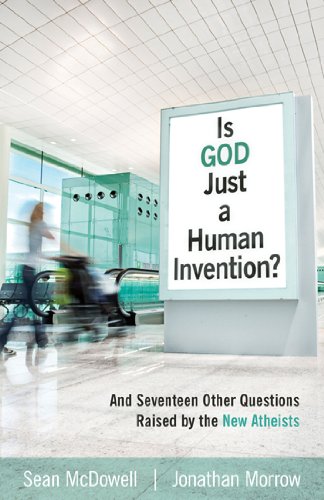
Is God Just A Human Invention?

Here’s the link to the Kindle edition of the book. I consider this book to be my favorite introduction to Christian apologetics. I give this book to everyone and one of my friends even started teaching it to a group of women in her church.

The thorough, chapter-by-chapter review of the book is here at Apologetics 315. The book is also a former read-along selection by Apologetics 315.

Excerpt:

One of the brashest challenges that religious truth has experienced over the past several decades is the remarkable rise of the pugnacious New Atheists. Sean McDowell and Jonathan Marrow, new generation Christian apologists, have undertaken the task of contesting this anti-theistic upsurge. And in Is God Just a Human Invention? And Seventeen Other Questions Raised by the New Atheists the authors have pulled together a wide range of research that powerfully critiques the arguments from the combative non-theists.

[…]The authors deal with the scientific and philosophical challenges to Christian theism in a reasoned and respectful manner.

[…]Is God Just a Human Invention? is loaded with exceptional quotes from Christian and non-Christian thinkers. Additionally, the book furnishes very short essays at the back of each chapter from various erudite Christian scholars that augment the thesis of what was advanced by the authors.

This volume combines simplicity and applicability without forfeiting precision. The authors lead the reader into the full girth of the many contemporary discussions concerning the defense of Christianity. They offer several of the leading arguments for Christian theism while toppling some of the most belligerent of the objections promoted by the New Atheists. They have written, with abundant care, to attain a thoroughness that is not often established in popular books. The wisdom and excellence with which each chapter is written makes this a crucial volume for the budding apologist’s library.

Here are the 18 topics, and after each topic a Christian scholar discusses the relevance of each topic.

  1. Is Faith Irrational? (Commentary by: Gregory Koukl)
  2. Are Science and Christianity at Odds? (Commentary by: John Warwick Montgomery)
  3. Are Miracles Possible? (Commentary by: Gary R. Habermas)
  4. Is Darwinian Evolution the Only Game in Town? (Commentary by: William A. Dembski)
  5. How Did the Universe Begin? (Commentary by: R. Douglas Geivett)
  6. How Did Life Begin? (Commentary by: Fazale R. Rana)
  7. Why Is the Universe Just Right for Life? (Commentary by: Jay W. Richards)
  8. Has Science Shown There Is No Soul? (Commentary by: Dale Fincher and Jonalyn Fincher)
  9. Is God Just a Human Invention? (Commentary by: Garry DeWeese)
  10. Is Religion Dangerous? (Commentary by: Douglas Groothuis)
  11. Does God Intend for Us to Keep Slaves? (Commentary by: Paul Copan)
  12. Is Hell a Divine Torture Chamber? (Commentary by: Frank Turek)
  13. Is God a Genocidal Bully? (Commentary by: Clay Jones)
  14. Is Christianity the Cause of Dangerous Sexual Repression? (Commentary by: Kerby Anderson)
  15. Can People Be Good Without God? (Commentary by: Mark D. Linville)
  16. Is Evil Only a Problem for Christians? (Commentary by: Randy Alcorn)
  17. What Good Is Christianity? (Commentary by: Glenn S. Sunshine)
  18. Why Jesus Instead of the Flying Spaghetti Monster? (Commentary by: Darrell L. Bock)

If you’re looking for a good book on Christian apologetics for beginners, this is a great choice. My Dad read it and he liked it, and he’s not an expert in apologetics.