All posts by Wintery Knight

https://winteryknight.com/

Wayne Grudem debates Richard Glover on the Bible, poverty and foreign aid

Two horses fight it out, may the best horse win!

A great episode of the Unbelievable podcast. This is a great debate. I really enjoyed it. All three speakers were excellent putting forward their points. It’s nice to hear an American voice, a British voice and an Australian voice debating an important issue. HIGHLY RECOMMENDED.

Details:

Wayne Grudem is a theologian known for his conservative approach to both doctrine and economics. His new book “The Poverty of Nations: A Sustainable Solution” (co-authored with economist Barry Asmus) makes the case that pouring aid into developing countries is a failed strategy. Grudem debates whether the Bible supports free market, capitalist economics with Australian economist and theologian Richard Glover who wrote a critique of the book for the Australian Bible Society.

 The MP3 file is here.

Summary:

Grudem:

  • The Bible speaks to all of life, including economics, stewardship, government
  • The study of economics helps us to understand how to take care of the poor
  • My job is to apply the teachings of the Bible to all of life

Brierley:

  • What’s your thesis in the book?

Grudem:

  • A good system is one where the poor have the opportunity to earn and save from their labor
  • Book is a response to a Kenyan couple Grudem met at a London conference on business and Christianity
  • Book is not concerned with how individuals and groups can do charity to help the poor
  • Our church already does that and we support individuals and groups doing charity
  • The book is concerned with how should nations be transformed in order to grow economically
  • What should the laws, policies and cultural beliefs of a nation be in order for it to not be poor?
  • The book lists factors that have moved nations from poverty to prosperity in different times and places
  • The thesis of the book is this: government should set their people free to be able to produce more
  • We advocate freedom in economics: freedom to work, freedom to save, freedom to start businesses
  • We believe that this free enterprise view is consistent with the Bible in a number of places
  • E.g. – private property is good for prosperity (thou shall not steal) but forbidden by communism

Brierley:

  • What about the church sharing in communities in Acts 2 and Acts 4?

Grudem:

  • That is not redistribution of wealth among individuals and businesses by a secular government
  • Those passages showed that there was voluntary sharing among Christians, which is not communism

Brierley:

  • What’s wrong with Grudem’s book?

Glover:

  • The book emphasizes the Bible and the goal is to help the poor in poor countries
  • Criticism 1: the book doesn’t engage with non-free-market perspectives on economics
  • Criticism 2: the book doesn’t survey all that the Bible says about economics

Brierly:

  • For 1) what is one of the views that is not considered?

Glover:

  • Jeffrey Sachs says that nations need a leg up before they can grow economically
  • Ha-Joon Chang says that free enterprise was not how the wealthy nations became wealthy

Grudem:

  • We do engage with other points of view, especially Jeffrey Sachs in the book
  • The trouble with leftist views on economic development is that it does not work in practice
  • NO COUNTRY has even been lifted out of poverty by foreign aid
  • He says we don’t cite enough from the wisdom literature: we have 64 citations in the index
  • He says we don’t cite enough from the gospels: we have 42 citations in the index
  • He says we don’t cite enough from the epistles: we cite 22 of 27 epistles in the index
  • Some economists won’t criticize cultural and moral values that hurt prosperity
  • As Christians, we think that moral and cultural values are part of the problem that needs solving

Brierley:

  • What about foreign aid?

Grudem:

  • Foreign aid doesn’t help: a lot of the money goes into government and rulers can be corrupt
  • Instead of encouraging people to start businesses, it tells people to go into government to get aid money
  • Economists (lists 3) are saying that foreign aid entrenches corrupt government in power, does no good

Brierley:

  • If it’s not working, should we keep doing it?

Glover:

  • When there is an immediate need, we should do it, even if it is not a long-term solution: we need both

Brierley:

  • Should we stop foreign aid completely?

Grudem:

  • Voluntary charitable giving from individuals and churches to help poor countries is good
  • Me and my co-author are both active on our church board that helps poor countries with urgent needs
  • Food and doctors are urgent needs, and we should help, but it doesn’t lift countries out of poverty
  • We need a long-term solution that helps poor countries produce their own food and doctors
  • We are criticizing 1) government to government aid and 2) IMF/World bank to government aid
  • We have had pushback because 500,000 people make a living from this foreign aid industry
  • No country has ever been lifted out of poverty into sustainable prosperity
  • That’s the definition of insanity: continuing to do the same thing that has never worked

Brierley:

  • Does the Bible support free enterprise as a way of creating sustainable prosperity?

Glover:

  • When I said the Bible was absent from his book, absent was a bad choice of words
  • But the hundreds of references he listed were not dealth with *in depth*
  • In the Scriptures, God is the one who provides (e.g. – in Ephesians, Sermon on the Mount)
  • The Bible is less focused on his people making money, and more focus on sharing basics, like food
  • Secular governments should just take it from people who have food and give it to hungry people
  • In 2 Cor 8-9, Paul talks about voluntary sharing so everyone will be equal

Brierley:

  • Does 2 Cor 8-9 undermine the free enterprise system you champion in the book?

Grudem:

  • The sharing in the Bible solves cases of urgent need, it does not lift countries from poverty to sustainable prosperity
  • Some older translations say “equality” in 2 Cor 8:13-14, but newer translations (e.g. – ESV) say “fairness”
  • The Greek word is translated as “fairly” the only other place it appears in the NT (Col 4:1), in every translation
  • God uses the means of human work and productivity to provide (daily bread is baked, doesn’t just fall from Heaven)
  • In general, there’s no provision in Scripture for a person to be dependent on donations for their entire lives
  • God promises Israel fields and mountains to tend and mine, but prosperity is from work, not depending on others

Brierley:

  • Does the Bible support this focus on work?

Grudem:

  • Working is highly praised in Scripture, (lists Bible passages that favor work over dependency)
  • Countries that were exposed to this notion of work and productivity have been more prosperous

Glover:

  • Jeffrey Sachs and other development economists don’t say you can be prosperous through dependence
  • They say that it is a necessary part of leading to nations out of poverty into poverty

Grudem:

  • It’s never worked. What nation has become prosperous through foreign aid?

Glover:

  • There are lots of nations, especially in Africa, where foreign aid has helped lift them out of poverty

Grudem:

  • Name one country in Africa where foreign aud has lifted them out of poverty into sustainable prosperity

Glover:

  • I can’t think of one right now.

Grudem:

  • Our book contains a map of Africa and we looked at every nation’s per capita income
  • No nation has been able to rise out of poverty through dependence on foreign aid
  • The only close one is Botswana, but they have abundant freedoms, Christian morals, less corrupt government
  • So Botswana is the best case and they became prosperous through becoming productive, not foreign aid

Brierley:

  • Is he right to say that charity is a short-term solution, but that it’s not good long-term for prosperity?

Glover:

  • Yes, and work is a very important focus in the Scriptures as he says.
  • But since the Fall work has been much harder, and may not have the outcomes that we would like

Grudem:

  • I also believe in emergency aid for when catastrophies happen, like floods and famines
  • But dependence on foreign aid enriches corrupt rulers and does not create the productivity that leads to sustained prosperity

Brierley:

  • Can foreign aid be used to give poor nations a leg up on becoming prosperous?

Grudem:

  • Dambisa Moyo, Oxford-educated economist from Zambia, says stop the aid, it’s doing more harm than good
  • Jeffrey Sachs’ view is that foreign aid hasn’t worked yet, but just keep trying a bit more
  • What works: limited government, rule of law, fair courts, documented property rights, low taxes, stable currency
  • People are creative and want to work, we just have to get government out of the way and let people work, earn and save

Brierley:

  • Is this free enterprise system supported by the Bible?

Glover:

  • The wealthy nations of the world did not become wealthy through productive work and free enterprise policies
  • Ha-Joon Chang: free enterprise policies have never brought a country from poverty to wealth
  • E.g. – wealth is created through tariffs (not by innovating and by economic freedom?)

Grudem:

  • I’ve read Ha-Joon Chang’s book, and his examples are very selective and limited
  • Index of Economic Freedom: the freest countries are the most prosperous, the least free countries are the most poor
  • When you look at macro data, instead of very selective examples, the free enterprise system is best for prosperity

Glover:

  • The book doesn’t do enough to engage with leftist economists (he doesn’t say which ones)
  • Just because nations who are free are rich, doesn’t mean freedom causes productivity
  • There are parts of the Bible that doesn’t support the free enterprise system (he names none)

Grudem:

  • The Bible is focused on work not dependency, and charity not government redistribution
  • The best way to help the poor in other countries is by encouraging work and productivity

47-year-old divorced woman with kids sues dating agency for failing to find her a rich husband

Do young women understand how to get to a stable marriage?

Today, many women put off marriage while they’re in their 20s, when they are most attractive to marriage-minded men. Some marry, but they marry based on spontaneity and feelings, and it turns into divorce. What happens next? Here’s an example from the UK Daily Mail. (H/T Dina)

Excerpt:

A divorced mother-of-three who sued an ‘exclusive’ dating agency after it failed to find her a rich boyfriend has been handed her money back by a top judge.

Tereza Burki paid £12,600 to Seventy Thirty to hunt for ‘possibly the man of my dreams, the father of my child’, she told the High Court in London.

The 47-year-old said the agency assured her it only dealt in ‘creme de la creme’ matches and could introduce her to ‘bachelors you dream of meeting’.

But Judge Richard Parkes QC today ordered the agency to repay her fee, ruling that she had been ‘deceived’ by Seventy Thirty’s then-managing director.

And, as well as giving her her money back, the judge awarded her £500 for the ‘disappointment and sadness’ she suffered. Her total award was £13,100.

Burki is 47 years old today, so in 2014, I assume that she was around 43 years old. 43, as you know, is well past the normal age for having children. Women’s fertility declines sharply at age 27, then takes a nose-dive at age 35. By 40, it’s nearly impossible to get pregnant, which is why women who want children ought to focus on finding a good man in their early-to-mid-20s.

More:

When she signed up with the agency in 2014, Mrs Burki’s requirements for the men she wanted to meet were ‘not modest’, the judge added.

She wanted a wealthy man with ‘a lifestyle similar or more affluent than her own’ and, ideally, ‘multiple residences’.

But the most important factor for Mrs Burki, who lives on an upmarket street in Chelsea, West London, was that her soulmate would be prepared to have more children, as she wanted four.

[…]Giving evidence during the case, Mrs Burki told the judge: ‘You shouldn’t promise people who are in a fragile state of mind, in their mid-40s, the man of their dreams.

I’m sure that the reason Dina sent me this article is to warn me about how irresponsible some women can be. After all, this woman HAD a decade in her 20s to get serious about finding a man who would commit to her, and give her children. We don’t know what happened in her 20s. But judging from the enormous gap between her demands and her own attractiveness (43 and divorced with 3 children from another man), she was probably being selfish. She’s very clear about what she wants from a man, but she hasn’t prepared for what a man might want from her.

So let’s review that.

Marriage-minded men are interested in a wife during a certain time window when the support of a woman really makes a difference. That time period is the stressful period of a man’s life, when he first graduates from college or trade school and has to start his career. The first years of a career are the most stressful. And that’s when having the physical, emotional, and practical support of a young, attractive, chaste woman really makes a difference. Married men do better at things like earning, saving, health, etc. than single men. Naturally, the best time to GET THIS SUPPORT is the time when the man is doing things that determine his earning, saving, health, etc.

It’s not that older women have no value. It’s that the woman has to be present during the critical time when a man is trying to do hard things, and he doesn’t have the safety net of savings, a resume, etc. Many men move for their first jobs, which just adds another level of difficulty to those early years. When I moved for my first job, everything was difficult: eating, sleeping, cleaning, being content with chastity, etc. I had no family nearby, and I left behind all my friends. It would have been nice to have had the support of a young, and beautiful marriage-minded woman at the critical time when I needed it.

But now, after the degrees have been earned, the gapless resume filled out, the retirement accounts filled, and the house paid for, it’s hardly the time for a woman over 40 to show up and demand her share, when she never invested anything into the enterprise.

And yet, many women apparently DO think like this. Many seem to have no concept of what a man wants out of marriage, and that’s why they waste their 20s doing what feels good to them, and just expecting marriage to happen without any self-denial or self-sacrifice or self-control. If they really cared about marriage, then they would prioritize understanding what marriage-minded men want and need. They would be developing marriage skills and marriage character – things like cooking, caring for others, being good with money, child care, being sober, being faithful, etc. If a woman wants a husband, then she ought to be concerned with helping him to do the things that she expects him to do as a husband.

There used to be some awareness in young women that premarital sex with hot bad boys was bad for her future husband. That focusing on partying and travel was bad for her future husband. That doing easy degrees, getting easy jobs, while going into debt was bad for future husband. Now it seems that women are making all their decisions based on what feels good for them in the moment, in total ignorance of how that ruins their ability to invest in the man who wants to marry them later. They just can’t (or won’t) understand how being selfish today has consequences to marriage and family tomorrow.

Do women not look at marriage-minded men doing what we are doing and think “I don’t want him to have to do that alone. I want to help him, so that it’s not so difficult. And if I have to learn how to do things that help him, then I will put my own needs and feelings second, and learn to do what helps him”. Is there any woman out there who looks at a good, marriage-ready man, and thinks about what he needs? And about what she can do to help him? If not, then is it any wonder that men have lost interest in marriage?

I noticed that Dalrock also posted on this, and some of the comments are interesting.

Two black economists explain how to end poverty in America

Economist Walter Williams

Walter Wiliams is one of my two favorite economists, the other being Thomas Sowell.

Here is his article on wealth and poverty on Creators written by Dr. Williams.

First, real poverty is not common in America:

There is no material poverty in the U.S. Here are a few facts about people whom the Census Bureau labels as poor. Dr. Robert Rector and Rachel Sheffield, in their study “Understanding Poverty in the United States: Surprising Facts About America’s Poor”, report that 80 percent of poor households have air conditioning; nearly three-quarters have a car or truck, and 31 percent have two or more. Two-thirds have cable or satellite TV. Half have one or more computers. Forty-two percent own their homes. Poor Americans have more living space than the typical non-poor person in Sweden, France or the U.K. What we have in our nation are dependency and poverty of the spirit, with people making unwise choices and leading pathological lives aided and abetted by the welfare state.

Second, the “poverty” is not caused by racism, but by poor choices:

The Census Bureau pegs the poverty rate among blacks at 35 percent and among whites at 13 percent. The illegitimacy rate among blacks is 72 percent, and among whites it’s 30 percent. A statistic that one doesn’t hear much about is that the poverty rate among black married families has been in the single digits for more than two decades, currently at 8 percent. For married white families, it’s 5 percent. Now the politically incorrect questions: Whose fault is it to have children without the benefit of marriage and risk a life of dependency? Do people have free will, or are they governed by instincts?

There may be some pinhead sociologists who blame the weak black family structure on racial discrimination. But why was the black illegitimacy rate only 14 percent in 1940, and why, as Dr. Thomas Sowell reports, do we find that census data “going back a hundred years, when blacks were just one generation out of slavery … showed that a slightly higher percentage of black adults had married than white adults. This fact remained true in every census from 1890 to 1940”? Is anyone willing to advance the argument that the reason the illegitimacy rate among blacks was lower and marriage rates higher in earlier periods was there was less racial discrimination and greater opportunity?

Third, avoiding poverty is the result of good choices:

No one can blame a person if he starts out in life poor, because how one starts out is not his fault.

If he stays poor, he is to blame because it is his fault. Avoiding long-term poverty is not rocket science. First, graduate from high school. Second, get married before you have children, and stay married. Third, work at any kind of job, even one that starts out paying the minimum wage. And finally, avoid engaging in criminal behavior. It turns out that a married couple, each earning the minimum wage, would earn an annual combined income of $30,000. The Census Bureau poverty line for a family of two is $15,500, and for a family of four, it’s $23,000. By the way, no adult who starts out earning the minimum wage does so for very long.

Fourth, what stops people from making good choices is big government:

Since President Lyndon Johnson declared war on poverty, the nation has spent about $18 trillion at the federal, state and local levels of government on programs justified by the “need” to deal with some aspect of poverty. In a column of mine in 1995, I pointed out that at that time, the nation had spent $5.4 trillion on the War on Poverty, and with that princely sum, “you could purchase every U.S. factory, all manufacturing equipment, and every office building. With what’s left over, one could buy every airline, trucking company and our commercial maritime fleet. If you’re still in the shopping mood, you could also buy every television, radio and power company, plus every retail and wholesale store in the entire nation”. Today’s total of $18 trillion spent on poverty means you could purchase everything produced in our country each year and then some.

Regarding those last two points, here is Thomas Sowell:

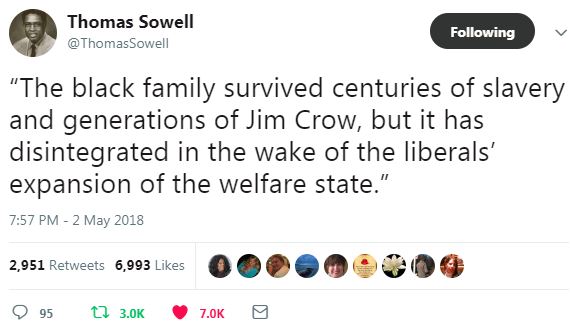
Economist Thomas Sowell blames welfare for killing the black family

To illustrate this point, here’s a graph with some helpful data taken from the U. S. Census.

Black women were more likely to be married before welfare programs

In fact, there is a whole video featuring Thomas Sowell to go with this graph:

And an article to go with it:

If we wanted to be serious about evidence, we might compare where blacks stood a hundred years after the end of slavery with where they stood after 30 years of the liberal welfare state. In other words, we could compare hard evidence on “the legacy of slavery” with hard evidence on the legacy of liberals.

Despite the grand myth that black economic progress began or accelerated with the passage of the civil rights laws and “war on poverty” programs of the 1960s, the cold fact is that the poverty rate among blacks fell from 87 percent in 1940 to 47 percent by 1960. This was before any of those programs began.

Over the next 20 years, the poverty rate among blacks fell another 18 percentage points, compared to the 40-point drop in the previous 20 years. This was the continuation of a previous economic trend, at a slower rate of progress, not the economic grand deliverance proclaimed by liberals and self-serving black “leaders.”

Ending the Jim Crow laws was a landmark achievement. But, despite the great proliferation of black political and other “leaders” that resulted from the laws and policies of the 1960s, nothing comparable happened economically. And there were serious retrogressions socially.

Nearly a hundred years of the supposed “legacy of slavery” found most black children being raised in two-parent families in 1960. But thirty years after the liberal welfare state found the great majority of black children being raised by a single parent.

The rest of the article points out how even crime rates among blacks were caused by the implementation of soft law enforcement policies by progressives. Just look at the big cities if you want to know what it is like for blacks to be ruled by Democrats. It sucks!

If everybody started to read more Thomas Sowell books, we would be much better off as a country! Only good things happen when people stop watching TV and listening to music and watching movies, and instead settle down in a chair with a Thomas Sowell book. I recommended a bunch of them in a previous post.