All posts by Wintery Knight

https://winteryknight.com/

Information Enigma: 21-minute video explains intelligent design

Can random mutation and natural selection create new functional information?

The video is here:

I have read and listened and watched a lot of material on intelligent design, but I have never seen so much value packed into such a short lecture. I really hope you’ll watch this and that it’s helpful to you.

Summary:

  • the big question when discussing the origin of life: where did the information in living systems come from?
  • Until 530 million years ago, the oceans were largely devoid of life
  • In a 10 million year period, many new forms of animal life emerged
  • New biological forms of life require new information
  • the discovery of DNA shows that living systems work because cells have information that allows them to build the components of molecular machines: cell types, proteins, etc.
  • can random mutation and natural selection create new functional information?
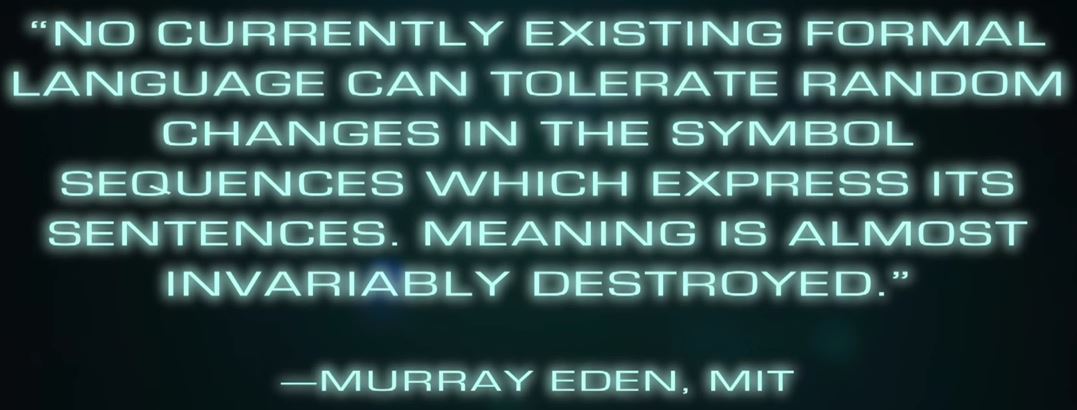
  • normally, random mutations tend to degrade the functionality of information, e.g. – randomly changing symbols in an applications code does not usually introduce useful new functions, it usually renders what is there non-functional
  • the majority of possible sequences will NOT have functions, so random mutations will more likely give you non-functional code, rather than functional code
  • example: a bicycle lock  with 4 numbers has many possible sequences for the 4 numbers, and only one of them has unlock functionality, the rest have no functionality
  • if you have lots of time, then you might be able to guess the combination, but if the lock as has 10 billion numbers, and only one combination that unlocks, you can spend your whole life trying to unlock it and won’t succeed
  • how likely is it to arrive at a functional protein or gene by chance? Is it more like the 4-dial lock (can be done with lots of time) or the 10 billion dial lock (amount of time required exceeds the time available)?
  • the probability is LOW because there is only one sequence of numbers that has unlock function
  • consider a short protein of 150 amino acids has 10 to the 195th power possible sequences
  • if many of these sequences of amino acides had biological function, then it might be easier to get to one by random mutation and selection than it is with a lock that only unlocks for ONE sequence
  • how many of the possible sequences have biological function?
  • Thanks to research done by Douglas Axe, we now know that the number of functional amino acid sequences for even a short protein is incredibly small…
  • Axe found that the odds of getting a functional sequence of amino acids that will fold and have biological function is 1 in 10 to the 77th power
  • Is that number too improbable to reach by chance? well, there are 10 to 65th atoms in the entire Milky Way galaxy… so yes, this is a very improbable outcome
  • can random genetic mutations search through all the sequences in order to find the one in 10 to the 77th power one that has biological function? It depends on how much guessers we have and how many guesses we get in the time available
  • even with the entire 3.5 billion year history of life on Earth, only about 10 to the 40th organisms have ever lived, which far smaller fraction of the 10 to the 77th total sequences
  • even with a very fast mutation rate, you would not be able to reach a functional protein even with all that time, and even with all those organisms

I was once having a discussion with a woman about the research that Axe did at the Cambridge University lab. He published four articles in the Journal of Molecular Biology. I held out one of the papers to her and showed her the numbers. She said over and over “I hate the Discovery Institute! I hate the Discovery Institute!” Well, yeah, but you can’t make the Journal of Molecular Biology go away with hating the Discovery Institute. JMB is peer-reviewed, and this was experimental evidence – not a theory, not a hypothesis.

We have been blessed by the Creator and Designer of the universe in this time and place with overwhelming evidence – an abundance of riches. For those who have an open mind, this is what you’ve been waiting for to make your decision. For the naturalists who struggle so mightily to block out the progress of experimental science, they’ll need to shout louder and shut their eyes tighter and push harder to block their ears. Maybe if they keep screaming “Star Trek” and “Star Wars” over and over to themselves, they will be able to ignore the real science a little longer.

Walter Bradley asks: what is religion really supposed to be about?

Dr. Walter L. Bradley

This lecture is based on the book “Truth in Religion” by famous philosopher Mortimer J. Adler. At the time of writing the book, he was not a Christian, but there is still a lot of value in the book for Christians who are trying to understand what religion should really be about.

About the speaker

The speaker is one of my top 3 favorite speakers of all time in Christian apologetics, Dr. Walter Bradley. (The other two are Dr. Stephen C. Meyer and Dr. Michael Strauss)

Here’s a biography:

Dr. Bradley received his B.S. in Engineering Science and his Ph.D. in Materials Science from the University of Texas in Austin.

Dr. Bradley taught for eight years at the Colorado School of Mines before assuming a position as Professor of Mechanical Engineering at Texas A&M University (TAMU) in 1976.

During his 24 years at Texas A&M, Dr. Bradley served as Head of the Department of Mechanical Engineering at Texas A&M University and as Director of the Polymer Technology Center, and received five College of Engineering Research Awards. He has received over $4,500,000 in research grants and has published over 140 technical articles and book chapters. He has also co-authored “The Mystery Of Life’s Origin: Reassessing Current Theories. He is a Fellow of the American Society for Materials and of the American Scientific Affiliation and serves as a consultant for many Fortune 500 companies.

You can read more about his recent research on how to use coconuts to make car parts in this article from Science Daily.

The MP3 file is here. (31 minutes + Q&A)

Topics:

  • what is pluralism?
  • what is multiculturalism?
  • what is relativism?
  • some propositions are true culturally – just for certain groups in certain times (cultures)
  • some proposition are true trans-culturally – true independently of what anyone wants or feels
  • Mathematical truth is trans-cultural – it is true regardless of cultural fashions
  • Scientific truth is trans-cultural – it is true regardless of cultural fashions
  • Some truths are not like this – cooking traditions, clothing traditions and greeting traditions
  • These kinds of truths are NOT trans-cultural, they vary by culture
  • The question is – is religion true like math and science, or true depending on the culture
  • Some people think that your religion depends on where you were born or what your family believes
  • Religions make conflicting claims about the way the world really is, so they can’t all be true
  • And these conflicts are at the core of the religions – who God is, how can we be related to him, etc.
  • So if religions convey trans-cultural truth, then either one is true or none are true
  • If they are not trying to convey trans-cultural truth, then they are not like math and science
  • Let’s assume that religion is the same as trans-cultural truth
  • How can we know which religion is true? 1) the laws of logic, 2) empirical testing against reality
  • Logical consistency is needed to make the first cut – self-contradictory claims cannot be true
  • To be true trans-culturally, a proposition must at least NOT break the law of non-contradiction
  • According to Mortimer Adler’s book, only Christianity, Judaism and Islam are not self-contradictory
  • All the others can be excluded on the basis of overt internal contradictions on fundamental questions
  • The others that are self-contradictory can be true culturally, but not trans-culturally
  • The way to proceed forward is to test the three non-contradictory religions against science and history
  • One of these three may be true, or they could all be false
  • We can test the three by evaluating their conflicting truth claims about the historical Jesus
  • Famous skeptics have undertaken studies to undermine the historical Jesus presented in the Bible
  • Lew Wallace, Simon Greenleaf and Frank Morrison assessed the evidence as atheists and became Christians
  • There is a lot of opposition in culture to the idea that one religion might be true
  • But if you take the claims of Jesus at face value, he claims to be the unique revelation of God to mankind
  • Either he was telling the truth about that, or he was lying, or he was crazy
  • So which is it?

Why don’t religious people ask if their religion is true?

People seem to be chicken these days about claiming that their religion is true. It’s easier to say that my religion is true for me, and your religion is true for you – reduce it to personal preferences. So long as everyone is sincere about what they believe, then that’s the most important thing, right?

But it is NOT TRUE that you can believe whatever you want as long as you are sincere – sincerity doesn’t mean that you can’t be mistaken. I can jump off the top of the Sears Tower and be sincere in my belief that I will float down like a feather, but that doesn’t make my belief true. If you want to have a good relationship with God, you have to know things about him, not just have sincere beliefs. You have to know whether he exists and what he is like – really. It’s not enough to have sincere beliefs that are not actually true.

I think that God’s existence and character can be assessed and known based on logic and evidence. I think that God exists independently of whether I want him to or not, and I think that his character and desires are not the same as my character and desires. And I don’t really care what my neighbors think of my disagreeing with them, my goal is not to keep silent and to just get along with them and be happier in my community.

God’s first commandment to us is not to love our neighbor – that’s number two. Number one is to love him. And how can we love him, if we don’t want to know him. And how can we love him, if we don’t tell people the truth about him when they ask us?

That message is not going to win us a lot of friends, but our job as Christians is to tell how and why God stepped into history. Jesus expects us to be his ambassadors and to carry out the task of evangelism faithfully, and to suffer with him and – if necessary – to be rejected like he was rejected.

Why don’t men today talk to women about commitment and marriage?

Painting:
Painting: “Courtship”, by Edmund Blair Leighton (1888)

I saw this essay from a young woman named Jordana Narin who is explaining how she feels about not being able to talk seriously to a man she chose to have premarital sex with on multiple occasions. She is a radical feminist and has a non-STEM degree in creative writing. The essay was published in the radically leftist New York Times.

First kiss:

I met [a guy] at summer camp in the Poconos at 14, playing pickup basketball by day and talking in the mess hall late into the night. Back home we lived only 30 minutes apart, but I didn’t see him again until 11th grade, when we ran into each other at a Halloween party in a Lower Manhattan warehouse.

[…]Under the muted flashes of a strobe light, we shared our first kiss.

No communication:

We stayed in touch for the rest of high school, mostly by text message.

[…]Every time his name popped up on my phone, my heart raced.

Still, we were never more than semiaffiliated, two people who spoke and loved to speak and kissed and loved to kiss and connected and were scared of connecting.

Where is this relationship going? This boy has no job and no savings and no proven record of steady work – and therefore he cannot afford to marry anyone. Why is she even talking to a man who cannot afford to marry her? He is not able to marry her, and handle getting her pregnant.

More:

Two years after our first kiss, we were exchanging “I’ve missed you” messages again. It was a brisk Friday evening in our first semesters of college when I stepped off a train and into his comfortable arms.

He had texted weeks earlier on Halloween (technically our anniversary) to ask if I would visit. We had not talked since summer, and I was trying to forget him. We had graduated from high school into the same inexpressive void we first entered in costume, where an “I’ve missed you” was as emotive as one got.

Long gaps in between text messages – they have nothing to talk about, and there is no purpose to the relationship.  This is the man she chose. Nevertheless, they are away from their parents, and so she had sex with him, choosing to lose her virginity to a man she was not married to.

And then:

Naïvely, I had expected to gain clarity, to finally admit my feelings and ask if he felt the same. But I couldn’t confess, couldn’t probe. Periodically I opened my mouth to ask: “What are we doing? Who am I to you?” He stopped me with a smile, a wink or a handhold, gestures that persuaded me to shut my mouth or risk jeopardizing what we already had.

On the Saturday-night train back to Manhattan, I cried. Back in my dorm room, buried under the covers so my roommates wouldn’t hear, I fell asleep with a wet pillow and puffy eyes.

The next morning I awoke to a string of texts from him: “You get back OK?” “Let’s do it again soon :)”

So my question for you is this: should a woman who has recreational sex with a jobless man she barely knows expect to have real relationships, including a marriage relationship?

There’s an interview that goes with it on the radically leftist NPR web site, but I saved a copy of the MP3 file here in case it disappears.

In the interview, she says:

“Everyone in college uses Tinder,” she said, referring to the wildly popular dating and hook-up app. “You can literally swipe right and find someone just to hang out for the night. 

And:

“In a different time, my grandparents, my great grandparents, they might have thought they were missing out on casual sex. But since my generation has been saddled down with that, we kind of look to the past and say well, wasn’t that nice. I think both are optimal. I’m a huge feminist, and I think women should be able to do whatever they want to do. If a woman wants to have tons of casual sex, she totally should. But I think that there should be the option. And they shouldn’t be gendered, women and men. But there should be the option of being in a relationship.”

Right. Young women like her accept radical feminism, which basically means that they think that the traditional path to marriage must be avoided, because it’s “sexist” and “controlling”. Chastity is sexist. Stay at home wife is sexist. Stay at home motherhood is sexist. She believes that women should prioritize recreational sex and career, marry later, and continue her career by placing the children in daycare and public schools. Any attempt by a marriage-minded man to get her to stop drinking, being promiscuous, having a career, and giving the kids to strangers is “sexist” and “controlling”. Is radical feminism a path to relationships and marriage?

How should marriage-minded men perceive a woman’s past choices to have premarital sex?

Consider this story from the Ottawa Sun about a woman who didn’t want to say no to sex right now, but wanted to get married “some day”:

A New York woman is facing charges after police say she lied about being raped by two football players at a party to get sympathy from a prospective love interest.

Nikki Yovino, 18, has been charged with falsely reporting an incident and tampering with or fabricating physical evidence.

Last October Yovino reported that she had been sexually assaulted in a bathroom by two Sacred Heart University football players at an off-campus party.

The men, however, said it had been consensual.

Capt. Brian Fitzgerald tells WABC-TV another student informed authorities of explicit text messages between the three. He says one man also recorded some of the incident on his cellphone.

“She admitted that she made up the allegation of sexual assault against (the football players) because it was the first thing that came to mind and she didn’t want to lose (another male student) as a friend and potential boyfriend. She stated that she believed when (the other male student) heard the allegation it would make him angry and sympathetic to her,” said an affidavit, according to the New York Post.

Two. Football. Players. At the same time.

She wanted a “relationship” with this other guy. She didn’t see why the “opportunity” to have premarital sex with two no-commitment bad boys at the same time should be rejected. After all, the man who would eventually have a relationship with her and marry her would presumably be OK with her choice. Because her choice was a good sign that she was ready for wife and mother roles.

I think that every single choice by a woman to have premarital sex with a no-commitment man is committing infidelity and adultery against her future husband. It’s a sign that she doesn’t have the self-control to value commitment over fun. She won’t be able to respect her husband as a leader, and be faithful (and sexually available) to him. She doesn’t see sex as a gift for the man who promises to take care of her. She sees sex as something to give to bad men to get validation and entertainment. And if she does marry later, I doubt that she will be as generous sexually with her husband. There is an epidemic of sex-withholding these days being committed by women who don’t see the man they took wedding vows with as worth of the energetic sex they freely gave to the no-commitment bad boys in their youth. Women who give bad boys premarital sex don’t see husband and father ability as desirable and worth rewarding.

No man can marry a “huge feminist”

Most men are not interested in committing to, or discussing commitment with, women who put pleasure above self-control. Most non-Christian men will have sex with a hedonistic women, but they won’t commit to them. Why would a man commit to a narcissist? If a man’s role is just to be ruled by the “huge feminist”, then there is no reason to discuss commitment or to commit. Radical feminists believe that relationships are about their plans and their needs. They are not interested in responsibilities, expectations or obligations to men or to children. Most men, even secular men, understand that such women are not suitable for commitment.

Will anyone explain marriage to these women?

Whenever I tell my Christian women mentors about what I am seeing today, they always say that women need to have marriage explained to them. But today, no one has the courage to tell young women that radical feminism is not the path to marriage. Instead, they are taught by parents and pastors to blame and shame men for not marrying them, as if their past decision-making had prepared their character for the roles of wife and mother.