
All posts by Wintery Knight

https://winteryknight.com/

Are atheists unbiased about the question of God’s existence?

I have a key that will unlock a puzzling mystery

Brian Auten has a book review posted up at Apologetics 315.

The book is “If There’s A God, Why Are There Atheists?”, by theologian R.C. Sproul. R.C. Sproul is one of my favorite theologians. The book in question has a very, very special place in my heart, because I think that it is one of the major reasons why I was able to resist pernicious ideas like religious pluralism and postmodernism for so long. Once you put on the glasses of Romans 1 and see for the first time what man is really doing with respect to God, you can never see things the same again. I’ll say more about this at the end, but let’s see what Brian wrote first.

The review

So often, you hear atheists complaining about religion is nothing but wish-fulfillment or some sort of crutch for people who are frightened by a variety of things. They think that God is invented to solve several problems. 1) how does the world work?, 2) is there meaning to suffering and evil?, 3) why should I be moral?, and 4) what will happen to me and my loved ones when I die?. On the atheistic view, God is just a crutch that people cling to out of weakness and ignorance. But is this really the case?

Sproul starts the book by investigating three atheists who sought to explain religious belief as a result of psychological factors.

Brian writes:

Before tackling the psychology of atheism, Sproul spends a chapter on the psychology of theism, from the perspective of Freud’s question “If there is no God, why is there religion?”11 What follows is an overview of various psychological explanations of theistic belief: Feuerbach’s “religion is a dream of the human mind.”12 Marx’s belief that religion is “due to the devious imagination of particular segment of mankind.”13 And Nietzche’s idea that “religion endures because weak men need it.”14 The author properly reiterates: “We must be careful to note that the above arguments can never be used as proof for the nonexistence of God. They can be useful for atheists who hear theists state that the only possible explanation for religion is the existence of God.”15 That being said, Sproul also reveals what these arguments presume:

Their arguments already presupposed the nonexistence of God. They were not dealing with the question, Is there a God? They were dealing with the question, Since there is no God, why is there religion?16

Sproul points out the weaknesses of each of these approaches and says “there are just as many arguments showing that unbelief has its roots in the psychological needs of man.”

Wow, could that really be true? What are the real reasons why people reject God? Does the Bible have anything to say about what those reasons are?

Brian cites Sproul’s contention:

The New Testament maintains that unbelief is generated not so much by intellectual causes as by moral and psychological ones. The problem is not that there is insufficient evidence to convince rational beings that there is a God, but that rational beings have a natural hostility to the being of God.

[…]Man’s desire is not that the omnipotent, personal Judeo-Christian God exist, but that He not exist.

In Romans 1:18-23, the apostle Paul explains what is really going on:

18The wrath of God is being revealed from heaven against all the godlessness and wickedness of men who suppress the truth by their wickedness,

19since what may be known about God is plain to them, because God has made it plain to them.

20For since the creation of the world God’s invisible qualities—his eternal power and divine nature—have been clearly seen, being understood from what has been made, so that men are without excuse.

21For although they knew God, they neither glorified him as God nor gave thanks to him, but their thinking became futile and their foolish hearts were darkened.

22Although they claimed to be wise, they became fools

23and exchanged the glory of the immortal God for images made to look like mortal man and birds and animals and reptiles.

Do you believe that? I believe that. I have never in my life met an atheist who varied from what Paul is saying here.

On this blog, I have presented many, many arguments for theism in general, and Christian theism in particular:

Sproul explains why atheists cannot allow themselves to live according to the evidence that is presented to them:

The cumulative effect of this knowledge that is clearly seen is to leave men ‘without excuse.’ Herein lies the basis of the universal guilt of man. No one can claim ignorance of the knowledge of God. No one can cite insufficient evidence for not believing in God. Though people are not persuaded by the evidence, this does not indicate an insufficiency in the evidence, but rather an insufficiency in man.

[…]The basic stages of man’s reaction to God can be formulated by means of the categories of trauma, repression, and substitution.

[…]If God exists, man cannot be a law unto himself. If God exists, man’s will-to-power is destined to run head-on into the will of God.

So, it’s pretty clear that there are huge implications to the question of God’s existence, and that the atheist will be affected by these implications when weighing evidence.

Here’s something Thomas Nagel, an excellent atheist philosopher, and not one of these idiots like Dawkins or Hitchens, said:

“In speaking of the fear of religion, I don’t mean to refer to the entirely reasonable hostility toward certain established religions and religious institutions, in virtue of their objectionable moral doctrines, social policies, and political influence. Nor am I referring to the association of many religious beliefs with superstition and the acceptance of evident empirical falsehoods. I am talking about something much deeper–namely, the fear of religion itself. I speak from experience, being strongly subject to this fear myself: I want atheism to be true and am made uneasy by the fact that some of the most intelligent and well-informed people I know are religious believers.

I want atheism to be true and am made uneasy by the fact that some of the most intelligent and well-informed people I know are religious believers. It isn’t just that I don’t believe in God and, naturally, hope that I’m right in my belief. It’s that I hope there is no God! I don’t want there to be a God; I don’t want the universe to be like that.”

(”The Last Word” by Thomas Nagel, Oxford University Press: 1997)”

The rest of the book review, and the book, deals with explaining in detail how atheists respond to an all-good, all-powerful, all-knowing Creator/Designer. I encourage you to click through and read the whole book review. You can read the review, and the book, and then investigate for yourself whether the atheists are effected by this bias against moral accountability.
Did “thousands of women” die in “back alley abortions” before Roe v. Wade?

I get into debates about abortion, and sometimes my opponent will complain that if Roe v. Wade were overturned, then thousands of women would die in illegal abortions. Well, if that ever happens to you, this post will help you to know how to respond to it.

First of all, if Roe v. Wade were overturned, then each of the 50 states would pass legislation deciding when abortions would be legal.

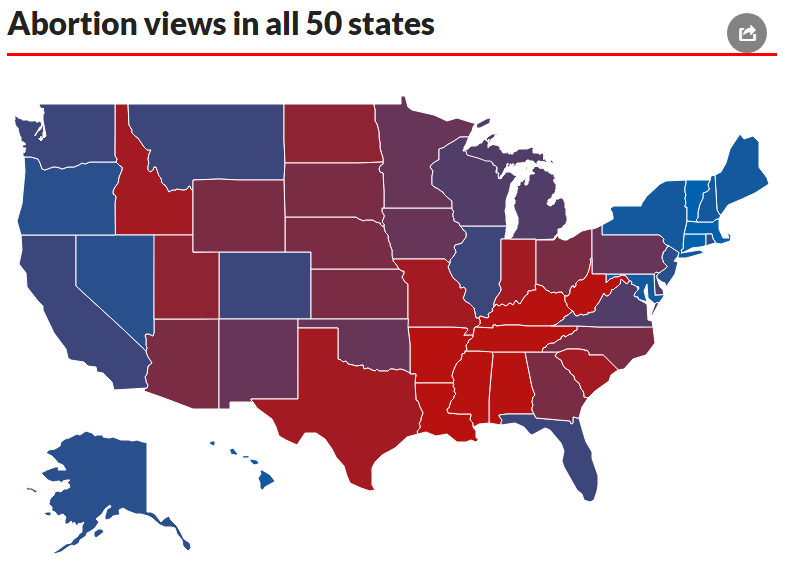
Here’s a map taken from the Washington Examiner:

Abortion rights after Roe v. Wade is overturned

Red states are more pro-life than blue states in this map. For example, New York is ranked #6, and Tennessee is ranked #45.

So, if a woman did have irresponsible sex with a hot bad boy, then she easily could terminate her child in one of the blue states.

Second, the number thrown around by abortion advocates is not accurate. It’s simply not true that “thousands of women” were dying from poorly-performed abortions when abortion was still illegal. Actually, abortions were performed by trained medical personnel, but it just wasn’t reported to the police.

Here’s a recent article from the radically leftist Washington Post:

Erica Sackin, a Planned Parenthood spokeswoman, directed us to a 2014 policy statement issued by the American College of Obstetricians and Gynecologists (ACOG): “It is estimated that before 1973, 1.2 million U.S. women resorted to illegal abortion each year and that unsafe abortions caused as many as 5,000 annual deaths.”

There is no citation in the statement for the estimate of “as many as 5,000 annual deaths,” even though many of the other sentences are carefully documented. None of the citations around this sentence supports the figure, and there is no explanation about how it was calculated.

[…]Meanwhile, Sackin also sent a variety of reports, many of which were referenced in a footnote in a document published by NARAL Pro-Choice America. One of the citations especially caught our eye: Frederick Taussig, “Abortion Spontaneous and Induced: Medical and Social Aspects,” (1936).

Why was a study from 1936 being cited? Because in 1936, we didn’t have antibiotics! People were dying all the time from any kind of surgery – not just abortion.

More:

The advent of antibiotics such as penicillin and improved medical procedures suddenly made abortion less risky. Another prominent researcher, Christopher Tietze, argued in a 1948 paper that the number of deaths from abortion was rapidly declining because of three reasons: contraceptive methods had improved so fewer women were getting pregnant, abortion providers were getting better at avoiding infections, and many lives had been saved because of the introduction of sulfa drugs and penicillin.

[…]The data collected by Tietze showed 2,677 deaths from abortion in 1933, compared with 888 in 1945, with much of the decline in septic cases associated with illegal abortions. (The numbers also include deaths from “therapeutic abortions,” permitted by law, and “spontaneous abortions.”)

By 1959, a leading researcher wrote: “Abortion is no longer a dangerous procedure. This applies not just to therapeutic abortions as performed in hospitals but also to so-called illegal abortions as done by physicians. In 1957, there were only 260 deaths in the whole country attributed to abortions of any kind. In New York City in 1921, there were 144 abortion deaths, in 1951 there were only 15.”

The writer was Mary Steichen Calderone, at the time medical director of Planned Parenthood. She attributed the decline in the mortality rate to antibiotics and the fact that 90 percent of illegal abortions were done by trained physicians.

OK, so abortion advocates cite the study from 1936, which already relies on questionable estimates, because they know that the later numbers are far, far lower – thanks to the widespread use of antibiotics. They’re lying, essentially, because lying helps them to persuade people who think with their feelings, and don’t look too closely at facts.

My third point is simple. Even if women hurt themselves during abortions, that wouldn’t be a reason to legalize abortion. Bank robbers hurt themselves during bank robberies, and drug dealers hurt themselves during drug deals. We do not legalize criminal activities just because criminals get hurt during the commission of those activities. So the real question is, what is the unborn? If the unborn is a living human being, then abortion on demand takes the life of an innocent human being without justification, and should therefore be illegal.

UPDATE: My pro-life friend Nathan sent me a fourth response:

There is a difference today that did not exist in 1973. We have a pro-life movement. We have over 2,000 pregnancy care ministries and clinics operating throughout the continental United States. I highly doubt these clinics will just disappear overnight if abortion became illegal nationwide. Women and children will still be in need, and the free market principles that enable charity to flourish will be there to help.

Given this reality, will proponents of abortion now finally step forward to help provide the support to women necessary so they never have to choose a back alley abortion? Given how they have worked themselves into a panic about rusty coat hangers, it seems they would be the most motivated to do so. The fact many don’t seem to want to do so is telling: They just want to justify their own support for abortion, regardless of whether it helps women or not.

Are snowflakes and libertarians right to worry that killing Iranian terrorists will start a war?

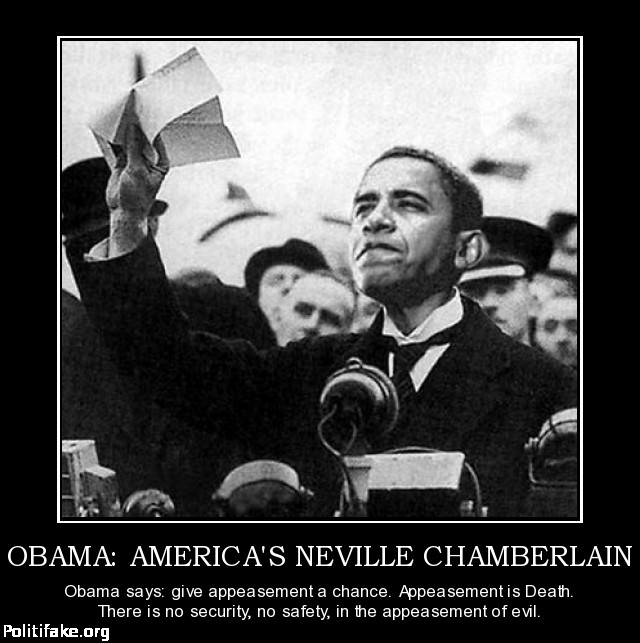
Neville Chamberlain Obama: peace in our time

I talked to a few progressives and libertarians on the weekend. They seemed to think that Trump’s decision to sanction two Iranian generals would lead to war. Now, I asked the libertarians and progressives a bit about how World War 2 started. They didn’t know anything about how it started. Let’s see what Trump did in Iran, and then look at WW2 history to see if it is likely to stop or start a war.

Before I start, I just want to say that someone shared a post by far-left filmmaker Michael Moore claiming that Americans had ever heard of Soleimani or the Quds Force. Here are my previous 134 posts on Iran, my previous 9 posts on the Quds Force, and my previous post on Soleimani. Speak for yourself, Michael Moore.

First, who is Solemani, and what is the Quds Force? The New York Times explains:

More than any other American military operation since the invasion of Iraq, the assassination yesterday of Maj. Gen. Qassim Suleimani, the head of Iran’s Qods Force of its Islamic Revolutionary Guards Corps, is a seismic event. The killings of Osama bin Laden and Abu Bakr al-Baghdadi, the leaders of al-Qaeda and the Islamic State, were certainly meaningful, but they were also largely symbolic, because their organizations had been mostly destroyed. Taking out the architect of the Islamic Republic’s decades-long active campaign of violence against the United States and its allies, especially Israel, represents a tectonic shift in Middle Eastern politics.

[…]In Lebanon, Mr. Suleimani built Lebanese Hezbollah into the powerful state within a state that we know today. A terrorist organization receiving its funds, arms and marching orders from Tehran, Hezbollah has a missile arsenal larger than that of most countries in the region. The group’s success has been astounding, helping to cement Iran’s influence not just in Lebanon but farther around the Arab world.

Building up on this successful experience, Mr. Suleimani spent the last decade replicating the Hezbollah model in Iraq, Syria and Yemen, propping up local militias with precision weapons and tactical know-how. In Syria, his forces have allied with Russia to prop up the regime of Bashar al-Assad, a project that, in practice, has meant driving over 10 million people from their homes and killing well over half a million. In Iraq, as we have seen in recent days, Mr. Suleimani’s militias ride roughshod over the legitimate state institutions. They rose to power, of course, after participating in an insurgency, of which he was the architect, against American and coalition forces. Hundreds of American soldiers lost their lives to the weapons that the Qods Force provided to its Iraqi proxies.

I think this part is worth emphasizing – Solemani was the aggressor in the Iraq embassy attack, and he has a record of attacking American armed forces:

Soleimani, who was designated and sanctioned by the U.N., E.U., and U.S. alike, directly approved Tuesday’s U.S. embassy storming in Baghdad by Iranian proxy militia Kataib Hezbollah, and was credibly assessed by Secretary of State Mike Pompeo as actively planning more “imminent” attacks against hard American assets in the Middle East, has been directly active in the mass murder of Americans. He personally oversaw the mass arming of Shiite Iraqi insurgents and it is estimated that the IRGC-QF targeted and killed over 600 Americans in Iraq from 2003–2011. The State Department asserts that this personally amounts to a whopping 17% of all deaths of U.S. military personnel during the Iraq War.

So, far from Trump’s response being disproportionate, this was actually a long-overdue response. It was even overdue from Trump.

The message that Iran got after 8 years of Obama was clear: acts of aggression committed by Iran against the United States and her allies would be rewarded, including the $1.7 BILLION payoff from the Obama administration. The Obama administration’s policy was isolationism and appeasement. And this was fine with Democrat voters, because not a single Democrat voter (or libertarian ) knew anything about Iran, the Iran deal, Soleimani, or the Quds Force. They are low-information voters.

Now let’s see how World War 2 started.

Here is a helpful lecture by military historian Victor Davis Hanson.

Germany re-armed in 1936. Austria was annexed in 1938. The Rhineland was re-occupied in 1938. Czechoslovakia was invaded in 1939. And the allied democracies did nothing to stop Hitler. Similarly, Japan also re-armed, broke treaties and invaded neighbors. And the allied democracies did nothing to stop them, despite having superior planes, tanks, and ships. This allowed the Axis powers time to research better weapons, re-arm, and gain a strategic advantage. The Axis powers could have been stopped early on, at a much lower cost in blood and treasure. It was the libertarians and the progressives with their policies of isolationism and appeasement that made World War 2 much worse than it needed to be.

VDH explains:

Hitler assumed the United States either could not or would not offer much military help to his intended European targets.

Why, then, did a relatively weak Nazi Germany between 1939 and 1941 believe that it could take on much of the world, and inspire Axis partners such as Italy and Japan to follow its suicidal lead?

The answer is obvious. British and French appeasement, Soviet collaboration and American isolation had together convinced Hitler and his Axis allies that the victors of World War I were more eager to grant concessions at any cost than were the defeated.

In the lecture, VDH explains that we know from the writings of the leaders of Germany and Japan that they interpreted the isolationist / appeasement policies of the libertarian progressives as weakness, and this is what caused them to re-arm and attack their neighbors. Prior to the historical start of WW2, the Western nations had better tanks, planes and ships than the Axis powers. But they refused to use them to deter the Axis powers. And that’s why World War 2 was much more costly and bloody than it needed to be.

Finally, I should quickly note that America pursued a different strategy in the Cold War, under Ronald Reagan. Reagan was villified by the libertarians and progressives for taking a strong stand against communism. Instead of appeasing and isolating, he put America on a war footing, making aggression costly to the Soviet Union. This approach worked to avoid an actual World War 3. Although his critics attacked him for being pro-war, his tough approach was exactly what was needed to cause the bully to back down.

Si Vis Pacem, Para Bellum